Shift from scarcity to possibility. Define the abundance mindset & discover practical, evidence-based exercises to cultivate more joy and opportunity.
July 22, 2026 (2mo ago)
Abundance Mindset: Cultivate Joy & Opportunity
Shift from scarcity to possibility. Define the abundance mindset & discover practical, evidence-based exercises to cultivate more joy and opportunity.
← Back to blog
Your coworker gets promoted, and two people in the room feel two completely different realities. One person smiles, congratulates them, and starts thinking about what skills to build next. The other person nods politely, then spends the rest of the evening replaying the same thought, “That should've been me.”
That split is the heart of an abundance mindset. It isn't cheerful denial, and it isn't pretending that life hands everyone the same opportunities. It's the habit of seeing possibility without instantly turning someone else's success into proof of your own lack.
That difference sounds small until you notice how often it shapes ordinary life. A job win, a friend's new apartment, a raise, a creative breakthrough, even someone else's good news can either open you up or make you contract. The mind chooses a story fast, and that story changes what you do next.
Introduction Is the Glass Half Empty or Overflowing
A colleague gets promoted on Friday afternoon. By Saturday, one person is asking, “What can I learn from this?”, while another is asking, “Why not me?” Both people saw the same announcement. They did not see the same world.
That's why the abundance mindset matters. It treats success like something that can be expanded through creativity, collaboration, and timing, instead of a fixed pie with too few slices to go around. The contrasting mindset assumes that if someone else got more, there must be less left for you.
Stephen R. Covey's 1989 bestseller The 7 Habits of Highly Effective People helped mainstream this idea by defining an abundance mentality as the belief that there are enough resources to share with others, a view that stands opposite to zero-sum thinking BetterUp's overview of Covey's abundance mindset. That framing still matters because it gives the concept a practical edge. It's not just “be positive”, it's “stop treating opportunity like a shrinking room.”
Practical rule: if someone else's win makes you feel smaller, pause and ask whether you're reacting to facts or to fear.
The good news is that this mindset isn't reserved for naturally optimistic people. It's something you can notice, question, and practice. And once you start seeing the difference between scarcity and abundance, the same daily events begin to look very different.
The Two Lenses Scarcity Versus Abundance
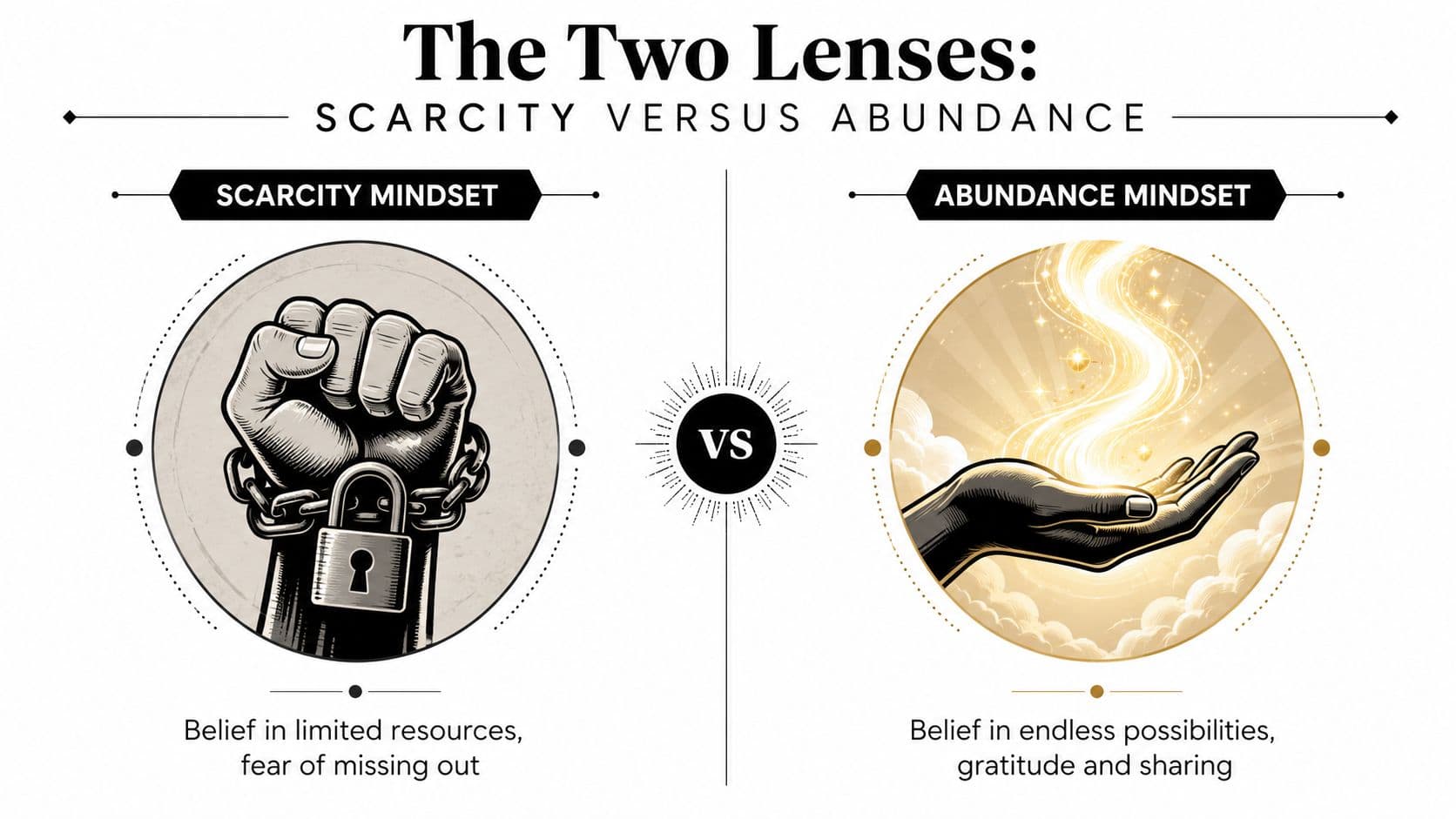
A simple way to understand the contrast is to think of the world as either a finite pie or an expanding garden. In the pie version, every slice given away makes your own slice thinner. In the garden version, shared effort can create more growth than any one person could produce alone.
The abundance mindset is commonly described in business and wellness writing as the belief that there are enough resources for everyone, while scarcity assumes resources are limited and one person's gain reduces what remains for others Tony Robbins' explanation of abundance and scarcity. That distinction is more than a slogan. It changes how people interpret praise, money, time, opportunities, and even someone else's good fortune.
Abundance Mindset vs. Scarcity Mindset at a Glance
| Characteristic | Scarcity Mindset (Finite Pie) | Abundance Mindset (Expanding Garden) |
|---|---|---|
| View of success | Someone else's gain feels like your loss | Someone else's gain can be a useful signal |
| Response to opportunity | Hurries, hoards, or compares | Shares, collaborates, and asks better questions |
| Response to other people's wins | Resentment or self-doubt | Curiosity and encouragement |
| Relationship to resources | “Not enough” | “Enough to work with, and room to grow” |
| Typical inner tone | Tight, defensive, urgent | Open, steady, constructive |
Covey's definition gives the historical baseline, but the lived experience is what readers recognize most. Scarcity sounds like, “There's only room for a few winners.” Abundance sounds like, “Different people can build different kinds of lives, and their success doesn't cancel mine.”
That's why the mindset is useful in everyday conflicts. A team can compete over credit, or it can distribute knowledge and let everyone improve. A friend's milestone can trigger comparison, or it can become a reminder that progress is possible in more than one form.
The mind under scarcity looks for what's missing first. The mind under abundance looks for what can still be built.
The image of an expanding garden fits especially well because gardens require patience, pruning, and care. They do not grow by force alone. They grow when people stop treating every plant as a rival for sunlight and start noticing how much can flourish side by side.
Why Cultivating Abundance Matters
The reason this mindset gets so much attention is that it seems to affect both how people feel and how they work. A 2026 workplace study by Taylor & Francis reported that adopting abundance mindsets was associated with improved executive functioning, reduced stress and burnout, and more collaborative team dynamics Taylor & Francis study. That matters because it links the idea to functioning, not just mood.
In daily life, that can look like someone staying calmer under pressure, listening longer before reacting, or handling a setback without spiraling into panic. In a team, it can show up as fewer turf battles and more willingness to share information. Those are ordinary behaviors, but they add up fast.
Why the emotional side matters
A 2019 experience-sampling study found that a higher sense of abundance was significantly associated with higher momentary positive affect and lower momentary negative affect in everyday life Springer study. That's a useful reminder that mindset isn't only a philosophy you discuss on calm weekends. It shows up in the texture of ordinary days.
When people feel like there's enough, they tend to move through the world with less internal friction. Conversations get less defensive. Decisions feel less desperate. Even disappointment becomes easier to absorb because it doesn't automatically mean disaster.
For a practical companion on money beliefs and spiritual framing, a guide on money and prosperity adds another layer to this conversation. It helps connect purpose, values, and the way people think about resources.
The bigger point is simple. Abundance thinking is useful when it softens unnecessary tension without asking you to ignore reality. It helps people work better together, recover faster from stress, and see opportunity without becoming naive.
The Brain Science of an Abundant Viewpoint

Scarcity is not just a mood. It changes how the brain allocates attention. Neuroeconomic evidence shows that when people are in a scarcity mindset, activity increases in the orbitofrontal cortex, a region tied to immediate reward, while activity decreases in the dorsolateral prefrontal cortex, which supports goal-directed choice and executive control PNAS study.
That pattern helps explain why stressed people often make short-term choices they later regret. The brain starts asking, “What do I need right now?”, instead of, “What serves me over time?” It narrows the field of view.
What that means in real life
If money feels tight, a person may focus so hard on the nearest bill that planning gets harder. If work feels threatening, someone may defend territory instead of solving the actual problem. The brain is trying to protect the person, but protection can become tunnel vision.
The practical upside is that this isn't fixed. Because the shift involves attention and control, it can respond to routine. A calmer cue, a slower pause, or a more generous interpretation can move a decision out of panic and back into strategy.
For readers who want a simple bridge between the conscious and unconscious layers of choice, a guide on subconscious and conscious patterns offers a useful companion. It fits here because the brain science makes one thing clear: repeated thoughts shape repeated reactions.
When the brain feels safe enough to zoom out, people usually make better long-range choices.
That's why abundance routines are most helpful before hard decisions, not after the damage is done. They don't erase constraints. They create a mental space where constraints can be handled with more wisdom and less urgency.
Daily Practices to Build Your Abundance Mindset
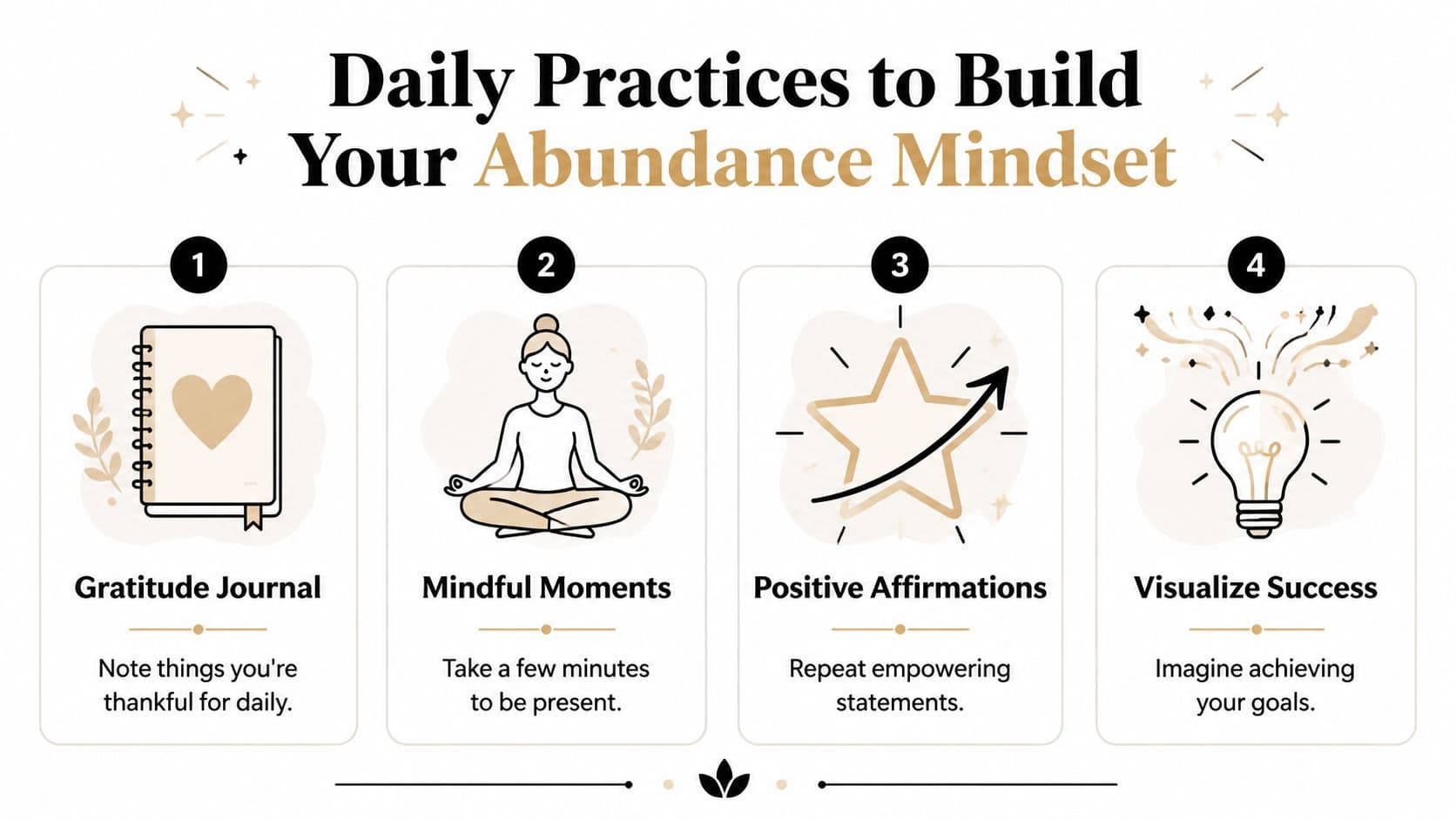
Small repetition beats dramatic intention here. Health guides recommend spending just 5 to 10 minutes a day on practices like gratitude or reframing, and they say that level of consistency can support measurable change in how life feels FRAME. That's a comforting target because it makes the practice manageable.
Use a brief reframing ritual
Start with one stubborn belief. Write it down in ordinary language, such as “I never get enough support” or “There's not enough money for me.” Then write a more expansive counterstatement beside it, not as fantasy but as a deliberate reframe. The point is to interrupt the old script long enough to create room for a different response.
Notice abundance in ordinary moments
A gratitude list can get stale if it stays too general. A more useful version names concrete evidence of support. A helpful conversation, a moment of extra time, a colleague who shared knowledge, a meal you didn't have to rush through. That kind of noticing trains the mind to spot sufficiency instead of only shortage.
Celebrate other people without making it about you
This one is harder than it sounds. If a friend gets something you want, say the congratulations out loud and stay present with the discomfort without feeding it. You're not pretending the feeling isn't there, you're refusing to let envy become the whole story.
Keep the practice light enough to repeat
If you need a structure, combine reflection with one simple action. The Life Purpose App offers an abundance mindset meditation and exercise centered on “wanting what you already have,” and it can fit alongside a notebook or a quiet walk as one tool among others. Used well, it doesn't replace real-life action, it helps you act from a steadier place.
For readers who want a companion habit, mindfulness can pair well with this approach because mindfulness makes it easier to notice when scarcity has taken over.
Practical rule: keep the practice short enough that you'll actually return to it tomorrow.
That consistency matters more than intensity. Abundance grows through repeated attention, not through one perfect afternoon of insight.
Connecting Abundance to Your Unique Life Path
The deepest version of abundance isn't envy-free copying. It's recognizing that your life has its own shape, gifts, and lessons. That's where Dan Millman's The Life You Were Born to Live becomes useful, along with the Life Purpose App, which turns that system into something you can explore from a birth date.
Millman's framework is built around a life path number that points toward core strengths, recurring challenges, and the kind of growth a person is likely here to practice. Used thoughtfully, that kind of self-knowledge can be grounding. It reminds people that abundance is not only about getting more, it's also about seeing what already belongs to them.
Self-knowledge changes the question
Without a clear sense of purpose, abundance can get distorted into endless comparison. One person measures themselves against another person's salary, visibility, or relationships and concludes they're behind. A life-path lens asks a different question. What are my actual gifts, and how do I develop them well?
That shift matters because it moves attention away from borrowed standards. Instead of chasing what looks abundant on the outside, you start noticing where your own energy is strongest. That can make gratitude feel less abstract and more personal.
For a practical companion on money beliefs and spiritual framing, a guide on money and prosperity adds another layer to this conversation. It helps connect purpose, values, and the way people think about resources.
The unique insight here is that abundance becomes more believable when it has a name and a shape. A person who understands their path doesn't need to imitate everyone else's route to feel worthy. They can treat their own development as a legitimate source of wealth.
Your life doesn't need to look like someone else's to be full.
That's the bridge between abundance and self-discovery. When people understand their strengths more clearly, they stop treating other people's gifts as evidence of their own lack, and they start building from what is already real.
Navigating the Pitfalls of Positive Thinking
An abundance mindset helps when it keeps you open. It backfires when it becomes a way to avoid hard facts. Research also recognizes that scarcity can narrow attention, which is exactly why optimism has to stay grounded in reality, especially when people are facing inflation, job insecurity, or debt PMC article on scarcity and attention.
That's the line between healthy abundance and toxic positivity. Healthy abundance says, “This is hard, and I still have options.” Toxic positivity says, “Nothing is wrong, just think better.” One creates movement. The other often creates shame.
The most useful test is simple. If your mindset helps you name the problem more clearly, it's working. If it pressures you to ignore pain, minimize risk, or blame yourself for feeling anxious, it's gone too far.
Abundance is not about pretending there's infinite money, infinite time, or infinite emotional energy. It's about recognizing that you still have something to work with. Sometimes that something is a skill, a relationship, a plan, or just enough steadiness to take one next step.
If you're ready to make this real, try one small practice today, then notice what changes over the next week. For a guided place to start, visit Life Purpose App and explore a tool that connects self-knowledge, purpose, and abundance in a practical way.
Discover Your Life Purpose Today!
Unlock your true potential and find your life’s purpose.
