Explore the Akashic Records meaning. This guide defines the soul's library, its history, and how to access it for self-discovery and life purpose.

June 14, 2026 (4mo ago)
Akashic Records Meaning: A Guide to the Soul's Library
Explore the Akashic Records meaning. This guide defines the soul's library, its history, and how to access it for self-discovery and life purpose.
← Back to blog
Explore the Akashic Records meaning. This guide defines the soul's library, its history, and how to access it for self-discovery and life purpose.
You may be here because the phrase Akashic Records keeps showing up in your life. A friend mentioned it after a meditation class. You saw it in a book on intuition. Or maybe you searched for akashic records meaning because you wanted one simple answer and found a blur of mystical language instead.
That confusion is common.
For some people, the Akashic Records are a sacred spiritual reality. For others, they're a useful metaphor for deep inner knowing. And for plenty of thoughtful readers, both curiosity and skepticism are present at the same time. That's a healthy place to begin.
An Invitation to Your Soul's Story
A practical way to approach this topic is to start with an image. Think of a library, but not one made of paper, shelves, and dust. Think of a living field of memory and meaning. In spiritual traditions that use this idea, that field is said to contain the story of every soul, including intentions, experiences, emotions, and possibilities.
That image helps because the phrase itself can sound abstract. When people ask about akashic records meaning, they're usually asking something more personal. They want to know: Is this supposed to be a real place? A symbolic tool? A spiritual practice? Can it help me understand my life?
The honest answer is that different people mean different things when they use the term.
Some speak about the Records as a kind of soul archive. Others treat them like a contemplative practice, similar to prayerful inquiry or intuitive meditation. Others hear the whole idea and think this sounds like a beautiful myth, and some may doubt it as fact.
All three responses are valid starting points.
The most grounded way to work with any spiritual idea is to ask not only what it is, but also how it is being used in real life.
People often turn to the Akashic Records during periods of transition. A relationship ends. A career no longer fits. A repeating pattern becomes impossible to ignore. At moments like that, the appeal isn't just mystery. It's meaning. People want a larger frame for what they're living through.
So rather than rush into exotic claims, it helps to move slowly. Start with the core definition. Then look at where the modern idea came from. Then consider how people try to access it, what they hope to learn, and how a thoughtful skeptic might interpret the same experience.
That pace matters. It keeps the topic clear, respectful, and useful.
What Exactly Are the Akashic Records
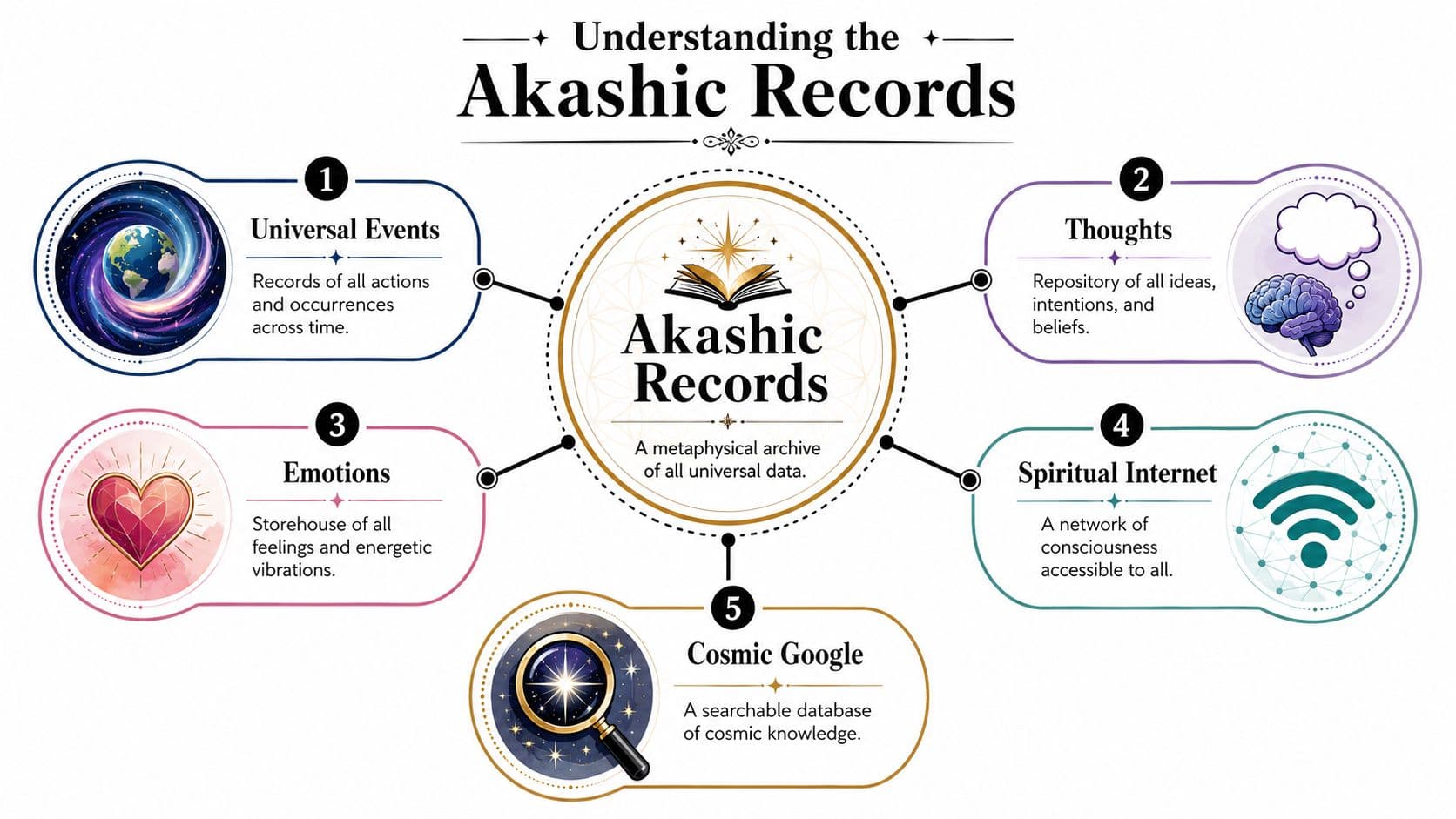
At the center of the idea is this: the Akashic Records are often described as a non-physical field of information that holds the imprint of experience. That includes thoughts, emotions, actions, and events across a soul's journey.
The word Akasha comes from Sanskrit and is commonly translated as ether or sky/space, which is why modern descriptions present the Records as an energetic or informational field rather than a physical archive, as explained in this overview of Akasha and the Akashic Records.
A simple way to picture it
Individuals often grasp the concept faster when they stop imagining books and start imagining a field.
You might hear analogies like these:
- A spiritual internet where consciousness is interconnected
- A cosmic Google where insight is searched through intention
- A Book of Life that reflects the story of the soul
- An energetic archive that isn't stored in matter, but in consciousness
None of those analogies are perfect. But each points to the same core idea. The Records aren't usually described as an object. They're described as a living repository of meaning.
What people believe is stored there
In spiritual teachings about the Records, this field is said to include more than past events. It can also include present dynamics and future possibilities. That's where some readers get tripped up.
A useful distinction helps:
| Term | What it suggests |
|---|---|
| Past | Experiences, patterns, memories, karmic themes |
| Present | Current lessons, relationships, emotional dynamics |
| Future possibilities | Probable directions, not fixed destiny |
Many traditions that work with the Akashic Records don't treat the future as locked. They treat it as fluid. In that view, the Records don't erase free will. They reflect tendencies, lessons, and openings.
Practical rule: If a reading claims your future is fixed and your choices don't matter, step back. That framing turns spiritual inquiry into dependence.
Literal archive or meaningful metaphor
Here's where the phrase akashic records meaning becomes more interesting than a dictionary definition.
For a believer, the Records may be a real spiritual dimension of knowledge.
For a symbolic thinker, they may function like a language for intuition. The records become a way of naming what arises when someone enters a quiet, reflective, receptive state.
For a therapist, coach, or contemplative practitioner, the idea may work as a structured mirror. It gives a person permission to ask deeper questions than they usually ask in ordinary life.
So when someone says they accessed the Akashic Records, they may mean different things. They may mean they contacted a sacred source of wisdom. They may mean they opened a deep meditative state and received insight. They may mean both.
The Origins and Evolution of the Concept
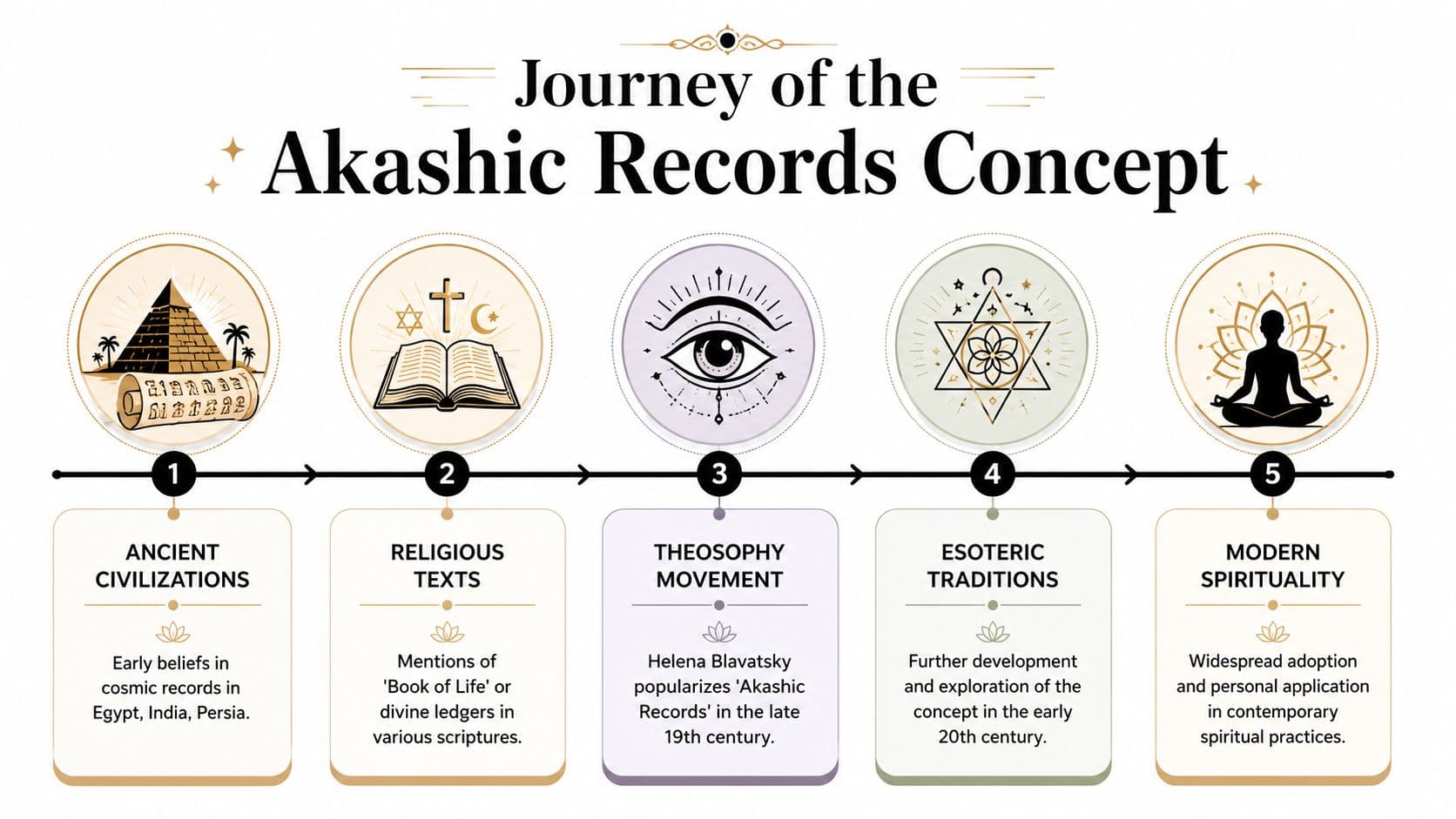
A lot of people assume the term Akashic Records comes directly from an ancient Sanskrit tradition in its modern form. Historically, that isn't the clearest picture.
The modern term emerged in the late 19th and early 20th centuries through Theosophy and related Western esoteric movements, rather than from a documented ancient Sanskrit archive tradition. Accounts of the concept place it within a modern spiritual lineage tied to the 1875 founding of the Theosophical Society and its spread through Europe and North America, as noted in Wikipedia's historical overview of the Akashic Records.
Why that history matters
This doesn't make the concept false. It makes it more precise.
The Sanskrit word Akasha is old. The modern phrase Akashic Records belongs to a later spiritual synthesis. That synthesis blended Eastern vocabulary with Western occult and esoteric ideas. So if you're looking for the meaning of the term, it's more accurate to place it in that modern spiritual stream than to assume it has always existed in the exact form people use today.
That historical clarity is useful because spiritual language often gathers authority by sounding ancient. Sometimes that's fair. Sometimes it's a simplification.
Edgar Cayce and the shift into practice
One reason the Akashic Records became widely known is Edgar Cayce. He helped move the idea from an esoteric concept into something people believed could be used for healing and personal guidance. A historical account of Cayce's influence says he claimed the records could help people discover everything from their essential purpose in life to the root cause of a long-standing problem. That framing made the Records feel personal and accessible rather than remote theory, as described in this article on Edgar Cayce and the Akashic Records.
Cayce's approach changed the tone of the conversation. The Records were no longer only about cosmic philosophy. They became something people consulted for practical questions.
From esoteric teaching to modern spiritual culture
That shift shaped how the topic is used today. In many modern spiritual communities, Akashic work is less about abstract cosmology and more about:
- Life purpose
- Emotional healing
- Relationship patterns
- Past life themes
- Soul-level guidance
If you want a broader spiritual context for ideas about unseen realms and spiritual laws, this topic offers a related perspective.
What matters most here is that the modern Akashic Records idea didn't drop unchanged out of antiquity. It evolved. It was interpreted, taught, translated, and personalized. That's part of why definitions vary so much from teacher to teacher.
How People Access the Akashic Records
Ask five practitioners how to access the Akashic Records and you'll hear some overlap, but not a single universal method. That's because Akashic work sits inside a spiritual culture of prayer, intuition, meditation, and symbolic perception.
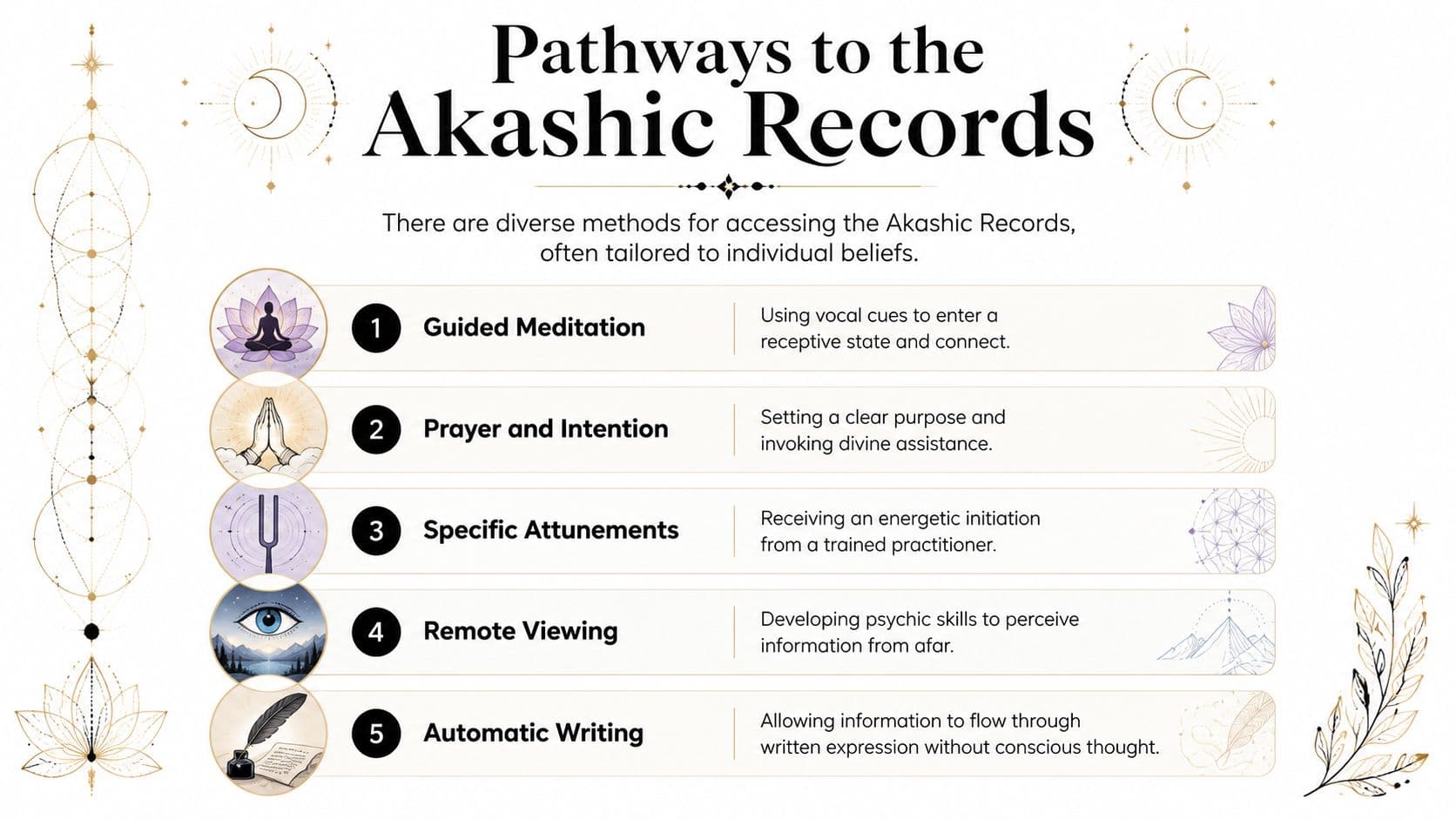
Most approaches begin the same way. A person becomes still, sets an intention, and tries to enter a receptive state.
Common pathways people use
Some methods are solitary. Others involve a trained reader.
-
Meditation
Many people begin with silence, breath, and visualization. The goal isn't to force a vision. It's to quiet the analytical mind enough to notice subtle impressions.
-
Prayer or invocation
Some traditions use a formal opening prayer. The prayer functions like a ritual threshold. It marks the shift from ordinary thinking into sacred inquiry.
-
Automatic writing
In this approach, a person writes a question, becomes still, and lets responses arise without over-editing. Later, they review the writing for patterns, symbols, and emotional truth.
-
Working with a practitioner
Some people prefer a guide, especially at the beginning. A reader may use prayer, intuitive listening, channeling, or trance-like focus to receive impressions on the client's behalf.
-
Attunement-based systems
Certain schools teach structured methods that include energetic preparation, specific wording, and ethical guidelines for entering the Records.
What actually helps the process
Technique matters less than posture. By posture, I mean the inner stance you bring.
A useful session usually includes:
- A clear question such as What pattern am I repeating in relationships?
- Emotional steadiness rather than desperation
- Discernment about what feels symbolic versus literal
- Respect for boundaries, especially if another person's private life is involved
Ask for insight that helps you take responsibility for your own life. That's usually more fruitful than asking for certainty about someone else's choices.
If you're new to meditation, these simple meditation steps offer an easy starting point without overcomplicating the practice.
A grounded way to begin
You don't need a dramatic mystical event to start.
Try this simple sequence:
- Sit somewhere quiet.
- Take a few slow breaths.
- Write one sincere question.
- Notice what feelings, images, words, or memories arise.
- Journal without deciding too quickly what any of it means.
For readers who want to deepen the contemplative side of this work, meditation and higher consciousness is a helpful companion topic.
The key is not performance. It's receptivity. People often expect lightning. More often, insight arrives as a gentle sentence, an unexpected memory, or a sudden sense of what needs attention.
Practical Applications for Self-Discovery
For many people, the value of Akashic work isn't in proving a metaphysical theory. It's in what the process brings to the surface. A good session or a sincere self-inquiry practice can help a person notice patterns that daily busyness keeps hidden.
That makes the Records useful as a tool for self-discovery.

Where people often seek guidance
The questions tend to be human, not abstract.
| Life area | What someone might ask |
|---|---|
| Relationships | Why do I keep attracting the same dynamic? |
| Work and purpose | What kind of contribution actually fits me? |
| Emotional patterns | Why does this fear feel older than the current situation? |
| Decision points | What am I not seeing clearly right now? |
These questions matter because they invite reflection at the level of meaning, not just surface problem-solving.
What the process can uncover
Sometimes an Akashic-style inquiry helps a person name a pattern they already sensed but hadn't articulated. Sometimes it reframes pain. A difficult relationship may begin to look less like punishment and more like a repeating lesson about boundaries, self-worth, or truth-telling.
Other times, the insight is symbolic rather than factual. A person may receive an image, a phrase, or a felt sense that doesn't behave like ordinary logic but still lands with emotional accuracy.
That can be useful. Not because symbolism is automatically supernatural, but because symbolic language often reaches parts of us that linear analysis misses.
A meaningful insight doesn't have to be literal in order to be transformative.
Pairing intuition with structure
Intuitive work can be powerful, but some people also benefit from structured systems of self-knowledge. If you're interested in numerology, life paths, or life numbers, it's worth grounding that exploration in Dan Millman's book, The Life You Were Born to Live, rather than mixing together random internet interpretations. The same ecosystem also includes the Life Purpose App, which many readers use as a companion tool for reflection.
That combination can be helpful. The Akashic approach asks what is my soul trying to understand? Millman's framework asks what core lessons and gifts am I here to work with? Those aren't identical questions, but they can complement each other.
Some people also explore soul themes through related modalities such as past life regression hypnotherapy, especially when symbolic or recurring material keeps surfacing.
The healthiest use of these tools is not dependence. It's clarity. A good practice should bring you back to your own responsibility, your own values, and your own capacity to choose.
Skepticism and Alternative Explanations
A balanced conversation about the Akashic Records has to include a simple fact. There is no empirical scientific proof that the Akashic Records exist as a literal cosmic archive.
That doesn't end the discussion. It changes the kind of discussion we're having.
Many explanations of the Records are overwhelmingly testimonial and don't clearly separate spiritual belief, symbolic interpretation, and literal claim, which leaves readers without a firm framework for evaluating the experience, as discussed in this critique of common Akashic Records misconceptions.
A few non-mystical ways to understand the experience
A skeptical or psychologically minded reader might interpret Akashic experiences in several ways.
-
Deep introspection A focused meditative state can help people notice thoughts and feelings that normal mental chatter blocks out.
-
Pattern recognition Humans are good at linking present struggles with older memories, family dynamics, and recurring stories. Sometimes a reading gives shape to that process.
-
Suggestion and expectation If someone enters a sacred-feeling ritual expecting guidance, the mind may organize experience into meaningful responses.
-
Confirmation bias People naturally remember the parts of a reading that fit and may ignore the parts that don't.
None of those explanations are insults. They're serious attempts to understand why these experiences can feel so vivid and helpful.
Why people still find value in it
Even when someone doesn't accept the Records as fact, the practice can still work as a meaning-making tool.
A meaningful ritual can slow a person down. It can create emotional honesty. It can help them ask better questions. It can offer language for grief, confusion, longing, and change. In that sense, the value may come less from proving an invisible archive and more from the quality of reflection the practice invites.
Here's a useful distinction:
| Framing | Main question |
|---|---|
| Literal spiritual belief | Is there truly a non-physical record of all souls? |
| Psychological interpretation | What inner material becomes accessible in this state? |
| Symbolic meaning-making | What story or image helps me understand my life more truthfully? |
Belief and skepticism don't have to fight
Some readers feel pressure to choose a side too quickly. Either this is absolutely real or this is nonsense. Real life is usually more nuanced.
You can remain open without becoming gullible. You can remain skeptical without becoming closed.
If a practice helps you become more honest, compassionate, and responsible, that's meaningful. If a practitioner makes inflated claims, encourages dependency, or treats interpretation as unquestionable fact, that's a sign to step back.
The mature path is discernment. Not dismissal. Not blind belief.
Your Next Steps on the Journey of Discovery
If this topic stirs something in you, start small. You don't need to force a grand spiritual identity around it.
Begin with a notebook. Write down one pattern in your life that keeps returning. Then ask a deeper question beneath it. Not how do I make this stop, but what is this pattern asking me to learn?
A simple practice can help:
- Sit calmly for a few minutes
- Ask one honest question
- Write whatever arises without judging it too quickly
- Review it later with both openness and common sense
That rhythm matters. It keeps your feet on the ground while leaving room for intuition.
You might also read carefully. If a teacher speaks about the Akashic Records as literal truth, notice whether they distinguish belief from proof. If a skeptic dismisses the whole subject, notice whether they're overlooking the genuine human value of contemplation and symbolic insight.
The most useful understanding of akashic records meaning may not be a final definition. It may be a lived relationship with inquiry itself. Some people will experience the Records as sacred reality. Others will treat them as a profound metaphor for soul wisdom. What matters is whether the practice helps you live with more clarity, humility, and courage.
If you're exploring life purpose alongside spiritual self-inquiry, the Life Purpose App is a practical next step. It's built around Dan Millman's The Life You Were Born to Live and offers a structured way to reflect on your life path, core lessons, and personal patterns. If you want a grounded companion to intuitive work, it's worth exploring.
Discover your life path today
Enter your date of birth and see your life path, free.
Find your life path