Explore ancient wisdom in modern times with practical rituals, mindset shifts, and tools like the Life Purpose App for clarity, purpose, and harmonious living.

August 21, 2026 (2mo ago)
Ancient Wisdom in Modern Times: A Practical Guide
Explore ancient wisdom in modern times with practical rituals, mindset shifts, and tools like the Life Purpose App for clarity, purpose, and harmonious living.
← Back to blog
Explore ancient wisdom in modern times with practical rituals, mindset shifts, and tools like the Life Purpose App for clarity, purpose, and harmonious living.
You close your laptop after a day filled with deadlines, messages, and decisions. Your work may look successful from the outside, yet the quiet that follows brings an uncomfortable question: What am I building, and does it reflect who I am? That tension between achievement and meaning isn't a uniquely modern problem. People have long searched for ways to understand their character, obligations, relationships, and direction.
Ancient wisdom in modern times becomes useful when we stop treating it as decorative spirituality or distant philosophy. It can offer practical questions for noticing patterns, choosing responses, and living with greater alignment. UNESCO describes traditional knowledge as the knowledge, innovations, and practices of Indigenous and local communities developed through experience over centuries and passed orally across generations, with particular importance in agriculture, fisheries, health, forestry, horticulture, and environmental management. UNESCO also warns that this knowledge is disappearing rapidly, alongside language loss that can interrupt the transmission of cultural memory and wisdom systems. (UNESCO's definition of traditional knowledge)
This guide approaches timeless teachings as tools for self-understanding. It also examines Dan Millman's life-path system, presented in The Life You Were Born to Live, and shows how the Life Purpose App can give that framework a practical digital form.
When Old Knowledge Meets a Modern Life
Maya starts her morning by checking messages before her feet touch the floor. During the commute, she answers work questions. At lunch, she scrolls through other people's achievements. By evening, she has completed the urgent tasks, but she can't name one meaningful thing she did for herself.
Nothing appears obviously wrong. She has a career, friends, and enough financial stability to make plans. Still, her choices feel reactive. She says yes quickly, postpones difficult conversations, and confuses being busy with moving forward. Her unease isn't a sign that she has failed. It's a sign that her daily actions and deeper values have drifted apart.
Ancient traditions addressed this kind of fragmentation in different languages. Buddhist practice developed methods for observing thought without being ruled by it. Stoic philosophy asked people to distinguish between what they can govern and what they cannot. Yogic teachings connected disciplined action with self-knowledge, while Indigenous knowledge systems often understand human well-being through relationships among people, place, and the natural world.
A framework instead of a mood
The phrase “ancient wisdom” can sound vague because it gathers many traditions under one label. A useful framework makes the idea more concrete. Ask four questions:
- What am I noticing? This develops attention.
- What is within my responsibility? This clarifies choice.
- What pattern keeps repeating? This reveals a possible lesson.
- What action would express my values? This turns insight into conduct.
These questions don't require a retreat, a particular belief system, or a dramatic change in lifestyle. Maya could use them after a tense meeting, before accepting another obligation, or while deciding whether a relationship supports the person she wants to become.
A grounded principle: Wisdom begins when observation becomes more important than impulse.
For readers who want a broader introduction to the subject, a guide to spiritual wisdom offers useful context. The point isn't to romanticize the past. It's to recognize that earlier thinkers developed structured ways to approach problems that still trouble people today, including fear, desire, identity, loss, ambition, and purpose.
Wisdom traditions also have remarkable historical continuity. A peer-reviewed review notes that Sumerian civilization acknowledged wisdom as a concept around 2,500 BCE, giving wisdom more than 4,400 years of documented history. (Review of wisdom across the ages) Ancient ideas survive not because every old practice should be copied, but because each generation keeps finding value in questions about how to live well.
The Major Strands of Ancient Wisdom
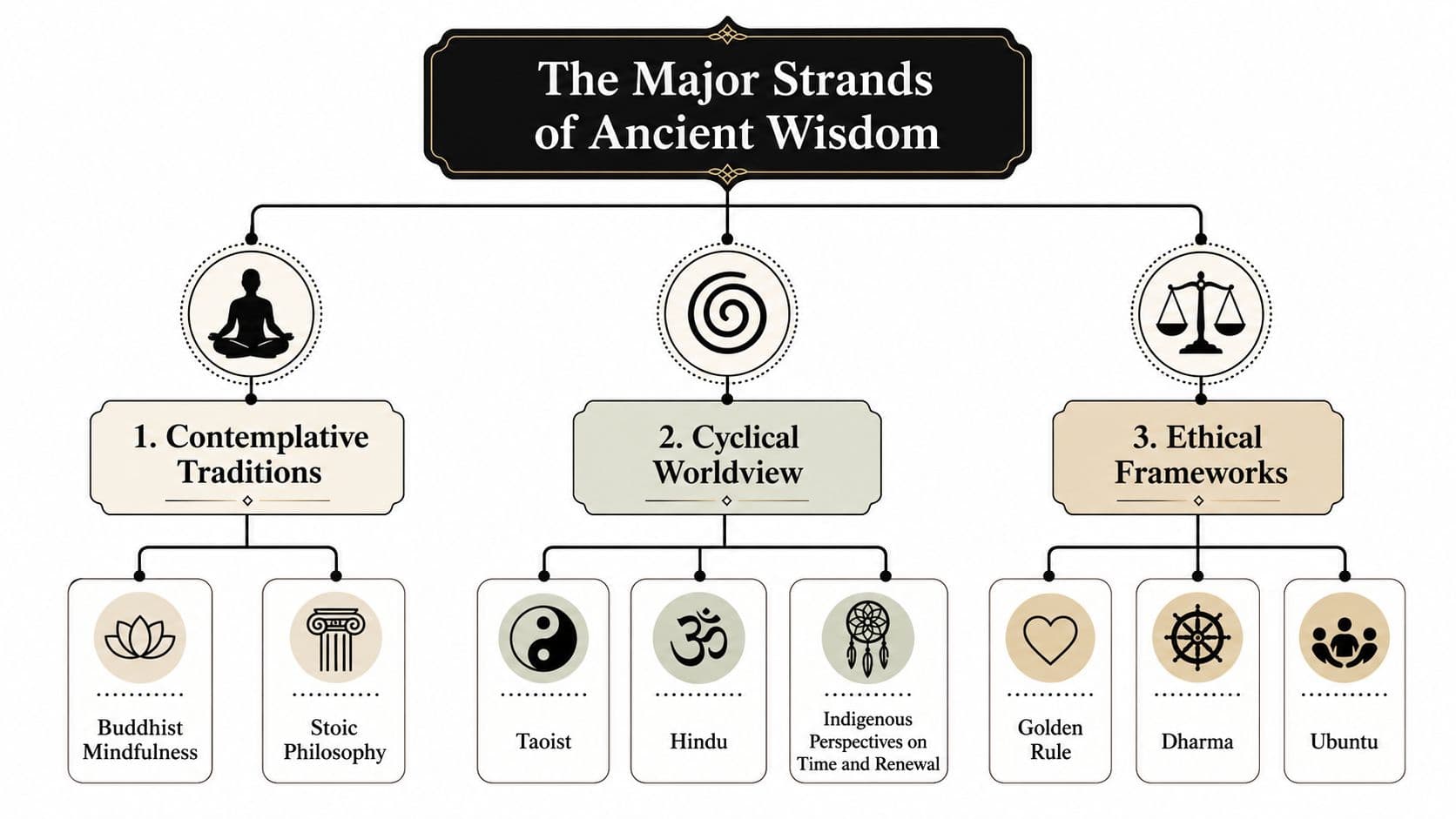
A beginner can approach ancient wisdom through several broad strands. These categories overlap, and they shouldn't be treated as rigid boxes. Their value lies in helping you recognize what a practice is designed to do.
Contemplative traditions
Contemplative traditions train attention. Buddhist mindfulness, for example, invites you to notice sensations, thoughts, and emotions as they arise. The practical modern translation is simple: before replying to a difficult message, observe the heat in your body and the story forming in your mind. You gain a small space between feeling and action.
Stoic philosophy uses a related discipline through judgment. Instead of asking whether an event is pleasant, ask what part of it is under your control. You may not control a colleague's opinion, but you can control whether you respond calmly.
Cyclical worldviews
Cyclical worldviews challenge the assumption that life should move in a straight line. Taoist, Hindu, and Indigenous perspectives can differ substantially, yet each may direct attention toward change, renewal, seasonality, and relationship with nature. A difficult period may be a phase requiring patience or preparation, not proof that your entire direction is wrong.
You can apply this lens to work and relationships. A season of learning may look less productive than a season of visible achievement, but it can still be necessary for later growth.
Symbolic systems and ethical living
Numerological and symbolic systems use patterns as mirrors. Pythagorean, Kabbalistic, and Vedic frameworks associate meaning with numbers, letters, or cosmic relationships. Their practical use depends on interpretation. A symbol should prompt reflection, not replace evidence or personal responsibility.
Ethical frameworks bring insight into conduct. Virtue, service, right action, the Golden Rule, Dharma, and Ubuntu all point toward the consequences of how we treat others. They ask you to measure wisdom by behavior, not by how spiritual your language sounds.
Across these strands, a shared idea emerges: human flourishing depends on understanding yourself in relation to something larger, whether that means conscience, community, nature, or a sacred order. Dan Millman's system belongs primarily to the symbolic strand, but its usefulness grows when you test its themes through contemplative attention and ethical action.
Dan Millman's Life-Path System and the Life Purpose App
Dan Millman's The Life You Were Born to Live presents a modern life-path system influenced by ancient numerological and archetypal approaches. The book's revised 25th Anniversary edition covers 45 life paths for people born between 1750 and the present, and connects those paths with themes involving health, money, sexuality, career, and relationships. (The Life You Were Born to Live on Apple Books)
The method is structured rather than impressionistic. According to the method summary, you add every digit in your birth date and keep the final sum as the lookup number. For example, if the digits total 37, you use 37 as the life-path number rather than reducing it to a single digit. (Description of the life-path calculation)
How to use the framework
Start with the calculation, then read the interpretation as a set of themes. A life path isn't a verdict about your personality. It's a prompt to examine recurring strengths, challenges, and choices.
- Enter the complete birth date. Add each digit carefully.
- Keep the final total. Use the resulting number to identify the relevant path.
- Study the themes. Look for patterns in motivation, relationships, work, and recurring difficulties.
- Compare the description with experience. Keep what helps you notice reality more clearly, and question what doesn't fit.
- Choose an experiment. Turn one insight into a small behavior, such as setting a boundary or completing a neglected responsibility.
Consider a reader whose path is 6. They might use the interpretation to examine service, family patterns, and balance. The helpful question isn't “Does this number predict my future?” It's “Where do I care for others wisely, and where do I over-function, control, or neglect myself?”
A digital tool can make this process easier to revisit. The Life Purpose App presents birth-date-based life-path analysis, spiritual laws, relationship dynamics, and life-cycle material associated with Millman's system. Readers can also explore the Life Purpose Oracle as a related way to think about purpose and self-inquiry.
Use symbols as questions, not commands. The interpretation becomes valuable when it leads to honest observation and responsible action.
Practical Rituals and Mindset Shifts for Daily Life
A wisdom practice earns its place by changing how you meet ordinary moments. You don't need an elaborate ceremony. A short ritual repeated consistently can reveal more than an intense practice performed once and abandoned.
Morning intention
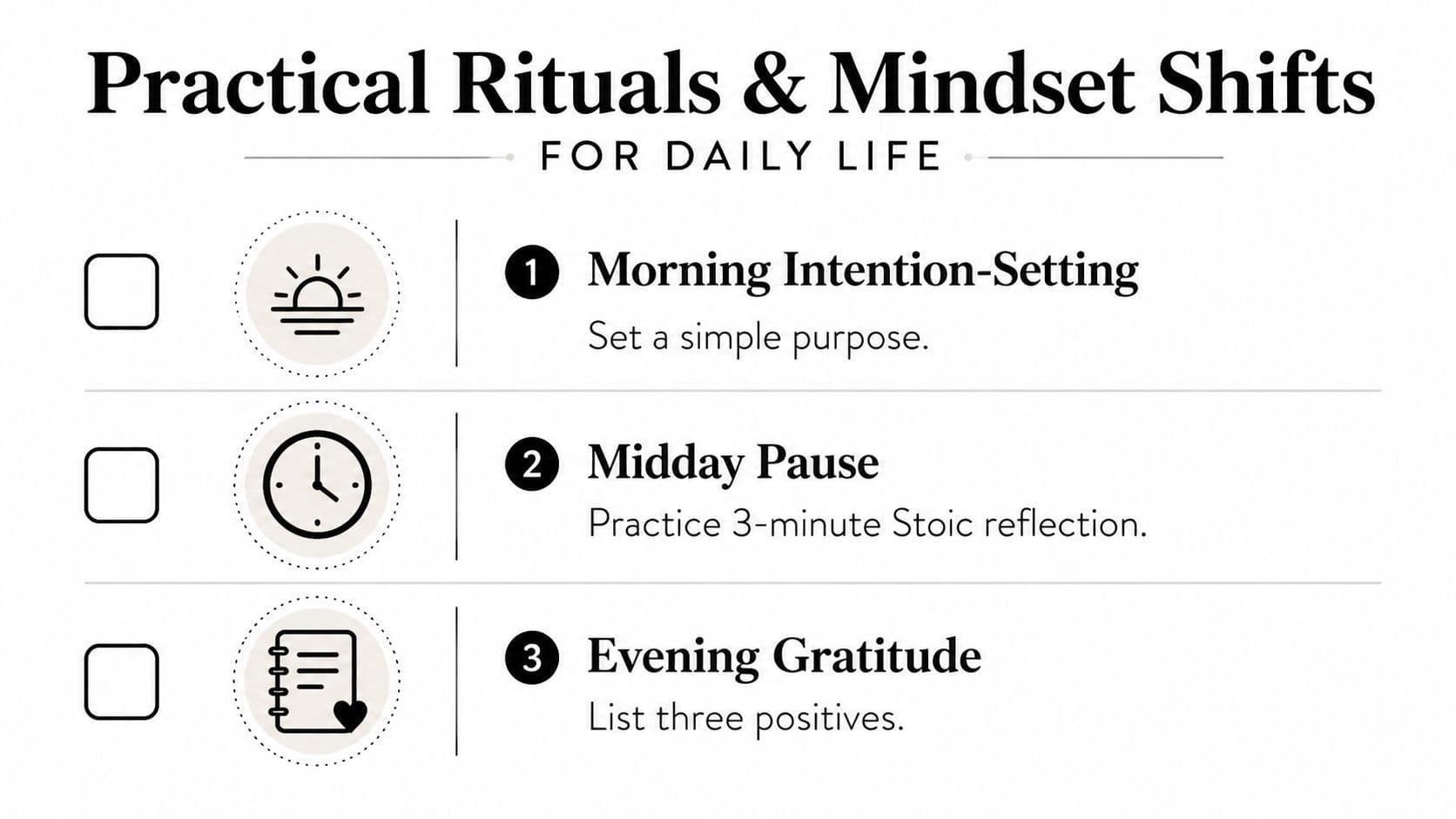
Before opening your inbox, write one sentence: “Today I want to practice…” Complete it with a quality such as patience, courage, restraint, or attention. Then name one situation where that quality may matter.
This resembles Stoic preparation because it turns values into an anticipated choice. It also prevents intention from becoming a vague wish. You're not promising to control the whole day. You're choosing how you want to participate in it.
Midday awareness
Set aside a brief pause. Notice your breathing, identify the strongest emotion present, and label it plainly: “planning,” “worrying,” “resentment,” or “fatigue.” Buddhist noting works this way. It doesn't ask you to suppress the experience or build an identity around it.
If your attention feels scattered, use a breathing reset. Follow the three-part breath practice and return to the next task only after noticing what has changed in your body.
A quiet tea ritual can also mark this transition. Preparing tea slowly, putting away your phone, and attending to taste and temperature can turn a routine pause into deliberate attention. These home matcha ceremony practices provide a practical starting point for creating that kind of space.
Evening reflection
Ask a Stoic-style question: “Where did my actions match my values today, and where did they not?” Write a brief answer without defending yourself. Then record one thing you appreciated, one difficulty you handled, and one repair you may need to make.
Once a week, compare your calendar with your stated values. If you say relationships matter but reserve no unhurried time for them, the schedule offers useful information. Ancient wisdom becomes self-knowledge when it shows you the difference between your ideals and your habits.
Keep the practice small. The aim isn't productivity or spiritual performance. It's consistent contact with your own motives, followed by choices that gradually become more deliberate.
Applying Ancient Wisdom to Relationships and Life Cycles
Relationships often expose patterns that private reflection leaves hidden. You may describe yourself as patient until a partner needs reassurance, or as independent until uncertainty appears. A life-path lens can give couples language for discussing these patterns, provided they use it as a conversation starter rather than a label.
Dan Millman's system also includes a nine-year cycle concept. The cycle offers a way to reflect on changing priorities across time. One phase may invite foundation-building, another creativity or expansion, while another may emphasize completion and release. The Life Purpose App applies this framework to personal timing and relationship dynamics, allowing users to compare life paths and consider how each person may be approaching the present cycle.
Comparing relationship uses
| Life-Path Number | Core Quality | Cycle Compatibility Note | Best Use in a Relationship |
|---|---|---|---|
| 6 | Service, care, and balance | A building phase may highlight shared responsibilities and boundaries | Discuss support without turning care into control |
| 37 | Reflection through the system's lookup method | A changing cycle can prompt a review of expectations and direction | Ask which assumptions still fit present experience |
| Different paths | Contrasting strengths and challenges | The same cycle may affect each person differently | Use differences to improve communication, not assign blame |
Suppose two people enter a foundation-building period at the same time. One may want to organize finances, create routines, and make firm commitments. The other may experience the same period as a demand to repair old habits before making new promises. Their timing overlaps, but their emotional work differs.
That distinction encourages patience. Instead of saying, “You aren't ready,” one partner can ask, “What does building a stable life require from you right now?” Instead of forcing a decision, both people can name their needs, limits, and expectations.
Timing isn't an excuse
Cycles shouldn't excuse avoidance. A person can't use a symbolic interpretation to justify dishonesty, neglect, or harmful behavior. The ethical test remains direct: does the framework support clearer communication and more responsible action?
For couples who want additional offline exercises, these ideas to strengthen your relationship at home can complement symbolic reflection with concrete conversation. The strongest use of a life-cycle lens is modest. It helps partners respect different tempos while continuing to make observable choices together.
Common Misconceptions and Cautions for Seekers
Ancient wisdom can lose its force when people turn it into a lifestyle accessory. Buying symbolic objects, repeating impressive phrases, or collecting readings won't necessarily produce insight. A practice matters when it changes attention, conduct, or the way you handle responsibility.
The opposite error is rigid belief. A life-path interpretation, meditation technique, or philosophical rule can become another form of avoidance if you use it to stop questioning. Confirmation bias makes flattering descriptions feel convincing while inconvenient observations disappear.
Keep discernment active
Use these safeguards:
- Respect cultural origins. Learn where a practice comes from and avoid presenting a complex tradition as a personal invention.
- Test interpretations. Compare an insight with your actual behavior, relationships, and decisions.
- Reject spiritual bypassing. Meditation or symbolism can't replace medical care, honest apologies, financial planning, or professional support.
- Watch for certainty. Anyone claiming complete authority over your destiny deserves careful scrutiny.
- Separate aid from authority. The Life Purpose App can organize life-path material and prompts, but it isn't a substitute for judgment.
Mindfulness also deserves a balanced reading. A randomized controlled trial of mindfulness-based stress reduction recorded a 4.8 mm Hg reduction in clinic systolic blood pressure and a 1.9 mm Hg reduction in clinic diastolic blood pressure, while progressive muscle relaxation showed a 0.7 mm Hg systolic reduction and a 1.2 mm Hg diastolic increase in that trial. (Mindfulness-based stress reduction trial) Those findings support a specific physiological effect in that study, not a promise that every spiritual practice will solve every problem.
A separate randomized longitudinal trial found increased heart-rate variability during practice in both mindfulness and active-control groups, while only the mindfulness group showed higher day-and-night heart-rate variability afterward, which the authors linked with improved sleep quality. (Mindfulness and heart-rate variability trial) Evidence can inform practice without turning it into a miracle claim.
Seek depth over novelty. Ask better questions, remain open to correction, and keep ethical responsibility beside every inner exercise.
Integrating Ancient Wisdom Into Your Modern Path
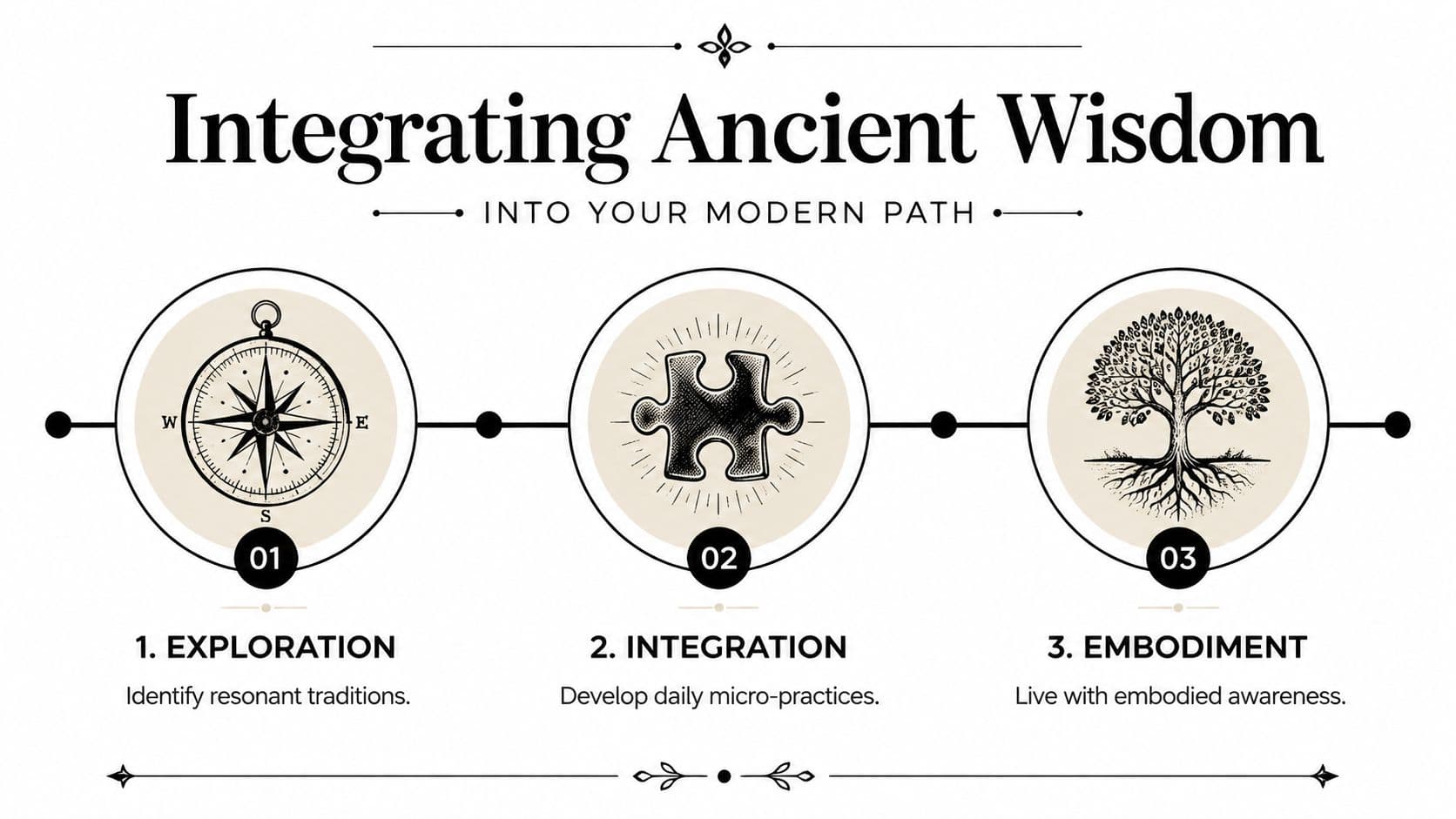
Integration works best when it has a sequence. You don't need to adopt every tradition at once. Choose a practice that improves attention, a framework that helps you examine identity, and a regular review that connects insight with behavior.
Exploration
Begin by reading and listening carefully. Compare contemplative practice, cyclical views of change, symbolic systems, and ethical teachings. Notice which questions feel relevant to your current life, rather than choosing a tradition because it looks appealing online.
During this phase, keep a simple journal. Record recurring conflicts, decisions you avoid, and qualities you want to develop. Use The Life You Were Born to Live and the Life Purpose App as references for life-path reflection, not as replacements for direct experience.
Integration
Build a daily rhythm around one short practice. A morning intention, a midday breath pause, and an evening values review create a useful foundation. Add one weekly conversation or journal entry about how your actions affect the people around you.
Your aim is not intensity. It's repetition with awareness. If a practice becomes burdensome, make it smaller until you can perform it sincerely.
Embodiment
Over the longer term, ask whether your choices express what you claim to understand. A person studying compassion should examine how they speak during conflict. A person exploring purpose should look at how they spend attention. A person reflecting on cycles should recognize when persistence has become resistance to necessary change.
Wisdom becomes modern when it enters the calendar, the conversation, and the decision.
Review your direction during a quarterly personal reset. Revisit your values, relationships, work, health habits, and current life-cycle themes. Keep useful practices, release those that have become empty, and make one concrete adjustment.
Ancient wisdom in modern times isn't a return to the past. It's a disciplined way to bring older questions into present choices. Your life path can offer a language for self-inquiry, while breathwork, journaling, ethical action, and honest relationships make that inquiry real.
The Life Purpose App offers birth-date-based life-path insight, spiritual laws, relationship dynamics, and nine-year cycle material connected with Dan Millman's The Life You Were Born to Live. Visit Life Purpose App to explore your life path, reflect on your purpose, and turn timeless ideas into practical questions for daily life.
Discover your life path today
Enter your date of birth and see your life path, free.
Find your life path