Explore the authoritarian vs authoritative debate. Learn the key differences in parenting and leadership, and discover how to adopt an authoritative approach.

September 28, 2026 (25d ago)
Authoritarian vs Authoritative: Key Differences
Explore the authoritarian vs authoritative debate. Learn the key differences in parenting and leadership, and discover how to adopt an authoritative approach.
← Back to blog
Explore the authoritarian vs authoritative debate. Learn the key differences in parenting and leadership, and discover how to adopt an authoritative approach.
You tell your teenager that the phone needs to stay out of the bedroom overnight. They ask why, you explain the concern, and together you agree on a charging spot. Or you say, “Because I said so,” threaten to take the phone away, and end the conversation. Both responses set a boundary, but they communicate very different ideas about authority.
That difference sits at the heart of authoritarian vs authoritative parenting, teaching, and leadership. One approach seeks obedience through imposed control. The other combines firm expectations with responsiveness, explanation, and respect. The distinction is not just “strict versus warm.” It concerns how power is used, how people learn to regulate themselves, and whether authority becomes credible or merely feared.
| Dimension | Authoritative approach | Authoritarian approach |
|---|---|---|
| Expectations | High and clearly explained | High and imposed |
| Responsiveness | High, with listening and support | Low, with limited attention to individual needs |
| Communication | Two-way dialogue | One-way instruction |
| Boundaries | Firm, consistent, and reasoned | Rigid, obedience-centered, and often punitive |
| Independence | Encouraged within limits | Restricted in favor of compliance |
| Source of influence | Credibility and legitimate authority | Position, control, and consequences |
Defining the Core Dimensions of Authority
A child wants to keep playing after bedtime. The adult has a genuine responsibility to end the activity, but the manner of doing so reveals the underlying style. An authoritarian response might be, “Turn it off now. No arguments.” An authoritative response could be, “Playtime is over because your body needs sleep. You can choose whether to put the game away or brush your teeth first, but bedtime is still now.”
Both adults are demanding. Neither treats the boundary as optional. The difference lies in whether the adult also remains responsive to the child's perspective, emotions, and developing capacity for responsibility.
The two dimensions that clarify the difference
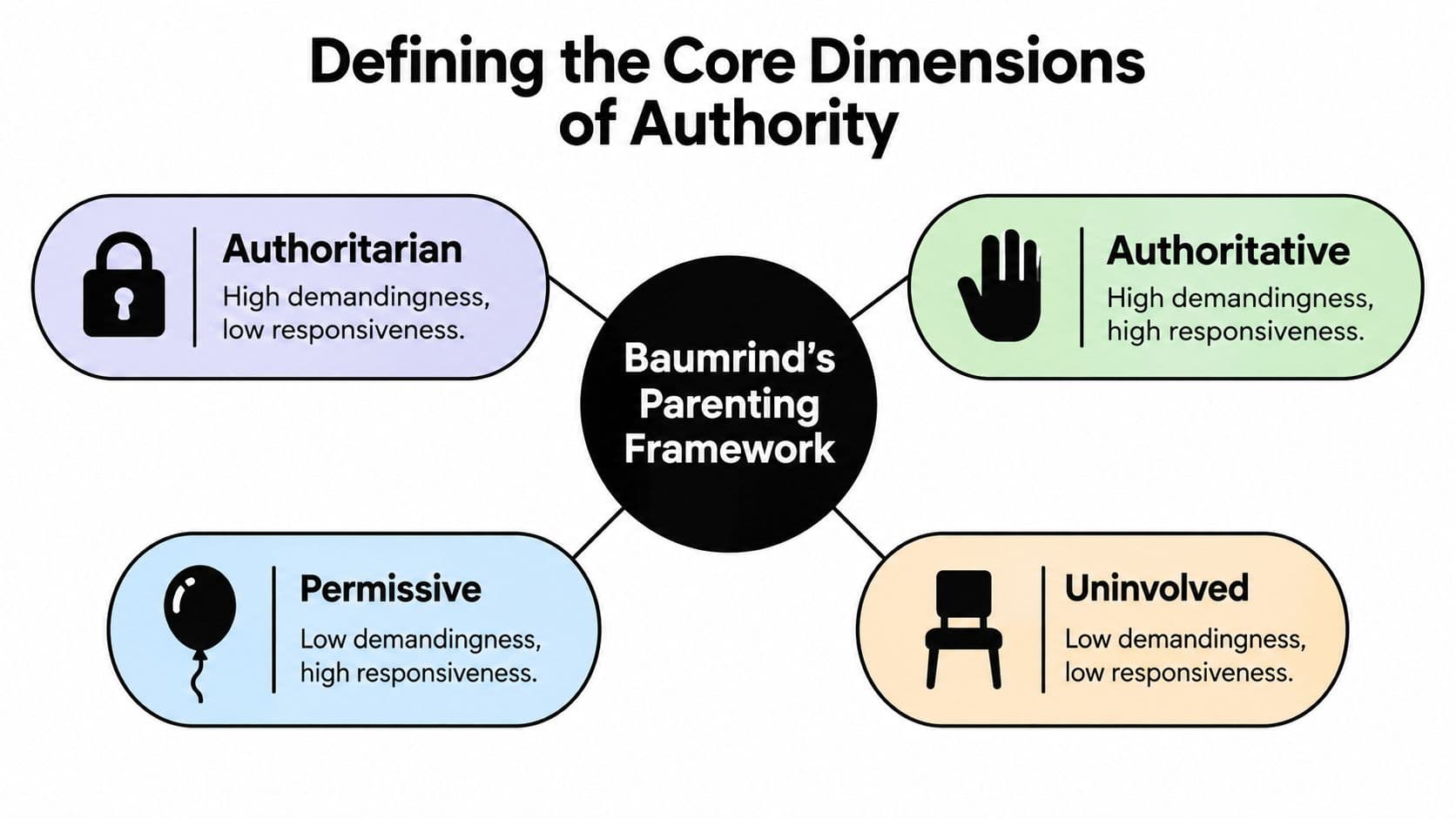
Baumrind's framework uses demandingness and responsiveness as the central dimensions. Demandingness refers to expectations, limits, monitoring, and follow-through. Responsiveness refers to warmth, communication, emotional availability, and attention to the individual's needs. Research summaries of Baumrind's framework define authoritative parenting as high in both responsiveness and demandingness, while authoritarian parenting is high in demandingness but low in responsiveness.
That vocabulary prevents a common mistake. Firmness itself doesn't make someone authoritarian. A teacher who expects careful work, a coach who enforces safety rules, or a parent who holds a curfew may be authoritative if they explain the standard, listen to relevant information, and apply consequences fairly.
Practical rule: Ask two questions at the same time. “What standard am I holding?” and “How am I treating the person who has to meet it?”
Authoritarian authority treats disagreement as disobedience. Authoritative authority treats disagreement as information, even when the final decision remains unchanged. The child may not receive permission to extend bedtime, but they can still be heard and guided.
The same principle applies to professional credibility. A coach, educator, or manager who wants to communicate expertise can explore resources such as branded authority tips for coaches, especially when the aim is to make authority visible through useful communication rather than forced compliance.
The Historical Roots of Imposed Control vs Legitimacy
The two words sound similar because both describe a relationship to authority, but their histories point in different directions. Authoritarian emphasizes authority imposed over individual freedom. Authoritative emphasizes authority that is recognized as proper, credible, or entitled to obedience.
The English history of authoritarian belongs to the nineteenth century. Its use is attested by 1859 for a person who advocates or practices authority over individual freedom, and by 1862 in the sense of favoring imposed order over freedom. By contrast, authoritative is older in English. The meaning “having due authority, entitled to credence or obedience” is recorded from the 1650s, while “proceeding from proper authority” is recorded from 1809. These dates and meanings are documented in the etymological history of authoritarian and authoritative.
Why the linguistic split matters
The distinction isn't merely academic. Words influence what people believe authority is supposed to accomplish. If authority means control over another person, questioning becomes a threat. If authority means credible guidance grounded in proper knowledge or responsibility, questions can strengthen trust.
That explains why an authoritarian parent often frames obedience as the central outcome. The rule must be followed because the adult has power. An authoritative parent still expects the rule to be followed, but the rule is connected to safety, values, development, or shared responsibilities. The child learns not only what to do, but why the boundary exists.
The same contrast appears in a classroom. An authoritarian teacher may silence questions because they slow the lesson or challenge status. An authoritative teacher can maintain order while inviting thoughtful disagreement, correcting misinformation without humiliating the student.
In leadership, the difference is equally important. A title can give someone formal power, but it can't automatically create legitimacy. Employees may follow an authoritarian manager because the manager controls evaluations or schedules. They tend to regard an authoritative leader as credible because that person sets clear standards, explains decisions, listens seriously, and accepts responsibility.
Authority doesn't need to disappear for relationships to become healthier. The more useful transformation is from coercive control to respected guidance. Parents and leaders still make decisions, enforce limits, and intervene when safety requires it. They avoid treating fear as the main evidence that their authority works.
Measuring the Real-World Impact on Behavior
The difference between these styles reaches beyond tone. Research connects them with different patterns of behavior, including externalizing problems, prosocial conduct, and interaction with peers.
An updated meta-analysis of 1,435 studies found that authoritative parenting had very small to small negative associations with child and adolescent externalizing problems, while authoritarian parenting was associated with higher levels of externalizing problems. The finding, reported in the updated meta-analysis indexed by PubMed, makes the distinction relevant to behavioral risk, not just family atmosphere.
Externalizing problems include behavior that turns distress outward, such as aggression, defiance, or other conduct difficulties. A child may comply immediately in an authoritarian home, but immediate compliance doesn't necessarily show that the child has understood the rule or developed internal regulation. Authoritative guidance aims to make expectations understandable and gradually transferable to the child's own judgment.
What children practice in each environment
Prosocial behavior offers another useful lens. A meta-analysis found a positive association between authoritative parenting and prosocial behavior, with r = .174, p < .001, and a negative association between authoritarian parenting and prosocial behavior, with r = -.107, p < .001, as reported in the meta-analysis of parenting and prosocial behavior. Prosocial behavior includes helping, sharing, and cooperating.
The practical interpretation is straightforward. Responsive firmness gives children repeated opportunities to understand other people's needs while still working within boundaries. Control without responsiveness can make the relationship feel like a contest in which the strongest person wins.
| Outcome Metric | Authoritative Approach | Authoritarian Approach |
|---|---|---|
| Externalizing problems | Very small to small negative association | Associated with higher levels of externalizing problems |
| Prosocial behavior | Positive association with helping and sharing | Negative association with helping and sharing |
| Peer interaction | Supports social competence through guidance and responsiveness | Can hinder peer interaction and social adjustment |
| Rule learning | Encourages understanding and internal responsibility | Emphasizes external compliance |
| Response to mistakes | Opens space for repair and learning | Can make mistakes feel threatening |
A review of authoritarian parenting and peer interaction found that authoritarian parenting significantly hinders children's peer interactions, with effects varying by gender, age, and family composition. The negative association was stronger for boys, younger children, and children with siblings, according to the review of authoritarian parenting and peer interaction.
These findings don't mean one interaction determines a child's future. Parenting is only one influence among many, and families change over time. They do show why the authoritarian and authoritative distinction deserves more precision than the label “strict.”
Emotional intelligence also depends on learning to identify feelings, understand consequences, and respond constructively. For readers working on those skills directly, a guide on building emotional intelligence offers a useful companion to the behavioral framework discussed here.
Contextual Nuances and Cross-Cultural Realities
“Authoritative is best” is a useful summary, but it becomes misleading when treated as a universal rule without context. Children and adults don't experience authority in a vacuum. Culture, economic conditions, schools, neighborhood safety, family structure, and access to resources can all shape how a demanding or responsive approach is interpreted.
Recent cross-national and school-age research continues to link authoritative parenting with better academic, emotional, and social outcomes, while authoritarian parenting is associated with worse behavioral and academic outcomes. Yet a 2025 cross-country study found that national economic development can strengthen the benefits of authoritative parenting and reduce the harms associated with authoritarian parenting on educational attainment, suggesting that the same style doesn't operate identically across societies. The findings are discussed in this cross-national analysis of parenting, development, and educational attainment.
Why context changes the experience of authority
Consider a family living in an environment where external dangers are serious and institutions are unreliable. A highly directive rule may be understood as urgent protection rather than a general philosophy of obedience. That context doesn't automatically make authoritarian behavior beneficial, but it helps explain why families may use strict control and why children may interpret it differently.
Cultural meanings also matter. In some communities, respect for elders and group responsibility are central values. An authoritative approach can support those values through clear expectations, shared obligations, and attentive communication. It doesn't require importing an individualistic model in which every decision becomes a negotiation.
The key question isn't whether children should have boundaries. It is whether the boundary is connected to care, meaning, and developing competence, or whether it exists mainly to preserve the adult's dominance.
A culturally responsive authoritative approach keeps the relationship between values and behavior visible. It doesn't confuse responsiveness with permissiveness or autonomy with isolation.
A large review summarized by Parenting Science's overview of parenting styles reports that an international meta-analysis of 428 published studies found authoritative parenting was linked to at least one positive outcome in every world region. That broad pattern supports the approach, while still leaving room to ask how its practices should be expressed in a particular community.
Professionals should also avoid using research to judge families without understanding structural pressures. A parent working multiple jobs, a teacher managing a crowded classroom, or a manager responding to a genuine crisis may have limited flexibility. The goal is not perfect responsiveness in every moment. It is a consistent movement toward authority that protects dignity while maintaining necessary standards.
Authority Dynamics in the Digital Age
A smartphone turns an old parenting question into a complicated one. A child can follow a household rule while still encountering social pressure, comparison, harassment, and identity experimentation online. A command such as “Give me your phone” may stop access temporarily, but it doesn't teach the judgment required when no adult is present.
Authoritarian control struggles in digital environments because online life can't be supervised through physical proximity alone. Young people need to make decisions across conversations, platforms, and changing social situations. Rules still matter, but the relationship must support disclosure, reflection, and repair when something goes wrong.

Boundaries that build digital judgment
A 2025 study found that authoritative parenting predicted higher self-esteem among college students who felt immersed in Instagram and X, while permissive and authoritarian parenting didn't moderate the relationship between social-media immersion and self-esteem. The finding appears in this study of parenting style, social media, and self-esteem.
The result doesn't mean an authoritative parent can prevent every harmful online experience. It suggests that a supportive structure may help young people maintain a more stable sense of self while navigating highly visible digital identities.
A useful conversation might include these elements:
- State the boundary: Define where and when devices are used, and identify the safety reason.
- Invite disclosure: Make it clear that reporting a frightening or confusing interaction won't automatically trigger humiliation or a disproportionate response.
- Review decisions: Discuss what happened, what the young person noticed, and what they might do next time.
- Adjust with maturity: Increase independence when the person demonstrates responsible judgment, while keeping core safety limits intact.
The authoritative approach doesn't abandon monitoring. It makes monitoring transparent and proportionate. The adult remains responsible for protection, but the young person practices the reasoning that digital independence requires.
This applies beyond families. Educators and youth leaders also shape how people respond to online conflict, public feedback, and reputation. Authority is strongest when it helps someone develop an internal compass rather than making them dependent on constant surveillance.
Translating Psychological Frameworks to Workplace Leadership
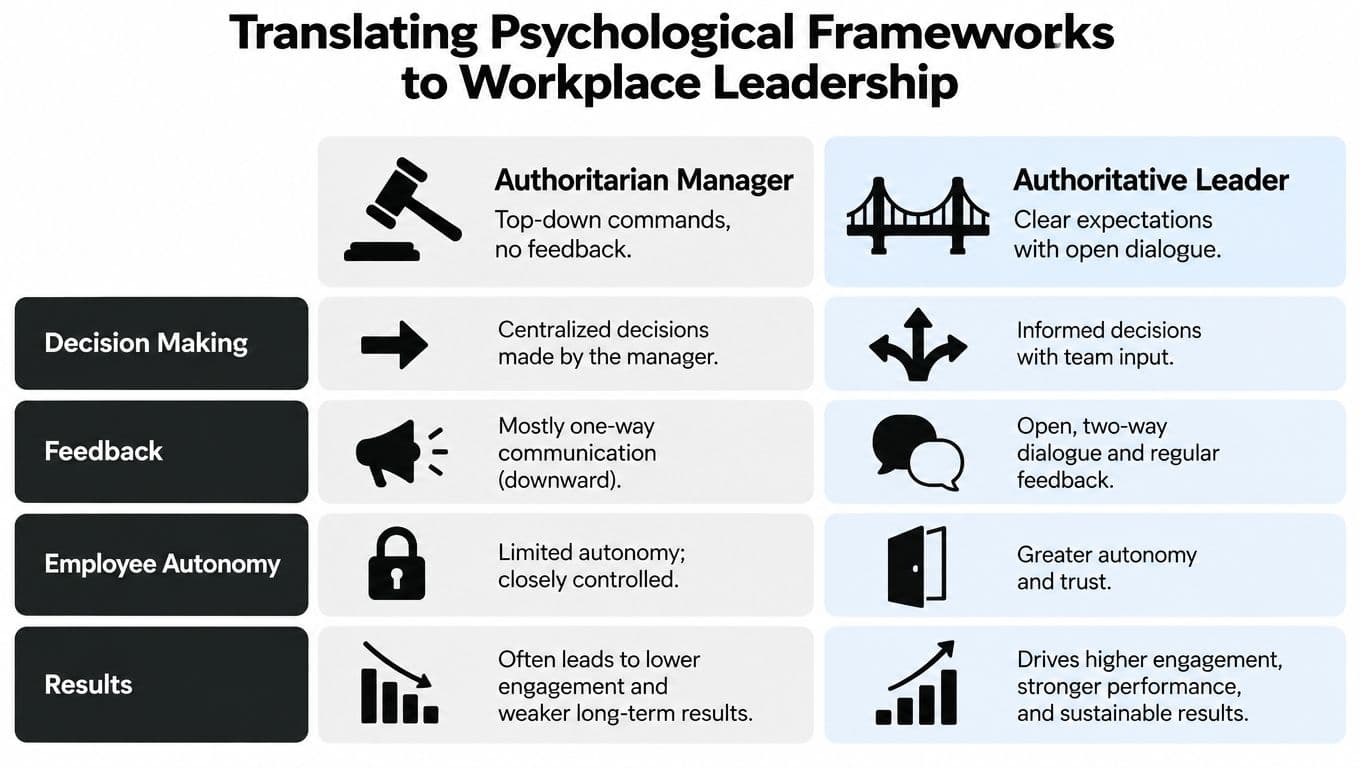
A manager can demand excellent work and still lead authoritatively. The decisive question is whether employees receive clear standards alongside meaningful support, context, and opportunities to contribute.
An authoritarian manager treats authority as a one-way channel. Decisions flow downward, questions appear disloyal, and mistakes invite blame. An authoritative leader keeps the performance bar visible but uses dialogue to surface obstacles, clarify tradeoffs, and help people improve.
Turning control into credible leadership
Start with the work, not the personality. A manager can examine how they assign tasks, respond to disagreement, conduct reviews, and handle failure.
- Clarify the standard: Say what quality looks like, why it matters, and what constraints cannot change.
- Create a feedback route: Ask employees what information, tools, or decisions are blocking progress.
- Separate accountability from humiliation: Address the behavior or result without attacking the person's character.
- Set bounded autonomy: Let employees choose methods when the outcome and risk limits are clear.
- Close the loop: Explain what changed after feedback, even when the final decision remains the same.
Authoritative leadership isn't consensus on every matter. In a safety incident, legal issue, or time-sensitive operational problem, a manager may need to give direct instructions. The style becomes authoritarian when directness turns into a standing refusal to listen, explain, or recognize the people affected.
A review summarized by Parenting Science reports that an international meta-analysis of 428 published studies linked authoritative parenting with at least one positive outcome in every world region. While workplace leadership isn't identical to parenting, the broader principle transfers carefully: high standards work better when people experience the authority figure as credible and responsive.
Managers who want to strengthen that credibility can explore practical guidance on how to build lasting authority, particularly if they're developing a public voice or professional reputation. You can also explore leadership content for further reflection on values-based management, as appropriate.
The result is a team that knows where it stands without feeling that every decision depends on pleasing one powerful person. Clear authority gives people direction. Responsiveness gives them room to think.
Practical Steps for Adopting an Authoritative Approach
Changing an established pattern requires more than adding a gentler tone to old commands. You need to preserve the boundary while changing the relationship around it. The following practices work across parenting, education, coaching, and management because they develop both structure and trust.
Begin with visible expectations
State the rule before the conflict. “Homework comes before gaming because school responsibilities come first” gives a child a usable principle. “The report must meet these standards because clients rely on accurate information” gives an employee a meaningful professional standard.
Invite questions without promising a different decision. Listening doesn't weaken authority when you remain clear about what is fixed and what can be discussed.
Make responsiveness behavioral
Warmth isn't a vague personality trait. It appears in specific actions:
- Listen for the need: A refusal may signal confusion, fatigue, fear, or disagreement. Find out which one before choosing a consequence.
- Explain the rationale: Connect the limit to safety, responsibility, fairness, or another value the person can understand.
- Offer bounded choices: Give two acceptable options, such as completing a task now or at an agreed time.
- Follow through consistently: Apply consequences predictably, without adding extra punishment in anger.
- Recognize effort: Praise preparation, honesty, recovery, and improvement, not only successful outcomes.
A repair conversation matters after you lose your temper. You can say that the rule still stands, acknowledge that your delivery was unhelpful, and return to the issue without surrendering the boundary. That teaches accountability in both directions.
Self-awareness supports the process. If you're interested in life paths or numerology as a reflective practice, use Dan Millman's book, “The Life You Were Born to Live”, and the Life Purpose App as reference points for examining your tendencies and values. They shouldn't replace psychological assessment, but self-reflection can help you notice whether stress pushes you toward control, avoidance, or genuine responsiveness.
For managers and coaches, empowerment in leadership per HR manager offers another perspective on giving people meaningful ownership while preserving accountability. You can also explore language that separates firm limits from coercive behavior.

Authority becomes authoritative when people can predict both your standards and your humanity. Set the limit, explain its purpose, listen to relevant information, and follow through without contempt. Those habits help children, students, and colleagues develop judgment instead of merely learning how to avoid punishment.
Life Purpose App helps you explore self-knowledge and life-path insights through the system connected with Dan Millman's “The Life You Were Born to Live”, giving you a structured way to reflect on values, tendencies, and relationships. Visit Life Purpose App to support the self-awareness that makes clear, respectful authority easier to practice.
Discover your life path today
Enter your date of birth and see your life path, free.
Find your life path