Discover how birth chart personality differs from numerology. Learn what astrology reveals about your soul and how Dan Millman's Life Purpose App complements

October 3, 2026 (9d ago)
Birth Chart Personality: Astrology vs Numerology Guide
Discover how birth chart personality differs from numerology. Learn what astrology reveals about your soul and how Dan Millman's Life Purpose App complements
← Back to blog
Discover how birth chart personality differs from numerology. Learn what astrology reveals about your soul and how Dan Millman's Life Purpose App complements
Have you ever wondered why a broad zodiac description can feel intimate, while a carefully calculated birth chart can still fail to predict how you'll behave? That tension sits at the heart of birth chart personality readings. People often want both a language for their inner life and an honest answer about what these systems can prove.
A birth chart and a numerological life path don't have to compete. Astrology uses a symbolic map of the sky, while Dan Millman's The Life You Were Born to Live uses birth numbers to explore purpose, gifts, and recurring lessons. Read thoughtfully, both can help you ask better questions about yourself, provided you treat interpretation as reflection rather than destiny.
Why We Seek Ourselves Through Ancient Systems
Maya had reached the familiar point of uncertainty. Her work looked respectable from the outside, yet she couldn't explain why every successful decision left her restless. A friend suggested looking at her birth chart, where Maya found language for emotional patterns she had struggled to name. Later, she encountered numerology and Dan Millman's The Life You Were Born to Live, which approached her birth date as a possible map of purpose.
At first, the two systems seemed to ask her to choose. Was she a person shaped by the Sun, Moon, planets, and houses, or was she defined by a life-path number? The better question was simpler: What can each system help me notice?
Astrology gave Maya images and relationships. She could reflect on how her emotional nature differed from the way she presented herself, or how her values appeared in work and partnership. Numerology offered a more compressed pattern, one that encouraged her to think about recurring lessons and the kind of responsibility she wanted to accept. The systems used different symbols, but both directed her attention inward.
The appeal is larger than the horoscope
Interest in these practices isn't confined to a small circle of spiritual enthusiasts. A 2025 Pew Research Center survey found that 27% of U.S. adults say they believe in astrology, while 30% say they consult astrology, tarot cards, or fortune tellers at least once a year. The survey included 9,593 U.S. adults and was conducted from October 21 to 27, 2024.
The same survey found that 13% of adults ages 18 to 29 rely on these tools at least a little when making major life decisions, compared with 7% of U.S. adults overall. Those figures don't establish that astrology works as a predictive science. They do show that many people use symbolic systems while making sense of identity, uncertainty, relationships, and direction.
Curiosity isn't the same as blind faith
Seeking more than one framework can be a sign of discernment, not confusion. A person might use astrology to explore emotional habits and use Dan Millman's book, together with the Life Purpose App, to reflect on purpose and life direction through birth numbers. The value comes from comparing what each interpretation brings to awareness, not from forcing every detail to fit.
Practical rule: Keep the insight, test the assumption, and never surrender a major decision to a chart or number alone.
This approach leaves room for intuition without abandoning judgment. Ancient systems can function as mirrors, prompts, and storytelling tools. They become less useful when someone treats a symbolic description as a fixed verdict about character, compatibility, health, or fate.
What Your Birth Chart Actually Reveals About Personality
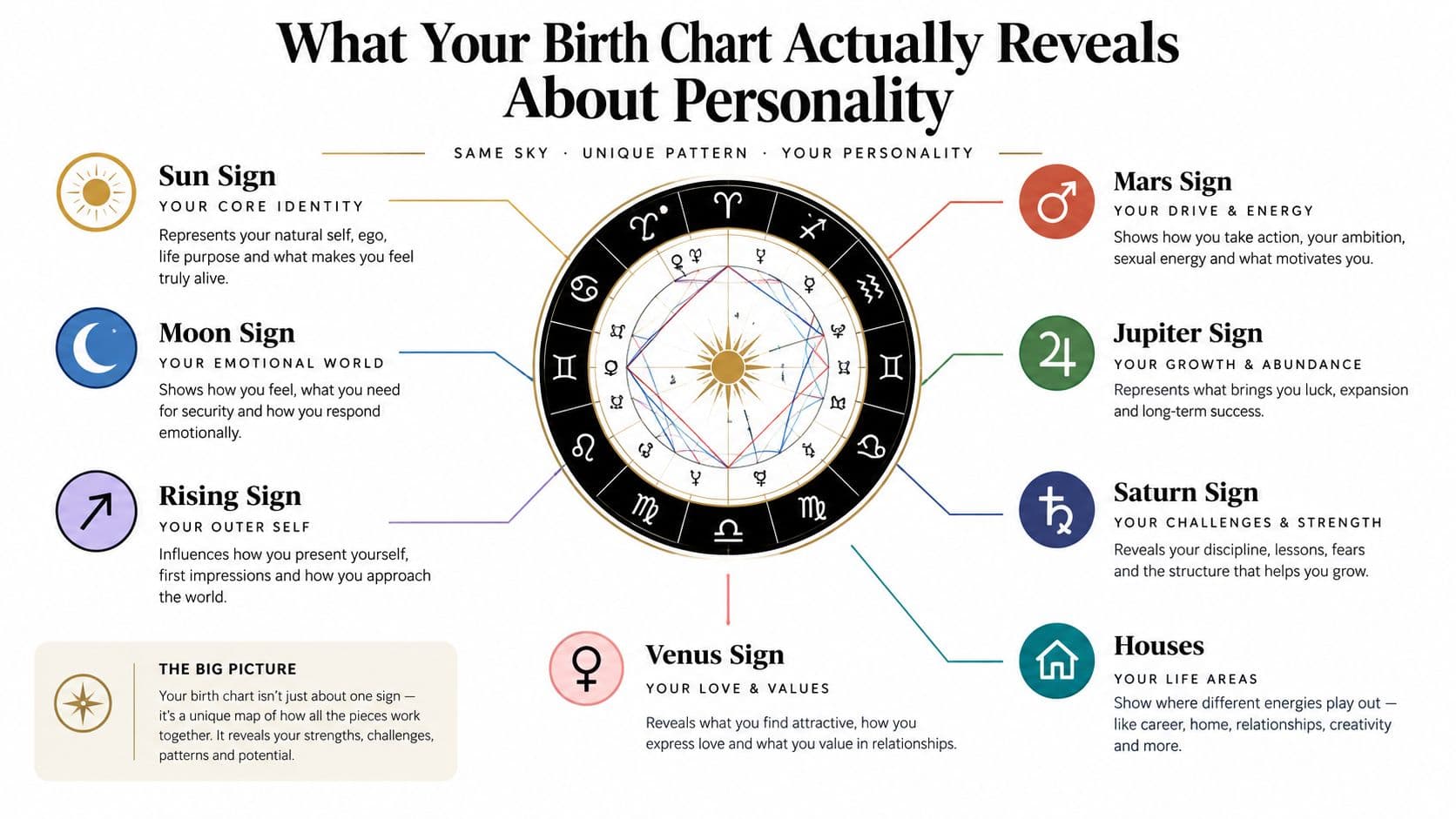
A natal chart, also called a birth chart, is a snapshot of the sky at the exact moment of birth. It uses the positions of the Sun, Moon, and planets in the twelve zodiac signs and twelve houses to describe personality, strengths, challenges, and life patterns, as outlined in this birth chart explanation from Astrograph.
Think of the chart as a stage production. The planets represent different functions, the signs describe the style in which those functions operate, and the houses show the area of life where the pattern appears. This metaphor helps prevent a common mistake, treating one placement as if it explains an entire person.
Start with the Sun, Moon, and Rising sign
Astrologers often begin with three reference points:
- The Sun: This is commonly read as your sense of identity, vitality, and the qualities you're learning to express consciously.
- The Moon: This is used to explore emotional needs, instinctive reactions, and the private experience beneath public behavior.
- The Rising sign: Also called the Ascendant, this describes the way you meet the world and the impression you tend to make before people know you well.
Suppose someone has a confident Sun placement but a cautious Moon placement. A symbolic reading might suggest a person who wants to be visible yet needs emotional safety before taking risks. That isn't a diagnosis. It's a prompt to ask whether the same tension appears in meetings, friendships, or intimate relationships.
Houses add the missing setting
The signs and planets don't operate in a vacuum. Astrology sources treat the twelve houses as different life areas. The first house concerns self and identity, the second relates to money and values, the seventh concerns relationships, and the tenth relates to career and public life, as described in this Allure guide to astrology birth charts.
A planet associated with communication may feel different in a house linked with partnership than in one associated with career. The interpretation changes because the question changes. Instead of asking only, “What am I like?”, you can ask, “Where does this pattern show up, and what does it ask me to practice?”
Exact birth time matters because it can change the Rising sign and house placements. If your recorded time is uncertain, treat those parts of a reading as provisional rather than pretending to precision you don't have.
Read the chart as a conversation
A useful first exercise is to write three sentences:
- What qualities do I identify with consciously?
- What emotions or needs do I tend to hide or misunderstand?
- How might other people experience me before they see the whole picture?
Then compare your answers with the symbolic language of the chart. If a description doesn't fit, you don't need to force it. The point of birth chart personality work is to widen self-observation, not to replace lived experience with a script.
The Science Behind Why Birth Charts Feel Personal
A fair account of astrology has to hold two ideas at once. Controlled evidence doesn't support the claim that birth-chart placements technically determine personality, yet many people find chart language personally meaningful. Dismissing one side creates a distorted picture.
A landmark 1985 double-blind study published in Nature tested whether astrologers could match natal charts with California Psychological Inventory profiles. The astrologers performed no better than chance, according to the historical summary of the research provided by PNB's review of zodiac signs and personality claims. That result became an important reference point in later critiques of astrology's predictive claims.
A much larger study reached a similar conclusion through a different route. A 173,709-person Chinese study reported that none of the 12 astrological signs, their element groupings, or their polarity categories showed a significant association with the Big Five traits, including extraversion, neuroticism, openness, agreeableness, and conscientiousness. The findings are summarized in this Psychology Today discussion of astrology and personality.
Why a description can still feel exact
The Barnum effect helps explain why general descriptions may feel unusually personal. People often recognize themselves in statements that are broad enough to apply to many individuals, especially when the wording emphasizes desirable qualities alongside familiar struggles.
Confirmation bias can deepen that impression. A reader remembers the sentence that captured a real experience and overlooks the parts that didn't fit. If the reading is delivered by someone trusted, or during a period of uncertainty, the emotional impact can become stronger.
That doesn't mean the reader is foolish. It means human beings are skilled at finding meaning in patterns, especially patterns that give shape to feelings they already carry. A chart can provide vocabulary for questions such as, “Why do I avoid conflict until I suddenly become direct?” It doesn't provide scientific proof that a planet caused the behavior.
Reflection and prediction are different uses
The evidence supports a careful distinction:
| Use of a chart | Responsible interpretation |
|---|---|
| Prediction | Treat claims about fixed outcomes with skepticism |
| Reflection | Use symbols to identify habits, needs, and questions |
| Decision-making | Combine personal judgment with practical evidence |
| Conversation | Let the reading open dialogue rather than close it |
The 2025 Conversation analysis of astrology's appeal describes astrology as a way many people make sense of themselves, rather than as a hard predictor of personality or fate. That distinction explains why a chart can feel useful without being empirically validated.
A symbolic system can matter psychologically without being a reliable measuring instrument.
Use the chart to notice a pattern, then check that pattern against your behavior, relationships, and choices. If it helps you ask a more honest question, it has served a reflective purpose. If it tells you that change is impossible, it has overstepped.
How Numerology Maps Identity Through Birth Numbers
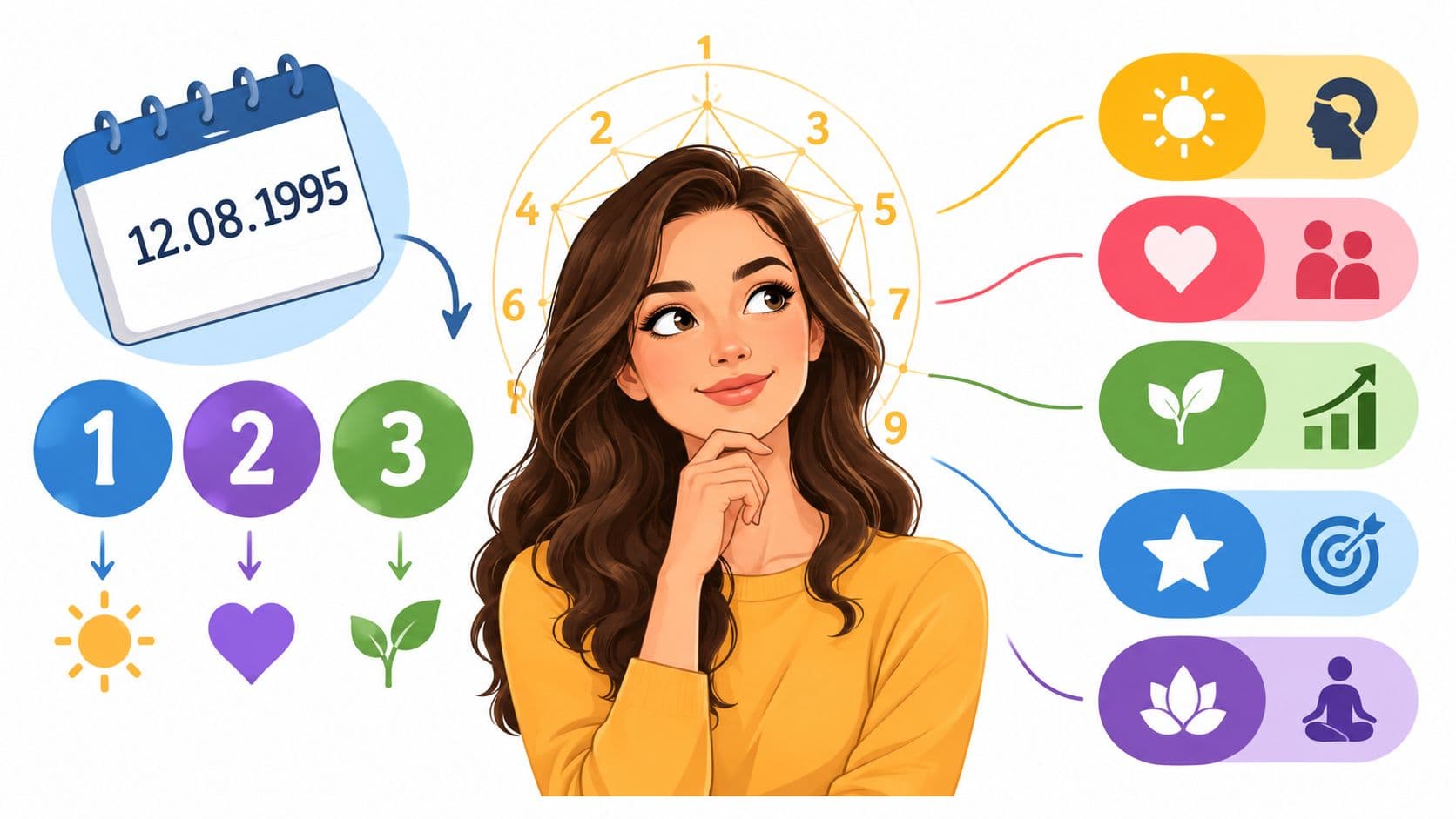
Astrology begins with planetary positions. Numerology begins with the birth date and reduces it into a pattern of birth numbers associated with qualities, lessons, and direction. Dan Millman's book, The Life You Were Born to Live, presents this approach as a way to consider what a person may be here to develop, while the Life Purpose App provides a digital way to explore that framework.
Dan Millman's system assigns different qualities to digits. In the framework described by The Shift Network's overview of Dan Millman's work, 1 relates to creative beginnings, 2 to cooperation, 3 to expression, 4 to structure, and 5 to freedom and independence.
Different symbols, similar questions
Astrology may ask how your emotional nature interacts with your public identity. Dan Millman's book asks you to consider the qualities associated with your birth numbers and how they might appear as gifts, challenges, or recurring responsibilities. Neither lens needs to cancel the other.
For example, a person reflecting on cooperation through the number 2 might examine how they handle dependence, negotiation, and shared responsibility. A person exploring the structure associated with the number 4 might look at discipline, reliability, and the danger of becoming rigid. These are useful prompts only when the individual compares them with actual behavior.
The numerical framework can feel more orderly than a full chart because the calculation creates a clear starting point. That clarity is appealing to people who prefer a defined method. It doesn't make the interpretation scientifically predictive, so the same standard of self-questioning still applies.
Meaning depends on context
Numbers have carried symbolic meaning across many traditions. Someone who wants a broader cultural perspective can read this guide by HD Asian Art on the symbolism of the number nine in Thai Buddhism, sacred numerology, and spiritual power. The comparison is valuable because it shows that numerical symbolism is never just arithmetic. Communities give numbers meaning through stories, practices, and beliefs.
For a practical introduction to birth-number themes, the Life Purpose App guide to the meaning of birth numbers can sit alongside The Life You Were Born to Live. Use both as interpretive resources, not as substitutes for observing how you actually live.
A useful question: What quality does this number invite me to practice, and where do I resist practicing it?
That question brings numerology back to self-understanding. A birth number shouldn't become a label that excuses poor choices. It can become a reminder to develop a strength with greater awareness.
Exploring Dan Millman's Life Purpose Framework
Dan Millman's The Life You Were Born to Live takes birth-number interpretation beyond a short personality label. A description of the revised 25th Anniversary Edition says it covers forty-five birth numbers, while a book listing explains that the system helps readers determine their own life path and explore the life paths of others.
The framework also addresses core issues, talents, and special needs connected with areas such as health, money, and sexuality, according to the [Magers and Quinn description of the book](https://www.magersandquinn.com/product/LIFE-YOU-WERE-BORN-TO-LIVE-(RE/19279383). That wider scope is important. It treats purpose as something expressed through practical areas of life, not merely as a flattering description of temperament.
Read a life path as a practice
A life path interpretation is most useful when you turn it into observation. Start with the quality associated with your birth number, then ask where it appears in three forms:
- As a gift: When does this quality help you respond skillfully?
- As a challenge: When does the same quality become excessive or defensive?
- As a lesson: What repeated situation asks you to use it with more maturity?
Someone exploring creative beginnings might notice a habit of starting projects with enthusiasm but struggle to sustain them. Someone reflecting on cooperation might discover that being supportive has sometimes meant avoiding necessary disagreement. Someone drawn to freedom might value independence yet need to learn how choices affect other people.
The interpretation becomes practical when it produces a behavior to examine. “I am independent” is static. “I need to distinguish healthy independence from refusing support” gives you something to work with.
The system is broader than a single trait
Millman's framework combines birth numbers into richer life-path interpretations rather than stopping at an isolated digit. The result is intended to address both potential and difficulty, including how a person handles relationships, work, material concerns, sexuality, and health-related patterns.
That makes it a useful parallel to astrology. A chart may give you a layered symbolic picture involving planets, signs, and houses. Dan Millman's book gives you a birth-date-based route into purpose and recurring life themes. One feels spatial and relational. The other feels sequential and numerical.
The Life Purpose App's Dan Millman numerology guide can help readers see how the system is organized before they begin interpreting their own path. Keep the book's framework at the center, and avoid blending it casually with unrelated numerology systems that use different definitions.
Keep interpretation grounded
No life-path reading can decide whether you should leave a job, end a relationship, or ignore professional advice. It can, however, help you name the values you want to bring into those decisions.
Write down one quality that feels familiar, one that feels uncomfortable, and one that you doubt. Then look for concrete examples from your history. This exercise protects you from accepting every statement just because it sounds spiritual, while still allowing the framework to reveal a perspective you hadn't considered.
Choosing Between Astrology and Numerology for Self-Discovery
Astrology and numerology answer similar human questions through different structures. Astrology begins with a sky map, using planetary placements, signs, and houses to create a layered portrait. Numerology begins with birth numbers and a life-path framework, including the teachings in Dan Millman's The Life You Were Born to Live and the Life Purpose App.
Choose astrology first if you want to explore emotional patterns, symbolic relationships, and the contrast between your private self and public presentation. Its language may suit you if images, myths, and interconnected influences help you think.
Choose numerology first if you prefer a defined calculation and a compact way to reflect on purpose, recurring challenges, and qualities such as cooperation, expression, structure, or independence. The method may feel easier to apply when you want a single theme to journal about.
| Your current question | A useful starting lens |
|---|---|
| Why do I react this way emotionally? | Astrology's Moon symbolism and chart context |
| How do I present myself to others? | Astrology's Rising sign and first-house themes |
| What quality am I learning to develop? | Dan Millman's birth-number framework |
| How do I reflect on purpose and recurring lessons? | The Life You Were Born to Live and its life-path structure |
| Why do two people relate differently? | Use either system as a conversation prompt, not a verdict |
The strongest approach may be sequential rather than competitive. Begin with a chart question, write down what resonates, then use a birth-number interpretation to test whether a different language reveals another aspect of the same experience.
For instance, astrology might help you describe a tension between wanting closeness and needing privacy. Numerology might prompt you to examine whether cooperation, freedom, or structure affects how that tension plays out. The second lens doesn't prove the first. It gives you another way to investigate your choices.
Choose the framework that sharpens your question, not the one that gives the most flattering answer.
Keep a journal of predictions separately from reflections. If a system encourages you to observe patterns and take responsibility, it can support self-discovery. If it pressures you to accept a fixed identity, step back.
Using the Life Purpose App for Practical Self-Exploration
The Life Purpose App works as a digital companion to Dan Millman's The Life You Were Born to Live. You enter your birth date and explore a life path among forty-five possibilities, along with spiritual laws, core gifts, and challenges connected with health, money, sexuality, career, and relationships.

The app also maps nine-year life cycles and lets you explore relationship dynamics involving friends, family members, co-workers, or public figures through in-app lookups. A free tier provides a summary of the life path and an overview of the system, while paid options provide the complete 25th Anniversary Edition content, detailed analyses, unlimited contacts, and full access to primary numbers and cycles.
It's available in English, French, and German, with customer support. Used alongside an astrology reading, it can give you a practical journaling structure without asking you to treat either system as scientifically proven.
Start with one question, such as “What pattern keeps appearing in my work?” Record the interpretation, then compare it with specific memories and current decisions. That small discipline turns a birth-date tool into a reflective practice rather than a source of labels. You can also explore the Life Purpose App self-discovery guide before deciding how you want to use the tool.
The Life Purpose App offers a birth-date-based way to explore Dan Millman's life paths, cycles, gifts, and challenges from The Life You Were Born to Live. Visit Life Purpose App to begin with your own birth date, then use the insights as a thoughtful companion to your birth chart personality exploration.
Discover your life path today
Enter your date of birth and see your life path, free.
Find your life path