People come to birth date analysis when they want more than labels — they want a practical map for patterns, challenges, and purpose. Dan Millman’s system uses your birth date as a symbolic map to help you see recurring lessons and next steps.

May 31, 2026 (4mo ago) — last updated October 6, 2026 (16d ago)
Birth Date Analysis: Find Your Life Path
Discover your life path with birth date analysis based on Dan Millman. Calculate your number, explore nine‑year cycles, relationships, and practical next steps.
← Back to blog
People come to birth date analysis when they want more than labels — they want a practical map for patterns, challenges, and purpose. Dan Millman’s system uses your birth date as a symbolic map to help you see recurring lessons and next steps.
Birth Date Analysis: Find Your Life Path
Unlock your potential with birth date analysis based on Dan Millman. Discover your life path, core challenges, and clearer next steps using the Life Purpose App.
Introduction
People arrive at birth date analysis for different reasons: years of curiosity about personality systems, or a turning point — a career shift, a difficult relationship, or the feeling that life keeps repeating the same lesson. You’re not looking for a party trick. You want a practical framework that helps you see why certain strengths come naturally, why some struggles recur, and what your life may be asking you to learn.
Dan Millman’s The Life You Were Born to Live treats the birth date not as fortune-telling but as a structured map of self-knowledge. It’s not a prison, a verdict, or a shortcut around responsibility. It’s a tool to help you live with more awareness and purpose.2
Your Birth Date Holds Deeper Meaning
Many people ask, “What am I here to learn?” On the surface their lives function: work, family, obligations. Yet something important feels unnamed. Birth date analysis begins with something simple and unchangeable — the date you were born — then builds a practical system to explore purpose through patterns of growth, challenge, and service.
Birth dates aren’t spread evenly across the calendar. U.S. birth data summarized by The Bump shows that 9 of the 10 most common birthdays in a 1994–2014 sample fell in September, with September 9 as the most common date on average.1 That doesn’t prove a spiritual system, but it does remind us birth is shaped by real patterns, not pure randomness.
More than a label
Many systems end with a one-line trait. Millman’s approach asks deeper questions:
- What are you here to develop?
- What habits may hold you back?
- How do your gifts show up in work, intimacy, health, and money?
- What recurring lessons keep asking for maturity?
That shift matters. A label can be entertaining. A life path can be useful.
Birth date analysis is most helpful when it moves you from self-description to self-observation.
Why this system stays meaningful
Readers appreciate a model that doesn’t flatten them. Millman uses the birth date as a starting point for reflection, not an identity badge. Many return to The Life You Were Born to Live and find the same page means something different at different life stages. Millman describes a detailed set of life paths grounded in his system’s structure and language.2
If you’ve seen only generic numerology, note this: different traditions use similar arithmetic but assign different meanings. Treat each result within its own system’s context rather than borrowing interpretations across traditions.3
Calculating Your Unique Life Path Number
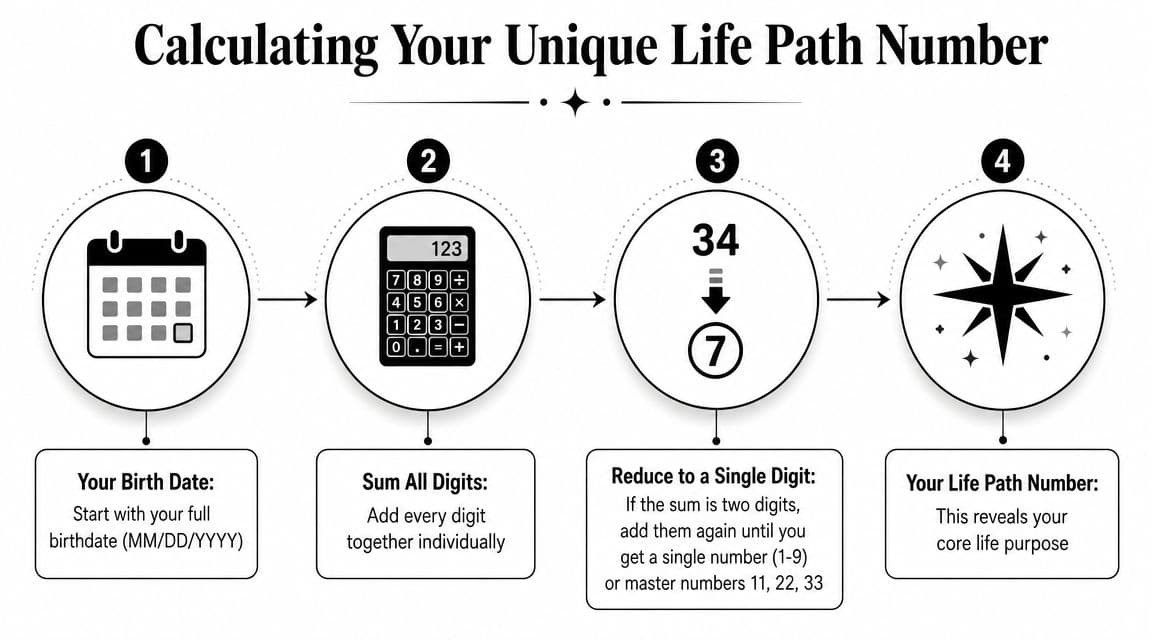
Start with your full birth date and add the digits together. That gives the base number used in Millman’s approach.
A simple example
May 15, 1985 becomes digits: 5 1 5 1 9 8 5
5 + 1 + 5 + 1 + 9 + 8 + 5 = 34
3 + 4 = 7
The base life path number is 7. The arithmetic is the key; the meaning depends on the system you’re using.
Common confusion
People often mix systems. Millman’s calculation connects you to a richer map: one of his distinct life paths described in The Life You Were Born to Live, not a generic one-word label.2
Practical rule: Do the arithmetic simply, then interpret the result within the system it belongs to.
Why the calculation matters
The math opens a door. The map becomes useful when it shows terrain: recurring challenges, natural capacities, and growth patterns. A number helps name themes like discipline, expression, commitment, or sensitivity. It doesn’t force outcomes; it identifies patterns you can work with.
The Spiritual Laws That Shape Your Path
Millman grounds each path in a set of spiritual laws. That changes the feel of birth date analysis: your path becomes a learning field, not a personality sketch. The laws explain how growth happens and how patterns move from friction toward maturity.
Laws turn traits into practice
Without laws, people may read a system passively and stop at identification. Millman asks for participation: a challenge trains you, a gift asks to be used wisely. Examples include:
- Flexibility matters when clinging to one outcome causes repeated suffering.
- Choice matters when someone blames fate but repeats unhealthy decisions.
- Action matters when insight exists but courage is missing.
Two people with similar talents can live very different lives: one works with the laws, the other resists them.
A living path, not a fixed identity
One humane aspect of Millman’s system is the allowance for development. A recurring struggle doesn’t mean you’ll repeat it forever; it means the lesson is visible. The spiritual law is not prediction. It’s participation.
Your Core Gifts and Challenges in Life
Millman’s method examines how a path shows up in lived experience: work, love, money, health, intimacy. Your path carries native strengths and predictable friction points. Strengths awaken you when you’re aligned; friction shows where life asks for honesty and refinement.
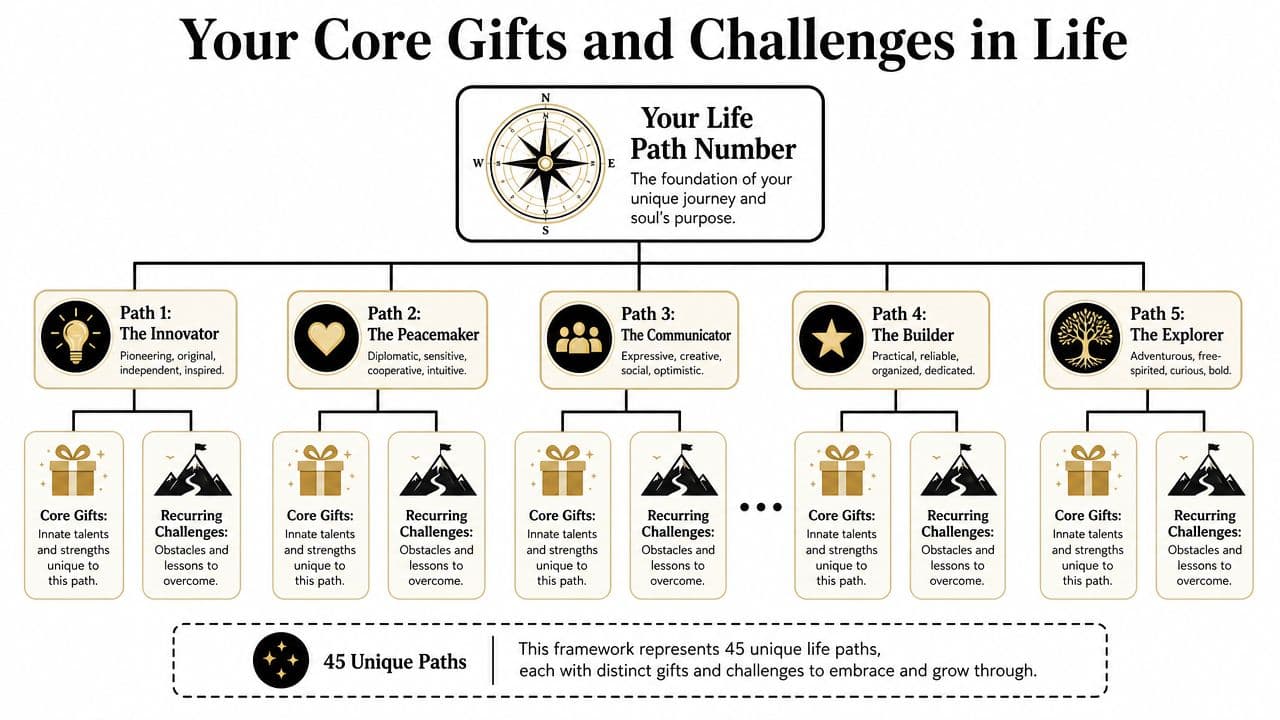
A simple framework for how a single path can affect many areas:
| Life area | Gift may look like | Challenge may look like |
|---|---|---|
| Career | creativity, leadership, clarity, service | procrastination, rigidity, fear, scattered focus |
| Money | resourcefulness, generosity, long-term thinking | avoidance, impulsive choices, poor boundaries |
| Relationships | empathy, loyalty, honesty, devotion | control, withdrawal, idealization, defensiveness |
| Health | resilience, body awareness, discipline | extremes, neglect, stress patterns |
| Sexuality | openness, tenderness, vitality | confusion, repression, dependency |
The same core lesson can echo through several life areas. Often the challenge is the doorway: the place where purpose is forged.
Your challenge often reveals the path most clearly.
Reading your path with compassion changes the question from “What’s wrong with me?” to “What is this pattern trying to teach me?” That shift can alter conflict with a partner, reactions to money pressure, and how you interpret stagnation at work.
Mapping Your Life with Nine‑Year Cycles
Understanding timing helps. Millman uses nine-year cycles to describe seasons of life. Each year in the cycle carries a different emphasis: initiation, structuring, reflection, completion, and so on.
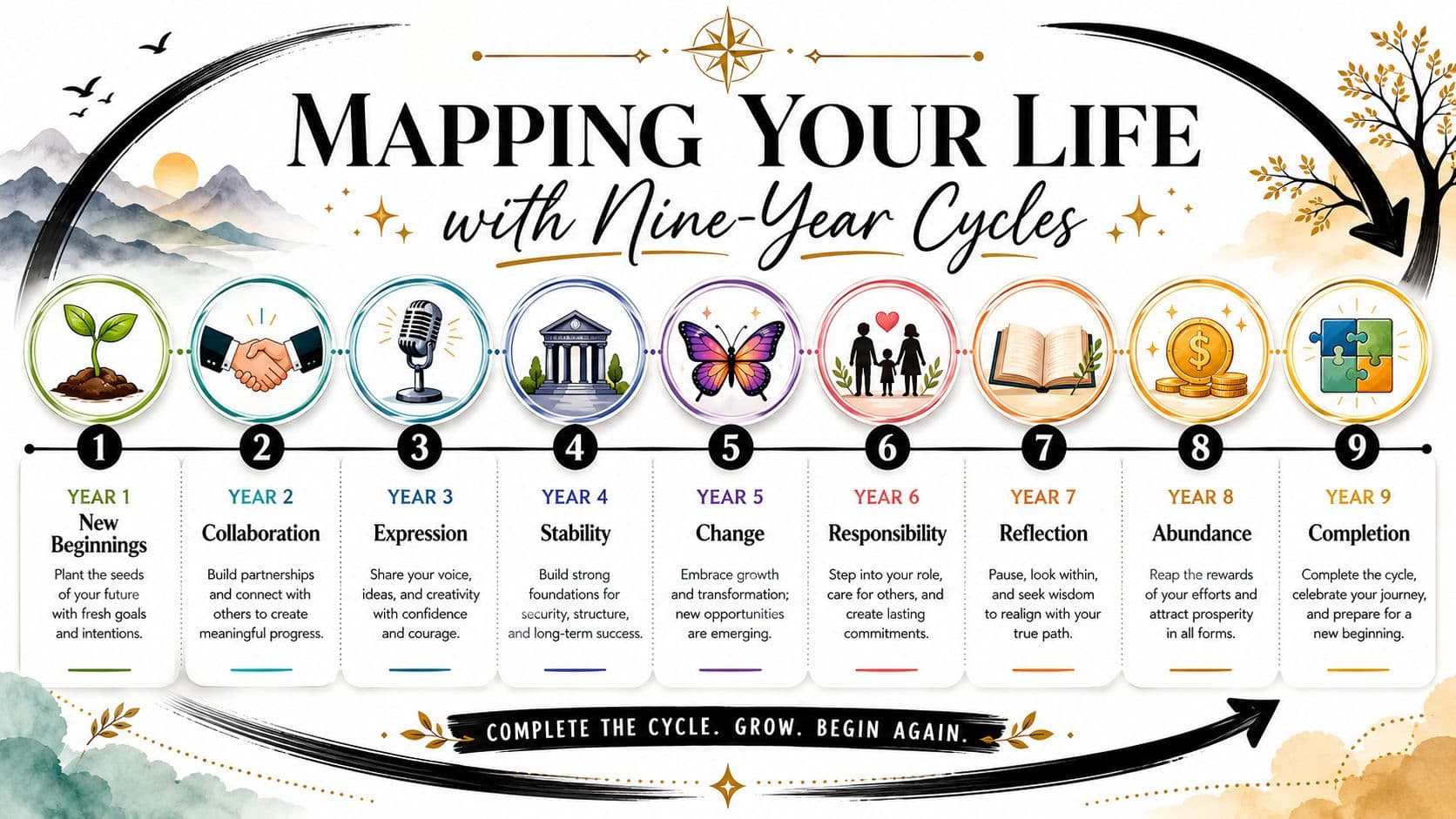
You don’t need to memorize every nuance. Notice the rhythm:
- Year 1: initiation, new direction.
- Year 4: structure, discipline, foundations.
- Year 7: reflection, study, retreat.
- Year 9: completion, release.
A challenge in a building year asks for patience and skill. The same challenge in a completion year asks for letting go. Timing changes interpretation and keeps the system alive.
Understanding Compatibility and Relationships
Relationship work is a common entry point. Millman’s system treats compatibility with nuance. A relationship can hold harmony and growth tension at once. Comparing paths reveals:
- Resonance in values and emotional style
- Growth tension where one person activates the other’s lesson
- Blind spots the pair may reinforce
- Complementary gifts that balance the relationship
This applies to romance, friendships, siblings, and business partners. The aim isn’t to rank people but to understand patterns. A challenging relationship may be the one that shows your unfinished work most clearly.
A challenging relationship isn’t always the wrong one. Sometimes it’s the one that invites maturity.
Use birth date analysis with humility. It highlights patterns and affinities but doesn’t replace communication, consent, or emotional skill.
Begin Your Journey with the Life Purpose App
When you want to apply this work to your own date, relationships, and timing, a practical tool helps. The Life Purpose App is a digital companion to Millman’s system: it calculates your path from a full birth date, connects the result to one of the life paths, and organizes interpretations around gifts, challenges, spiritual laws, cycles, and relationship dynamics. Visit the Life Purpose App at https://lifepurposeapp.com.

A tool brings depth and access together. Use it to calculate your number, revisit readings, compare dates with people close to you, and track current cycles. Let it support reflection, then test patterns against real life.
If a reading points to a discipline challenge, examine your habits. If it highlights relationship lessons, review your history. If a cycle suggests completion, ask what you already know needs to be released.
The value of birth date analysis is practical: it helps you live with more awareness, compassion, and direction.
If you want to explore your own path in a practical format, the Life Purpose App offers life path interpretation, relationship insight, and nine‑year cycle guidance.
Frequently Asked Questions
Q: How do I calculate my life path number?
A: Add every digit in your full birth date, then reduce the total to a single digit (or the base number used by the system). For example, 5/15/1985 → 5+1+5+1+9+8+5 = 34 → 3+4 = 7.
Q: Will my number define me forever?
A: No. The number names recurring patterns and lessons. Millman’s system focuses on growth and participation — the number shows tendencies you can work with rather than a fixed identity.
Q: Can birth date analysis tell me if a relationship will last?
A: It can highlight resonance, tension, and shared lessons, but it can’t replace communication, consent, or effort. Use it to ask better questions about growth and compatibility.
1.
The Bump, “Most Common Birthdays,” summary of birth date patterns (1994–2014), https://www.thebump.com/a/most-common-birthdays.
2.
Dan Millman, The Life You Were Born to Live: A Guide to Finding Your Life Purpose (New World Library), overview of the life path system and its descriptions. See https://danmillman.com/book/the-life-you-were-born-to-live/.
3.
Encyclopaedia Britannica, “Numerology,” for background on differing numerology traditions and interpretation approaches. See https://www.britannica.com/topic/numerology.
Discover your life path today
Enter your date of birth and see your life path, free.
Find your life path