Learn how a birth date love compatibility calculator works, how to read the results, and what to do next. A practical guide grounded in Dan Millman's system.

August 29, 2026 (1mo ago)
Birth Date Love Compatibility Calculator: A Real Guide
Learn how a birth date love compatibility calculator works, how to read the results, and what to do next. A practical guide grounded in Dan Millman's system.
← Back to blog
Learn how a birth date love compatibility calculator works, how to read the results, and what to do next. A practical guide grounded in Dan Millman's system.
You've just entered two birthdays into a compatibility calculator. The result says 63%, or perhaps “challenging,” and now you're wondering whether the number confirms what you already feel, warns you away from the relationship, or means almost nothing at all. A score can be intriguing, but without context, it leaves you staring at a symbol instead of understanding the people involved.
A thoughtful reading treats birth-date numerology as a reflective language. It can help you discuss temperament, recurring friction, timing, and personal growth. It can't replace honest communication, professional support, or your own judgment about whether a relationship feels safe and respectful.
What a Birth Date Love Compatibility Calculator Really Does
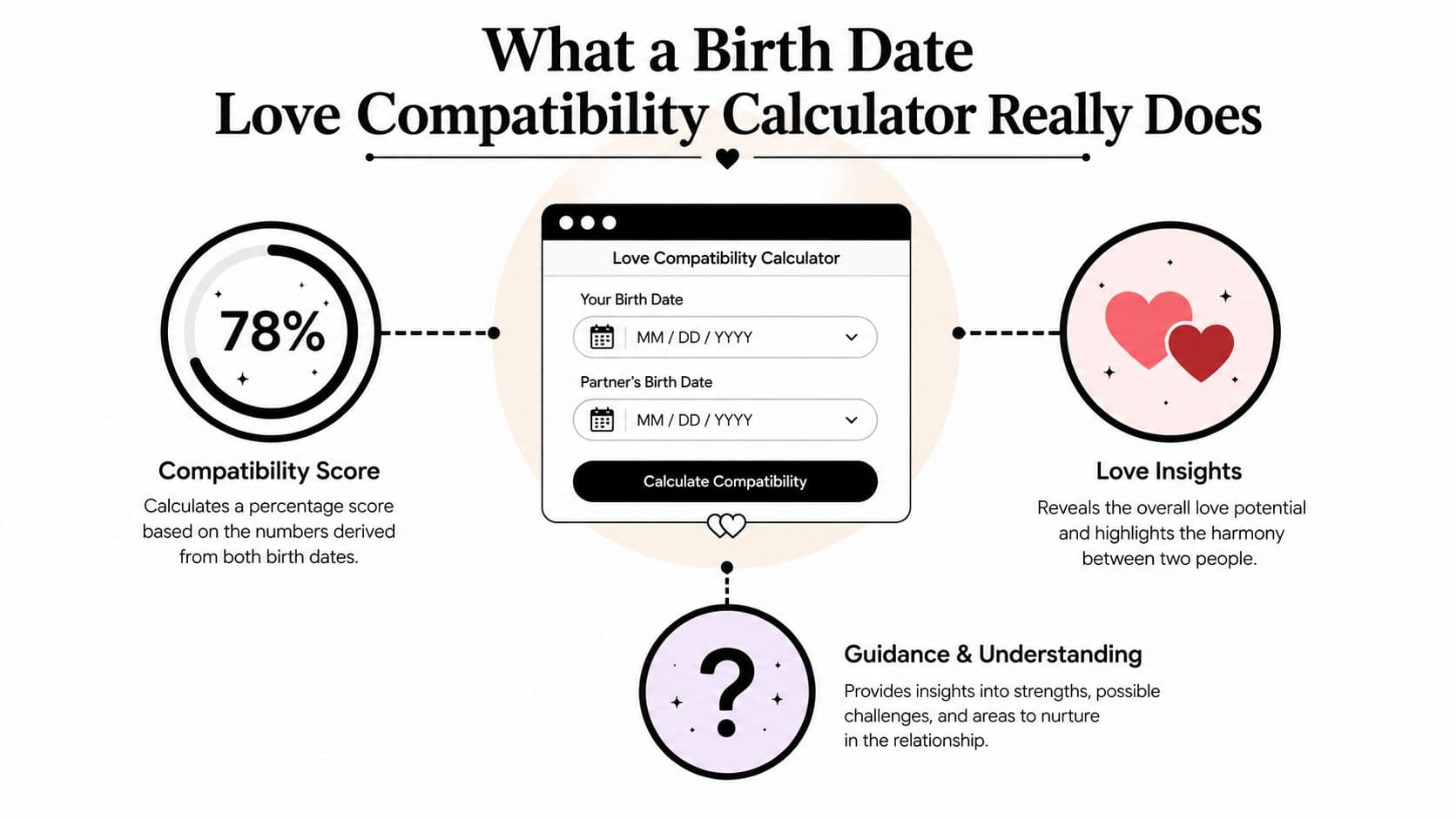
A birth date love compatibility calculator is usually a deterministic rules engine. You enter two dates of birth, the software derives a life path number for each person, and it compares the resulting paths through a predefined compatibility system. Some tools return a percentage, while others use labels such as natural, supportive, dynamic, or challenging.
The basic model belongs to a long esoteric tradition. Numerological ideas have been associated with ancient Egypt, Babylon, China, Rome, Japan, and Greece, while the word numerology wasn't recorded in English until 1907, as summarized in this history of numerology overview. Pythagoras is often treated as the symbolic father of numerology, but the modern Western format took shape in the early 1900s. A calculator is therefore a contemporary presentation of an older symbolic practice, not a newly discovered dating science.
Dan Millman's book, The Life You Were Born to Live, and the Life Purpose App provide a distinct birth-date framework built around 45 unique life paths and life-cycle interpretation. In that system, the date isn't reduced only to a simple nine-path comparison. The framework also recognizes different path qualities, including paths such as 13, 14, 16, and 19. I won't use the separate-number terminology sometimes added by other numerology traditions, because Millman's system should be read on its own terms.
The three layers on a result page
A useful calculator generally gives you three working layers:
- The primary pairing: Your life path and your partner's life path, derived from the two birth dates.
- A descriptive category: A phrase that frames the interaction, such as natural, supportive, or challenging.
- A numeric score: A quick summary that may express the pairing as a percentage or another rating.
The score isn't a fortune teller. It doesn't predict whether you'll stay together, and it isn't a clinical relationship assessment. Compatibility research in actual dating behavior points toward selective attraction based on observed personality traits, not birth dates. One large mobile-dating analysis found an average effective match rate of 0.12%, based on 508,989 effective matches divided by all possible matches, while another study identified assortative preferences for agreeableness, openness, and extraversion, not every personality trait. See the peer-reviewed analysis of dating behavior and compatibility for that distinction.
A useful rule: Let the result begin a conversation. Don't let it make the decision for you.
Entering Your Birth Dates the Right Way
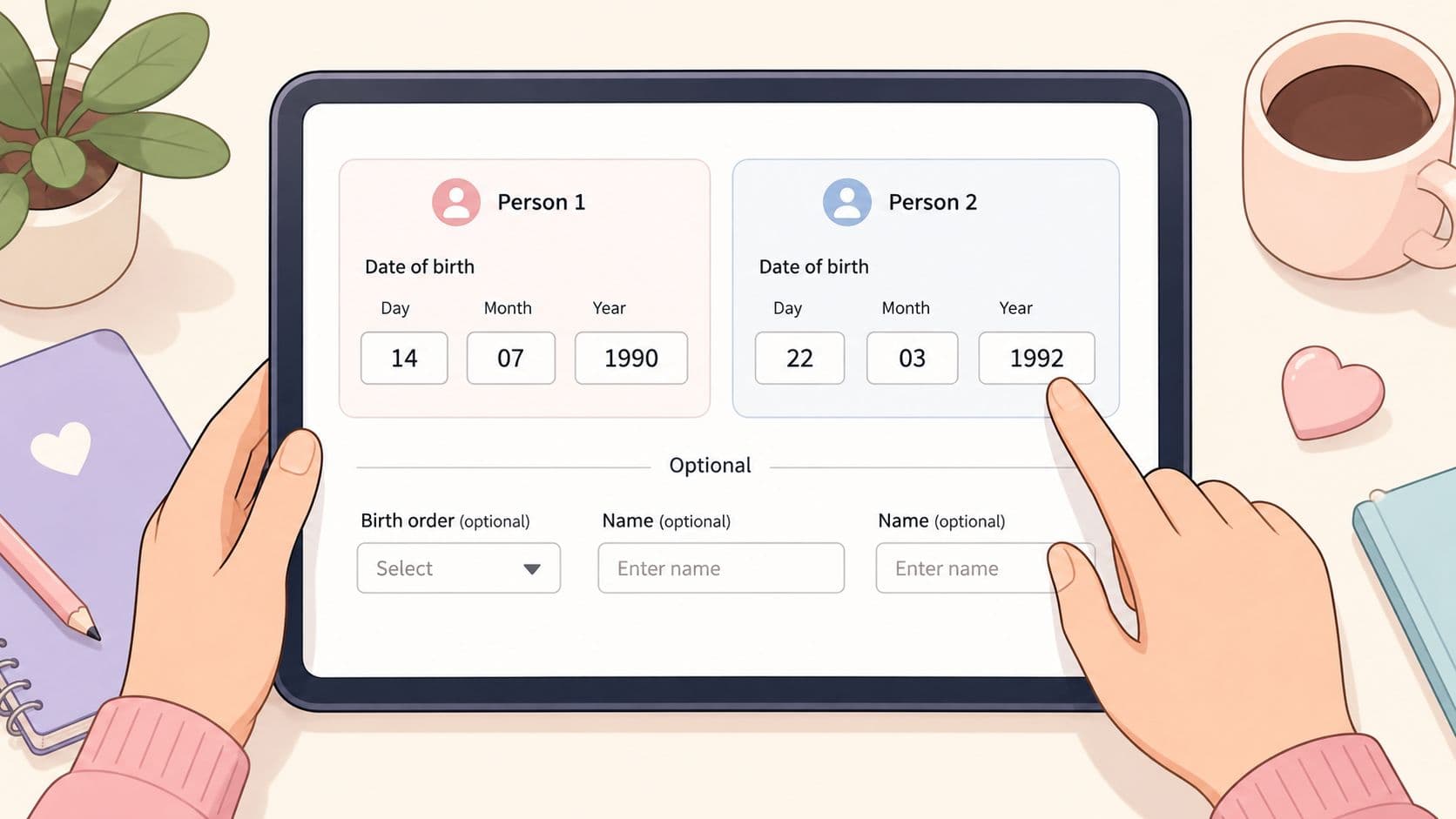
The quality of a reading begins with the input. Most birth-date calculators need the full calendar date for both people, including day, month, and year. Some tools ask for names or birth order as optional labels, but those details aren't the same as the date itself and shouldn't be substituted for it.
Dan Millman's book, The Life You Were Born to Live, and the Life Purpose App both keep the birth date at the center of the life-path process. If you want to understand the arithmetic before using a tool, follow the step-by-step explanation of calculating a life path.
A hand calculation
Take July 14, 1992:
- Month: July is 7.
- Day: 1 + 4 = 5.
- Year: 1 + 9 + 9 + 2 = 21, then 2 + 1 = 3.
That calculation would produce 7 + 5 + 3 = 15, then 1 + 5 = 6. Different numerology systems can organize reductions differently, so you should always follow the method used by the specific calculator rather than combining rules from several sites.
A commonly described life-path method adds the date digits and reduces the result to a single digit from 1 to 9, as shown in a birth-date compatibility calculation example. Other systems preserve particular compound path patterns instead of treating every date as interchangeable. Dan Millman's book, The Life You Were Born to Live, and the Life Purpose App use their own interpretive framework, so consistency matters more than memorizing a universal formula.
Input mistakes that change the reading
Check whether the form expects day/month/year or month/day/year. Swapping the day and month can create a completely different date, especially when both numbers are valid calendar months.
Use the actual birth date, not the date of a legal name change, an administrative correction, or a recorded hospital time. Birth-date numerology generally works from the calendar date alone, so the single line you enter deserves careful attention.
Walking Through Two Real Birth Dates
Maya and Jordan want to compare their dates without treating the result as a verdict. Maya was born 22 March 1989, and Jordan was born 9 October 1991. Their first useful step is to show the arithmetic openly.
For Maya, March contributes 3. Her day is 22. Her year reduces as 1 + 9 + 8 + 9 = 27, then 2 + 7 = 9. The calculation becomes 3 + 22 + 9 = 34, followed by 3 + 4 = 7. The 22 remains a meaningful influence in the way this example is interpreted, even though the final reduced result is 7.
Jordan's October becomes 10, then 1. The day contributes 9. The year becomes 1 + 9 + 9 + 1 = 20, then 2. Jordan's calculation is therefore 1 + 9 + 2 = 12, followed by 1 + 2 = 3.
What appears after submission
The calculator now displays a 7 and 3 pairing. A narrative interface might describe it as “expressive and curious,” with a score in the mid range. That wording doesn't tell Maya and Jordan what they must do. It gives them a prompt: Maya may want depth, quiet, and time to process, while Jordan may bring verbal energy, experimentation, and a desire to keep the relationship moving.
A fuller result page usually layers in secondary numbers, shared challenges, and a short paragraph about the pairing. The technical description of one compatibility model shows how tools can compare Life Path, Expression, Soul Urge, and Personality pairings, then apply weighted aggregation to an overall result. That's why a small date-parsing or mapping error can affect more than one part of the output, as explained in this technical compatibility model.
Maya and Jordan should ask whether the description matches their lived experience. Do they enjoy the difference, or does one person feel ignored while the other feels crowded? The value is in answering those questions together, not in defending or rejecting the number.
Reading Numbers, Scores, and Challenging Pairings
Start with the two primary life paths, then examine the secondary numbers and the score. A result page may separate attraction, communication, emotional rhythm, and long-term alignment, but calculators don't all weight those dimensions in the same way. A strong overall result can still contain one area that repeatedly demands attention.
A category such as harmonious usually points to ease and shared rhythm. Dynamic suggests energy, stimulation, and possible friction. Growth-oriented describes a pairing that may stretch both people. Challenging identifies tension, not automatic failure. These categories work better as descriptions of relationship work than as rankings of human worth.
Three pairings in plain language
A 3 and 7 pairing can feel stimulating but emotionally uneven. One person may process life through expression and exchange, while the other needs privacy and reflection. They can learn from each other, but they'll need to discuss how much closeness and quiet each person needs.
A 4 and 8 pairing may show strong practical alignment. Both people might appreciate organization, responsibility, and tangible progress, yet the relationship may need deliberate attention to tenderness, play, and romance.
A 1 and 9 pairing can create fast attraction that later settles into friendship. One person may lead with independence, while the other brings a broad, compassionate outlook. A published compatibility example assigns this pairing 70%, described as moderate, while another gives it 63%, demonstrating that different calculators can produce different outputs for the same life-path combination. Compare the Life Path 1 and 9 compatibility example with the broader compatibility chart for life-path pairings.
| Category | Sample Pairings | Typical Dynamic |
|---|---|---|
| Harmonious | Similar or naturally supportive paths | Ease, familiarity, and shared rhythm |
| Dynamic | 3 and 7 | Stimulation with differences in emotional pacing |
| Growth-oriented | Complementary paths | Development through contrast and practice |
| Challenging | 1 and 8 | Strong wills that require respect and clear boundaries |
Before you react to any result, use this checklist:
- Separate the score from the relationship: A percentage is static; your daily behavior is lived.
- Find the growth area: Ask which dimension creates recurring tension.
- Check the context: Timing, values, communication, and safety matter more than a label.
- Keep the question open: Read the result as a map of possibilities, not a sentence.
For a grounded discussion of how compatibility relates to real relationships, Dan Millman's book, The Life You Were Born to Live, and the Life Purpose App can add a life-path and cycle perspective, but neither should be used to overrule direct experience.
Next Steps, Privacy Tips, and Common Questions
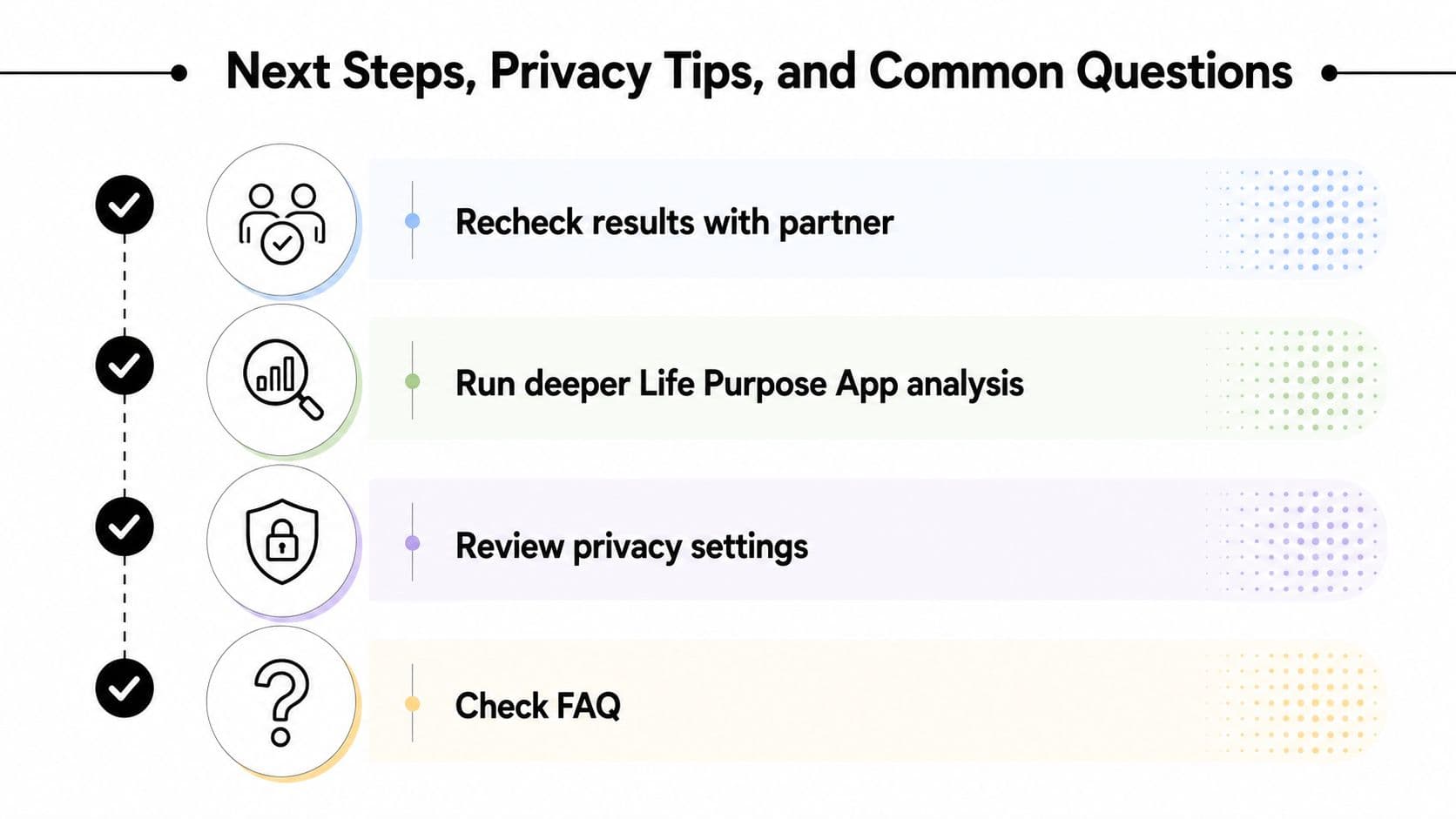
Treat the result as a first reading. Recheck the dates with your partner present, compare the calculator's description with specific moments from your relationship, and write down the areas that feel accurate, incomplete, or completely off-base.
For a deeper birth-date reading, the Life Purpose App applies Dan Millman's book, The Life You Were Born to Live, through its 45-path system, life-path interpretation, relationship dynamics, and nine-year cycle analysis. You can use it as a follow-up tool for examining primary numbers and broader patterns, rather than as a replacement for direct relationship work.
Revisit the score after six months, not to see whether the number has changed, but to test whether your understanding has become more precise. Have you developed a better way to repair conflict? Are you discussing needs earlier? Does the original description still fit the relationship you're living?
Protect the information you enter
Use only tools that explain what they calculate and why. Avoid sites that demand full social profiles, unrelated personal details, or access to information that a simple birth-date reading doesn't need.
Clear stored birth data when the option exists. Don't enter someone else's date without permission, and don't share a partner's result publicly. A birth date is personal information, even when a calculator presents it as a casual form field.
Common questions
Can a birth-date calculator tell me whether we'll stay together?
No. It can describe a symbolic pairing, but it can't predict your choices, repair skills, values, or safety.
Do I need birth time and birthplace?
Many date-based tools use only the calendar date. Full astrology charts may ask for more information, but that's a different method and shouldn't be blended into a numerology result without explanation.
Why do two calculators give different scores?
They may reduce dates differently, preserve different path patterns, compare different secondary numbers, or assign different weights to each dimension.
What should I do with a challenging result?
Look for the specific tension behind the label. Then discuss it with your partner and compare the reading with your behavior, communication, and shared values.
Is a high score enough to continue a relationship?
No. A high score can be pleasant, but it doesn't excuse disrespect, dishonesty, emotional disconnection, or unsafe behavior.
The Life Purpose App offers a birth-date-based view of Dan Millman's 45 life paths, relationship dynamics, and nine-year cycles, so you can move beyond a bare compatibility percentage. Visit Life Purpose App to explore the system with your partner and turn the result into a more honest conversation about how you grow together.
Discover your life path today
Enter your date of birth and see your life path, free.
Find your life path