Bodily kinesthetic intelligence involves using your body to solve problems and create. Learn what it is, why it matters, and how to strengthen it in daily life.

September 1, 2026 (1mo ago)
Bodily Kinesthetic Intelligence: A Practical Guide
Bodily kinesthetic intelligence involves using your body to solve problems and create. Learn what it is, why it matters, and how to strengthen it in daily life.
← Back to blog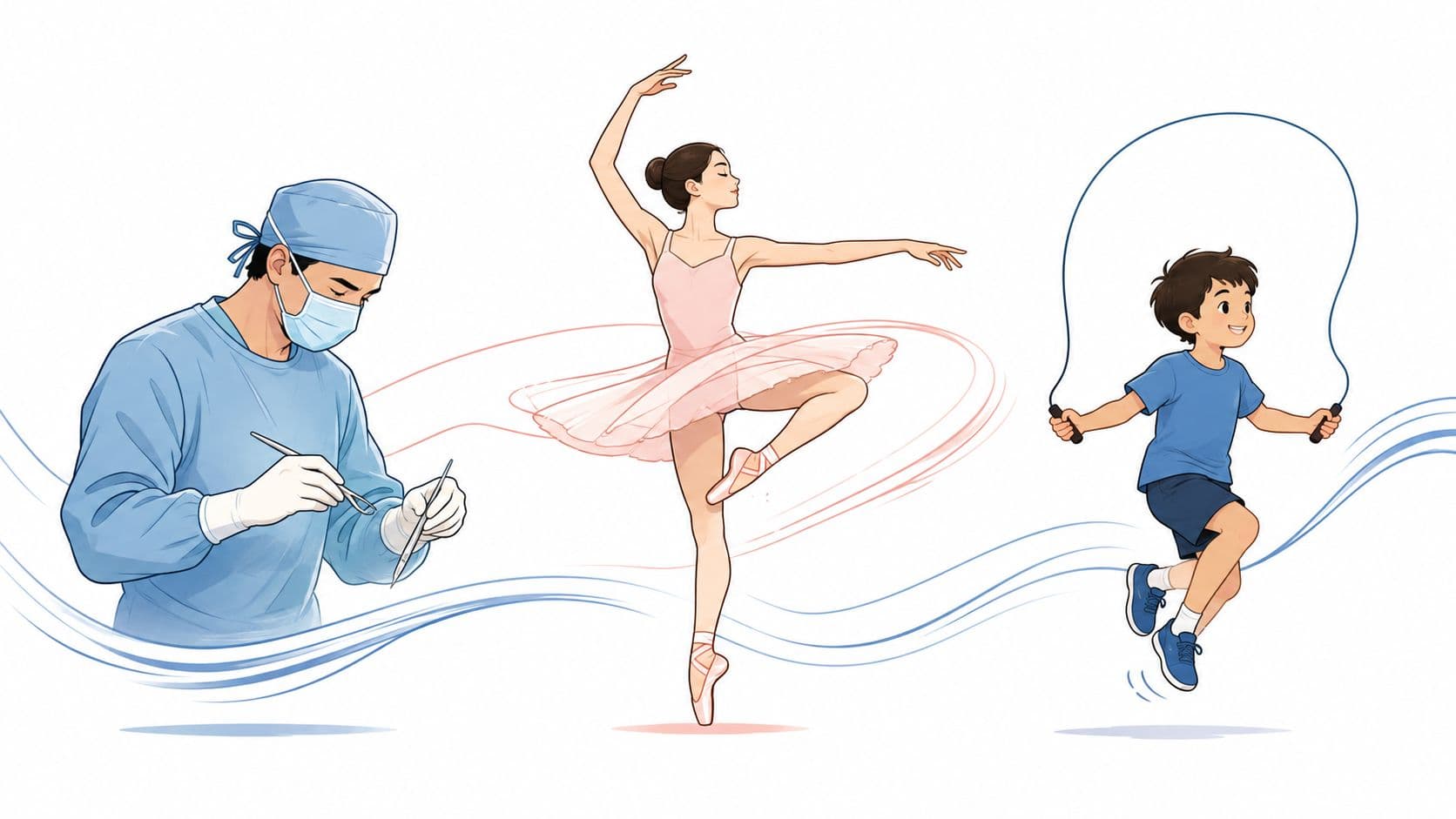
Bodily kinesthetic intelligence involves using your body to solve problems and create. Learn what it is, why it matters, and how to strengthen it in daily life.
You may notice it when your hands understand a task before you can explain it. A child adjusts a wobbling tower without stopping to calculate its center of gravity. A mechanic senses that a bolt is cross-threaded through the resistance in the tool. A dancer hears a correction once, then lets the body solve it through the next phrase. These moments point toward bodily kinesthetic intelligence, a form of ability concerned with purposeful movement, timing, body awareness, and skilled interaction with the physical world.
The term is often reduced to “being a kinesthetic learner,” but that shortcut creates confusion. Bodily kinesthetic intelligence isn't just a preference for touching objects, moving around, or avoiding lectures. It describes a capacity that can appear in surgery, dance, sport, craftsmanship, teaching, sign language, and ordinary problem-solving. The more useful question isn't whether you like to move. It's what your body can perceive, coordinate, remember, and create.
Watching a Surgeon, a Dancer, and a Child at Play
A surgeon steadies one hand inside a chest cavity while the other guides an instrument through a narrow space. The movement is small, deliberate, and responsive. A choreographer repeats the same eight-count, not because the steps are unknown, but because each joint must arrive at the right time, with the right force and relationship to the music.
Nearby, a toddler experiments with a skipping rope. The rope lands too early, then too late. The child watches, pauses, and tries again, gradually discovering that the arms, feet, eyes, and rhythm must cooperate. None of these people is merely “moving a lot.” Each is solving a problem through controlled action.
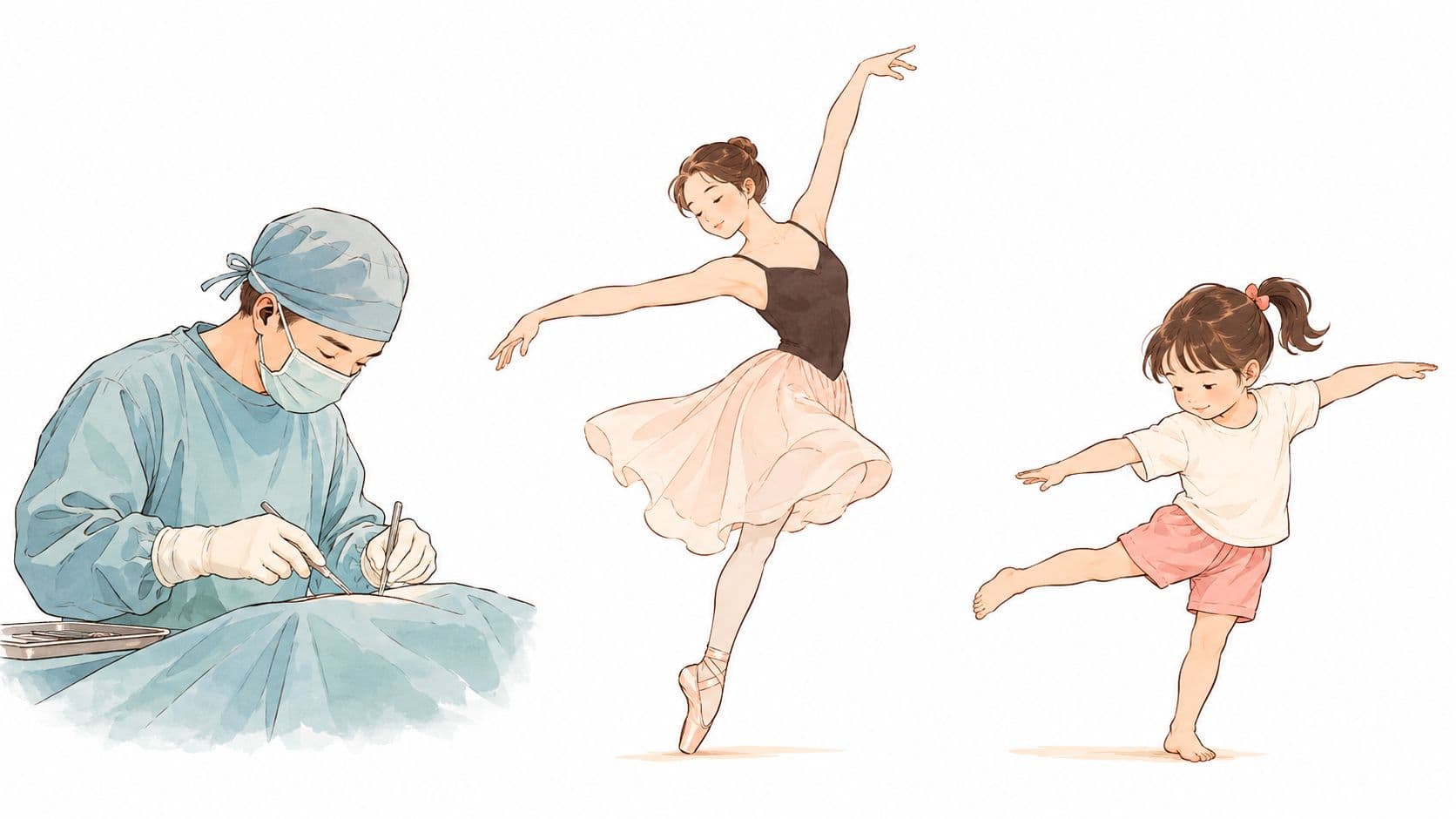
The dancer might use improvisation to find a better transition, allowing sensation and timing to guide the next choice. Readers interested in that process can explore this practical Danza Academy improv guide for a grounded introduction to movement-led decision-making.
What links the surgeon, dancer, and child is refined control, not a general love of activity. They notice feedback, adjust force, organize sequences, and make the body serve an intention. Howard Gardner gave that kind of problem-solving a formal place in his theory of multiple intelligences. The definition begins with the body, but it leads to a broader idea of intelligence itself.
What Bodily Kinesthetic Intelligence Means
Howard Gardner introduced bodily kinesthetic intelligence in Frames of Mind in 1983, placing it among the original seven intelligences in his theory of multiple intelligences. He later expanded the model to eight intelligences in 1995 by adding naturalistic intelligence. This history matters because it gave purposeful physical skill a broader meaning. Timing, dexterity, body control, and skilled object handling could represent intellectual capacity, not only athletic ability. Northern Illinois University summarizes Gardner's framework and its historical development.
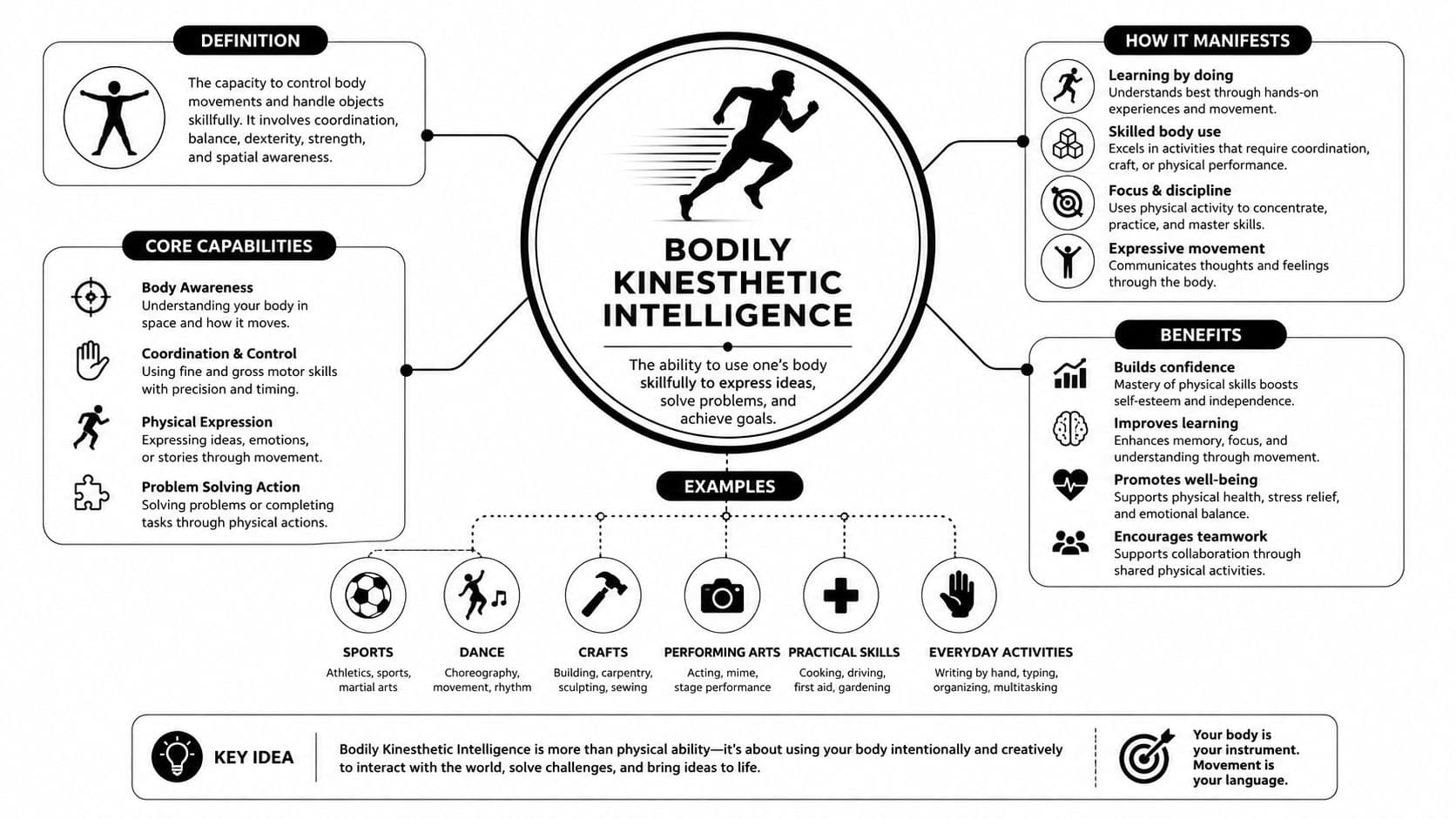
Gardner defined this intelligence as the ability to solve problems or create products by using the body, or parts of the body. The range is wide. It includes running, balancing, and changing direction, along with suturing, carving, typing, playing an instrument, or shaping meaning through the hands. A detailed overview also identifies movement, strength, endurance, flexibility, balance, dexterity, expression, and body language as relevant features. LearningBP outlines these characteristics and examples.
The body as a thinking instrument
The body gathers information through pressure, position, tension, balance, and movement, then uses that information to refine action. A craftsperson may not verbalize every change in grip. The fingers detect resistance, the eyes check alignment, and the nervous system adjusts the next movement.
Athleticism involves stamina and strength, but bodily kinesthetic intelligence also includes refined timing, dexterity, and object control. A watchmaker, sculptor, physical therapist, or surgeon may show exceptional ability through quiet, specialized movements. Their skill appears in how accurately they read feedback and turn it into purposeful action.
The concept also differs from a broad kinesthetic learning preference. Someone may enjoy hands-on lessons without demonstrating a distinct intelligence. Bodily kinesthetic intelligence concerns coordinated movement, sensory feedback, and purposeful practice. A practical explanation of hands-on learning style can clarify the popular educational term, as long as preference and demonstrated skill remain separate.
Traits and Assessment Cues You Can Spot
You don't need to label a child, student, or colleague after watching one activity. Bodily kinesthetic intelligence is better understood through repeated observations across different tasks. Look for how a person senses position, organizes movement, handles objects, and adapts when the task changes.
| Trait | Assessment Cue |
|---|---|
| Whole-body coordination | Catches or redirects an object while adjusting posture and foot position smoothly. |
| Fine motor control | Uses fingers and hands accurately when assembling, drawing, fastening, or manipulating small objects. |
| Proprioception and balance | Moves through space without constantly looking at the feet or losing alignment. |
| Mimicry | Reproduces a dance phrase, gesture, or physical demonstration after limited observation. |
| Tolerance for physical challenge | Tries an unfamiliar movement with attention to safety instead of freezing or rushing blindly. |
| Body-led sequence memory | Recalls a routine through the order and sensation of actions, even when verbal instructions fade. |
| Tactile sensitivity | Notices changes in texture, pressure, resistance, or vibration while working. |
Assessment cues should remain concrete. Can the person adjust a grip when a tool slips? Can they slow down and preserve form? Do they notice that one side is compensating for the other? A movement assessment may examine body control, rhythmic sensitivity, expressiveness, creativity, and object manipulation, rather than treating intelligence as one invisible personality trait. Verywell Mind describes these observable assessment areas.
How teachers and coaches observe it
A dance teacher may watch whether a student can keep rhythm while changing direction. A sports coach may look at balance, anticipation, and recovery after an awkward step. A classroom teacher might notice a student's ability to construct a model, demonstrate a process, or remember a sequence through action.
For personal reflection, keep a simple movement journal. Write down the task, what felt easy, what required attention, and which feedback helped. The body often communicates through fatigue, tension, hesitation, or sudden ease. A thoughtful guide to listening to your body can support that kind of observation without turning it into a diagnosis.
Beyond the Learning Style Myth
The phrase “kinesthetic learner” often suggests that some people learn through movement while others learn through vision or listening. That claim sounds intuitive, especially when a student concentrates better during a practical activity. The problem appears when the preference becomes a fixed rule, such as “this student must move to learn” or “that student can't understand spoken explanations.”
Gardner's original idea is more specific. Bodily kinesthetic intelligence is an intelligence domain, not a required classroom format. It concerns the ability to use the body skillfully to solve problems or create products. A dancer may learn choreography by watching, listening, counting, touching the floor, and repeating the phrase. A surgeon may study anatomy through diagrams and lectures before applying precise hand control. No single sensory route explains the whole performance.
The evidence-based distinction
The influential 2008 Pashler review and follow-up research did not establish that matching instruction to a supposed learning style reliably improves outcomes. That doesn't make movement irrelevant. It means educators should avoid sorting learners into rigid categories and should choose teaching methods based on the task, the learner's prior knowledge, and the kind of performance being developed.
Movement can still deepen learning. Students may understand geometry by manipulating shapes, remember a procedure by physically rehearsing it, or solve a problem more clearly when they use gesture. These examples support physically engaged practice and embodied cognition, not the claim that every person has one fixed way of learning.
Use this filter when you hear the term:
- Myth: A kinesthetic learner must fidget, stand, or touch something to absorb information.
- More accurate view: A person may develop strong movement control, body awareness, timing, dexterity, and object-handling skill.
- Myth: Kinesthetic ability is a fixed identity.
- More accurate view: Motor skills respond to structured practice, feedback, and changing demands.
- Myth: Being physically active automatically proves bodily intelligence.
- More accurate view: The relevant question is whether movement is coordinated, purposeful, adaptable, and precise.
The popular label is too broad. The underlying capacity is worth taking seriously because people can train the specific movement skills that make it visible.
Where This Intelligence Shows Up in Real Life
In an operating theater, a laparoscopic surgeon watches a screen while guiding instruments that extend the reach of the hands. The surgeon reads tissue tension indirectly, through resistance and visual feedback, then changes pressure without seeing the fingertips themselves. The intelligence lies in translating intention into a small, accurate movement under demanding conditions.
A contemporary dancer receives one rehearsal note: soften the landing and let the torso initiate the turn. On the next attempt, the phrase changes. The dancer hasn't just memorized a new instruction. The body has reorganized timing, weight, and sequence.
Movement solving practical problems
A carpenter runs a plane across a board and feels the grain begin to give way. The sound changes, the resistance lightens, and the hand adjusts before the edge tears the wood. The craftsperson combines tactile sensitivity, tool control, visual judgment, and timing.
On a soccer field, a youth coach reads the players' spacing and sees that a passing lane will open after two movements. The coach may teach the pattern with words, but also demonstrates the angle of the hips, the pace of the run, and the instant when the pass should leave the foot. Embodied instruction makes an invisible decision visible.
A sign-language interpreter shapes meaning through the hands, face, posture, and rhythm of the body. Accuracy depends on more than finger positions. The interpreter must coordinate expression, spatial placement, timing, and attention to the audience.
Bodily intelligence appears wherever the body notices information and turns it into action.
That includes a physical therapist helping a client find a safer alignment, an actor adjusting breath and posture to change a character, and a teacher demonstrating a science process with carefully chosen gestures. Sport is one setting, not the definition.
Notice which scene feels familiar. Perhaps you remember tools better than instructions, learn a new physical sequence quickly, or explain ideas naturally through demonstration. That response isn't a final label, but it can reveal a direction worth exploring.
Bodily Kinesthetic Intelligence and Your Life Path
Dan Millman's book The Life You Were Born to Live offers a life path framework organized around Birth, Growth, Self, and Service. Used thoughtfully, that framework can give a developing physical gift a sense of direction without turning it into a permanent identity. Bodily kinesthetic intelligence is one thread in a person's life, alongside interpersonal, intrapersonal, linguistic, spatial, musical, and logical strengths.
Birth
At Birth, the gift may appear as an early pull toward climbing, building, dancing, imitating gestures, handling tools, or testing balance. A child doesn't need a career plan. The body is exploring its available languages.
Growth
Growth brings discipline. The person chooses a practice and learns that natural coordination isn't enough by itself. Repetition, correction, patience, and respect for recovery turn raw interest into dependable skill.
Self
At Self, the question becomes more personal. What does movement express? Does the person want performance, craftsmanship, healing, competition, discovery, or teaching? A physical strength can support identity, but it shouldn't imprison the person inside a single role.
Service
Service asks how the gift helps someone else. A dancer may mentor beginners. A physical therapist may restore confidence after injury. A coach may teach young athletes how to listen to effort and fatigue. The movement becomes a way of contributing, not merely proving ability.
The Life Purpose App connects with this reflective approach by mapping multiple intelligences alongside life-path themes, so users can consider physical ability together with cognitive, interpersonal, and introspective qualities. The useful question isn't only, “How good am I at moving?” It's “What is my movement for?”
That question keeps self-development spacious. You may discover that bodily skill supports a larger purpose in education, care, leadership, art, or practical service. No intelligence is the whole self.
How to Develop It Step by Step
Development works best when you train attention as well as movement. A person who repeats a pattern without noticing errors may reinforce the wrong pattern, while a slower practice can reveal where balance, timing, or force begins to break down.
Start with body awareness
Choose slow activities that make sensation easy to notice. Tai chi, Feldenkrais-inspired exploration, basic balance drills, controlled squats, or walking with deliberate changes in pace can help you sense weight transfer and alignment. Keep the first practice gentle and consistent. The purpose is not exhaustion. It's learning to detect what the body is doing before adding speed.
Build one structured skill
Select a discipline with clear fundamentals, such as juggling, martial arts, dance, climbing technique, or object manipulation. Practice the basic patterns with consistent form rather than chasing complexity too soon. Children can develop the same foundations through playful tasks, and this collection of fun motor skills activities for preschool children offers age-appropriate ideas for turning coordination into exploration.
A workable weekly rhythm might include several short sessions, each with one technical focus. One day can emphasize balance, another timing, and another accuracy. The exact schedule matters less than regular repetition and a clear target.
Add feedback loops
Your felt sense isn't always accurate. Record a movement on video, ask a coach to watch one detail, or use a wearable sensor when it helps answer a question. Compare what you thought you did with what the recording shows. That gap is useful information, not a personal failure.
Reflection also connects movement to the broader mind-body connection. Write a few lines after practice: what changed, what remained difficult, and what cue helped the most.
Transfer the skill
Move beyond drills. Apply coordination to teaching a class, repairing equipment, preparing a performance, guiding a partner, or demonstrating a process. Transfer proves that the skill can adapt to a real context rather than remaining tied to one exercise.
Rest protects the work. Recovery days, varied movement, and cross-training can reduce the strain that comes from repeating one pattern too narrowly. Strong bodily intelligence includes knowing when to apply force and when to stop.
Career Fit and Answers to Common Questions
Bodily kinesthetic intelligence can guide several kinds of work without deciding on one profession. A dancer may rely on timing and expressive control, while a surgeon needs precise hands, tactile feedback, and spatial judgment. Fit depends on the movement demands of the role, personal interests, and the other abilities a person brings.
| Career Cluster | Example Roles | Core Movement Skill |
|---|---|---|
| Performance | Professional dancer, actor, stunt worker | Timing, expression, coordination, and controlled presence |
| Skilled trades and crafts | Carpenter, surgeon, physical therapist, VR software prototyper | Dexterity, tactile feedback, spatial action, and tool control |
| Teaching and coaching | Dance teacher, sports coach, movement instructor | Demonstration, body-language modeling, correction, and rhythm |
Common questions
Is there a standardized test? No single universally accepted test captures the entire intelligence. Assessment work is becoming more structured, including a 2026 e-assessment model for motion literacy based on Laban dance notation and a 2026 study using a validated kinesthetic intelligence scale with adolescents. The Retos research paper discusses this movement toward digital and movement-specific assessment.
Is it the same as being athletic? Athletic performance may involve strength, speed, or endurance. Bodily intelligence also includes fine-motor precision, timing, expression, proprioception, and handling objects. A person can show strong bodily intelligence through careful craft or skilled demonstration without competing in sport.
Can adults develop it? Yes. Repeated, task-specific practice and useful feedback can improve motor capacity, although people begin with different physical histories.
How does it relate to ADHD or dyspraxia? A movement preference or intelligence label cannot establish either condition. Strengths and difficulties vary by person, so qualified professionals should provide assessment and support.
Why does the learning-style version persist? It gives a simple explanation for why practical activities help many students. A more accurate view treats movement as support for particular tasks, not as a fixed label that controls instruction.
A life-purpose framework can connect physical gifts with the direction of your work and service. A framework for aligning your gifts with career choice can ground these ideas further.
The Life Purpose App helps you explore Dan Millman's The Life You Were Born to Live through life-path insight, personal gifts, challenges, and longer cycles of development. Use it to place bodily kinesthetic intelligence beside your other strengths, then turn self-observation into clearer direction for practice, work, and service.
No intelligence is the whole self.
That question keeps self-development spacious. You may discover that bodily skill supports a larger purpose in education, care, leadership, art, or practical service. No intelligence is the whole self.
How to Develop It Step by Step (continued)
Development works best when you train attention as well as movement. A person who repeats a pattern without noticing errors may reinforce the wrong pattern, while a slower practice can reveal where balance, timing, or force begins to break down.
Start with body awareness
Choose slow activities that make sensation easy to notice. Tai chi, Feldenkrais-inspired exploration, basic balance drills, controlled squats, or walking with deliberate changes in pace can help you sense weight transfer and alignment. Keep the first practice gentle and consistent. The purpose is not exhaustion. It's learning to detect what the body is doing before adding speed.
Build one structured skill
Select a discipline with clear fundamentals, such as juggling, martial arts, dance, climbing technique, or object manipulation. Practice the basic patterns with consistent form rather than chasing complexity too soon. Children can develop the same foundations through playful tasks, and this collection of fun motor skills activities for preschool children offers age-appropriate ideas for turning coordination into exploration.
A workable weekly rhythm might include several short sessions, each with one technical focus. One day can emphasize balance, another timing, and another accuracy. The exact schedule matters less than regular repetition and a clear target.
Add feedback loops
Your felt sense isn't always accurate. Record a movement on video, ask a coach to watch one detail, or use a wearable sensor when it helps answer a question. Compare what you thought you did with what the recording shows. That gap is useful information, not a personal failure.
Reflection also connects movement to the broader mind-body connection. Write a few lines after practice: what changed, what remained difficult, and what cue helped the most.
Transfer the skill
Move beyond drills. Apply coordination to teaching a class, repairing equipment, preparing a performance, guiding a partner, or demonstrating a process. Transfer proves that the skill can adapt to a real context rather than remaining tied to one exercise.
Rest protects the work. Recovery days, varied movement, and cross-training can reduce the strain that comes from repeating one pattern too narrowly. Strong bodily intelligence includes knowing when to apply force and when to stop.
Discover your life path today
Enter your date of birth and see your life path, free.
Find your life path