Explore 7 books about purpose in life, from Frankl’s meaning-centered psychology to practical tools for purpose, relationships, work, and daily action.

September 26, 2026 (27d ago) — last updated September 27, 2026 (27d ago)
7 Books About Purpose in Life Worth Reading
Explore 7 books about purpose in life, from Frankl’s meaning-centered psychology to practical tools for purpose, relationships, work, and daily action.
← Back to blog
Explore 7 books about purpose in life, from Frankl’s meaning-centered psychology to practical tools for purpose, relationships, work, and daily action.
The most popular advice about purpose is often too tidy. Find your passion, identify your values, and everything will become clear. Real life asks harder questions. You may need meaning during hardship, a direction after leaving a job, a clearer view of your patterns, better daily habits, or a reason to commit to people and principles beyond yourself.
That's why this ranking treats purpose as several related questions rather than one grand answer. Each book offers a different starting point, from resilience and self-knowledge to experimentation, service, and evidence-informed behavior. If you're interested in life paths or numerology, pair Dan Millman's The Life You Were Born to Live with the Life Purpose App, using Millman's system as the reference point and the app as a practical companion for reflection.
1. Man's Search for Meaning
Viktor E. Frankl's Man's Search for Meaning belongs first because it addresses the question beneath many other purpose questions: how can a person keep living when circumstances strip away comfort, certainty, and control? Frankl combines memoir from the concentration camps with an explanation of logotherapy, his psychological approach centered on the human will to meaning. The result is concise, severe, and intensely focused.
This isn't a motivational workbook. Frankl doesn't offer a neat sequence of exercises for choosing a career or designing a weekly routine. Instead, he shows how meaning can emerge through the stance a person takes toward suffering, the work or responsibility still in front of them, and the relationships or values they refuse to abandon. The historical trauma is emotionally heavy, so readers should approach it with care. The publisher's page for the book provides context for this landmark work.
Practical rule: Read Frankl when you need a framework for endurance, not a shortcut to certainty.
In real life, use the book by writing down one situation you can't immediately change and separating it from the response still available to you. That doesn't make hardship acceptable, and it doesn't excuse injustice. It gives you a more honest question than “What do I feel like doing?” You can ask, “What responsibility, relationship, or principle is asking something of me today?” For a grounded explanation of the wider idea, read about life purpose.
2. The Life You Were Born to Live Revised 25th Anniversary Edition
Dan Millman's The Life You Were Born to Live suits readers who want purpose explored through a defined life-path system rather than through open-ended reflection. The revised edition expands the framework from 37 life paths to 45, and Millman says the update adds material for people born after 2000, along with clearer explanations and new insights. Millman's explanation of the revised edition describes that development directly.
The book presents a method for people born between 1750 and the present to determine a life path from a birth date, then examine recurring strengths, challenges, spiritual laws, vocational themes, relationship dynamics, and nine-year cycles. The Apple Books description confirms that precise birth-date method and the historical range covered by the system. The book is substantial, at 504 pages, so it works better as a reference for ongoing self-inquiry than as a quick weekend read.
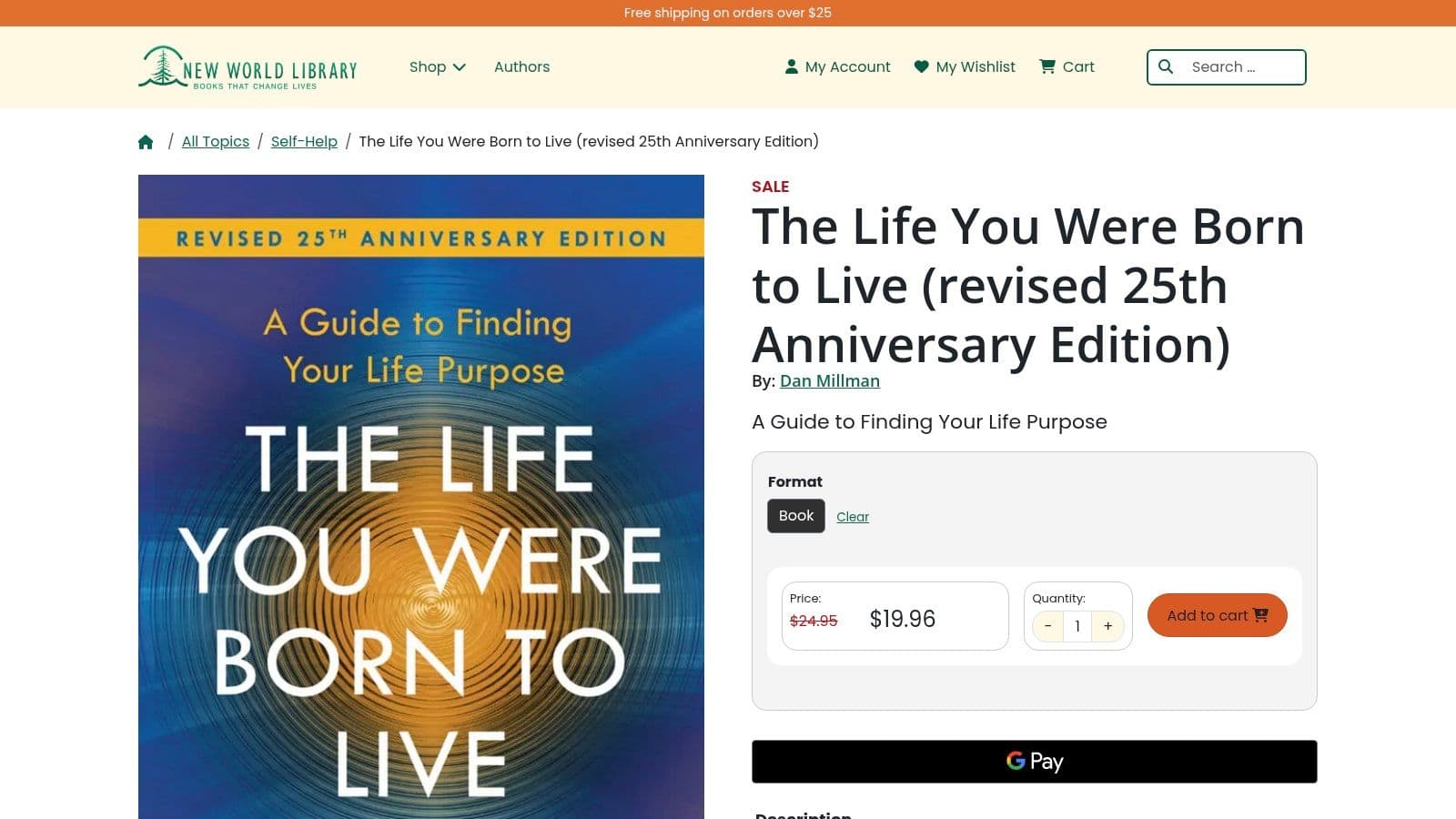
Use the Life Purpose App alongside the book for guidance on finding your life path number. The app can make the birth-date lookup and related exploration more convenient, while Millman's text supplies the context needed to interpret the system thoughtfully. It's a system-specific approach, so readers seeking only secular psychology may find it less familiar. Readers drawn to numerology, life paths, and relationship analysis will find a more actionable structure for repeated reflection.
3. Designing Your Life
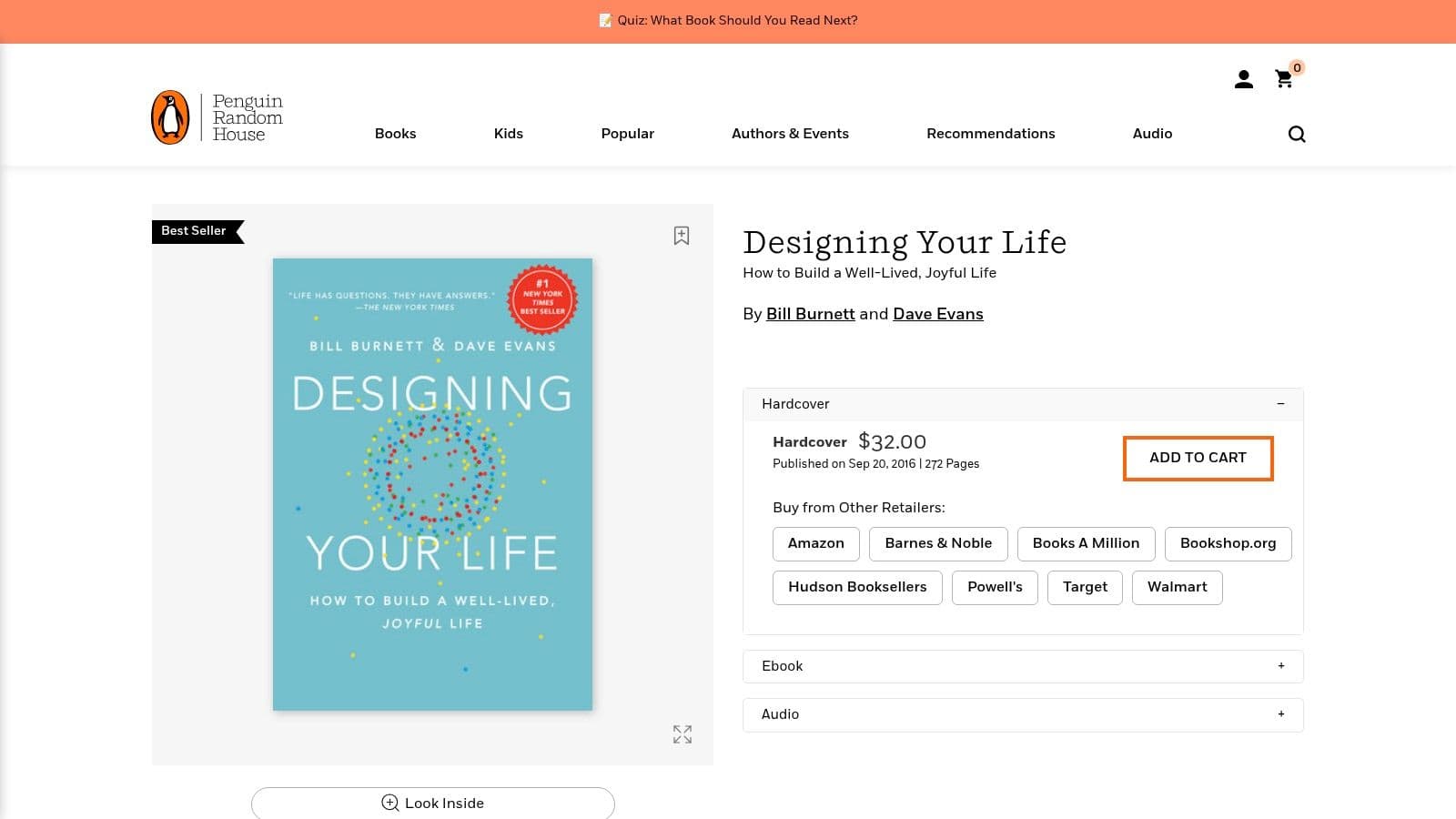
Purpose doesn't always arrive as a revelation. Sometimes you discover it by testing possibilities, noticing what happens, and adjusting your direction. Bill Burnett and Dave Evans build Designing Your Life around that premise, applying design thinking to career and life decisions through reframing, prototyping, and wayfinding.
The book is especially useful for someone who feels trapped by a false choice. You might believe you must either stay in a draining profession or start over completely. A design approach asks you to create smaller experiments instead. Talk to someone doing the work, volunteer for a related project, take a class, shadow a professional, or test a new routine before making a dramatic commitment. The official book page from Penguin Random House describes its connection to Stanford's Life Design Lab methods.
Turn uncertainty into experiments
The book's strength is its practical process. It won't settle the philosophical question of why you exist, and it requires consistent follow-through. What it can do is reduce decision paralysis by replacing abstract speculation with low-risk learning.
Try the approach this way:
- Name the stuck point: Write the problem without assuming the first explanation is correct.
- Generate alternatives: Describe several possible futures rather than defending one fixed plan.
- Prototype one option: Take a small action that produces information.
- Review the evidence: Notice energy, curiosity, resistance, and practical constraints.
For readers who want to turn reflection into a concrete plan, the Life Purpose App can sit beside the book as a separate planning prompt. Burnett and Evans are the better choice when your immediate purpose question is, “What could I try next?”
4. Ikigai The Japanese Secret to a Long and Happy Life
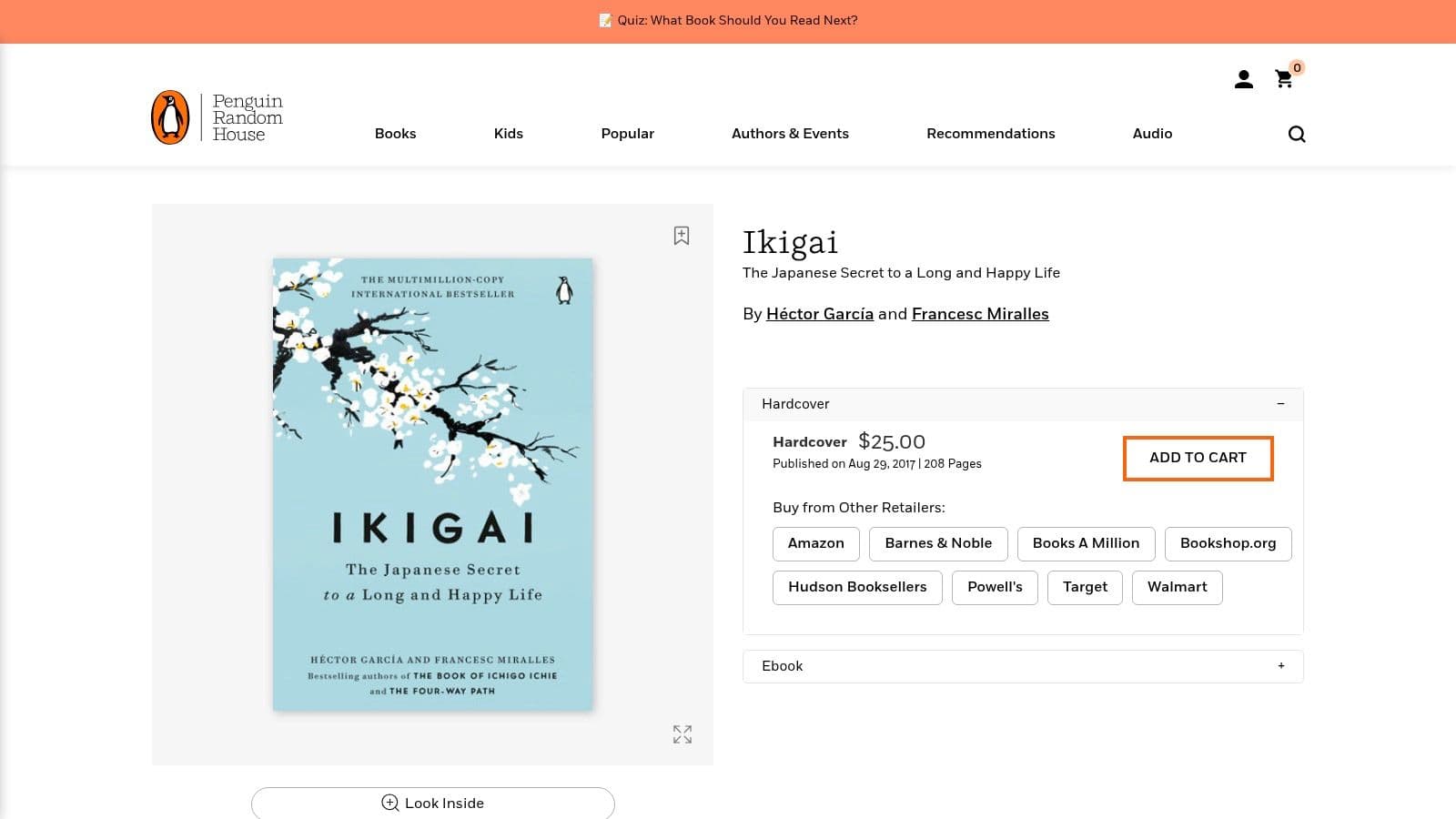
Héctor García and Francesc Miralles offer an accessible entry into purpose through Ikigai: The Japanese Secret to a Long and Happy Life. The book introduces ikigai, commonly explained as a reason for living, and connects it with daily activity, community, staying engaged, and habits that support a satisfying life. It's shorter and lighter than the more demanding books on this list, which makes it a useful first step for readers who feel overwhelmed by grand theories.
Many readers encounter ikigai through the familiar overlap among what they love, what they can do well, what they can be paid for, and what the world needs. The book's wider emphasis is less about discovering one perfect occupation and more about building a life in which ordinary activities, relationships, and contribution have value. Its publisher description presents it as a practical introduction to the concept and its related habits.
Its limitation is also clear. Ikigai offers inspiration and prompts, but readers seeking a detailed career method or a rigorous philosophical account may want a second book afterward. Use it as a daily reflection tool. At the end of each day, record one activity that absorbed your attention, one person who made life feel more connected, and one useful action you took. After several weeks, review the pattern. Purpose may appear first as a repeated way of spending your time, not as a dramatic statement about your future.
5. Find Your Why
Simon Sinek, David Mead, and Peter Docker make purpose more operational in Find Your Why: A Practical Guide for Discovering Purpose for You and Your Team. The central question is not what you do. It's why your work or contribution matters, and how that reason can guide decisions. The book is structured as a workbook, with exercises, illustrations, facilitation guidance, and help for individuals or groups. Its official publisher page positions it as a practical companion for personal and team purpose work.
This is a strong choice for a career transition, leadership conversation, coaching session, or team workshop. Instead of inventing an impressive mission statement, gather specific memories of times you felt useful, engaged, or proud of the contribution you made. Look for the recurring effect you had on other people. The book also addresses a common obstacle, similar-sounding WHY statements that sound polished but don't distinguish one person or team from another.
Practical rule: Purpose becomes more useful when it changes a decision, not just when it produces a sentence.
The business-tilted tone won't suit everyone. Readers looking for spiritual exploration or a deeper account of meaning may find the method utilitarian. It also works better with an accountability partner or facilitator, particularly when another person can challenge vague language and ask for concrete examples.
Use the book by testing your proposed WHY against a real choice. If it says you help people become confident, ask whether it changes the client you accept, the project you choose, the feedback you give, or the skills you develop. If nothing changes, the statement needs more work.
6. The Second Mountain
David Brooks's The Second Mountain: The Quest for a Moral Life answers a different purpose question: what are you willing to commit yourself to when achievement alone stops satisfying you? Brooks contrasts the pursuit of status and individual success with a deeper life organized around commitments to family, vocation, faith or philosophy, and community. The book blends personal narrative, reportage, and social-science discussion, giving the argument a broad and accessible shape.
It's a reflective book rather than a diagnostic tool. You won't find a precise questionnaire that calculates your direction or a weekly sequence for changing your behavior. Instead, Brooks asks readers to consider the obligations that give a life structure. A vocation, in this sense, isn't merely a job title. It's a sustained form of contribution that connects ability with responsibility. Community isn't a vague feeling of belonging either. It involves showing up for people when doing so is inconvenient.
The publisher's overview of The Second Mountain reflects that focus on a moral life shaped by commitment. Readers who feel lonely, successful but unfulfilled, or tired of treating every decision as a personal optimization problem may respond strongly to its argument.
Apply it by choosing one commitment you already claim to value and giving it a visible place in your calendar. Call the relative, mentor the junior colleague, attend the local meeting, or return to the practice that connects your principles with other people's needs. A purpose built only around private fulfillment can remain fragile. Brooks is most useful when you're ready to ask what your life is for in relation to others.
7. Life on Purpose
Victor J. Strecher's Life on Purpose: How Living for What Matters Most Changes Everything is the best fit here for readers who want purpose connected to behavior, wellbeing, and practical lifestyle change. Strecher, a public-health professor at the University of Michigan, brings together philosophy, neuroscience, and behavioral research, while also discussing habits that can support a purposeful life. The Apple Books listing for Life on Purpose provides the book's publication information and description.
Rather than treating purpose as a single insight, Strecher connects it with the conditions that make purposeful action easier to sustain. The book discusses lifestyle pillars including sleep, presence, activity, creativity, and eating. That broad scope is useful for readers who understand their values but can't consistently act on them. It can also feel tangential if you want only purpose-finding exercises, because general health habits occupy part of the conversation.
Make values easier to practice
Use Strecher's approach by pairing one meaningful aim with one supportive behavior. If you want to contribute as a mentor, protect a regular period when you have enough attention to prepare. If creative work matters, establish a routine that gives you a workable starting point rather than waiting for perfect inspiration. If relationships are central, create a repeatable way to be present with the people you care about.
A useful test: A purpose statement should point toward behavior you can repeat.
This isn't as step-by-step as Find Your Why or Designing Your Life, but it bridges reflection and implementation. For more context on creator-focused work and purpose-led audience building, see this creator marketing strategy example. The broader lesson is practical: purpose becomes credible when your daily choices make room for it.
7-Book Comparison: Purpose in Life
| Title | 🔄 Implementation Complexity | ⚡ Resource Requirements | 📊 Expected Outcomes | Ideal Use Cases | ⭐ Key Advantages / 💡 Tip |
|---|---|---|---|---|---|
| Man's Search for Meaning | Low, read & reflect; emotionally intense | Minimal (time, emotional readiness) | Deep reframing of meaning; resilience perspective | Individual reflection, therapy, study groups | ⭐⭐⭐⭐⭐ Timeless psychological insight; 💡 Pair with a companion workbook for exercises |
| The Life You Were Born to Live (Revised) | Moderate, learn system of 45 life paths | Moderate (book study, optional app use) | Personalized life-path profile and long-term guidance | Readers interested in numerology-style systems and long-term self-inquiry | ⭐⭐⭐⭐ Systematic and actionable; 💡 Use with the Life Purpose App for reflection |
| Designing Your Life | Moderate–High, iterative exercises and prototyping | Moderate (time, practice, possible workshops) | Practical prototypes; reduced decision paralysis; career experiments | Career transitions, coaching, classrooms, hands-on workshops | ⭐⭐⭐⭐ Practical design-thinking tools; 💡 Schedule small low-risk experiments regularly |
| Ikigai: The Japanese Secret to a Long and Happy Life | Low, concise, intro-level guidance | Low (short read, simple prompts) | Inspiration and habit-oriented adjustments; lifestyle focus | Readers seeking an accessible entry to purpose and longevity habits | ⭐⭐⭐ Accessible cultural synthesis; 💡 Combine with structured exercises for career focus |
| Find Your Why | Moderate, structured facilitation recommended | Moderate (workbook, facilitator or partner) | Clear WHY statements; team alignment and actionable language | Teams, organizational workshops, coaches | ⭐⭐⭐★ Highly practical for teams; 💡 Use a facilitator for best results |
| The Second Mountain | Low, narrative and reflective essays | Low–Moderate (reading, reflective time) | Shift toward commitment- and service-oriented purpose | Readers seeking community- and service-focused meaning | ⭐⭐⭐⭐ Compelling synthesis of research & stories; 💡 Reflect on concrete commitments rather than abstract ideals |
| Life on Purpose | Moderate, evidence-based guidance with practical tips | Moderate (time to adopt lifestyle pillars) | Science-grounded behavior change supporting wellbeing and purpose | Wellness professionals, coaches, readers seeking research-backed guidance | ⭐⭐⭐⭐ Research-backed and practical; 💡 Focus on a few lifestyle pillars to start (sleep, presence, activity) |
Build a Reading Path, Not a Reading Pile
The best book depends on the question you're carrying into it. Choose Frankl if you need a foundational account of meaning during suffering or uncertainty. Choose Millman if you want a defined life-path system for self-inquiry, with the Life Purpose App available as a digital companion to the book's framework. Choose Burnett and Evans if you're stuck between career options and need experiments rather than more abstract thinking.
Choose Ikigai if you want an approachable way to examine daily routines, connection, and engagement. Choose Sinek, Mead, and Docker if you need a structured WHY process for yourself, a team, or a coaching conversation. Choose Brooks if your purpose question involves commitment, community, faith, vocation, or service beyond individual achievement. Choose Strecher if you already know what matters but want behavior-informed ways to make that purpose more present in ordinary life.
The sequence matters because these books solve different problems. Frankl can help you clarify why meaning matters. Millman can give you a system for interpreting personal patterns. Burnett and Evans can move you into action. Ikigai can bring attention back to daily life, while Find Your Why turns contribution into language and decisions. Brooks widens the frame toward responsibility, and Strecher helps connect purpose with sustainable behavior.
Don't read all seven at once. Choose one book, write down the single question you want it to answer, and apply one exercise or reflection before starting another. A quiet walk can also help you process what you've read, especially when you use walking to fuel creativity as a deliberate pause rather than another task. The aim isn't to collect impressive ideas about purpose. It's to let one idea alter what you notice, choose, or do next.
The Life Purpose App offers a digital companion to Dan Millman's The Life You Were Born to Live, with birth-date life-path lookup, access to the book's system, life cycles, spiritual laws, and relationship insights. If Millman's approach fits your search for self-knowledge, visit Life Purpose App and use it alongside the book as you reflect on your direction.
Discover your life path today
Enter your date of birth and see your life path, free.
Find your life path