June 11, 2026 (Today)

8 Powerful Burnout Prevention Strategies for 2026

Discover actionable burnout prevention strategies rooted in self-knowledge. Learn to align with your purpose and navigate life's cycles to build resilience.

← Back to blog
Cover Image for 8 Powerful Burnout Prevention Strategies for 2026

Discover actionable burnout prevention strategies rooted in self-knowledge. Learn to align with your purpose and navigate life's cycles to build resilience.

Tired of being tired? It might be more than just stress.

That flat, worn-down feeling can sneak up on you. You're getting through the day, answering messages, showing up for people, hitting deadlines, but inside, something feels off. Work that used to matter feels mechanical. Rest doesn't seem to restore you. Even small demands start to feel heavy.

Burnout often gets treated like a personal weakness or a time-management problem. That misses the point. The World Health Organization formally recognized burnout in 2019 as an occupational phenomenon tied to chronic workplace stress that hasn't been successfully managed, which gave employers and health systems a clearer framework for treating it as a real work-related risk, not just a vague complaint (American Nurses Association overview of burnout).

That matters because “take a vacation” advice only goes so far. A break can help, but if your work, relationships, pace, and expectations are out of sync with who you are, the exhaustion returns fast. That's where a more personalized approach becomes useful.

The most effective burnout prevention strategies usually combine practical changes in how work is designed with deeper self-knowledge. If you want a framework for that inner side, Dan Millman's book, The Life You Were Born to Live, and the Life Purpose App offer a structured way to understand your life path, challenges, rhythms, and patterns. If you're navigating burnout in a demanding profession, this perspective also pairs well with grounded guidance on building resilience in medical careers.

1. Life Path Alignment and Purpose Clarity

A person standing on a numbered path leading toward a rising sun with a compass overhead.

One of the fastest ways to drain your energy is to keep succeeding in the wrong direction. You can be competent, responsible, admired, and still find yourself depleted because your daily life doesn't match your deeper nature.

Dan Millman's The Life You Were Born to Live gives language for this problem through its life path system. The Life Purpose App applies that system in a practical way. It helps you identify one of 45 life paths, along with core gifts and growth themes, so you can assess whether your work and obligations fit who you are. A good starting point is the overview of The Life You Were Born to Live in the Life Purpose App.

Where misalignment shows up

Misalignment rarely looks dramatic at first. It often looks like persistent friction. You procrastinate on tasks that seem “good on paper.” You recover slowly after ordinary workdays. You feel more relief than satisfaction when projects end.

A common example is someone in a prestigious role who discovers that their deeper orientation leans toward creativity, service, teaching, healing, or contemplative work. The issue isn't that the current job is bad. It's that the role may reward traits that don't nourish the person living it.

Burnout often begins where your outer success and inner truth stop matching.

If you use a system like Dan Millman's, the point isn't to make impulsive life changes. It's to spot patterns. When a person sees that their path emphasizes expression, compassion, or depth, they can stop interpreting their exhaustion as laziness and start treating it as a signal.

Practical moves that help

  • Review your current role candidly: List your main responsibilities and note which ones energize you, which ones feel neutral, and which ones leave you drained.
  • Match duties to gifts: If your path points toward communication, service, insight, or creativity, look for ways to shape your role around those strengths.
  • Talk to a manager concretely: Ask for responsibility shifts that better fit how you work best, instead of making a vague plea for less stress.

Purpose clarity doesn't remove pressure. It does reduce the kind of exhaustion that comes from living against yourself.

2. Boundary Setting Through Self-Knowledge

A lot of people try to set boundaries by memorizing scripts. That helps a little. It doesn't help enough if you still don't know where your limits are.

Self-knowledge makes boundaries real. When you understand your tendencies, your blind spots, and the roles you fall into under pressure, you can stop calling overextension “kindness” or “commitment.” Dan Millman's The Life You Were Born to Live is useful here because it frames challenge patterns as part of a path, not as evidence that you're broken. The Life Purpose App turns that into something easier to apply in daily life. Its guidance on setting healthy boundaries can help you translate insight into decisions.

The difference between service and self-erasure

People with a strong helping instinct often burn out because they confuse generosity with constant availability. They say yes before checking capacity. They absorb emotional spillover from coworkers or family. They become the reliable one, then inwardly resent everyone for needing them.

That pattern doesn't improve just because you “try harder” to protect your time. It improves when you can name the inner driver. Maybe you want approval. Maybe you fear conflict. Maybe your identity depends on being needed.

The practical question is simple. What does a healthy yes look like for you, and what kinds of yeses always become expensive later?

Boundaries that actually hold

  • Name your repeat boundary failure: It might be after-hours messages, emotionally loaded family calls, or taking ownership of work that belongs to someone else.
  • Use self-revealing language: “I don't have capacity for that this week” is stronger than overexplaining.
  • Revisit boundaries by season: Your limits change with life cycles, energy, caregiving demands, and work intensity.

Practical rule: If a request regularly leaves you tired, resentful, or disconnected from your own priorities, it needs a boundary.

Strong boundaries aren't harsh. They're how you stop feeding burnout with guilt-based decisions.

3. Nine-Year Life Cycle Navigation

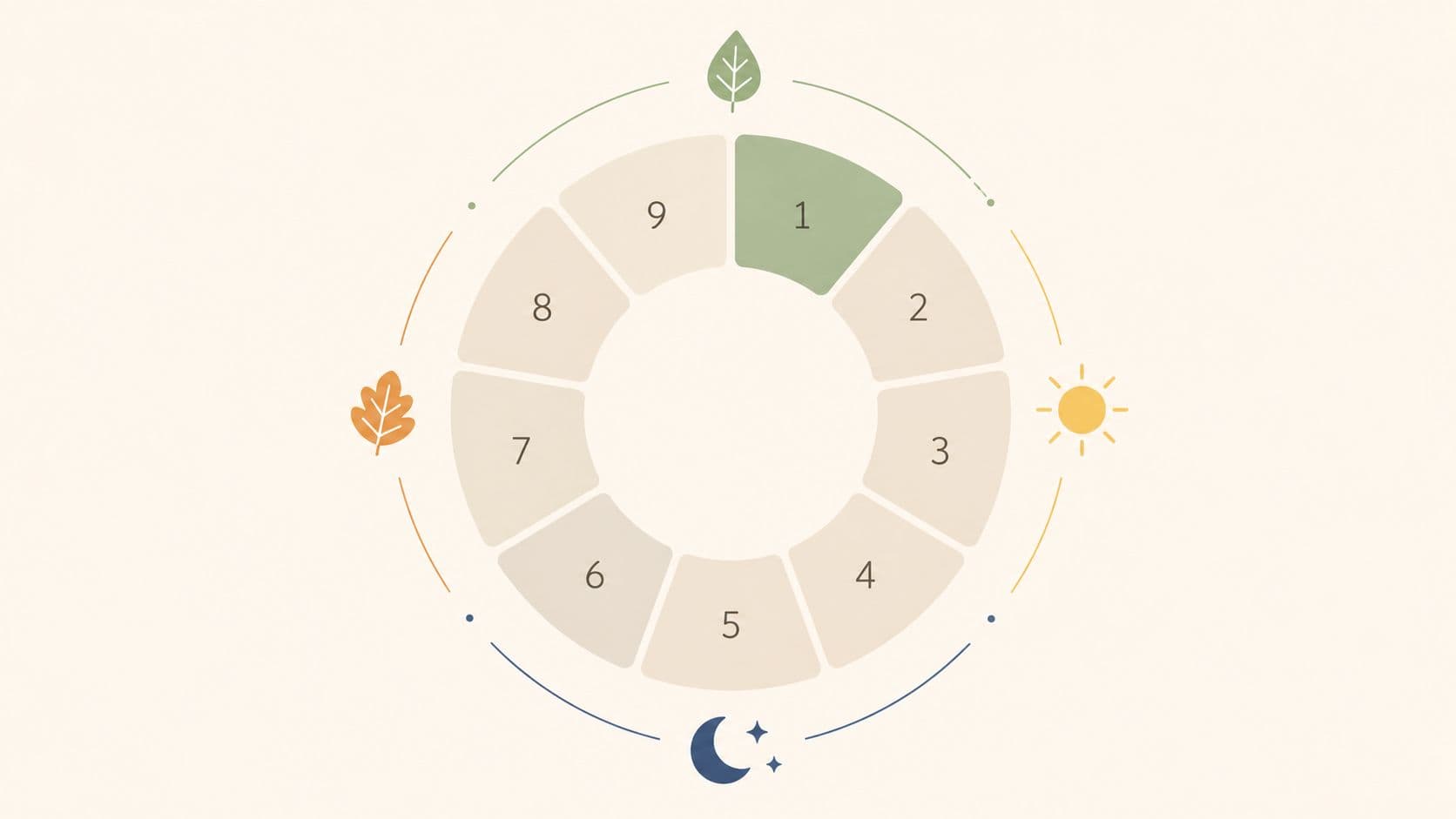
A circular diagram divided into nine segments numbered one to nine, symbolizing a cycle or process.

One reason burnout can feel confusing is that people judge every season of life by the same standard. If you're not as productive, focused, or ambitious as you were in a different chapter, you may assume something's wrong with you.

Dan Millman's The Life You Were Born to Live offers a different lens through its nine-year cycle framework. The Life Purpose App makes it easier to check where you are in that rhythm through its numerology nine-year cycle guide. Whether you take that system as fact or use it as a reflective tool, it can help you stop forcing growth, completion, recovery, and reinvention to all look the same.

Don't demand expansion in a completion season

Some years are naturally better for building, launching, and pushing forward. Others feel more like pruning, ending, integrating, or grieving. When people ignore that distinction, they often call a necessary inward season “burnout,” “failure,” or “lost motivation.”

A familiar scenario is someone trying to start major new projects while also feeling the need to let old roles, identities, or obligations fall away. They keep pushing, but the body resists. Energy gets muddy. Focus scatters. Progress feels oddly expensive.

That doesn't always mean stop everything. It often means adjust the demand.

How to work with the season you're in

  • Check your current cycle: Use it as a prompt to ask what this period is really asking of you.
  • Scale expectations accordingly: A consolidation season may call for finishing, simplifying, or stabilizing, not aggressive expansion.
  • Share realistic limits: If you're in a demanding life phase, let key people know what capacity looks like.

This is one of the more humane burnout prevention strategies because it replaces self-judgment with timing. Not every season is built for maximum output.

4. Relationship Dynamics Understanding and Compatibility Mapping

Burnout rarely stays contained to workload alone. Difficult relationships intensify it fast. A tense boss, a draining coworker, a demanding partner, or a friendship built on emotional overdependence can turn manageable stress into deep exhaustion.

That's why relationship insight matters. Dan Millman's The Life You Were Born to Live gives a framework for understanding differences in temperament, challenge, and growth. The Life Purpose App extends that by letting people compare paths and reflect on compatibility patterns. Used well, this doesn't become a tool for labeling others. It becomes a way to reduce unnecessary friction.

Stop making every difference personal

People burn out in relationships when they keep interpreting difference as threat. One person wants direct communication. Another needs more reflection before speaking. One values efficiency. Another values harmony. One needs solitude after work. Another reaches for connection.

Without a framework, both sides can feel wronged. With a framework, the dynamic becomes easier to name. The goal isn't to prove who's right. It's to understand why the same interaction leaves one person energized and the other person wiped out.

A manager, for example, may realize that one team member thrives on autonomy while another needs clearer structure. A partner may see that conflict escalates not because love is missing, but because stress responses clash.

Some burnout is really accumulated relational friction.

Better questions to ask

  • Which relationships restore me, and which ones consistently deplete me?
  • What communication style does this person respond to best?
  • Am I expecting sameness where I need understanding instead?

Relationship mapping won't fix a toxic environment on its own. But it can reduce avoidable conflict, soften blame, and help you stop spending energy on misunderstandings that don't need to keep happening.

5. Values-Based Time and Energy Management

A person holding a glowing heart icon, symbolizing energy replenishment against a backdrop of calendar squares.

Most time management advice treats hours as the problem. Burnout often proves the deeper issue is misused energy. Two hours spent on meaningful work can leave you tired but satisfied. Two hours spent in value-conflicting work can leave you hollow.

That's why a values audit matters more than another productivity app. Dan Millman's The Life You Were Born to Live can help identify what your path naturally asks you to develop and express. Once that's clear, you can look at your calendar with sharper eyes.

Audit your calendar for meaning, not just efficiency

Start with your recurring commitments. Meetings, admin work, caregiving, side projects, volunteer roles, social obligations, mentoring, errands. Then ask a more honest question than “Is this productive?”

Ask, “Does this belong to the life I'm trying to live?”

The Centers for Disease Control and Prevention's public health guidance on burnout prevention emphasizes that organizational changes such as flexible scheduling, job crafting, adequate staffing, clearer task assignment, and stronger support are central because burnout grows out of demand-resource imbalance, not just poor self-care (CDC public health burnout prevention module). That aligns with lived experience. People don't usually burn out because they forgot to optimize their calendar color-coding. They burn out because too much of their time gets consumed by work that lacks support, clarity, or meaning.

A cleaner way to allocate energy

  • Keep what matters: Protect work that reflects your gifts, values, and responsibilities that belong to you.
  • Modify what can be reshaped: Turn a draining role into a more aligned one by renegotiating scope or format.
  • Release what's performative: Some commitments exist mostly to maintain an image, not a life.

When your schedule reflects your values more closely, resilience stops being abstract. It becomes visible in how you spend a Tuesday.

6. Spiritual Law Integration for Resilience

Some burnout is practical. Too much work, too little recovery, poor leadership, unclear expectations. Some burnout is existential. You're not just tired. You've lost meaning, trust, or perspective.

Spiritual framing can offer assistance, if it's used responsibly. Dan Millman's The Life You Were Born to Live explores spiritual laws and life lessons as part of personal development. The value of that approach isn't magical thinking. It's perspective. When people see challenge as part of a growth pattern instead of proof that life is punishing them, they often become less brittle under pressure.

Use meaning without using it to bypass reality

A spiritual lens should never become an excuse for tolerating abuse, overwork, or exploitation. If your job is unsustainable, “learn the lesson” isn't enough. Real burnout prevention strategies still require practical changes in workload, support, and design.

But when someone is facing a hard transition, a setback, or a season of uncertainty, spiritual law can give structure to the experience. Cause and effect, cycles, action, patience, surrender, responsibility. These ideas help people ask better questions than “Why is this happening to me?”

A career disappointment, for example, may be the event that finally reveals years of misalignment. A strained relationship may expose a lifelong pattern of overgiving. The pain is real. So is the insight.

A resilient person doesn't deny difficulty. They find a way to place it inside a larger meaning.

What this looks like in practice

  • Name the lesson without romanticizing the pain.
  • Pair insight with action: If the lesson is about limits, then limits need to show up in your calendar.
  • Return to the body: Perspective matters, but so do sleep, food, rest, and reduced overload.

Spiritual resilience works best when it stays grounded. Insight should make your life clearer, not more avoidant.

7. Self-Compassion Development Through Challenge Understanding

Burnout gets worse when exhaustion turns into self-attack. You're already depleted, then you add shame. You tell yourself you should be stronger, more disciplined, more grateful, more resilient. That inner pressure doesn't motivate healing. It deepens the collapse.

A more useful approach is to understand your struggle in context. Dan Millman's The Life You Were Born to Live treats certain difficulties as part of a person's developmental path. That framing can reduce the reflex to turn every challenge into a character indictment.

Talk to yourself like someone worth helping

Many people are surprisingly cruel to themselves during burnout. They'd never speak to a friend the way they speak internally after missing a deadline, needing rest, or losing motivation. Once you understand that some themes are recurring growth edges, it becomes easier to replace contempt with curiosity.

This doesn't mean lowering standards until nothing matters. It means dropping the fantasy that harshness is the same as accountability.

A person who repeatedly struggles with relationships, money, visibility, commitment, or self-trust may start to see those areas not as proof of failure, but as the exact places life keeps asking for maturity.

What compassion changes

  • It lowers shame: You stop wasting energy hiding your struggle from yourself.
  • It improves recovery: Rest works better when it isn't contaminated by guilt.
  • It supports wiser decisions: People make cleaner choices when they aren't operating from panic and self-rejection.

A meta-review in the medical literature found that burnout decreased significantly in 75% of person-directed stress-management studies, supporting the use of structured interventions such as mindfulness and stress-reduction training, especially when combined with organizational changes like workload review, manager coaching, and regular tracking (medical literature review on burnout interventions). Self-compassion fits that pattern. It's not passive. It's part of a structured way of interrupting the inner conditions that keep burnout alive.

8. Seasonal Life Planning and Sabbatical Integration

If you wait until you're broken to rest, you waited too long. One of the most overlooked burnout prevention strategies is to plan recovery before you feel desperate for it.

That might mean a sabbatical. It might mean a quiet month, a lighter quarter, a no-travel season, or a deliberate pause between major efforts. The deeper principle is the same. Human beings need cycles of output and renewal. Dan Millman's The Life You Were Born to Live supports this kind of rhythm through its focus on life phases and timing.

Flexibility can burn you out too

A lot of modern work sounds supportive on paper. Flexible hours. Hybrid work. Autonomy. In practice, flexibility without structure can create constant ambiguity. Work leaks into evenings. Priorities stay fuzzy. People never feel fully off.

Recent workplace guidance has stressed realistic workload audits, clear prioritization frameworks, permission to say no, and manager coaching because too much autonomy without structure can leave people carrying unclear expectations and constant urgency (Spring Health guidance on burnout prevention). That trade-off matters. Freedom isn't restorative if it also means you're always mentally on call.

A planned sabbatical or low-intensity season creates a clean boundary that ordinary weekends often can't provide.

Build recovery into the year

  • Identify natural completion points: End of a project, school year, product cycle, contract, or caregiving stretch.
  • Plan rest early: Recovery usually requires logistics, money, conversations, and permission.
  • Return gradually: Don't come back from deep rest and instantly refill every open space.

A large U.S. workforce survey reported that 55% of employees are currently experiencing burnout, with fully remote workers at 61%, and the response increasingly emphasizes system-level controls such as workload audits, recovery-conscious scheduling, decision-latitude expansion, and microbreak normalization rather than relying only on resilience training (U.S. burnout survey summary). That points to a useful truth. Recovery shouldn't be treated as a reward for surviving overload. It needs to be part of the design.

8-Point Burnout Prevention Comparison

Item🔄 Implementation Complexity⚡ Resource Requirements📊 Expected Outcomes💡 Ideal Use Cases⭐ Key Advantages
Life Path Alignment and Purpose ClarityMedium, initial learning curve to interpret life path 🔄Low–Medium, birthdate input, time for reflection, app access ⚡Clearer purpose; improved motivation; reduced misalignment 📊Career pivots, long-term planning, reducing chronic mismatch 💡Deep decision framework; cycle mapping; validates strengths ⭐
Boundary Setting Through Self-KnowledgeMedium, requires consistent practice and communication 🔄Low, app insights + time for boundary practice; possible coaching ⚡Stronger, sustainable boundaries; less overcommitment; better relationships 📊Overloaded professionals, caregivers, relationship change efforts 💡Values-rooted limits; reduces guilt; clearer communication ⭐
Nine-Year Life Cycle NavigationLow–Medium, easy calculation, nuanced interpretation needed 🔄Low, app calculation and planning time ⚡Normalized energy fluctuations; better timing for goals; less shame 📊Project scheduling, recovery planning, anticipating transitions 💡Seasonal planning; improved pacing; anticipates transitions ⭐
Relationship Dynamics & Compatibility MappingMedium, requires data for others and careful interpretation 🔄Medium, multiple profiles, paid tier for detailed analyses ⚡Increased empathy; reduced interpersonal friction; targeted strategies 📊Team management, partnerships, family conflict resolution 💡Actionable compatibility insights; improves communication ⭐
Values-Based Time & Energy ManagementMedium, audit and habit change needed 🔄Medium, time to audit commitments; negotiation with stakeholders ⚡Better prioritization; increased fulfillment; less wasted energy 📊Productivity realignment, eliminating low-value tasks, scheduling work 💡Aligns tasks to values; reduces decision fatigue; boosts meaning ⭐
Spiritual Law Integration for ResilienceMedium–High, conceptual learning and spiritual framing 🔄Low–Medium, study time, reflective practices; paid content optional ⚡Greater meaning-making; reduced anxiety; increased acceptance 📊Coping with setbacks, reframing failure, deepening purpose work 💡Perspective shift; long-term resilience; transforms obstacles ⭐
Self-Compassion Development Through Challenge UnderstandingLow–Medium, simple reframes but needs ongoing practice 🔄Low, app guidance, journaling, practice time ⚡Reduced shame; improved emotional regulation; sustainable effort 📊High self-criticism, therapeutic contexts, personal growth work 💡Normalizes struggle; improves resilience; supports steady progress ⭐
Seasonal Life Planning & Sabbatical IntegrationMedium–High, requires negotiation and logistical planning 🔄High, time off, financial reserves, employer/family coordination ⚡Prevents chronic stress; restored energy; improved long-term productivity 📊Burnout prevention, planned recovery, career sustainability strategies 💡Institutionalizes rest; enhances recovery; preserves career longevity ⭐

Your Path to Sustainable Well-Being Starts Now

Preventing burnout isn't about becoming better at enduring a life that keeps draining you. It's about building a life, a workload, and a set of relationships that you can inhabit without losing yourself.

That usually means working on two levels at once. First, the outer level. Workload, clarity, staffing, boundaries, expectations, communication, recovery, support. Second, the inner level. Purpose, self-knowledge, timing, challenge patterns, values, and the stories you tell yourself when life gets hard.

Individuals are often told to focus on only one side. They're either handed self-care advice with no structural support, or they're told to fix the system while ignoring the fact that misalignment can still burn them out even inside a decent environment. In real life, both matter. A person can't meditate their way out of chronic overload. They also can't spreadsheet their way into meaning.

That's why a personalized framework can be so useful. Dan Millman's The Life You Were Born to Live offers a way to understand your gifts, your recurring lessons, and your cycles in a deeper context. For some people, that becomes the missing bridge between spiritual insight and practical change. It helps them see why one kind of work nourishes them while another gradually empties them. It helps them stop forcing productivity in a season meant for completion or recovery. It helps them set boundaries that fit who they are, instead of copying someone else's rules.

If burnout has been creeping in, start smaller than you think. Look at one draining pattern. One relationship. One responsibility that no longer fits. One way your schedule contradicts your values. One story about yourself that needs to change. Small realignments often do more than dramatic declarations.

The Life Purpose App can be one relevant tool if you want a practical way to explore the system from The Life You Were Born to Live. What matters most is that you begin paying attention to your own design instead of treating exhaustion as the price of being responsible.

Your energy matters. Your purpose matters. Your well-being isn't an indulgence. It's part of the path.


If you want a more personalized starting point, Life Purpose App offers a way to explore the system from Dan Millman's The Life You Were Born to Live, including life path insights, challenges, relationship dynamics, and nine-year cycles. Use it as a reflective tool to spot where your work, energy, and purpose may be out of alignment.

← Back to blog

Discover Your Life Purpose Today!

Unlock your true potential and find your life’s purpose.