Discover the best career coaching tools for 2026. Our expert guide reviews 10 top platforms for assessments, client management, and goal tracking.
July 11, 2026 (1mo ago)
10 Best Career Coaching Tools for 2026: An Expert Guide
Discover the best career coaching tools for 2026. Our expert guide reviews 10 top platforms for assessments, client management, and goal tracking.
← Back to blog
You're good at coaching. But if your week keeps disappearing into scheduling links, intake forms, follow-up emails, invoicing, and half-finished client notes, your actual coaching gets squeezed into the margins.
That's the main problem with most career coaching tools. They promise scale, but many just add another dashboard. The right stack should reduce admin, sharpen client insight, and help you move people from confusion to action.
That matters even more now. Job seekers are using AI heavily, but many still struggle to get seen by real people. In the current market, 81% of job seekers use AI tools to find positions, while 63% report being screened out by AI systems before a human reviews their application. Good coaching tools help clients manage that reality without turning them into keyword robots.
I also think most roundups miss something important. Career decisions aren't only about efficiency, strengths reports, or ATS scores. Some clients need a deeper framework for purpose and pattern recognition, especially when they're making a major transition. That's why this list follows the way many coaches work, from self-discovery and onboarding to delivery and results tracking.
1. Life Purpose App
If a client says, “I'm successful on paper, but I still feel off,” I don't start with a scheduler or a CRM. I start with a better conversation. That's where Life Purpose App stands out.
It's the official digital companion to Dan Millman's book, The Life You Were Born to Live, and it turns that framework into something coaches and clients can use quickly. In Dan Millman's system, there are exactly 45 unique life paths, calculated by adding every digit in the full birth date into one total rather than reducing immediately to a single digit. That's much more specific than the vague personality shorthand many people bring into coaching.
Where it fits in a coaching workflow
I like this tool early in the process, especially when the client is dealing with identity questions, recurring career patterns, or tension between ambition and meaning. The app maps the client's life path through Dan Millman's The Life You Were Born to Live framework and connects it to gifts and challenges across five domains: health, money, sexuality, career, and relationships.
That matters because career decisions rarely stay inside the “career” box. A client might call a role mismatch a confidence issue when it's really a repeating lesson around money, boundaries, or self-worth.
Practical rule: Use purpose-based tools to open the conversation, not to close it. They should deepen inquiry, not replace judgment.
The app also goes beyond a single snapshot. It includes life-cycle views and relationship dynamics, which can be useful when a client keeps running into the same friction with bosses, partners, or collaborators.
What works and what doesn't
What works is precision inside its own model. Because it's rooted directly in Dan Millman's The Life You Were Born to Live, it feels coherent rather than patched together. It's fast enough for clients to engage with between sessions, and the free entry point lowers resistance. If you want a simple starting point, it’s an easy way to begin.
The trade-off is obvious. This is an interpretive self-discovery framework, not an evidence-based diagnostic instrument. If you need hiring assessments, psychometrics, or enterprise reporting, this isn't that tool.
Still, there's a real gap here that most career coaching tools ignore. The industry talks constantly about resume optimization and job search tactics, but questions about using generative AI for spiritual or purpose-based career coaching remain poorly answered, even as AI-augmented coaching expands. Life Purpose App is valuable because it addresses the self-discovery side directly, and it does so through Dan Millman's The Life You Were Born to Live rather than a generic “find your purpose” quiz.
2. CliftonStrengths
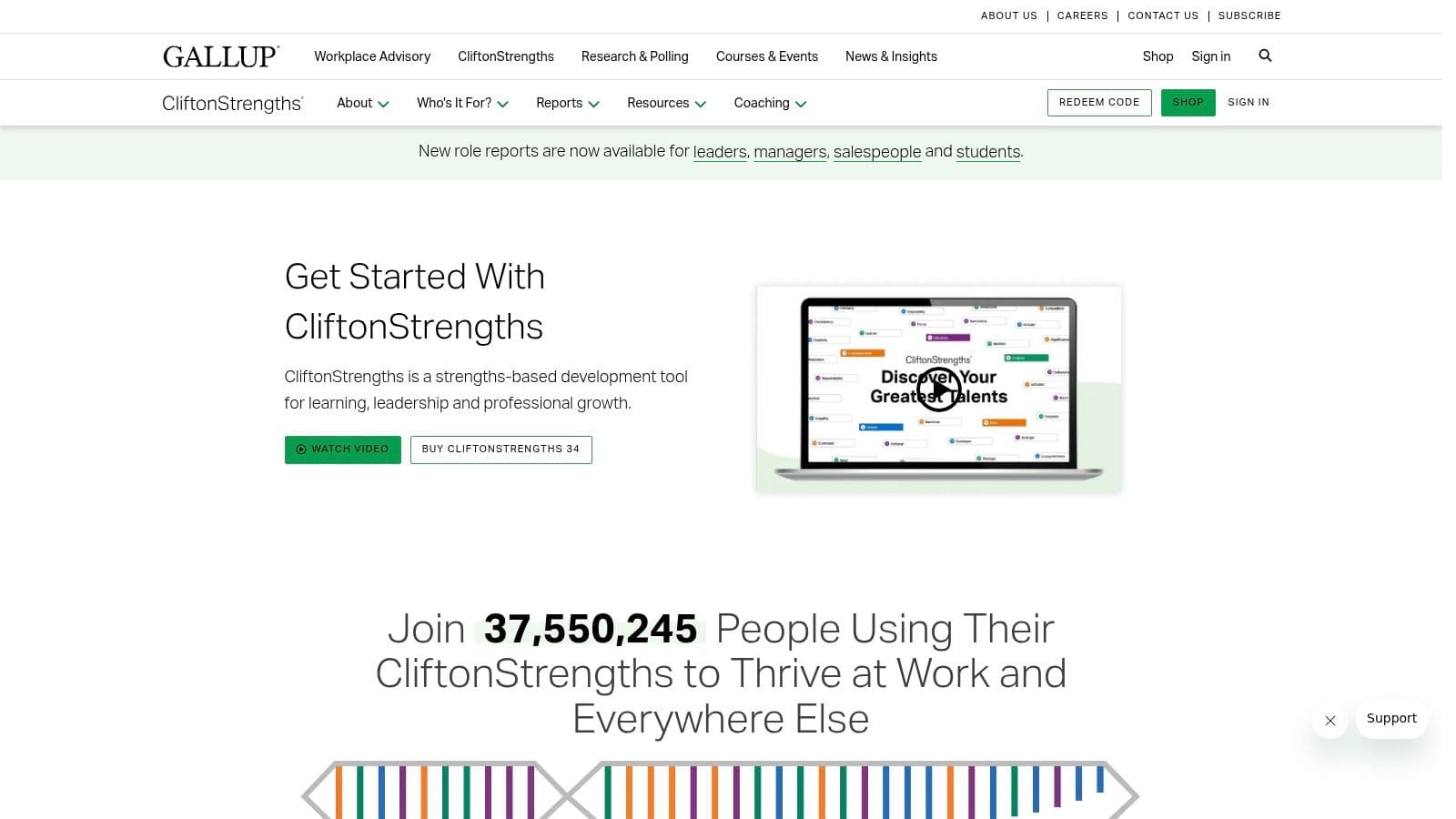
CliftonStrengths by Gallup is one of the easiest tools to use with clients who want a practical language for what they naturally do well. Many have already heard of it, and that familiarity helps. You spend less time convincing them to engage and more time translating results into career decisions.
I don't treat strengths reports as answers. I treat them as pattern prompts. A client's top themes can help frame role fit, collaboration style, delegation habits, and where they're likely to over-rely on what comes easily.
Best use case
CliftonStrengths is especially useful when the client is not lost, just scattered. They have options, but no filter. The report gives you one.
- Good for role fit: It helps clients compare jobs that look similar on paper but require different ways of operating.
- Good for team language: It's handy with managers and internal mobility clients who need a common vocabulary.
- Less useful alone: Without coaching, many clients just admire the report and change nothing.
One caution. Strengths work can become flattering but non-directive if you're not careful. Clients still need hard decisions, not just validation.
3. CoachAccountable
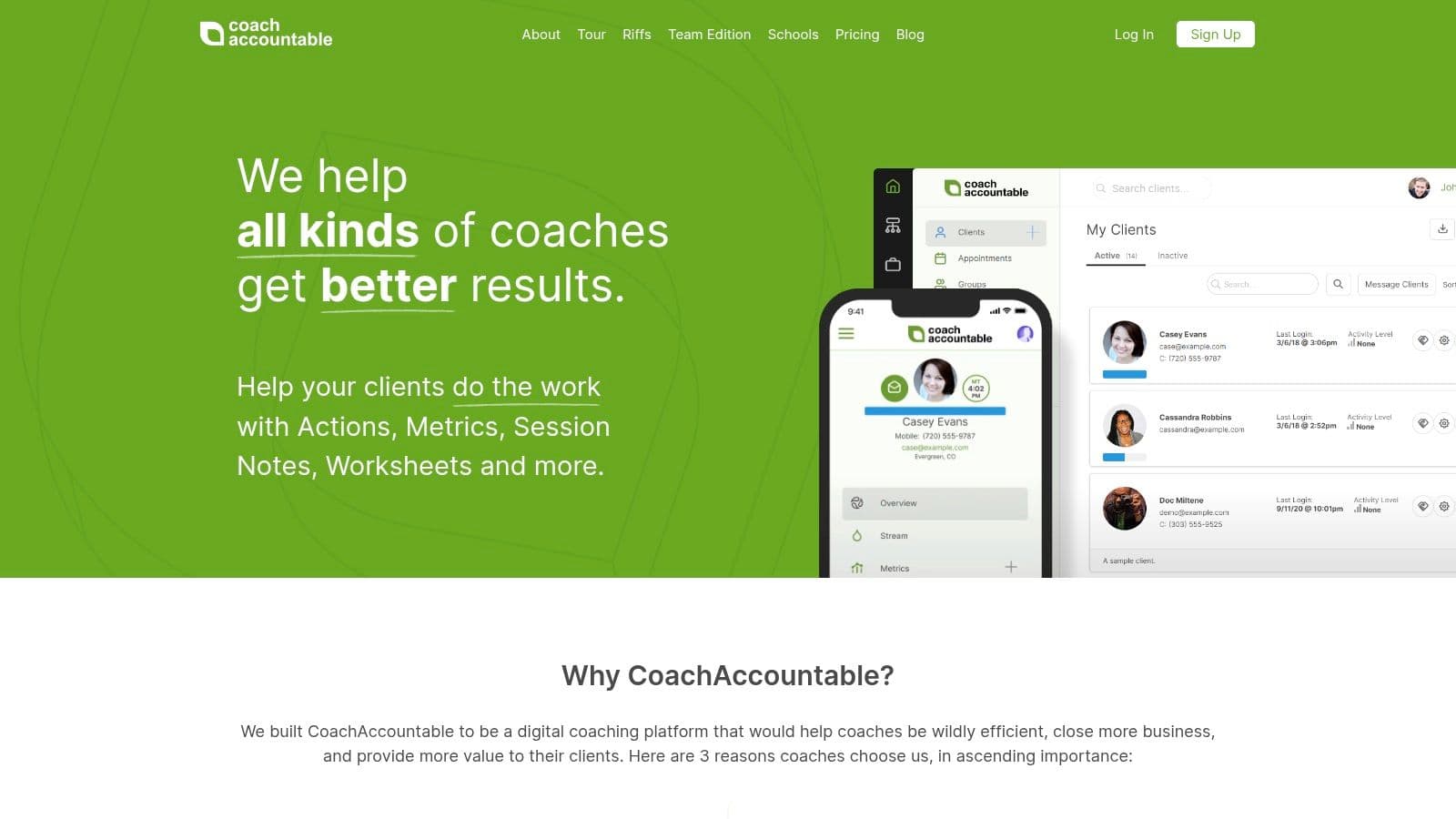
A client finishes a strong session, agrees to three next steps, then disappears into email, calendar reschedules, and half-finished notes. That is usually the point where a career coaching practice starts to feel harder than it should. CoachAccountable fixes that part of the workflow.
I recommend it when a coach has already figured out their method and now needs a system to deliver it consistently. Session notes, worksheets, habits, metrics, forms, invoicing, reminders, and progress tracking live in one place. That matters if your work spans self-discovery, job search execution, and accountability coaching, because clients often stall in the handoff between insight and action.
Where it fits in a coach's workflow
CoachAccountable is strongest in the middle and back half of delivery. It helps you turn an intake into a structured program, keep commitments visible between sessions, and show progress over time. If your practice includes reflective work up front, I would still keep that separate. A tool for administration should not have to carry the weight of deeper identity work, which is why I like pairing it with a more introspective framework.
The app also goes beyond a single snapshot. It includes life-cycle views and relationship dynamics, which can be useful when a client keeps running into the same friction with bosses, partners, or collaborators.
What works and what doesn't
What works is precision inside its own model. Because it's rooted directly in Dan Millman's The Life You Were Born to Live, it feels coherent rather than patched together. It's fast enough for clients to engage with between sessions, and the free entry point lowers resistance. If you want a simple starting point, the Life Purpose Calculator is an easy way to begin.
The trade-off is obvious. This is an interpretive self-discovery framework, not an evidence-based diagnostic instrument. If you need hiring assessments, psychometrics, or enterprise reporting, this isn't that tool.
Still, there's a real gap here that most career coaching tools ignore. The industry talks constantly about resume optimization and job search tactics, but questions about using generative AI for spiritual or purpose-based career coaching remain poorly answered, even as AI-augmented coaching expands. Life Purpose App is valuable because it addresses the self-discovery side directly, and it does so through Dan Millman's The Life You Were Born to Live rather than a generic “find your purpose” quiz.
4. Paperbell
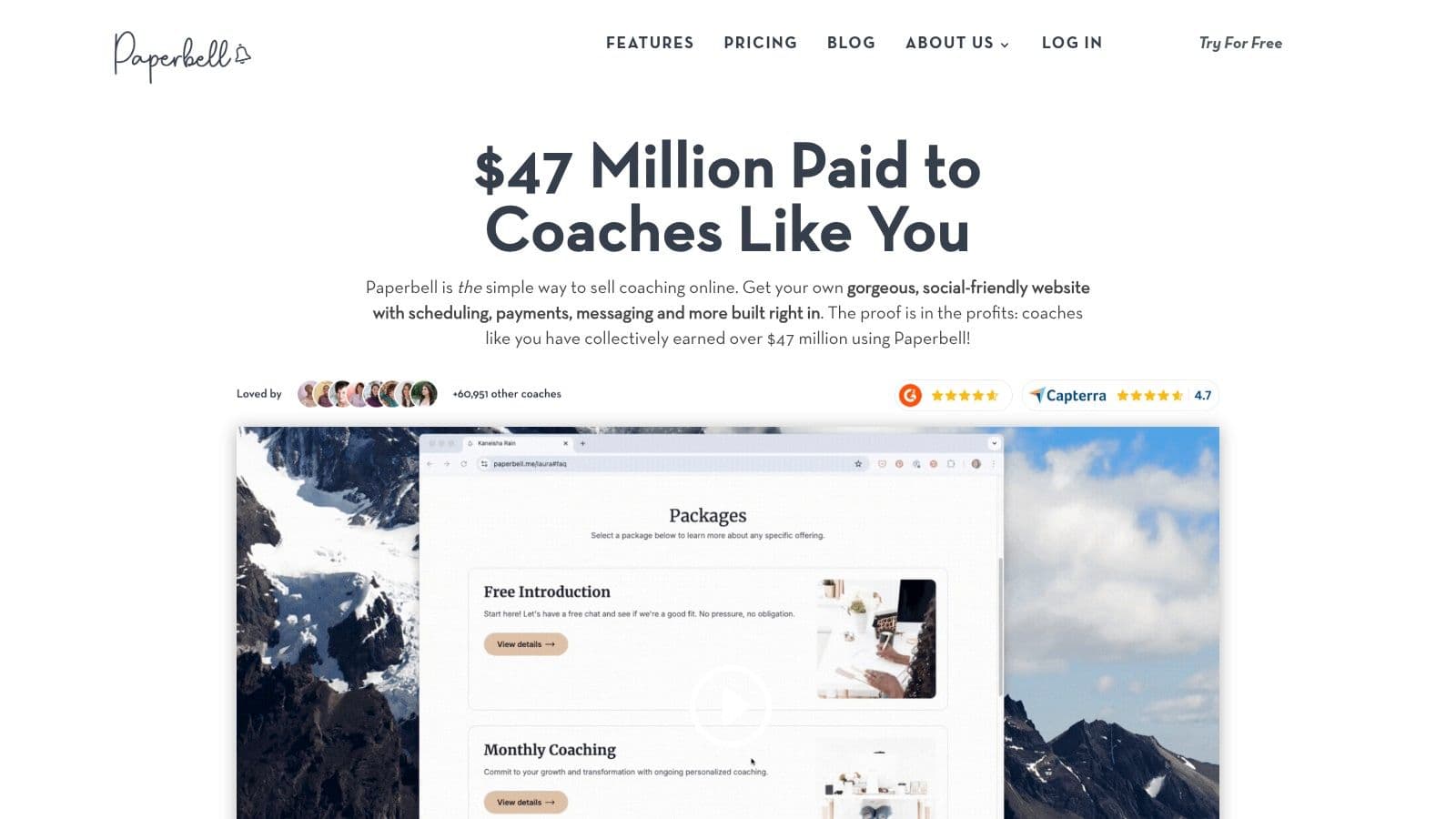
A client says yes to your package, then the admin work starts. You send the contract. They ask where to pay. The calendar link gets buried. Intake arrives late. Paperbell fixes that handoff better than many coaching platforms I have used.
Paperbell fits early in a coach's workflow. It helps you turn interest into a booked, paid, onboarded client without building a stack of separate tools. For solo career coaches, that matters. Administrative drag can eat the time you meant to spend on actual coaching.
I usually recommend it to coaches with clearly defined offers, such as interview prep, career transition programs, or accountability coaching. If your process already starts with deeper self-discovery work and then moves into structured support, Paperbell handles the business side cleanly while letting your method stay your own.
Where it fits best
Paperbell works well for independent practices that sell packaged services and want a client experience that feels simple from the first payment onward.
- Strong for solo delivery: Packages, contracts, scheduling, intake, and payments live in one place.
- Useful for offer clarity: It suits coaches who sell repeatable programs with a clear start, scope, and price.
- Less suited to larger engagements: HR reporting, stakeholder views, and multi-layer program management are limited.
That trade-off is the key point. Paperbell gives speed and order, but not much operational depth beyond the needs of a solo or small practice.
For many career coaches, that is a fair exchange. If your workflow moves from self-discovery into coaching packages and straightforward client delivery, Paperbell keeps the front half of the business tidy without forcing you into enterprise software.
5. Satori
Satori has been around long enough to understand what coaches need at the point of sale and delivery. It's especially good for discovery calls, onboarding sequences, contracts, scheduling, and payments.
What I like about Satori is that it doesn't try to be everything for everyone. It's focused. That focus makes it easier for newer coaches to learn and easier for established coaches to deploy quickly.
A smart option for early-stage and training practices
Satori makes sense in two situations. First, when you want a coach-specific system without enterprise clutter. Second, when you're running trainee, certification, or pro bono programs and need a lighter operational structure.
It also suits coaches who sell programs rather than one-off sessions. You can move a client from discovery conversation to signed agreement to scheduled work without stitching together multiple tools.
What it doesn't do as well is deep organizational reporting. If you're serving HR teams that want broad analytics, stakeholder visibility, and larger implementation support, you'll probably graduate to a different platform.
6. Coaching.com
Coaching.com is the platform I look at when a coaching practice has outgrown the lighter all-in-one tools. The shift usually happens at a clear point in the workflow. You are no longer just guiding self-discovery, onboarding a client, and scheduling sessions. You are coordinating multiple coaches, multiple programs, branded resources, and reporting for people beyond the coachee.
That is where Coaching.com earns its place.
Its real strength is operational control across a larger coaching ecosystem. You can manage engagements, assign coaches, deliver content, track activity, and give stakeholders a clearer view of what is happening without building your own patchwork stack. For firms selling leadership programs or running cohort-based career development at scale, that matters more than a slick solo-coach experience.
I would not put this at the top of the list for a new independent coach. Paperbell, Satori, or CoachAccountable are easier to set up and easier to justify early on. Coaching.com makes more sense once your workflow includes team delivery, client organizations, or a need to standardize how coaching is run across accounts.
Best for multi-coach practices and enterprise-style delivery
What stands out here is structure. Coaching.com is built for practices that need more than client notes and appointment reminders. It supports the parts of coaching that clients rarely see but larger programs depend on: coach matching, program oversight, branded delivery, and reporting that helps an HR or L&D buyer stay confident in the rollout.
I have seen this trade-off many times. As your practice grows, flexibility starts to compete with simplicity. A smaller platform feels faster. A larger platform gives you more control, but only if you will use that control.
Coach's note: Once a coaching business has several coaches and outside stakeholders involved, admin quality becomes part of the client experience. Confusion behind the scenes eventually shows up in the program.
The downside is predictable. Pricing is less straightforward, setup takes longer, and the platform can feel heavy if your business is still built around a small roster of private clients. If your coaching workflow is still personal and low-volume, this will probably feel like too much system. If you are building a coaching operation rather than a solo practice, it starts to look like the right kind of infrastructure.
7. Torch
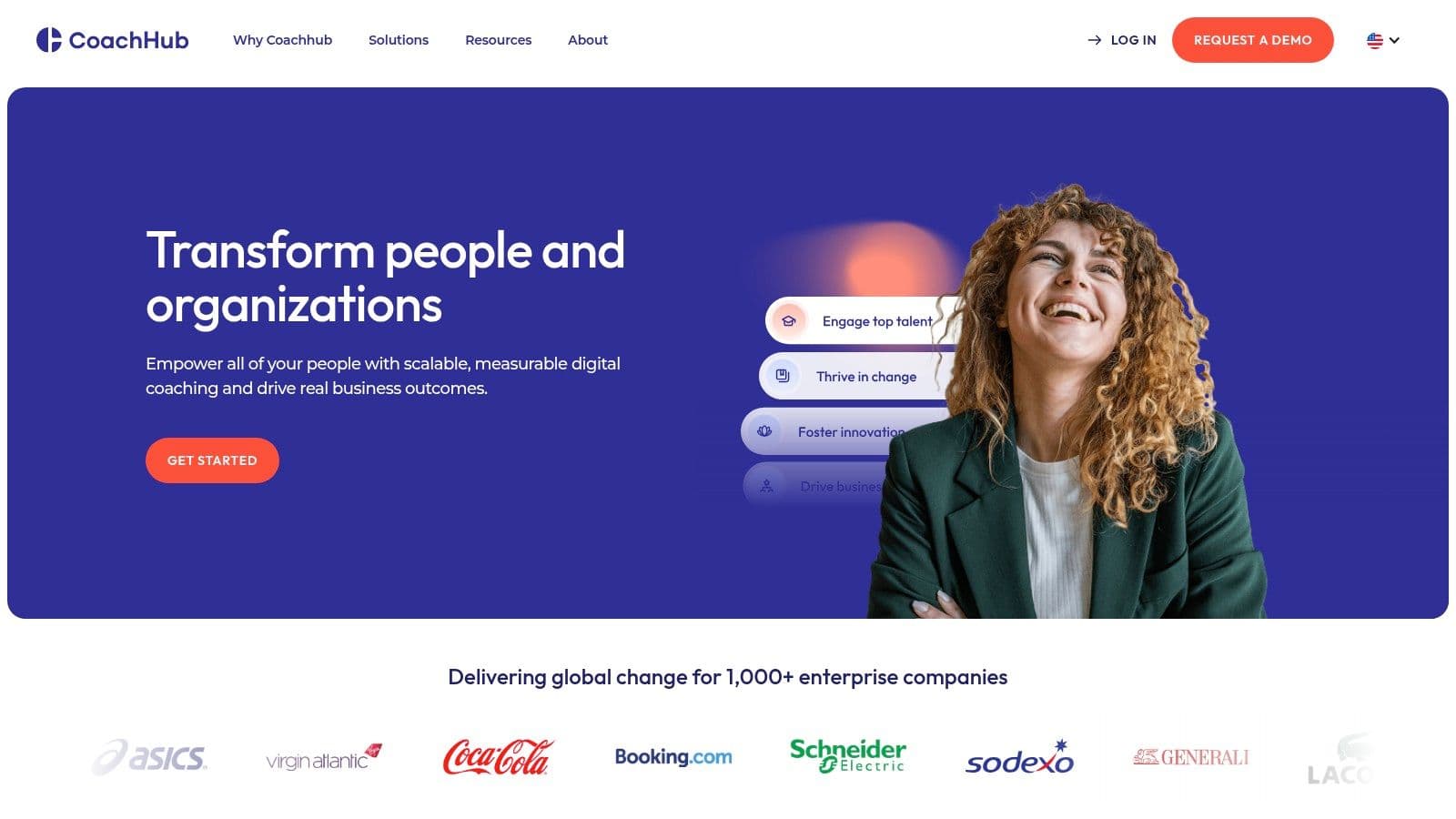
Torch is built for organizations that want coaching tied directly to leadership development and business performance. That's a different buying context than a private career coach serving individual clients.
Torch combines human coaching with its AI agent, Spark, plus organizational features such as feedback workflows, manager alignment, and administrative tooling. I wouldn't suggest it for a solo practice unless your business is mostly corporate.
Best for HR and talent teams
What Torch gets right is reinforcement between sessions. That's where many coaching programs lose momentum. The human work happens in the session, but the learning often fades in the gap.
Its positioning also aligns with a broader market reality. The global AI career coach market is projected to grow from USD 4.2 billion in 2024 to USD 23.5 billion by 2034, a projected CAGR of 18.7% Yet people still want human guidance, which is why hybrid models are getting so much attention.
The trade-off is accessibility. Torch is enterprise-focused, custom-priced, and likely excessive for independent coaches who just need scheduling, notes, and client accountability.
8. CoachHub
A common coaching scenario looks like this. One leader is in Berlin, another is in Chicago, HR wants consistent reporting across both, and the business still expects the coaching to feel personal. CoachHub is built for that kind of delivery.
It serves organizations that need a large coach network, digital session delivery, AI-supported matching, and centralized measurement. In a coaching workflow, this sits far downstream from the self-discovery tools and solo-practice platforms earlier in the list. It is less about helping one coach run a business and more about helping an employer run coaching across a population.
Where CoachHub fits
CoachHub makes sense when scale, governance, and visibility matter as much as the coaching itself. That usually means enterprise L&D, talent, or HR teams managing programs across regions, functions, or leadership levels.
For independent career coaches, the practical value is narrower. You are more likely to encounter CoachHub as part of a corporate engagement model, or as a network you coach within, than as software you buy for your own practice.
The trade-off is straightforward. CoachHub gives organizations structure and oversight. A solo coach usually needs flexibility, simple client management, and a stack that supports intimate, high-context work. If your approach includes both practical career strategy and deeper personal exploration, this platform is usually too enterprise-shaped for the front end of that process.
I would shortlist CoachHub for companies rolling out coaching broadly and tracking participation, consistency, and program outcomes. I would not put it on a starter toolkit for an independent coach building a practice from the ground up.
9. EZRA Coaching
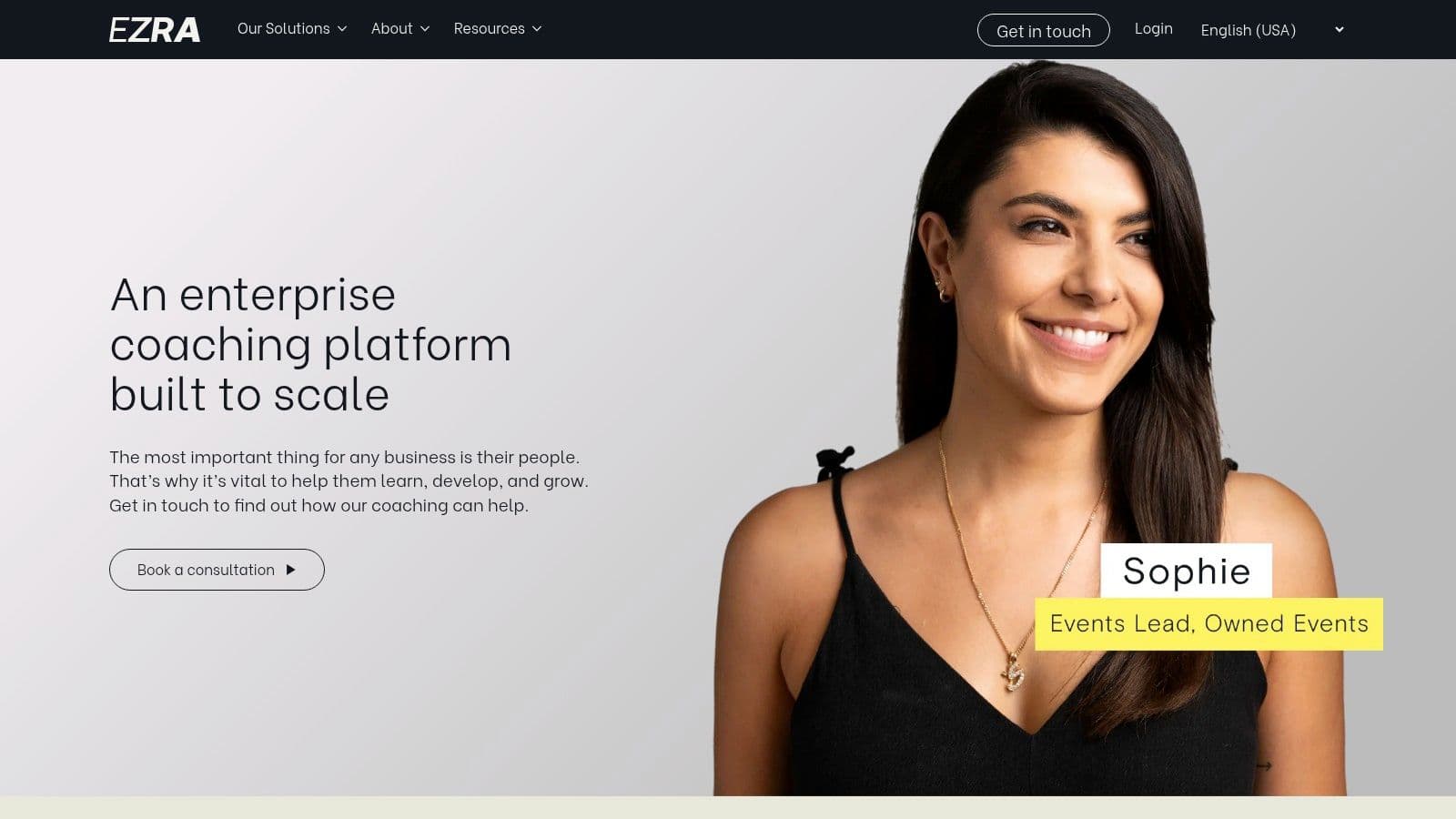
A common scenario in corporate coaching looks like this. HR wants leadership coaching available across regions, procurement wants a recognized vendor, and senior stakeholders want reporting they can defend internally. EZRA Coaching is built for that buyer.
Backed by LHH and the Adecco Group, EZRA sits on the enterprise end of the coaching workflow. It is less about helping a solo coach run discovery, onboarding, and client delivery, and more about giving employers a structured way to offer coaching at scale. That distinction matters in this list, because the earlier tools support the coach's day-to-day practice, while EZRA supports organizational rollout and oversight.
Where EZRA fits
I'd look at EZRA when the coaching program needs executive credibility, standardized delivery, and a vendor that clears internal approval more easily than a smaller platform. For HR and L&D teams, that can outweigh the loss of flexibility that independent coaches often value.
For solo practitioners, EZRA is usually more useful as a reference point than a purchase decision. It shows what enterprise buyers often prioritize: consistency, coach access, and program structure. If your work centers on personal reinvention or a career transition strategy that starts with deeper self-assessment, this platform enters much later in the process.
The trade-off is straightforward. EZRA gives companies a polished delivery model and institutional confidence. Independent coaches usually need closer client context, lighter admin, and room for a method that integrates both hard career strategy and reflective work.
One practical note. If clients are moving from enterprise coaching into active job search, they often need more tactical support than a platform like EZRA is designed to provide. That is where tools focused on execution become useful, including resources on understanding Jobscan match scores.
10. Jobscan
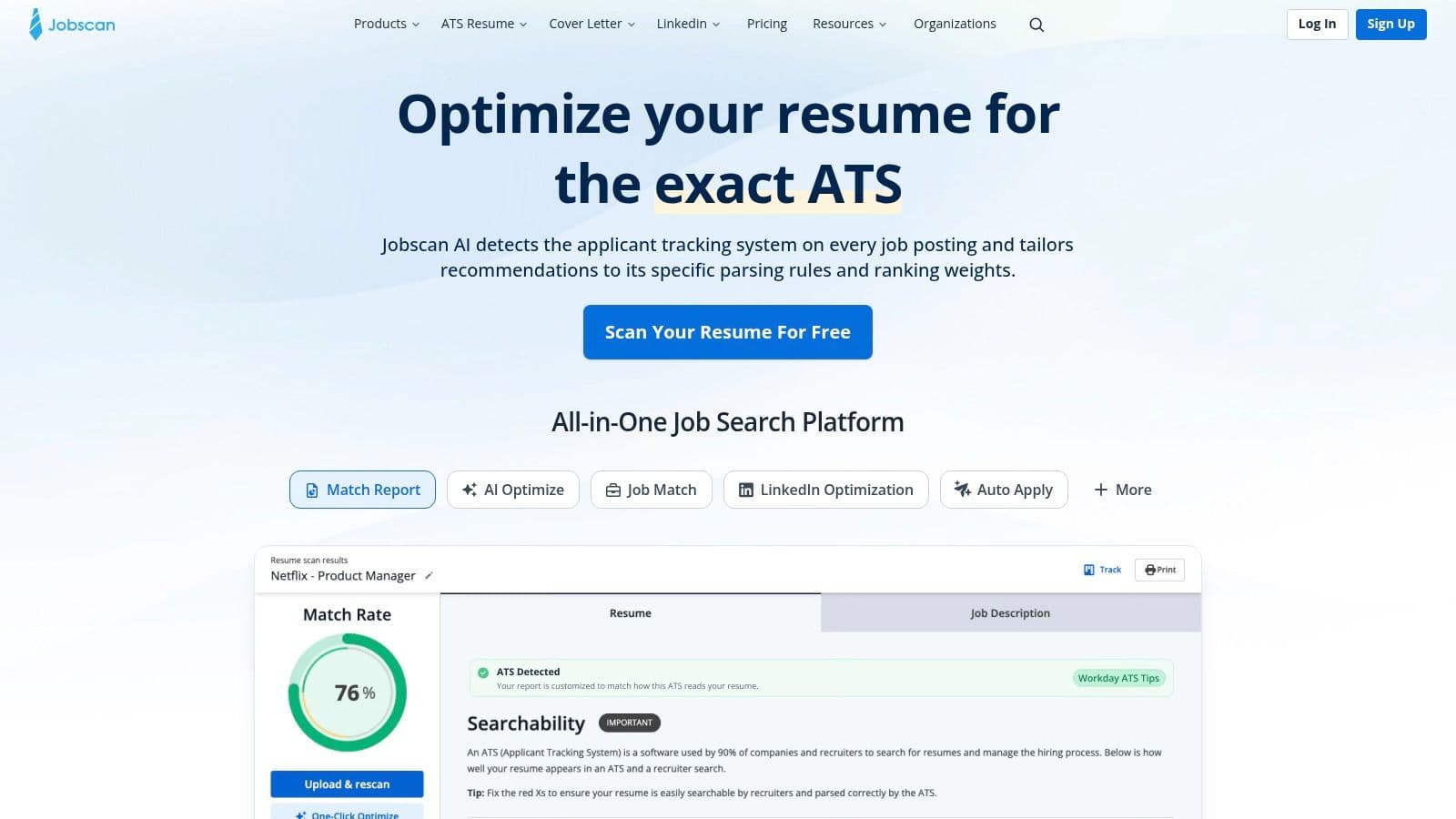
A client has a strong story, a clear target role, and a resume that reads well. Then the applications still stall. At that point, I want a tool that helps diagnose fit at the document level, and Jobscan is useful for that part of the workflow.
Jobscan works best late in the coaching process. Earlier tools in my toolkit help clients clarify direction, strengths, motivation, and program structure. Jobscan handles execution. It compares a resume or LinkedIn profile against a job description, surfaces missing keywords, and shows where the language is too far from what the employer is screening for.
Where Jobscan earns its place
I use it after positioning is settled. Once a client knows which roles to pursue, Jobscan helps translate a good strategy into a document that is easier for both ATS filters and recruiters to recognize.
That matters most in transition work. A client moving from operations into project management, or from academia into industry, often has relevant experience but the wrong wording. In that stage of a search, it pairs well with a broader approach to making a career transition. For a more tactical explanation of resume scoring mechanics, this piece on understanding Jobscan match scores is a useful companion.
The trade-off is real. Clients can start chasing the score instead of improving the message. A resume stuffed with keywords may test better in software and still sound thin, repetitive, or generic to a hiring manager.
So I treat Jobscan as a calibration tool, not a writing authority. It helps tighten alignment, catch obvious gaps, and give clients concrete revision work between sessions. The coach still has to protect clarity, credibility, and a search strategy grounded in the right target.
Top 10 Career Coaching Tools, Comparison Snapshot
A useful stack should match the way career coaching work happens. I look at these tools in sequence: deeper self-discovery first, client delivery and operations next, then enterprise scale and job-search execution.
| Product | Best fit in the workflow | UX / Quality (★) | Value / Pricing (💰) | Target audience (👥) | Unique selling point (✨) |
|---|---|---|---|---|---|
| Life Purpose App 🏆 | Early self-discovery, values work, pattern recognition, holistic coaching conversations | ★★★★, intuitive, multilingual, well supported | 💰 Free summary. Paid tiers include the full 25th Anniversary Edition, detailed analyses, and unlimited contacts | 👥 Spiritual seekers, Dan Millman readers, numerology enthusiasts, coaches | ✨ Official digital companion to The Life You Were Born to Live, with life-path and relationship mapping clients can use in session |
| CliftonStrengths (Gallup) | Strengths assessment, language-building, career direction, team development | ★★★★☆, familiar framework, strong coaching applications | 💰 Paid assessments. Pricing varies by report and organization licensing | 👥 Organizations, coaches, career development professionals | ✨ Well-known strengths framework with a large training and content ecosystem |
| CoachAccountable | Ongoing coaching delivery, action tracking, habits, metrics, team management | ★★★★, deep coach workflows, function-first UI | 💰 Subscription. Pricing is not fully public. Team Edition avoids per-seat fees | 👥 Independent coaches, teams, enterprises | ✨ Mature coach-specific workflows and reporting built for long-term program delivery |
| Paperbell | Solo practice setup, packages, payments, contracts, scheduling | ★★★★, simple, coach-friendly setup | 💰 Flat, transparent pricing. Core features are included | 👥 Independent coaches who want simplified packaging and delivery | ✨ All-in-one platform with low setup friction and predictable pricing |
| Satori | Intake, discovery, onboarding, forms, early-stage practice operations | ★★★★, focused, easy-to-learn coach UX | 💰 Tiered plans (Essentials/Pro/Leader). Free Scholar plan for trainees | 👥 Coaches at different business stages, trainees, certification programs | ✨ Scholar plan for trainees and pro bono pilots, plus plans that match practice growth |
| Coaching.com | Enterprise program management, coach matching, reporting, branded delivery | ★★★★, enterprise-grade depth and reporting | 💰 Enterprise pricing. Implementation can raise first-year cost | 👥 Firms and enterprises scaling multi-coach programs | ✨ End-to-end platform plus marketplace and guided coach matching |
| Torch | Leadership coaching tied to business goals, AI support, enterprise reporting | ★★★★, human-plus-AI model connected to organizational strategy | 💰 Custom enterprise pricing. Demo and procurement process required | 👥 HR and talent teams, enterprise leadership development | ✨ AI coaching agent combined with expert coaches and organizational reporting |
| CoachHub | Global coaching at scale, broad coach matching, AI personalization, ROI tracking | ★★★★, scalable international coaching experience | 💰 Contact-sales pricing. Not self-serve | 👥 Large organizations, HR leaders seeking scale | ✨ Large global coach network with AI-driven personalization and measurement |
| EZRA Coaching (LHH/Adecco) | Structured leadership coaching programs with built-in assessment | ★★★★, structured programs with measurable assessments | 💰 Contact-sales pricing. Enterprise procurement is typical | 👥 Corporations seeking executive and leadership coaching | ✨ Backed by LHH/Adecco, with integrated assessment and executive-level program options |
| Jobscan | Resume refinement, keyword alignment, application execution | ★★★★, task-focused, fast for application prep | 💰 Free tools plus Premium subscription for advanced features | 👥 Job seekers, career coaches supporting applicants | ✨ ATS-focused optimization and clear keyword gap analysis |
No single tool covers every stage equally well. That is the trade-off.
If your practice starts with identity, meaning, and long-range fit, Life Purpose App and CliftonStrengths belong near the front of the workflow. If your bottleneck is client management, CoachAccountable, Paperbell, and Satori solve very different operational problems. If you work inside large organizations, Coaching.com, Torch, CoachHub, and EZRA are built for scale, reporting, procurement, and stakeholder visibility. Jobscan sits at the end of the process, where strategy has to become a stronger application.
Choosing Your Coaching Toolkit Start With Your Why
A coach signs three new clients in one week. One needs clarity about direction, one needs a tighter coaching experience with better follow-through, and one needs help turning good strategy into a job search that gets interviews. If those clients all go through the same tool stack, something usually breaks.
The right toolkit depends on where your work starts and where it tends to stall. A solo coach selling a focused package needs different infrastructure from an enterprise provider running leadership programs across business units. In practice, the expensive mistake is usually not buying too little. It is buying a platform built for a different coaching model, then patching the gaps with manual work.
I start with the bottleneck. If onboarding, scheduling, and payments are consuming attention, Paperbell or Satori can clean that up. If clients need tighter execution between sessions, CoachAccountable usually does more for delivery and accountability. If the coaching engagement ends with resumes, applications, and ATS alignment, Jobscan makes sense late in the workflow. If the work begins with identity, meaning, and long-range fit, Life Purpose App or CliftonStrengths belong much earlier.
That sequence matters.
A lot of tool roundups mix self-discovery, practice management, and enterprise coaching into one flat list, as if they solve the same problem. They do not. My own workflow is layered. Start with insight. Then add client onboarding and program delivery. Then add tactical execution support if your clients need help translating insight into action.
I also would not separate practical and reflective work as sharply as many coaches do. Career decisions are rarely just about strengths or salary. They are also about timing, family systems, confidence, energy, and what a client believes their work is for. That is why I keep a spiritual self-discovery tool in the same conversation as SaaS platforms. Used well, it can surface patterns and decision friction faster than another intake form.
One caution from practice. Meaning without constraints can turn into fantasy, and operations without meaning can turn coaching into admin. Clients still have to make choices that fit their finances, responsibilities, and risk tolerance. Coaches who handle both sides well usually get better follow-through because the plan feels aligned and workable.
The stack does not need to be large. One tool for insight. One for running the coaching relationship. One for tactical execution, if your niche calls for it. That is enough for many career coaches.
If you want a deeper self-discovery tool in your coaching workflow, try Life Purpose App. It brings Dan Millman's The Life You Were Born to Live into a practical format clients can use between sessions, with life path insight, life-cycle context, and relationship dynamics that often surface career conversations faster than another worksheet ever will.
Discover Your Life Purpose Today!
Unlock your true potential and find your life’s purpose.
