Discover a step-by-step framework for career decision making. Assess your values, make clear choices, and align your career with your life's purpose.
July 13, 2026 (1mo ago)
Master Career Decision Making: Your Path to Purpose
Discover a step-by-step framework for career decision making. Assess your values, make clear choices, and align your career with your life's purpose.
← Back to blog
You've probably had this moment already. A job posting looks promising, a friend tells you about a new field, a part of you wants stability, another part wants meaning, and suddenly every option feels loaded. If you choose too fast, you worry you'll trap yourself. If you wait too long, you worry you're falling behind.
That tension is the core terrain of career decision making. It isn't just about picking a title. It's about identity, money, timing, energy, and the quiet question beneath all of it: will this life genuinely feel like mine?
The Crossroads of Career Decision Making
A lot of people think being stuck means they've failed some basic adult task. I don't see it that way. I see people at a crossroads, trying to make a decision that carries emotional weight and practical consequences at the same time.
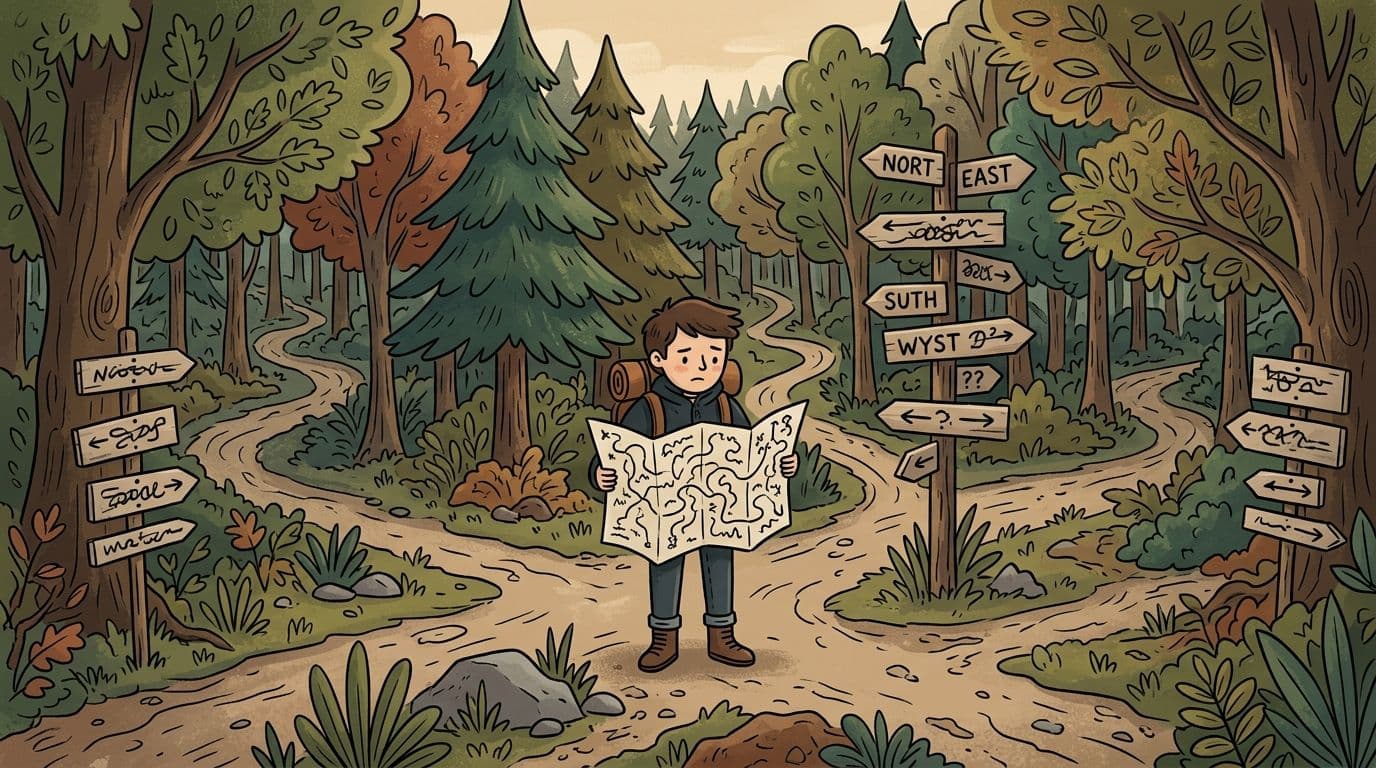
One client type I see often sounds like this: “I've built experience, but I'm not sure I want more of the same.” Another sounds different: “I have too many interests, and every choice feels like closing a door.” Different story, same friction. They're not lacking ambition. They're carrying too many variables at once.
That matters because modern careers rarely move in a straight line. Longitudinal data from Statistics Canada shows that career decision-making is a prolonged process, with nearly 4 in 10 young adults (38.3%) deciding to pursue a completely new career after their initial choice according to Statistics Canada's reporting on youth career paths. That doesn't describe a few confused outliers. It describes a normal pattern of re-evaluation.
Why indecision feels heavier now
Career choices used to be framed as one big reveal. Find the right field early, commit, and stay on track. Real life doesn't cooperate with that script.
People change. Industries change. Family responsibilities change. A role that looked good on paper at twenty-two can feel deadening later because your priorities matured. That isn't inconsistency. It's development.
Practical rule: Stop treating career indecision like a character flaw. Treat it like a signal that your current map is incomplete.
A better response is process, not panic. If you need structured help sorting through executive-level transitions, career pivots, or leadership trade-offs, AI-powered coaching for executive careers can be useful when you need a sharper outside perspective.
What actually helps at this stage
When someone feels overwhelmed, I don't tell them to “follow their passion” or “trust the market.” Both are incomplete. A strong decision usually comes from three moves:
- Reduce the fog: Identify the core decision. Are you choosing an industry, a role, a work style, or a lifestyle?
- Separate urgency from importance: Some choices need action now. Others only feel urgent because uncertainty is uncomfortable.
- Use a decision method: Clarity usually appears through structure, not through waiting for a flash of certainty.
That's the first shift. You don't need perfect confidence before you move. You need a reliable way to think.
Start with Who You Are Not What You Do
Most bad career decisions start too far downstream. People compare job titles before they've defined the standards those titles must meet. That's backwards.
Your first job is to build a personal decision filter. Not a vision board. Not a vague list of dreams. A working document that helps you judge options in a disciplined way.
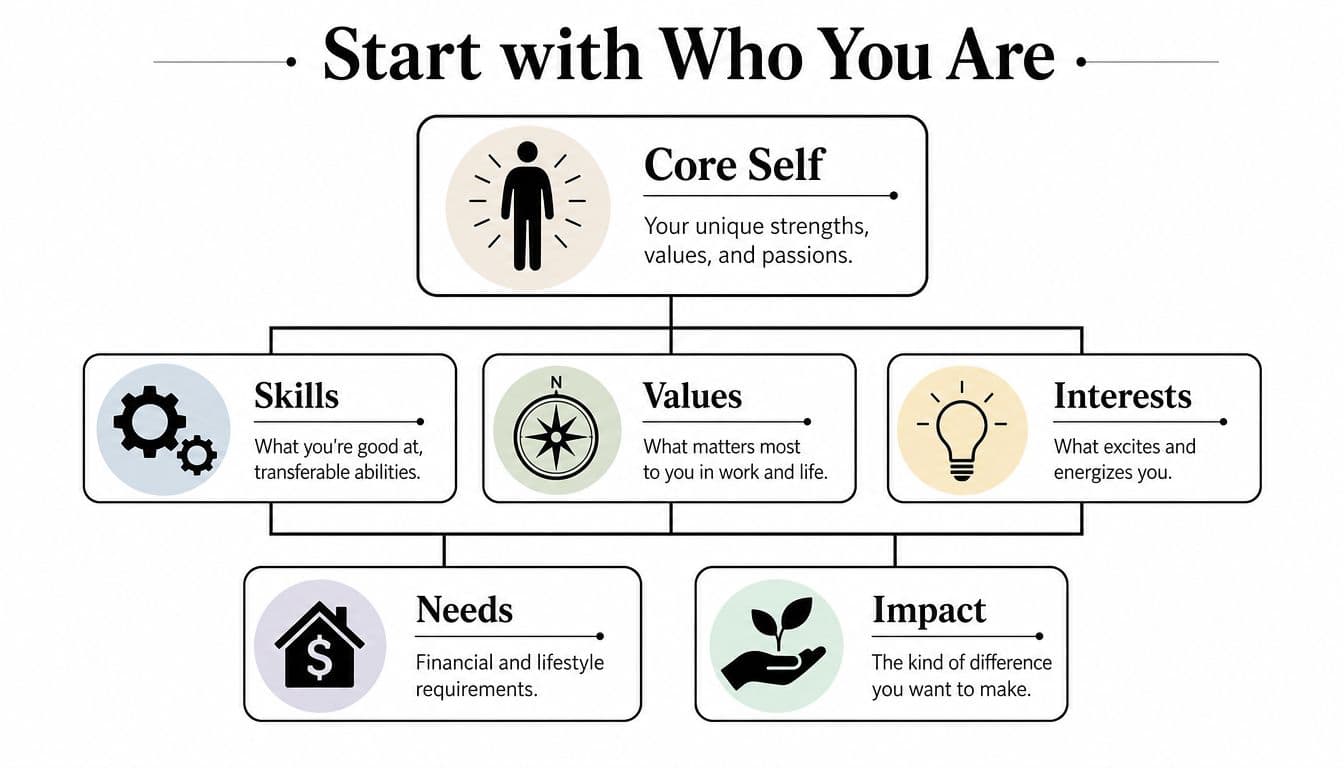
A strong filter includes values, strengths, interests, needs, and preferred impact. Without that, people chase prestige, copy someone else's idea of success, or drift into work they can perform but don't wish to sustain.
Build your personal decision filter
Start with a blank page and answer these prompts in writing.
- Values: What do you refuse to trade away for salary or status? Autonomy, stability, creativity, service, mastery, flexibility, recognition, quiet focus, community. Pick the few that really govern your choices.
- Strengths: What do people reliably trust you to handle? Look for patterns in past work, not compliments that sound nice but don't predict performance.
- Interests: Which tasks pull you in without forcing yourself? Don't ask what sounds impressive. Ask what holds your attention.
- Needs: What does your life require right now? Income floor, schedule control, location freedom, benefits, low travel, room for family responsibilities.
- Impact: What kind of contribution feels meaningful to you? Solving hard problems, helping individuals, building systems, teaching, designing, leading.
Write short evidence beneath each answer. If you say you value autonomy, note where lack of autonomy drained you. If you say mentoring matters, name when that work energized you.
Spot your pattern of indecision
People often assume they're “just overthinking.” Usually the pattern is more specific than that. A massive global study of over 31,000 people identified seven distinct types of career indecision, such as being “internally conflicted” or “generally uninformed,” proving that getting stuck is a universal experience with predictable patterns in this cross-national study on career indecision types.
That distinction helps because different problems need different remedies.
| Pattern | What it often feels like | What usually helps |
|---|---|---|
| Internally conflicted | “I want two incompatible things” | Rank trade-offs instead of trying to keep every option alive |
| Generally uninformed | “I don't know enough to choose” | Gather real role data before judging fit |
| Externally conflicted | “Everyone has an opinion” | Separate your values from family or social pressure |
| Unmotivated | “Nothing feels worth pursuing” | Look at burnout, discouragement, and energy before strategy |
Don't ask, “What career should I choose?” first. Ask, “What kind of confusion am I actually dealing with?”
If you want a deeper reflection exercise around identity before role selection, this guide on self-knowledge and direction is a useful companion.
A simple document that changes decisions
Your decision filter can fit on one page. Mine would include:
- Top values
- Non-negotiable needs
- Strengths I want to use often
- Work conditions I avoid
- Kinds of impact that feel meaningful
That page becomes your north star. If an opportunity pays well but violates three core criteria, it's not a good option. It's a tempting distraction.
Practical Tools for Making a Clear Choice
A pros-and-cons list feels productive because it's familiar. It's still one of the weakest tools for complex career decision making. It treats every factor as equal and lets mood influence the outcome too easily.
A better approach is to compare options with more structure. Think of three levels. Basic reflection, weighted comparison, and a full decision process.
Pros and cons versus a weighted matrix
Let's use one example. Say you're choosing between staying in operations, moving into UX research, or training as a coach.
A plain pros-and-cons list might help you brainstorm, but it quickly breaks down. “Higher pay” sits next to “more creative” as if they carry the same weight. They don't.
A weighted scoring matrix fixes that. You choose criteria from your decision filter, assign more weight to what matters most, and score each path against those criteria.
| Criteria | Weight | Operations role | UX research | Coaching |
|---|---|---|---|---|
| Autonomy | High | Medium | High | High |
| Income stability | High | High | Medium | Low to medium |
| Use of strengths | High | Medium | High | High |
| Meaning | High | Medium | Medium | High |
| Training burden | Medium | Low | Medium | Medium |
This doesn't make the choice for you. It shows where emotion may be overriding your own standards.
Use the CASVE cycle when the decision is tangled
When decisions carry greater weight, I prefer a more disciplined method. The Cognitive Information Processing approach, using the five-stage CASVE cycle (Communication, Analysis, Synthesis, Valuing, Execution), is a proven method that shows statistically significant reductions in career decision-making difficulties among those trained to use it, as summarized in this explanation of the CIP and CASVE framework.
Here's what that looks like in practice:
- Communication: Name the gap. “My current work is stable, but I feel disengaged and don't want ten more years of it.”
- Analysis: Look at self and options. Skills, values, constraints, role realities.
- Synthesis: Generate possibilities, then narrow them.
- Valuing: Judge the likely impact on you and others. What does each option cost, support, and limit?
- Execution: Choose, plan, and act.
If you like practical frameworks, this roundup of career coaching tools can help you turn reflection into a decision process.
Biases that quietly ruin good decisions
People often don't struggle because they lack intelligence. They struggle because certain thinking traps feel rational in the moment.
If your main reason for staying is “I've already invested so much,” you may be protecting the past instead of choosing the future.
Three traps show up constantly:
- Sunk cost fallacy: You keep going because of time, money, or education already spent.
- Maximization bias: You hunt for the single best option and freeze because every path excludes something.
- Gut-only decision making: You call it intuition, but sometimes it's fear, status anxiety, or familiarity.
One of the best correctives is a pre-mortem. Assume the choice failed two years from now. Ask why. That question forces you to surface risks before commitment instead of romanticizing an option.
Beyond Logic Connecting to Your Life Path
A logical choice can still feel wrong. That's one of the hardest truths in career work. You can choose the role with the best salary, strongest brand, and clearest path upward, then wake up months later with the sinking sense that you've built a life around competence instead of alignment.
That's where deeper self-knowledge matters. Not as a replacement for practical thinking, but as a layer that explains why certain paths nourish you and others don't.

Why self-awareness often isn't enough
Some people know themselves reasonably well and still can't move. They can describe their values, name their gifts, and talk intelligently about fit, yet they stay stuck between insight and action.
That gap is real. Research shows a significant “knowledge-action disconnection” in career choices, with up to 58.5% of students facing a decision-making block because they lack a foundational analysis of their unique identity, according to this Frontiers article on career decision barriers.
In practice, that often looks like this:
- You know you need meaningful work, but can't translate that into a role.
- You know your gifts, but don't know when to make a move.
- You know what you dislike, but still can't name what fits.
Bringing purpose frameworks into the decision
I find particular value in systems that go deeper than resume strategy. When I talk about life paths or numerology, I'm talking specifically about the framework in Dan Millman's book The Life You Were Born to Live and the companion Life Purpose App.
Millman's system originally defined 37 life paths for people born between 1750 and 1999, and the updated 25th Anniversary Edition expanded that to 45 unique life paths to cover those born after 1999, as noted in this interview about the updated edition. The system also uses birth numbers, where the intermediate sum points to obstacles and energies, while the final simplified number points to the main life mission, described in this overview of the birth-number mechanic.
I don't use that kind of framework to bypass reality. I use it to ask better questions.
A career choice gets stronger when it matches both your external reality and your inner pattern of meaning.
If your path emphasizes teaching, service, leadership, depth, discipline, or expression, that won't hand you a job title. It will, however, sharpen how you evaluate titles. It can also help explain why one role feels draining even when it looks impressive from the outside.
For readers who care about values as a predictor of sustainable performance, this piece on how values predict performance makes a useful complement to that deeper reflection.
The missing piece is often timing
Another reason a good option can feel off is timing. Dan Millman's The Life You Were Born to Live and the Life Purpose App are relevant here because the system maps a repeating nine-year life cycle that people use to think about timing in areas like health, money, and career, as described on the Life Purpose App site.
That doesn't replace common sense. It adds context. Sometimes the right career direction still needs a different season for full commitment, training, visibility, or risk.
A practical career decision isn't only about what fits. It's also about when you have the internal and external capacity to carry it well.
Test Your Path with Low-Risk Experiments
Once you've narrowed the field, stop debating in abstraction. Test your ideas. Small experiments beat long internal monologues almost every time.
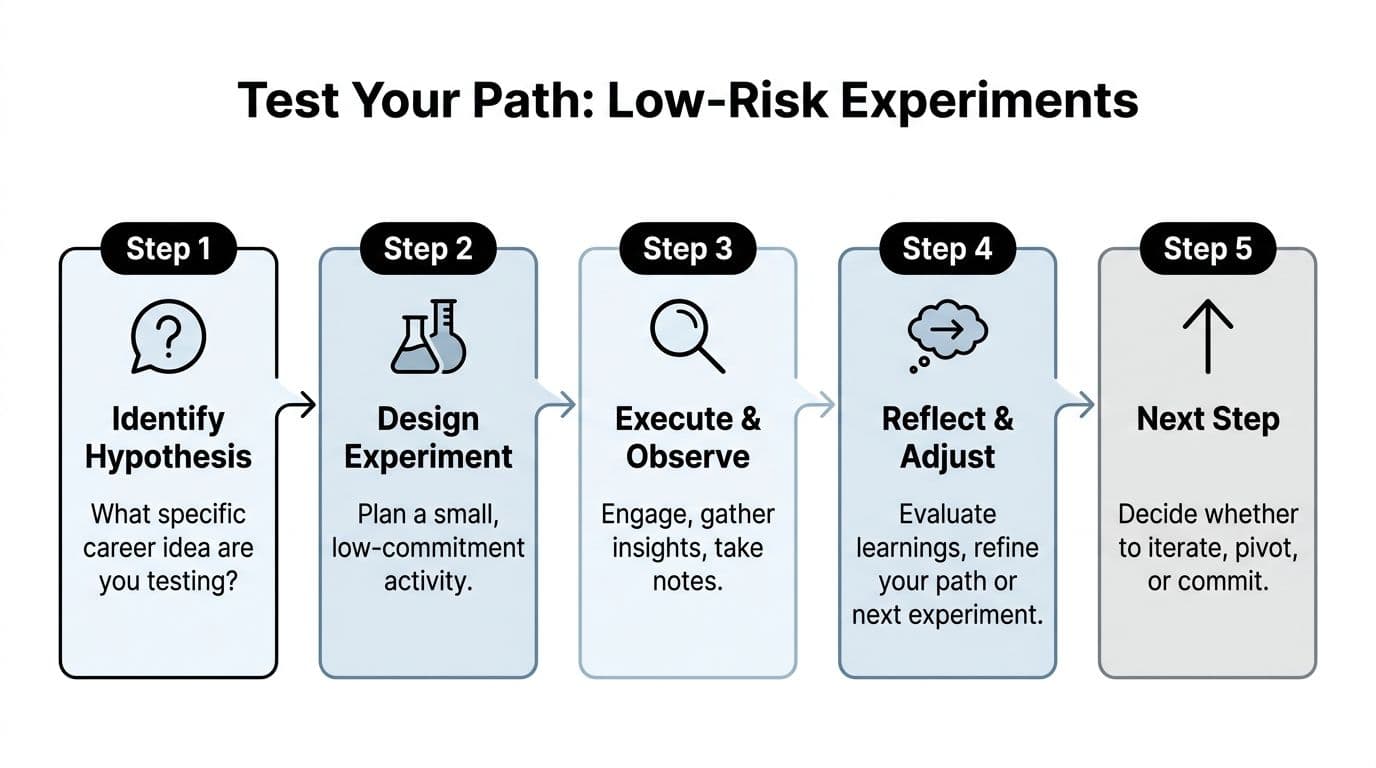
Many individuals become trapped by the search for the perfect answer. Behavioral psychology shows that “maximizers,” who obsess over finding the single best option, often suffer from decision paralysis. Running small experiments is a “satisficer” strategy, helping you find a great option by gathering real data and reducing the anxiety of the unknown, as discussed in this behavioral psychology explanation of maximizers and satisficers.
What a good experiment looks like
A career experiment should be small, specific, and informative. It should answer one concrete question.
Not “Should I become a therapist?”
Better: “Do I like spending focused time listening, guiding, and holding emotional complexity?”
Not “Would I enjoy product work?”
Better: “Do I enjoy turning messy user feedback into structured insights?”
Five useful experiments
- Informational interviews: Talk to people doing the work now. Ask about daily tasks, stress points, advancement, and what outsiders misunderstand.
- Short project work: Take on a contained freelance task, volunteer assignment, or internal stretch project that mirrors the role.
- Shadowing: Observe someone for a day or part of a day if the field allows it.
- Skill sampling: Enroll in a workshop or short course and notice your actual energy, not your fantasy self.
- Environment testing: Spend time in the kind of setting the job requires. Solo, client-facing, deadline-driven, collaborative, field-based.
Try to disconfirm your fantasy. If an option still fits after contact with reality, it gets stronger.
Questions to ask after each test
Don't end the experiment when the activity ends. Debrief it.
- What part of this felt natural?
- What drained me faster than expected?
- Would I want more responsibility in this kind of work?
- What skills or conditions made the biggest difference?
- Did the reality feel better or worse than the idea?
That reflection gives you something more useful than confidence. It gives you evidence.
From Decision to Action A Realistic Plan
A decision without a plan tends to dissolve under pressure. The first busy week, one difficult conversation, or one new doubt is enough to knock it loose. Action creates traction. Wishes don't.
The plan doesn't need to be elaborate. It needs to be concrete. If you've chosen a direction, translate it into what happens this quarter, this month, and this week.
Turn the choice into visible steps
I like a three-layer plan.
- Quarter: What outcome matters most? Examples include portfolio pieces completed, certification research finished, networking restarted, or a pilot offer tested.
- Month: What projects support that outcome? Break the quarter into chunks you can schedule.
- Week: What are the next three actions? Keep them clear enough that you can do them without another round of soul-searching.
If you want a reminder of why specific targets help people move instead of drift, this short read on why goals are important adds useful context.
Add accountability and review points
Individuals don't fail because the plan was wrong. They fail because the plan stayed private, vague, and easy to postpone.
Use at least one of these:
- A checkpoint partner: Someone who asks what you completed, not just how you feel.
- A recurring review: Weekly works well. Look at evidence, friction, and next moves.
- A visible tracker: One page, one document, one place where progress is obvious.
For a practical structure, personal development planning can help you convert insight into scheduled action.
Expect resistance without obeying it
You will feel doubt after choosing. That doesn't automatically mean the decision is wrong. Often it means the decision is real.
The useful question isn't “Do I feel totally certain?” It's “Am I acting in line with what I've already learned?” That standard is steadier. It respects both reflection and evidence.
If you want help connecting career direction with deeper purpose, the Life Purpose App offers a practical way to explore the system from Dan Millman's The Life You Were Born to Live. You can use it to understand your life path, reflect on core gifts and challenges, and bring another layer of clarity to career decisions that need to feel both grounded and meaningful.
Discover Your Life Purpose Today!
Unlock your true potential and find your life’s purpose.
