You may be at a familiar crossroads: your current work pays the bills, but something feels off. This guide shows how Dan Millman’s Life You Were Born to Live system turns a birth-date calculation into practical insight for aligning work with purpose, testing opportunities, and timing career moves.

May 23, 2026 (5mo ago) — last updated August 3, 2026 (2mo ago)
Career Path Numerology: Find Purpose with Millman
Use Dan Millman’s Life You Were Born to Live system to map your life path, align work with purpose, and time career moves.
← Back to blog
You may be at a familiar crossroads: your current work pays the bills, but something feels off. This guide shows how Dan Millman’s Life You Were Born to Live system turns a birth-date calculation into practical insight for aligning work with purpose, testing opportunities, and timing career moves.
Career Path Numerology: Find Purpose with Millman
Summary: Use Dan Millman’s Life You Were Born to Live system to map your life path, align work with purpose, and time career moves.
Introduction
You may be at a familiar crossroads: your current work pays the bills, but something feels off. Or you’re competent and respected, yet you suspect the work that truly matters sits just beyond your reach. This guide explains how to use Dan Millman’s framework from The Life You Were Born to Live to turn a birth-date calculation into practical insight for career clarity, timing, and vocational strength.2
You’ll learn how Millman’s approach differs from broad numerology lists, how to find the right life path for his system, and how to translate that path into testable career choices and timing strategies.
Career path numerology as a mirror, not a label
You’ve probably seen the nine-number framework where numbers 1 through 9 are treated as archetypes and a Life Path Number is calculated from the birth date by reducing month, day, and year to single digits and adding them together.1 That simple model can be useful, but it often reads like a personality snapshot rather than a working map for vocational development. For example, the common reduction of July 29, 1986 to a Life Path 6 (7 + 2 + 6 = 15 → 1 + 5 = 6) illustrates the method but only scratches the surface.4
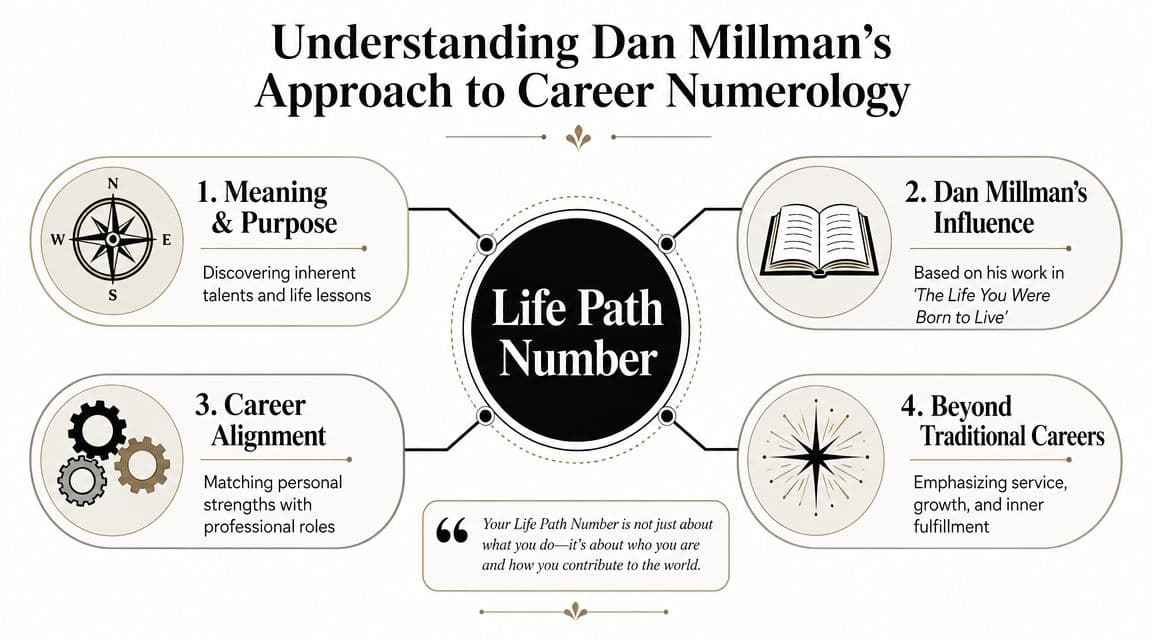
Dan Millman’s The Life You Were Born to Live approaches the birth date as a blueprint for recurring lessons, gifts, and forms of service rather than a job label. His system identifies 45 distinct life paths and highlights recurring tests, strengths, and developmental themes that show up across different work contexts.2
Understanding Millman’s approach to career numerology
Millman asks a different question than “What career matches my number?” He asks, “What qualities and lessons is my life asking me to develop through my work?” That shift makes the system more practical: it helps explain why certain environments drain you, why the same conflict returns in different roles, and where your natural abilities meet service.
Where generic numerology offers broad personality sketches, Millman’s system gives you a more detailed trail map: not just the highways, but the side roads, steep climbs, and places travelers commonly lose their way.
Career as an expression of purpose
Millman encourages you to read career as one arena where life lessons become visible. The better question is not, “What job matches my number?” but, “What kind of work helps me develop qualities my path is asking of me?” A person can succeed in several fields and still be living the same core lesson in each. That’s why Millman’s framework can be practical without becoming rigid.
Use it to reflect on questions such as:
- What contribution gives me a sense of meaning
- Which work struggles keep repeating, even in different roles
- Where do my natural abilities meet real service
- What qualities is my career asking me to strengthen
Practical rule: Use career path numerology to clarify patterns and purpose, not to outsource your choices.
Millman’s model tends to stay stable across life stages, which makes it useful in long-term career reflection. Many readers pair his book with a digital companion to ensure the path calculation and interpretation align with his framework.5
How to find your unique life path number (the Millman way)
The impulse to grab a calculator and add a birth date is understandable. In standard Pythagorean numerology, the method is straightforward: reduce month, day, and year to single digits and add them. But Millman’s system includes two-digit path nuances and life-cycle considerations—so a quick online widget that returns “You’re a 7” may miss important detail.1
If you want your Millman path as intended, hold two ideas at once:
- Your birth date is the entry point. The date matters and provides a concrete calculation.
- The interpretation needs Millman’s structure. His framework maps 45 paths and ties them to recurring lessons and gifts.
- Meaning comes after the number. First confirm the correct path, then study gifts, lessons, vocational themes, and timing.
If you want a reliable calculation tied to Millman’s system, use the official digital companion rather than a generic calculator.5

Connecting your path to vocational strengths
A common career moment: you’re good at your job, people respect your work, and yet something feels off. Millman’s system helps you examine that tension precisely. It treats vocational strength not just as a talent but as a pattern of energy—how you tend to contribute, which demands bring out your best, and where growth lessons show up on the job.
Three grounded examples:
- Expressive pattern: Teaching, coaching, writing, brand strategy, or community building. If placed in tightly scripted roles with little authentic communication, self-doubt can grow.
- Achievement/authority pattern: Operations, entrepreneurship, finance, leadership. The lesson is how to hold power cleanly without tying worth to outcomes.
- Inward/truth-seeking pattern: Research, analysis, healing, systems design, technical fields. These roles need depth and time for reflection; cultures that reward constant performance can drain them.
Gifts and friction often appear together. Friction at work may not mean you picked the wrong field; it can signal the lesson your path keeps placing in front of you.
| What you notice at work | What it may point to |
|---|---|
| You feel underused | A natural strength is not being asked for |
| You repeat the same conflict | A core lesson may be active |
| You perform well but feel flat | The role matches competence more than meaning |
| You feel stretched and engaged | Growth and alignment may be meeting |
For readers translating path themes into observable strengths, the Life Purpose App and other practical guides can help convert archetypal language into job-fit tests and resume framing.5
Making practical career choices with your insights
Insight is meaningful, but rent is real. Treat numerology as a structured self-reflection tool, not a predictive machine. There’s no peer-reviewed evidence that birth-date numerology forecasts job fit or performance, so use your path as a working hypothesis to be tested against observable features of roles.
Test the environment, not just the title
A title can be misleading. Instead, evaluate roles on factors such as:
- Autonomy: room to initiate and own outcomes
- Collaboration load: constant coordination vs. deep solo focus
- Pace of change: frequent shifts vs. steady building
- Ambiguity tolerance: comfort with uncertainty vs. success through structure
A leadership pattern doesn’t require a founder title—look for decision latitude, project ownership, and chances to shape direction.
A simple decision filter
- Write down your strongest path themes from Millman’s system.
- Translate themes into workplace needs: independence, service, creativity, rigor, visibility, depth.
- Review the job through those lenses.
- Notice where the role matches, where it strains you, and whether strain is developmental or draining.
Balance inner alignment with outer facts: credentials, responsibilities, compensation, and lifestyle realities all matter. Use practical tools (resume guides, job-search apps, interview practice) alongside reflection to make effective moves.
Timing your career moves with life cycles
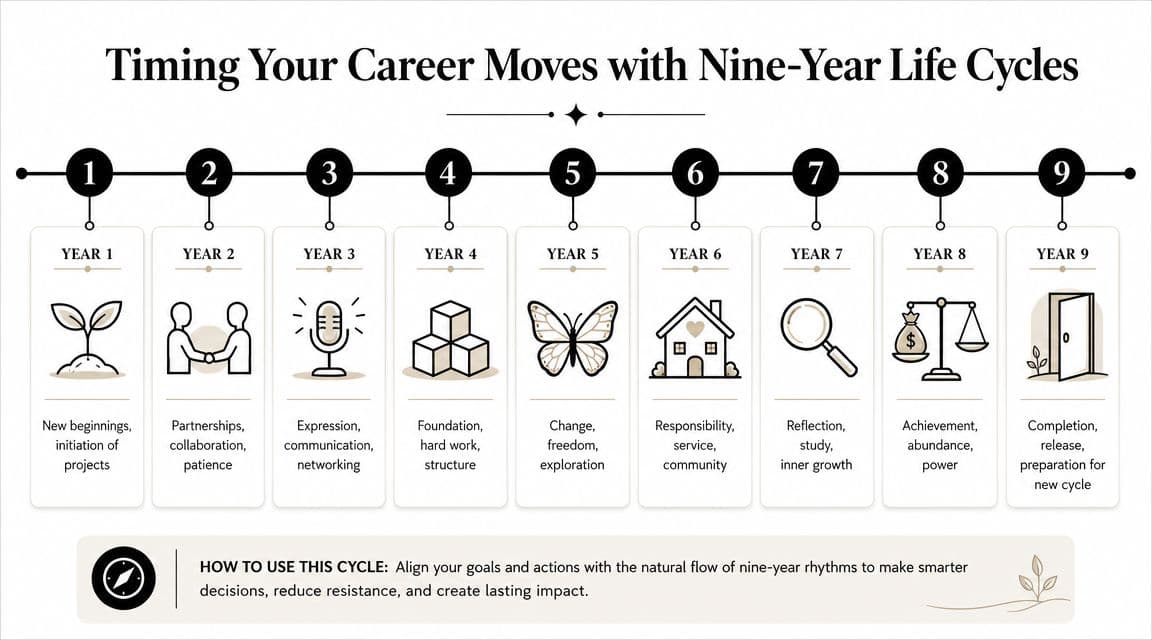
Many career guides skip timing, yet timing matters. Millman’s system includes nine-year life cycles that help contextualize seasons for initiation, building, change, and completion. Reading your season can reduce anxiety and guide when to launch, study, consolidate, or release commitments.
A role that feels wrong in one season may be right in another. Compare your timing to these broad rhythms:
- Years of initiation: favor starting and experimenting
- Years of building: favor discipline, systems, and commitment
- Years of change: favor reinvention, travel, or healthy disruption
- Years of completion: favor endings and preparation for a new cycle
People in different cycles can look out of sync—one launching a business, another returning to school, another closing a chapter—yet each may be exactly where they need to be. Millman frames life as rhythmic rather than random, which can calm career anxiety and clarify next steps.3
Your career as a journey of purpose
A career can be a ladder, a paycheck, a craft, a platform, or a form of service. Millman offers a quieter question: does the work you’re doing help you become who you came here to be? Career path numerology works best as a decision aid that points toward environments and developmental patterns rather than occupational guarantees.
The invitation is to become more honest about what sharpens you versus what depletes you. Be honest about whether you want prestige, freedom, service, depth, stability, expression, or some mix of those. Millman treats purpose as something lived, not performed; your career is one of the places where inner development becomes visible.
If you want to explore your path in Millman’s terms, start with the official companion to ensure your calculation and interpretation align with his 45-path structure.5
Quick Q&A: Common questions about career path numerology
Q1: Can numerology tell me which job to take?
A1: No single number guarantees a job title. Use your path to identify environments and developmental themes, then test roles for autonomy, collaboration, pace, and ambiguity.
Q2: How accurate is the Life Path calculation for Millman’s system?
A2: The birth date is the entry point, but Millman’s method includes two-digit paths and life-cycle context. Use a companion tool or the official resource for accurate Millman-specific results.2
Q3: How should I use these insights with real-world constraints?
A3: Treat the path as a working hypothesis. Translate themes into workplace needs, compare job realities against those needs, and accept that timing and practical facts (credentials, pay, location) matter.
1.
Pythagorean numerology overview: https://en.wikipedia.org/wiki/Pythagorean_numerology
2.
Dan Millman, The Life You Were Born to Live and official resources: https://www.danmillman.com
3.
Discussion on workforce change and skill shifts: https://www.ijcrt.org/papers/IJCRT25A3211.pdf
4.
Example of common Life Path calculation and career ideas: https://www.californiapsychics.com/blog/astrology-numerology/numerology-career-ideas-based-life-path-number.html
5.
Life Purpose App (official digital companion to The Life You Were Born to Live): https://www.lifepurposeapp.com
Discover your life path today
Enter your date of birth and see your life path, free.
Find your life path