Explore career path numerology using Dan Millman's framework. This guide explains how to use your life path number from his book to find vocational clarity.
May 23, 2026 (2mo ago) — last updated June 16, 2026 (1mo ago)
Career Path Numerology: A Guide to Finding Your Purpose
Explore career path numerology using Dan Millman's framework. This guide explains how to use your life path number from his book to find vocational clarity.
← Back to blog
You may be at that familiar crossroads. Your current work pays the bills, but something about it feels off. Or maybe you're good at what you do, yet you still have the quiet suspicion that your real work in life sits somewhere just beyond your reach.
That's where career path numerology starts to become interesting. Not as a magic answer. Not as a shortcut to “the perfect job.” And certainly not as a rigid label.
Used well, it can become a mirror.
In the familiar tradition, modern Western numerology grows out of Pythagorean numerology, where numbers 1 through 9 are treated as archetypes and a Life Path Number is calculated from the birth date by reducing month, day, and year to single digits and adding them together. One commonly cited example reduces July 29, 1986 to a Life Path 6 through 7 + 2 + 6 = 15, then 1 + 5 = 6, as described in this overview of numerology career ideas.
But if you're drawn to Dan Millman's book, The Life You Were Born to Live, you're stepping into a more specific map. It asks a deeper question than “What career matches my number?” It asks, “What lessons, gifts, and forms of service are woven into the life I came here to live?”
That's a different conversation. And a more useful one.
Understanding Dan Millman's Approach to Career Numerology
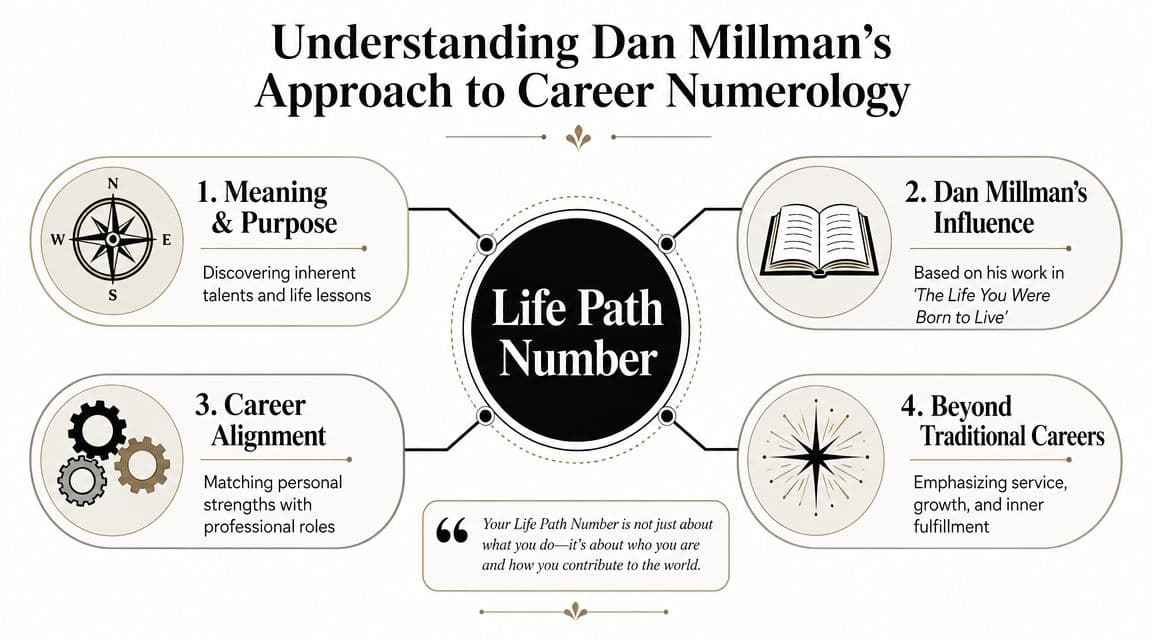
You can feel busy, capable, and even successful, yet still sense that your work is asking something more personal of you. Dan Millman's approach in The Life You Were Born to Live speaks to that moment. It treats your birth date less like a label and more like a blueprint for growth, service, and the lessons you keep meeting in real life.
That is a very different use of numerology.
Generic career numerology often offers broad personality sketches. You are independent. You are creative. You are analytical. Those descriptions may be interesting, but they rarely explain why certain work environments drain you, why the same conflict keeps resurfacing with bosses or clients, or why one kind of effort feels meaningful while another feels empty. Millman's system looks at a deeper pattern made up of strengths, recurring tests, and developmental themes.
Why this feels different from pop numerology
Many numerology articles stop with the familiar nine-number framework and attach each number to a likely career style. Millman's model is narrower, more structured, and more personal. In The Life You Were Born to Live, the focus is on 45 distinct life paths, each with its own blend of gifts and lessons. That added detail changes how you read career questions.
A simple comparison helps here. Generic numerology works like a map that marks only major highways. Millman's system adds side roads, steep climbs, and places where travelers commonly lose their way. If you are trying to understand work that fits your deeper nature, that extra detail is often what makes the guidance usable rather than merely interesting.
For a clearer explanation of how this system differs from standard number meanings, a focused overview tied specifically to his method is available.
Career as an expression of purpose
People often hear the phrase "career numerology" and assume it should name a profession. Millman points somewhere more grounded and more useful. He asks you to look at career as one arena where your life lessons become visible.
In other words, the question is not, "What job matches my number?" The better question is, "What kind of work helps me develop the qualities my path is asking of me?" A person may succeed in several fields and still be living the same core lesson in all of them. That is why Millman's system can be practical without becoming rigid.
You can use it to reflect on questions like these:
- What kind of contribution gives me a sense of meaning
- Which work struggles keep repeating, even in different roles
- Where do my natural abilities meet real service
- What qualities is my career asking me to strengthen
Practical rule: Use career path numerology to clarify patterns and purpose, not to outsource your choices.
A job title can change many times over a lifetime. The deeper pattern Millman describes tends to stay with you, much like the curriculum of a long course that shows up in different classrooms. That is why his approach stands apart from generic numerology and why readers looking for authentic guidance are usually better served by his original framework, or the official Life Purpose App built around it, than by broad one-size-fits-all number lists.
How to Find Your Unique Life Path Number
The initial impulse is to grab a calculator and add up a birth date. That's understandable. It's also where a richer system is often accidentally flattened into a quick internet formula.
In standard Pythagorean numerology, the method is simple. Reduce the month, day, and year to single digits, then add them. That's the structure behind many Life Path calculations. But if you're working from Dan Millman's The Life You Were Born to Live, that simple sum doesn't tell the whole story.
Accuracy matters here because Millman's system isn't just about a single base number.
Why a quick calculator can miss the point
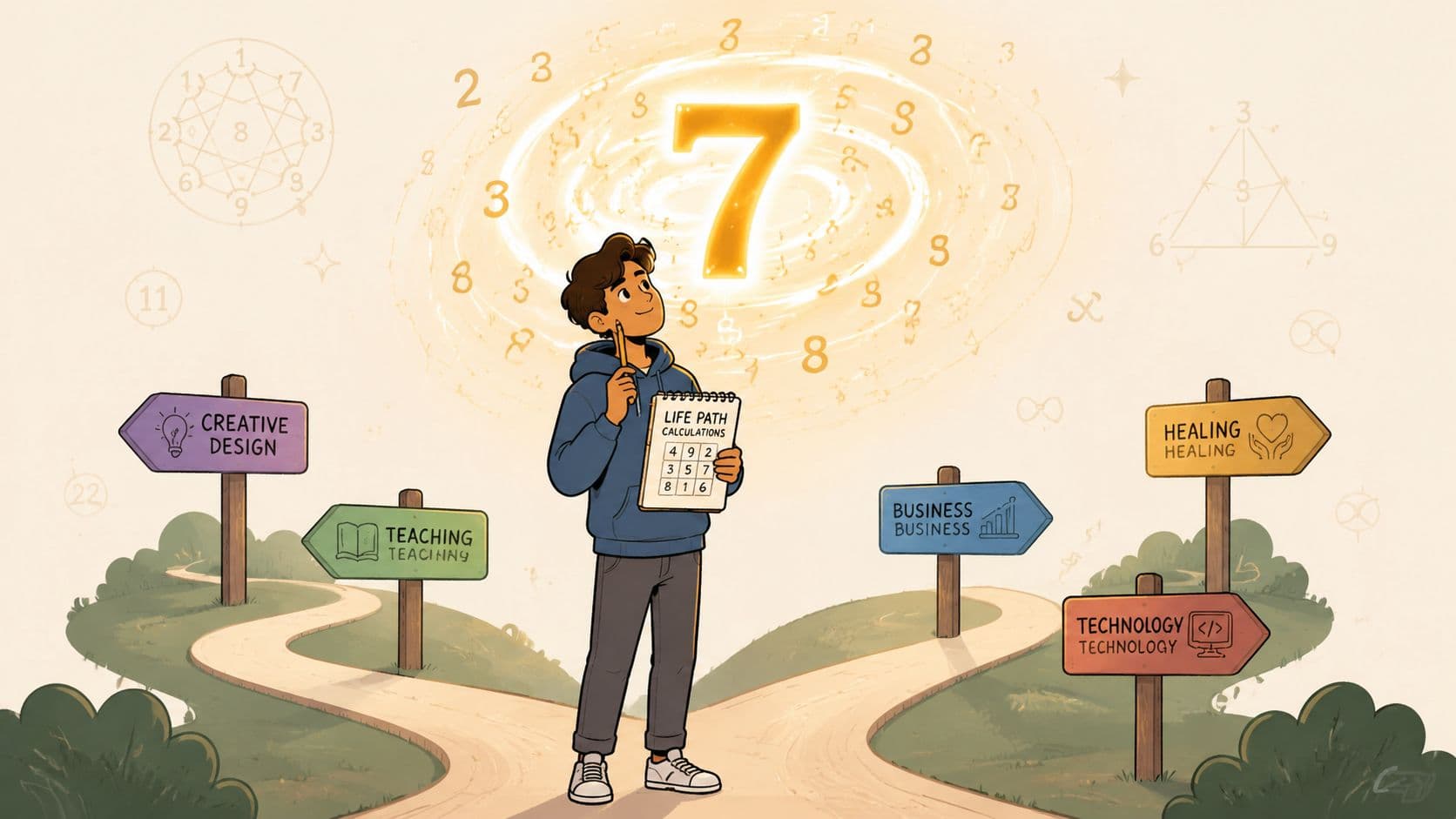
Many readers come in expecting one of the familiar nine categories. Millman's framework is more specific. It includes 45 unique life paths, many expressed as two-digit paths connected to a base number. That extra level of detail is part of what gives the system its depth in The Life You Were Born to Live.
A simple online widget that spits out “You're a 7” may leave out the very nuance you came for.
That's a little like hearing someone say you play “music” when what you really need to know is whether your instrument is piano, cello, or drums. The category is broad. The lived expression is specific.
A grounded way to approach the calculation
If you're curious, it helps to hold two ideas at once:
-
Your birth date is the entry point.
The date matters. This is not random or symbolic in a loose sense. It begins with a concrete calculation. -
The interpretation needs the right system.
Dan Millman's book, The Life You Were Born to Live, uses a specific structure. If you want your path as intended in that system, a generic calculator won't reliably deliver it. -
The meaning comes after the number.
People often rush to interpretation before they've identified the correct path. That's backwards. First get the right path. Then study the gifts, lessons, and career implications.
If your map is off by even a little, the directions that follow won't feel right.
For that reason, readers who want the calculation tied specifically to Millman's framework usually turn to the official digital companion built around The Life You Were Born to Live. The Life Purpose App calculates one of the 45 paths from a birth date and presents the path in the context of the system rather than a generic numerology list.
That's the heart of this step. Don't rush it. In career path numerology, a vague answer often creates more confusion than clarity.
Connecting Your Path to Vocational Strengths
A common career moment goes like this. You are good at your job, people respect your work, and yet something feels off. The role uses your skills, but it does not quite use you.
Dan Millman's system gives you a more precise way to examine that tension. In The Life You Were Born to Live, the question is not merely which profession matches a number. The better question is which kind of work draws out your natural strengths while also asking you to develop the lessons built into your path.
That difference matters. Generic numerology often stops at broad labels. Millman's framework is more like reading a detailed trail map instead of a road sign. A road sign can point you in a general direction. A trail map shows the terrain, the steep climbs, and the places where your footing matters.
Two people can share a similar surface style at work and still need very different things to feel aligned. One may need expression and human contact. Another may need responsibility and measurable results. A third may need depth, truth, and time to think. From the outside, all three can look successful. On the inside, only one environment may feel sustainable.
What vocational strength actually means in Millman's system
In this framework, a vocational strength is not just a talent. It is a pattern of energy. It describes how you tend to contribute, what kinds of demands bring out your best, and where your growth lessons are likely to show up on the job.
That is why broad job lists can mislead. “Teacher,” “manager,” or “writer” tells you almost nothing by itself. A classroom can reward inspiration or rigid control. A management role can involve mentoring people or just protecting metrics. The title is the container. Your path helps you understand what kind of container lets your nature function well.
Here are three grounded examples.
A person with a strongly expressive current often does well in work where ideas need to move between people. Teaching, sales conversations, writing, coaching, brand strategy, or community building may feel natural. If that person spends years in a tightly scripted role with little room for authentic communication, self-doubt can grow. The issue may not be lack of ability. The issue may be chronic mismatch.
A person with a stronger achievement or authority pattern may be drawn to operations, entrepreneurship, finance, leadership, or any role where decisions carry weight. They often bring steadiness under pressure. Their lesson is not whether they can hold power. It is whether they can hold it cleanly, without turning every result into a referendum on their worth.
A person with a more inward or truth-seeking pattern may come alive in research, analysis, healing work, systems design, strategy, or technical fields. They often need depth the way a plant needs water. Place them in a culture that rewards constant performance, quick charm, and endless meetings, and their energy can ebb away.
Gifts and friction usually appear together
Millman's model is helpful here because it treats struggle as information. Friction at work does not always mean you chose the wrong field. Sometimes it points to a lesson your path keeps placing in front of you.
| What you notice at work | What it may point to |
|---|---|
| You feel underused | A natural strength is not being asked for |
| You repeat the same conflict | A core lesson may be active |
| You perform well but feel flat | The role fits competence more than meaning |
| You feel stretched and engaged | Growth and alignment may be meeting |
This is a kinder way to read your career life. A recurring problem with authority, visibility, discipline, money, or trust may not be random. It may be the exact muscle your path is asking you to strengthen through work.
If you want a more focused companion to this idea, the Life Purpose App article on talents helps translate personal patterns into observable strengths. For readers who are actively exploring roles, resumes, or applications alongside that reflection, this guide on AI tools for job seekers can support the practical side of the search.
Your work life often functions like a training ground. The strengths feel natural. The lessons do not. Both belong to the path.
Making Practical Career Choices with Your Insights
In this area, people often need the most help. Insight is meaningful, but rent is real. Deadlines are real. Hiring managers are real. So how do you use career path numerology without floating away into abstraction?
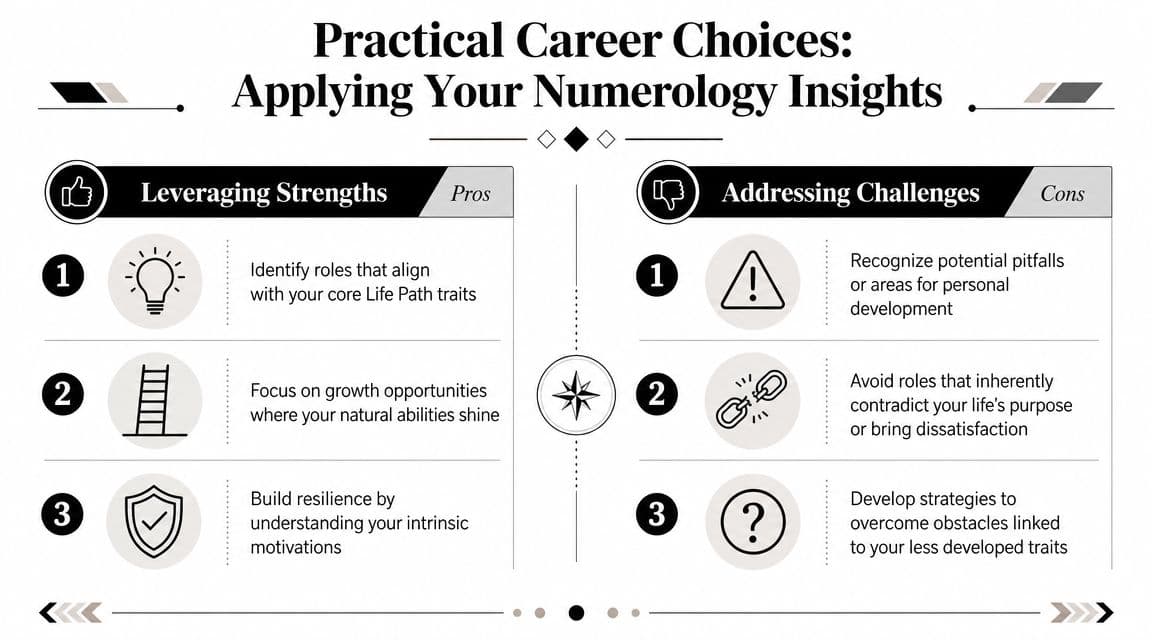
Treat it as a self-reflection tool, not a predictive machine.
That practical stance matters because there is no peer-reviewed evidence that birth-date-based numerology can forecast job fit or performance. A more defensible approach is to turn your archetype into a working hypothesis about what suits you, then test it against observable features of a role, as explained in this practical guide to careers for life path numbers.
Test the environment, not just the title
A title can be misleading. “Marketing manager” can mean creative strategy at one company and spreadsheet triage at another.
So instead of asking, “Is this the right career for my path?” ask questions like these:
-
Autonomy
Do you get room to initiate, decide, and own outcomes? -
Collaboration load
Does the role ask for constant coordination, or deep solo focus? -
Pace of change
Are you energized by frequent shifts, or do you do better building steadily over time? -
Ambiguity tolerance
Does this job require comfort with uncertainty, or success through structure and process?
A person who identifies with a leadership or initiative pattern shouldn't assume they need a founder title. They can test for fit by looking at decision latitude, project ownership, and how often they get to shape direction. That's a more grounded use of numerology.
A simple decision filter
Try this short exercise before accepting a role or making a pivot:
- Write down the strongest themes you see in your path from The Life You Were Born to Live.
- Translate those themes into workplace needs. Independence, service, creativity, rigor, visibility, depth.
- Review the actual job through those lenses.
- Notice where the role matches, where it strains you, and where the tension feels developmental versus draining.
If you're actively searching, practical support matters too. Alongside reflective tools, a resource like this guide on AI tools for job seekers can help with the operational side of the process, such as resumes, applications, and search workflow.
Reality check: A meaningful career choice honors both inner alignment and outer facts.
Some people also use the Life Purpose App as a way to review path themes from Dan Millman's The Life You Were Born to Live while comparing them against real-world constraints like credentials, responsibilities, and the kind of environment they want to work in.
That's the sweet spot. Spiritual insight in one hand. Practical evidence in the other.
Timing Your Career Moves with Life Cycles
Many people don't just want to know what fits them. They want to know when to move.
That question gets skipped in most career path numerology content. Plenty of material talks about personality and suitable jobs, but much less addresses the timing of a change, a retraining period, or the launch of something new. That gap matters even more in a labor market where adaptability has become central. In the World Economic Forum's Future of Jobs 2025 report, employers projected that 39% of workers' core skills will change by 2030, and 170 million new roles may be created while 92 million may be displaced, as noted in this discussion of career timing and workforce change.
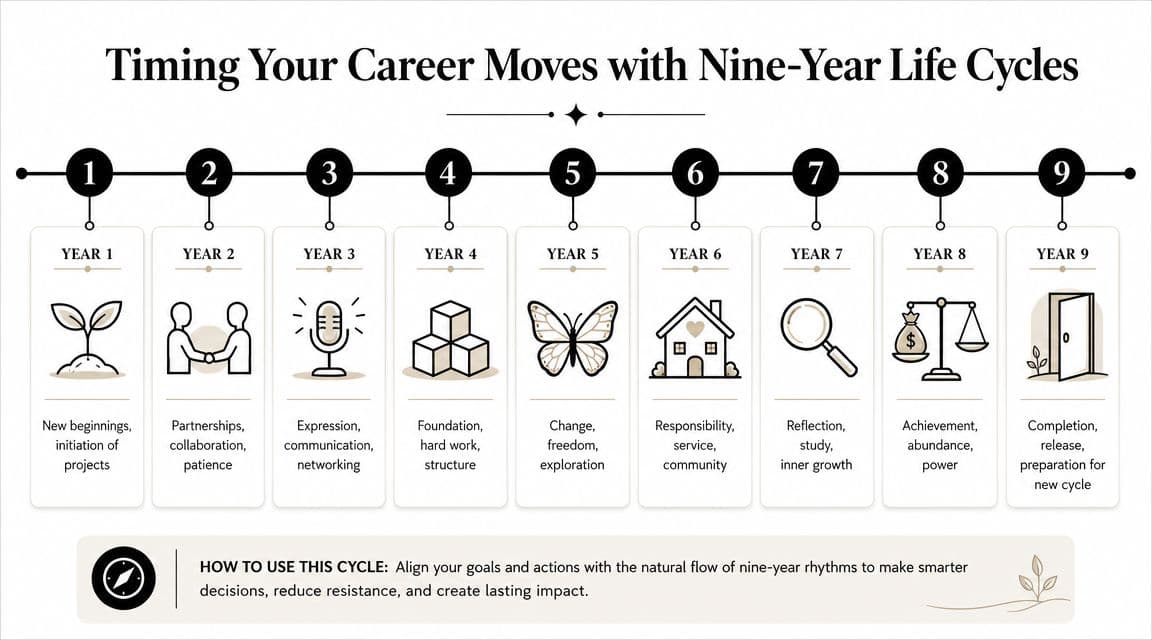
Dan Millman's The Life You Were Born to Live becomes especially useful here because it brings in nine-year life cycles.
Why timing changes the reading
A role that feels wrong in one season may become appropriate in another. Not because your soul changed, but because the lesson changed.
Career paths resemble farming. You don't harvest during planting season, and you don't force seedlings to behave like mature trees. Career decisions work the same way. Some years support bold beginnings. Others ask for patience, completion, study, or consolidation.
Here's the broad rhythm many people find helpful:
- Years of initiation often favor starting, experimenting, or stepping into a new identity.
- Years of building ask for discipline, systems, and commitment.
- Years of change can bring movement, travel, reinvention, or healthy disruption.
- Years of completion tend to highlight endings, release, and preparation for the next cycle.
Reading your season instead of resisting it
People get confused when they compare themselves to someone in a different cycle. One person is launching a business. Another is going back to school. Another is ending a chapter that no longer fits. All three may be exactly where they need to be.
That's why timing can calm career anxiety. It gives context to your restlessness.
If you're in a period that emphasizes reflection, forcing a dramatic leap may create unnecessary friction. If you're in a year that supports initiation, waiting too long can feel just as uncomfortable. Dan Millman's The Life You Were Born to Live frames this beautifully because it treats life as rhythmic rather than random.
For readers who want to explore this timing layer more directly, a Life Purpose App article on numerology life cycles offers a helpful orientation.
Your Career as a Journey of Purpose
A career can be a ladder, a paycheck, a craft, a platform, or a form of service. Sometimes it's all of those at once. What Dan Millman's The Life You Were Born to Live adds is a quieter question underneath them all. Does the work you're doing help you become who you came here to be?
That's why career path numerology is most useful when it moves beyond labels.
It isn't about saying, “You are this number, therefore you must do that job.” In practice, numerology works better as a decision aid that points toward work environments rather than occupation guarantees. An analytical orientation, for example, can fit research, cybersecurity, compliance, or data analysis depending on the conditions of the role, as described in this article on numerology and ideal work environments.
What this path asks from you
The true invitation is to become more honest.
Honest about the kind of pressure that sharpens you versus the kind that depletes you. Honest about whether you want prestige, freedom, service, depth, stability, expression, or some personal mix of all five. Honest about whether your current work reflects your gifts or only your survival skills.
That's why Dan Millman's The Life You Were Born to Live has stayed meaningful for so many readers. It treats purpose as something lived, not performed. Your career isn't separate from your inner development. It's one of the places where that development becomes visible.
A grounded final thought
If you take anything from this, let it be this. Your path doesn't need to be dramatic to be real. It needs to be aligned.
Sometimes alignment looks like changing industries. Sometimes it looks like staying in the same field but choosing a healthier environment. Sometimes it looks like finally admitting that the work you're good at isn't the work that gives your life meaning.
Career path numerology won't remove uncertainty. But through Dan Millman's The Life You Were Born to Live, it can give uncertainty a shape. And once something has a shape, you can work with it.
If you want to explore your path in a way that follows Dan Millman's The Life You Were Born to Live, start with the Life Purpose App. It's a practical way to look up your birth-date-based path, reflect on gifts and challenges, and study the timing patterns that may be influencing your career decisions right now.
Discover Your Life Purpose Today!
Unlock your true potential and find your life’s purpose.
