Learn what career purpose really means, how to tell if you're on or off track, and practical steps to clarify and align your work with what matters most.
August 4, 2026 (3d ago)
How to Find Your Career Purpose and Actually Live It
Learn what career purpose really means, how to tell if you're on or off track, and practical steps to clarify and align your work with what matters most.
← Back to blog
You can have a respectable career on paper and still feel a quiet mismatch underneath it. The meetings are fine, the pay is fine, the title looks fine, and yet Sunday night arrives with that familiar question, the one people try to ignore because everything seems stable enough to stay. Career purpose usually enters there, not as a dramatic life crisis, but as a nagging sense that your work and your deeper wiring aren't fully speaking to each other.
For a lot of people, that feeling doesn't mean they need a total reset. It means they need clearer language for what they're trying to build, and more honesty about what work can and can't carry. A career purpose is not a fantasy job, and it's not a demand that every workday feel inspiring. It's a way of understanding the contribution you're trying to make, the strengths you keep bringing with you, and the values you don't want to lose along the way.
The Moment Career Purpose Starts to Matter
A person can spend years doing everything “right” and still hit a strange wall. The résumé makes sense, the next promotion looks plausible, and the calendar stays full, but the work starts to feel oddly hollow. That's often the moment the question appears, not because life has fallen apart, but because the gap between outer success and inner meaning has become hard to ignore.
This is one reason career purpose shows up so often in mid-career conversations. Early on, many people are trying to get established. Later, once the basic structure is in place, they begin asking whether the structure matches who they are. The question isn't always “Should I quit?” More often it's “What exactly am I building, and why does it matter to me?”
A familiar kind of restlessness
The restlessness is easy to miss because it doesn't always look dramatic. Some people feel bored. Some feel overextended. Others feel oddly competent and strangely uninvolved at the same time. They can do the job, but they don't feel attached to the meaning of it.
Practical rule: If the work is stable but your inner interest keeps shrinking, don't treat that as immaturity. Treat it as information.
That matters because purpose isn't just a private preference. It affects how people engage at work, how they tell their story, and how they decide what deserves another year of their life. The point of this article is not to promise a perfect answer. It's to help you separate the parts of the problem you can work with from the parts that only look mysterious because nobody has named them clearly yet.
What Career Purpose Actually Means
Career purpose is the through-line that connects your contribution, your values, and your natural strengths over time. It's not the same thing as a job title, because titles are external. It's not the same thing as a passing passion, because passions can flare up and fade. And it's not identical to life purpose, because life purpose is broader and includes relationships, inner growth, and the kind of person you're becoming outside work.
A simple way to hold the difference is this. Career purpose is a compass, not a destination. A compass helps you choose direction when the road bends. It doesn't hand you a finished map of every stop you'll make.
That distinction matters because a lot of confusion comes from treating purpose like a single perfect role you must discover before life can begin. In practice, a sense of purpose works as a way to decide whether a path still fits, whether a role lets their strengths breathe, and whether their daily effort points toward something they care about. That's why purpose can stay steady even when jobs change.
Dan Millman's book, The Life You Were Born to Live, offers one structured way to think about this. Its life-path framework asks people to look at recurring gifts and challenges rather than only at surface preferences. The Life Purpose App is built as a companion to that book, and it gives people a way to enter a birth date, see a life-path summary, and use that as a mirror for patterns they may already sense in themselves. For some readers, that kind of structure makes purpose feel less vague and more workable.
How to keep the definition grounded
A useful definition has to survive real life, not just sound elegant. If your idea of purpose can't handle bills, setbacks, or changing roles, it's too fragile to be useful. The better test is whether it helps you notice patterns, make choices, and explain your work in a way that feels honest.
Purpose is strongest when it becomes legible in action. That's why it helps to ask, What do I keep doing well, even when the setting changes? and What kind of contribution leaves me feeling more like myself, not less? Those questions are more useful than trying to force a grand label onto your whole career.
Why Purpose Matters at Work and Where It Doesn't
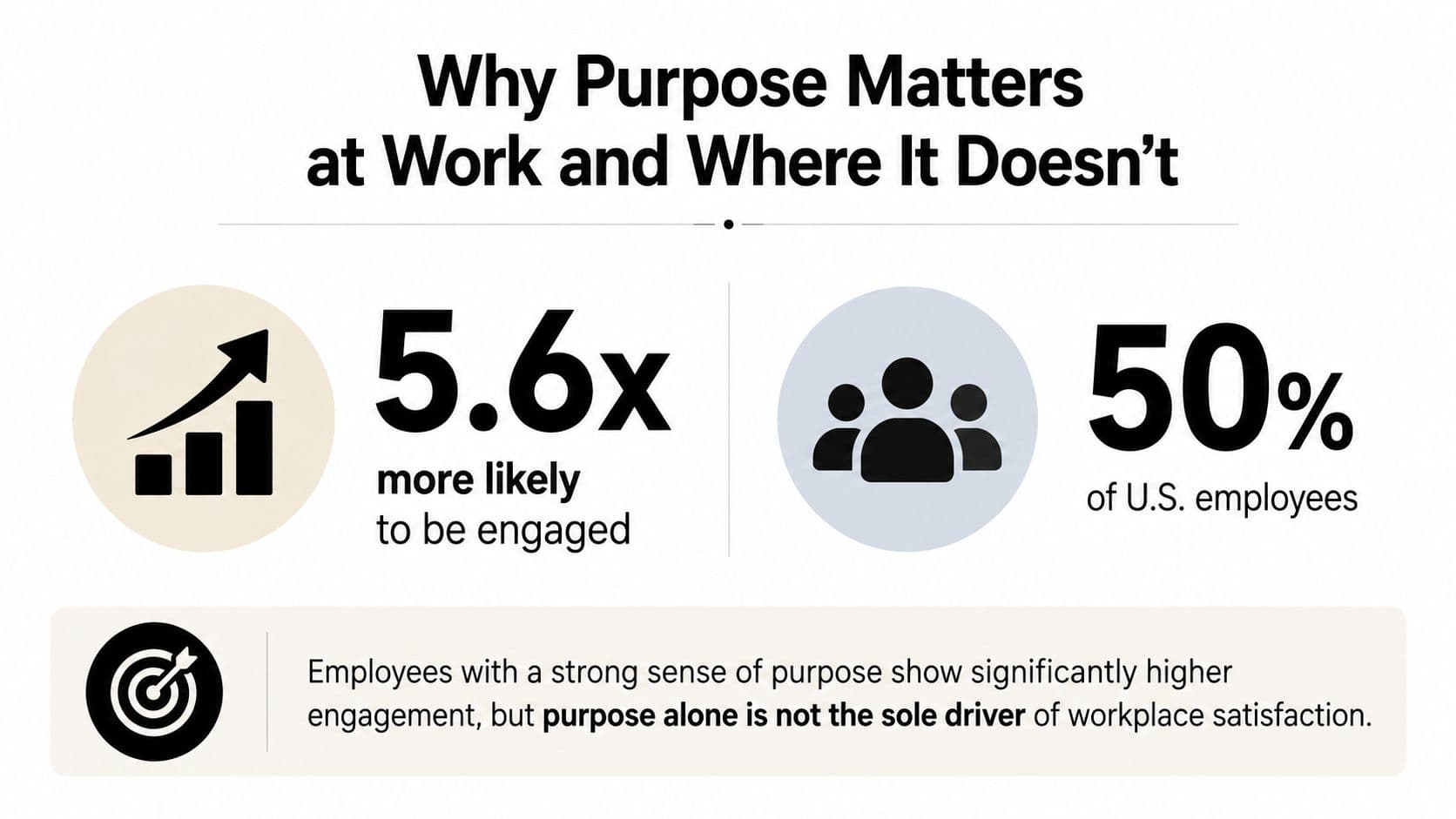
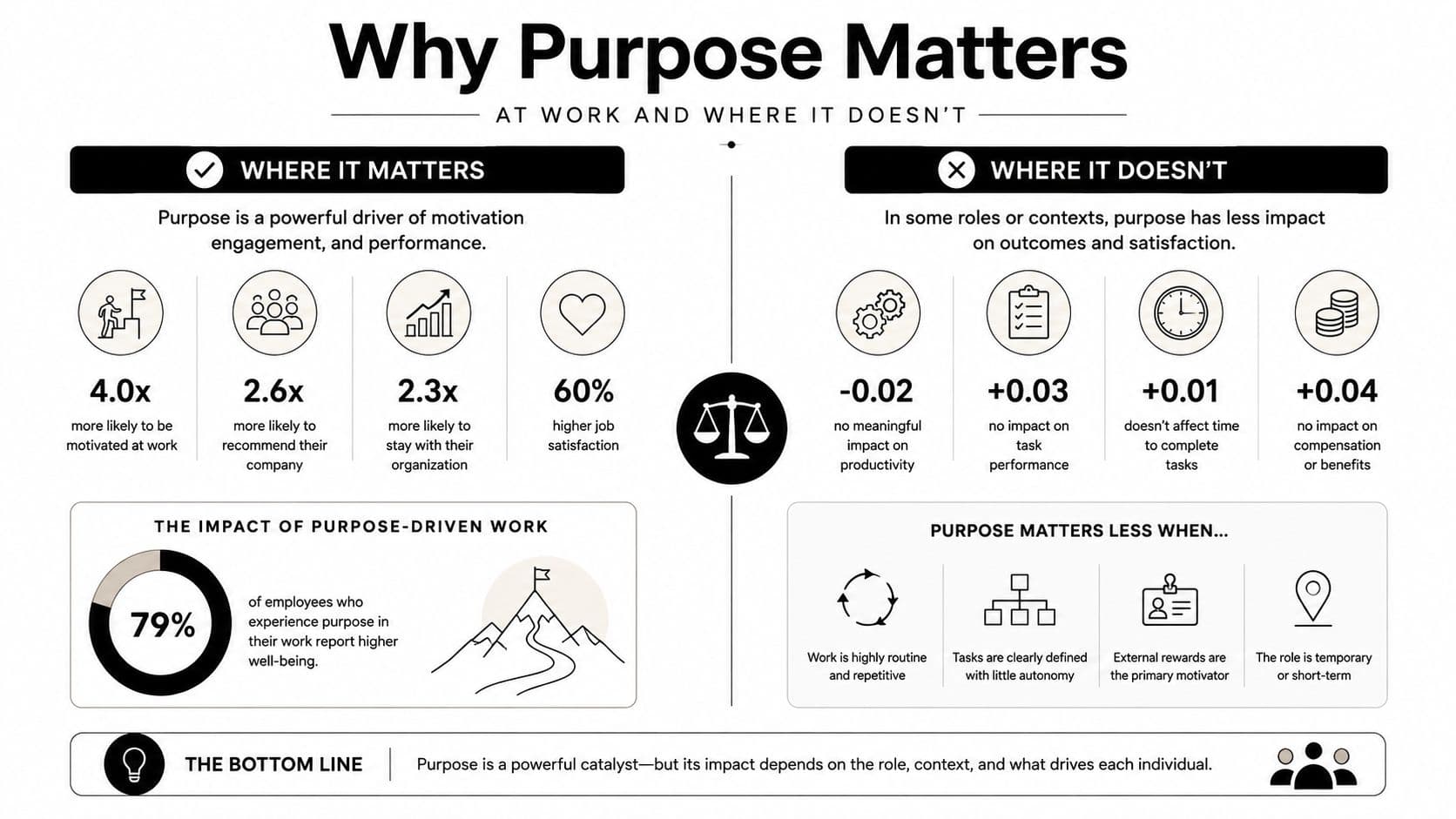
The data makes one thing clear, purpose at work isn't just a nice idea. Gallup reported in 2024 that employees with a strong sense of purpose at work are 5.6 times as likely to be engaged as those with a low sense of purpose, and that 50% of U.S. employees with strong work purpose are engaged. Gallup also found that 45% of employees say they work primarily to collect a paycheck and benefits, which is a reminder that meaning is unevenly distributed across the workforce. Gallup's 2024 findings on purposeful work show that engagement correlates with purpose, but access to meaningful work varies.
That's only part of the picture. LinkedIn's global purpose-at-work report found 37% of members worldwide were purpose-oriented, and another 38% weighed purpose equally with money or status. The U.S. workforce sat near the middle at 40%, slightly above the global average, which suggests that purpose is widely desired, but not universally organized around in the same way. LinkedIn's Global Report on Purpose at Work shows how long this conversation has been around, and how broad the interest already was.
The useful tension people often miss
Purpose matters most when it can be expressed in the work itself. In technical roles, that often means outcomes, not slogans. A resume becomes more credible when it uses measurable impact, because numbers make purpose readable as performance rather than self-description, a point reinforced in resume-metrics guidance for technical experience. That's one reason the conversation about purpose should include evidence, not just identity.
At the same time, there's a healthy contrarian view. The University of Virginia Department of Economics argues that a career does not have to have a single overarching purpose, and MIT Sloan Management Review notes that organizational purpose and personal purpose are not always aligned. That means purpose is powerful, but it isn't a moral duty, and it isn't always something a single job can fully hold. For career planning, that's a relief, not a failure. It lets you ask a more practical question, what belongs in work, what belongs outside work, and what kind of balance you want across a whole life.
If you're mapping those trade-offs, a broader view of planning can help, especially one that keeps the conversation practical rather than idealized. One useful starting point is this guide on career planning strategies, which sits closer to real decisions than abstract inspiration does.
Signs You're On or Off Purpose
People often expect purpose to feel loud. In reality, it usually shows up as a sense of fit that doesn't need to announce itself. The work may still be hard, but it doesn't feel like constant translation. You can see where your effort goes, and you can feel some connection between what you do and what you care about.
Questions that point toward fit
Ask yourself a few honest things. Do you lose track of time because the work uses your mind in a satisfying way? Do other people's problems feel meaningful to you because the work lets you solve them? Do your strengths feel useful rather than decorative? If the answers keep leaning yes, you may be closer to purpose than you think.
Off-purpose signs can look quieter than people expect. Chronic boredom is one. Constant comparison with peers is another. So is the strange feeling that you're performing a role instead of expressing a skillset that's yours. Those aren't just mood problems, they're signals that the work may not be using your wiring well.
Some people don't feel off purpose as pain. They feel it as numbness.
That numbness is what makes purpose hard to name. Pain is obvious. Numbness is easy to normalize. People say they're fine, then spend years gradually losing curiosity, energy, or confidence. If burnout is part of what you're facing, it can help to read how executives recover from burnout with the understanding that fatigue and misalignment often feed each other.
A simpler way to self-check
Try separating the question into three parts. First, what tasks drain you for reasons that have nothing to do with effort? Second, where do you feel alert in a way that seems to come from your own design? Third, what kind of contribution would still matter to you even if nobody applauded it right away? Those answers won't hand you a job title, but they will reveal patterns.
That's enough to start. Purpose usually becomes clearer when you stop asking whether you love every part of your work and start asking whether the work consistently lets you recognize yourself.
Using Dan Millman's Life-Path System and the Life Purpose App
Dan Millman's The Life You Were Born to Live presents a life-path system built around 45 unique life paths. In that framework, the date of birth is used as an entry point for exploring recurring gifts and challenges across areas like career, money, health, relationships, and other parts of life. The point isn't to reduce a person to a number. It's to give language to patterns that can otherwise feel too vague to trust.
The Life Purpose App works as a digital companion to that book. You enter your birth date, and it returns a summary of your life path, a system overview, and access to deeper analyses if you choose the paid options. In practical terms, that means it gives you a structured mirror. It doesn't tell you what job to take or what identity to adopt. It helps you compare the work you're doing with the drives and abilities the system says you carry.
Where the framework helps most
This kind of tool is most useful when your own self-assessment keeps looping. Some people know they're capable, but they can't tell whether they're underusing themselves or in the wrong environment. Others sense a pull toward certain kinds of work, but they can't articulate why the pull keeps returning. A life-path framework can make those patterns easier to examine without pretending to make the decision for you.
That's where a life purpose oracle guide fits in naturally, because the idea is not prediction, it's interpretation. A framework like this can serve as a check against self-deception. If your current role clashes with the talents and challenges you keep seeing in yourself, that clash deserves attention. If the role lines up well, the framework can give you confidence that you're not missing something obvious.
A grounded way to use it
Treat the output as evidence to compare, not a verdict to obey. Read it, notice what feels accurate, then look back at your own work history. Where have you felt most alive, most effective, or most drained? Do the patterns line up? If they do, you have something more stable than a mood. You have a working theory.
A Stepwise Practice to Clarify Your Career Purpose
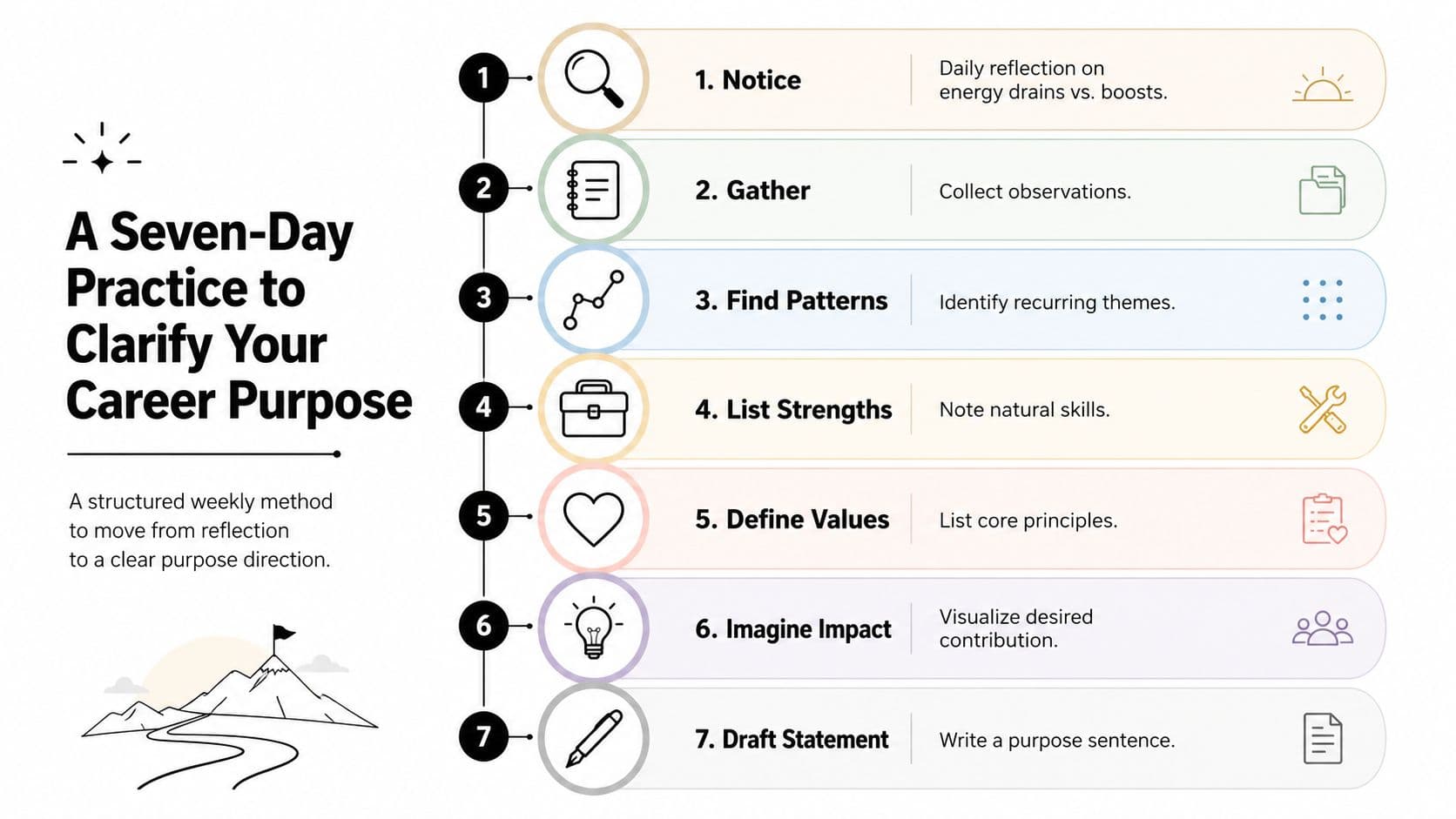
A clear purpose rarely arrives in one clean sentence. It usually emerges from noticing, comparing, and testing. For a busy professional, a week is enough to get started if the steps stay simple and honest.
Day 1 and Day 2 notice what moves your energy
Spend ten minutes at the end of each day writing down what drained you and what energized you. Don't editorialize. Just list the meetings, tasks, conversations, and moments that left a mark. By the second day, you'll already have enough material to see whether your reactions are random or patterned.
Day 3 and Day 4 gather and sort the evidence
On the third and fourth days, group the notes into themes. Maybe you feel sharper when you're solving a concrete problem, or calmer when you're helping someone understand something complex. Maybe your energy rises around autonomy and falls in crowded, reactive settings. The point isn't to label yourself too quickly, it's to notice recurring conditions.
Practical rule: If a theme shows up repeatedly in a week, treat it as a serious clue, not a coincidence.
This is also a good moment to compare your observations with a structured lens. The about this coaching guide resource can help you think about career development as a process of reflection and adjustment rather than a single leap. If you're using Dan Millman's framework or the Life Purpose App, read the summary now and ask where it confirms or challenges your own notes.
Day 5 through Day 7 test one hypothesis
By the fifth day, write one sentence that begins, “I may be most purposeful when I…” Keep it provisional. Then test it with one small experiment. That could be a conversation with a manager, a short project shift, or a volunteer task that leans into the pattern you noticed. By the seventh day, you won't have a life verdict, but you will have a sharper guess and a first real test.
The values clarification exercise can sit alongside this process because purpose gets clearer when values stop staying abstract. A purpose statement that survives a week of honest evidence is worth more than one that only sounds good in the abstract.
The One-Calling Myth and How Purpose Actually Evolves
A lot of career advice still assumes there is one perfect path waiting to be found. That idea can feel reassuring, yet it also puts a kind of pressure on people that real careers rarely satisfy. Purpose usually changes as skills deepen, responsibilities shift, and your idea of a good life matures. Like a map that gets updated as roads are built, purpose is something you refine as you go.
Recent career research points in the same direction. The career pivot advice from Eztrackr reflects a practical truth about transitions, people often need to adjust rather than start over from zero. Broader survey work on younger workers has also pointed to the mix of money, meaningful work, and well-being as a real balancing act, and university career resources often describe development as uneven rather than straight. Put together, those ideas weaken the one-calling myth. A career can be purposeful without being singular.
Purpose can be a moving target
That does not make purpose vague. It means purpose is alive. A role that fit well at one stage may feel too narrow later, while a job that once seemed overly practical may become meaningful because it supports stability, growth, or family life. Dan Millman's framework in The Life You Were Born to Live helps here because it treats a life path as a pattern to study, not a fixed script to worship.
Purpose also differs from passion in that it does not require daily drama. It works more like a working alignment between what you do, what you can carry, and what matters in your current season. Some people feel that alignment strongly inside their job. Others find part of it at work and part of it through family, service, learning, or a side project. That split is not a failure by default. It may be the honest shape of a healthy life.
MIT Sloan's discussion of organizational purpose and personal purpose not always matching fits this reality too. A workplace can have a mission that does not fully mirror yours, while your own purpose still shows up in how you work, how you learn, and what you bring home with you. That is one reason people can stay engaged without believing their job must carry their whole identity.
What to do when work only partly fits
The answer is not always to leave. Sometimes a shift in scope, team, or responsibility is enough to make the same role feel more coherent. Sometimes the work is decent enough, and the deeper purpose is developing through another channel, such as caregiving, service, study, or a project outside work. That is often more truthful than pretending every job should feel like a calling every day.
If you are weighing a move, the practical side matters too. career pivot advice from Eztrackr can help you think through transition without treating reinvention as the only option. The better question is simpler: does your current role still support the mix of stability, growth, and meaning you need right now?
Bringing It All Together and Choosing One Next Step
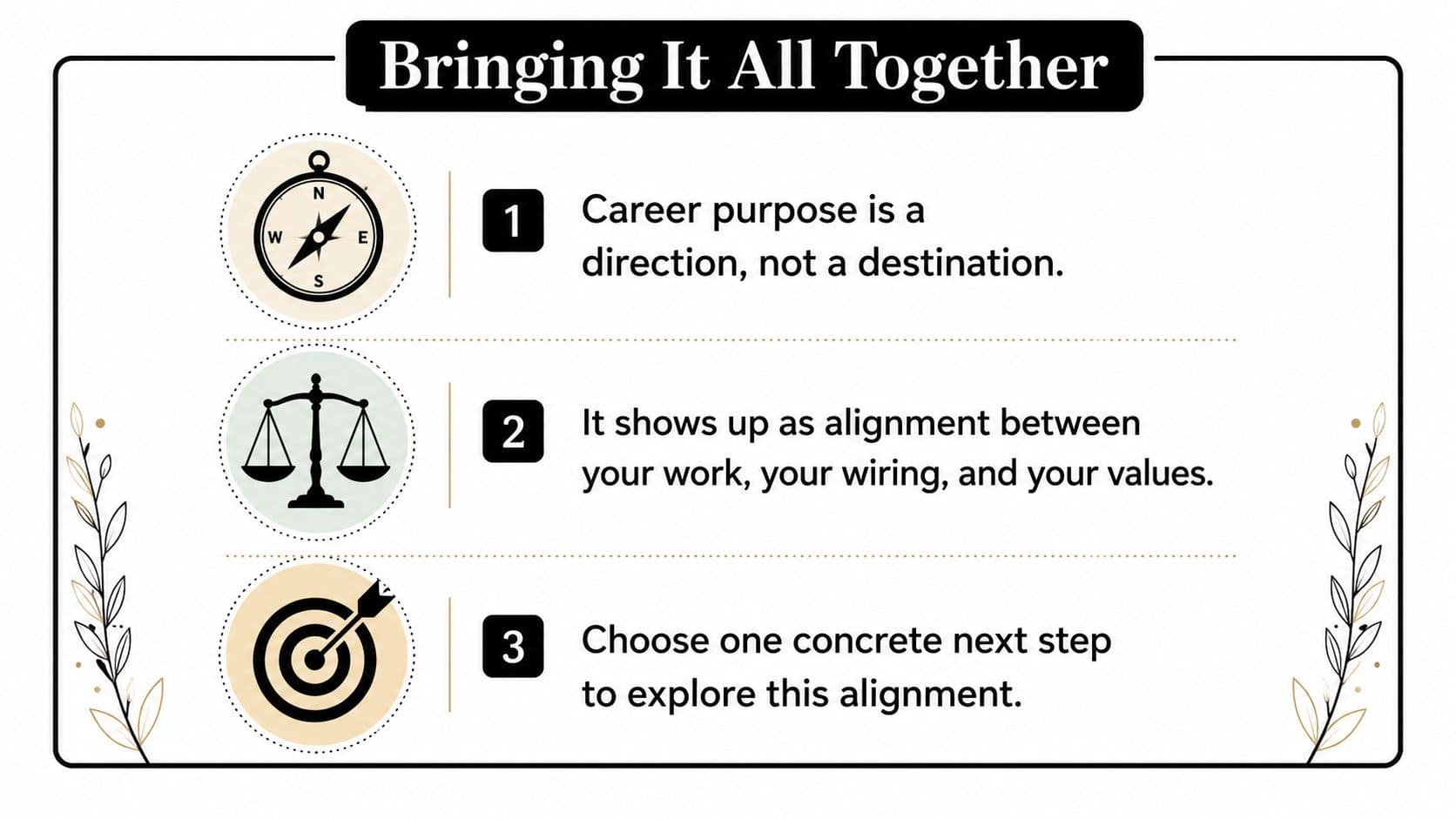
Career purpose is a direction, not a destination. It shows up when your work, your wiring, and your values point in the same general direction, even if the path is uneven and the timing is imperfect. It can be clarified through reflection, sharpened with a framework like Dan Millman's The Life You Were Born to Live, and tested in real life through small experiments.
A short way to remember the whole thing
Purpose is not the same as passion, and it doesn't have to feel dramatic every day. It's a working alignment that can be felt, tested, and revised. Some people find it through reflection alone. Others need structure, language, or a mirror that helps them see their own pattern more clearly.
The goal isn't to find one perfect career and protect it forever. The goal is to keep making honest adjustments toward work that fits.
That's why the next step matters more than the perfect answer. A 30-minute reflection, one conversation with someone who knows your work well, or a careful look at a life-path summary can move you farther than another month of vague thinking. If you've been waiting for clarity to arrive fully formed, start smaller. Pick one thing and test it.
If you want a structured way to explore your own patterns, the Life Purpose App gives you a practical companion to Dan Millman's framework and helps you examine how your drives and abilities may connect to career choices. It won't decide your path for you, but it can make your purpose feel clearer, more concrete, and easier to act on. Visit it when you're ready to turn reflection into something you can use.
Discover Your Life Purpose Today!
Unlock your true potential and find your life’s purpose.
