Learn how compatibility matches built on life paths work for partners, friends and family, with steps to read them without taking them as destiny.

November 20, 2026 (6d ago)
Compatibility Matches Using Life Paths: How to Read Them
Learn how compatibility matches built on life paths work for partners, friends and family, with steps to read them without taking them as destiny.
← Back to blog
Learn how compatibility matches built on life paths work for partners, friends and family, with steps to read them without taking them as destiny.
You have their birthday saved in your phone, and you're half tempted to treat it like an answer. Maybe it's a new partner, a sibling you keep clashing with, or a colleague whose style leaves you tired by Thursday. You want to know whether the friction is a real mismatch or just a bad week.
A life path reading can help you name the friction. It cannot tell you to stay, leave, hire, or cut someone off. In Dan Millman's The Life You Were Born to Live, each life path is a description of themes, not a score of love. The Life Purpose App turns a date of birth into that path so you can set two descriptions side by side. Compatibility matches work best when you use them as a prompt for one specific conversation about contrast, with consent and limits built in.
How Life Path Compatibility Matches Work
Think of two maps of the same city, drawn from different viewpoints. They show the same streets, but one map puts the river in the centre and the other puts the station there. Neither map is the city. A compatibility match is that kind of reading: two birth dates set side by side, not a score of how much you will love each other.
A life path is calculated from a date of birth, which is why the same two people always produce the same result. Mood, a good holiday, or a fight last Tuesday does not change it. Dan Millman's The Life You Were Born to Live is the reference for what each path describes. The Life Purpose App runs the arithmetic and lets you save other people so you can come back to the comparison.
Three layers, then a hard stop
A useful match has three layers, and you should keep them separate.
- Path themes: The book describes tendencies for each path, such as how someone approaches work, closeness, or responsibility. Those themes are the raw material, not a character reference.
- Cycle timing: People can be in different points of a nine-year life cycle. One person may be in a building year while the other is in a year that asks for review. The clash can be timing, not character.
- Priority and communication: Daily life often snags on this point. One path may treat direct talk as care. Another may treat the same talk as pressure.
A match suggests topics to talk about. It must not be asked to decide whether a relationship will succeed.
Check the number by hand
Take every digit of the birth date, add them, then keep adding the digits of the total until one digit remains. For 14 March 1990, 1+4+3+1+9+9+0 makes 27, and 2+7 gives a life path of 9. Dan Millman's The Life You Were Born to Live explains what each path means, and the Life Purpose App runs the calculation for you. If your hand check and the app disagree, re-enter the date before you interpret anything.
How to Run a Compatibility Match in Five Steps
Do this with one person you already know, not with a stranger's birthday you found online. You can save your friends in the app and look up their life paths, life cycles, and relationship dynamics once they have agreed. If you want the arithmetic in more detail before you start, use the walkthrough.
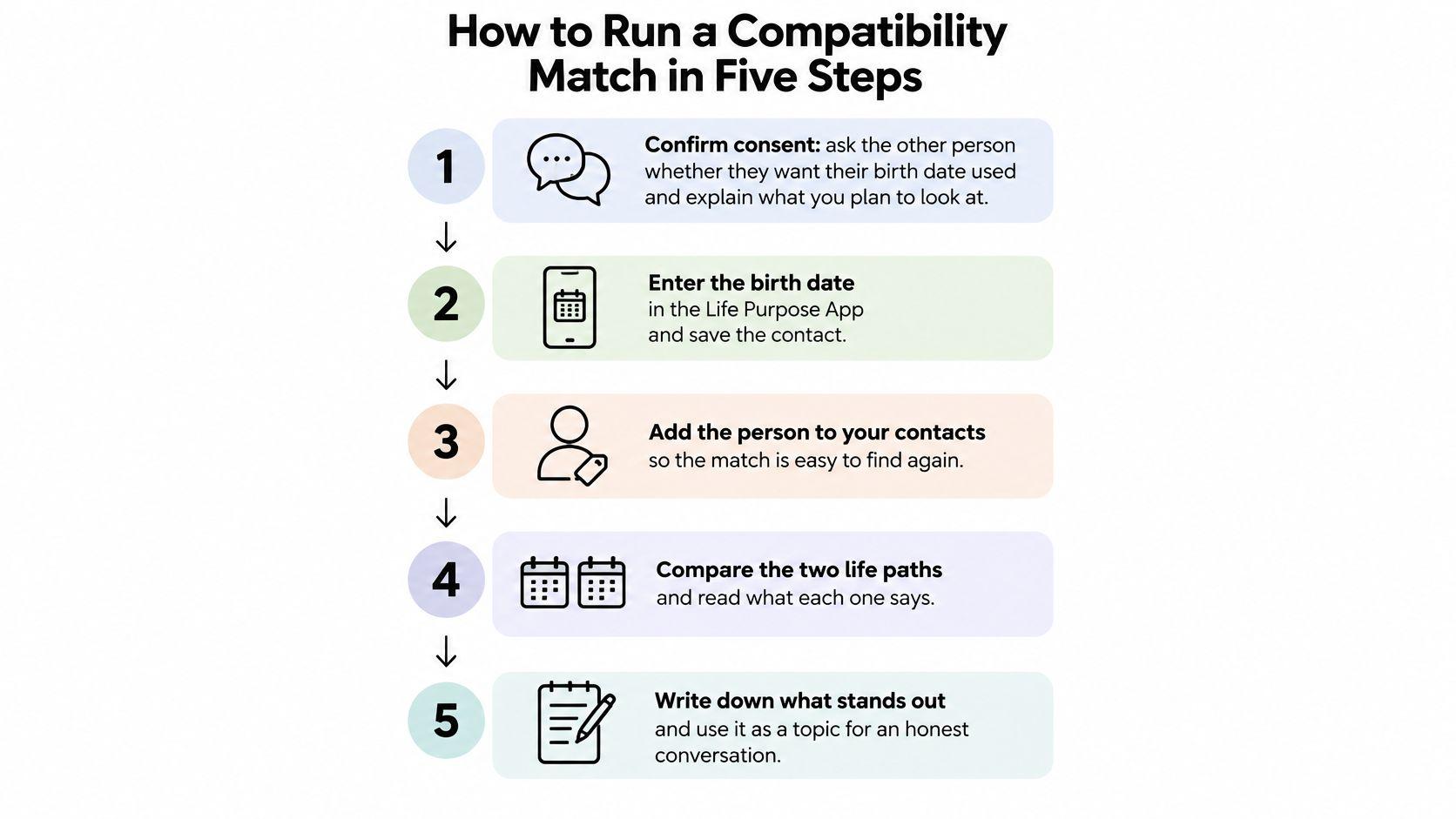
The five steps
-
Confirm consent. Ask whether they want their birth date used, and say what you plan to look at: path themes, cycle timing, and places you might talk past each other. Consent prevents surprise. The common slip is running the match first and telling them later, which turns a conversation tool into something done to them.
-
Enter the date and save the contact. Put the birth date into the Life Purpose App and save the person so you can return to the life path, life cycles, and relationship dynamics without retyping. Saving is for your notes, not for sharing their date with anyone else. People often skip the save, then redo the reading from memory and mix the two paths up.
-
Read the book passage, not only the summary. Note each life path, then read the matching passage in The Life You Were Born to Live. The summary is a doorway. The passage holds the gifts, the trouble spots, and the wording you should not flatten into a label. Skipping the book is the other common slip: a one-line tag starts to sound like a diagnosis.
-
Compare on three lines. Write where the paths overlap, where they contrast, and where one can support the other. Overlap is not automatically good, and contrast is not automatically bad. A written contrast stops you from exaggerating one difference until it swallows the rest of the person.
-
Write two questions. These are questions you will ask out loud, not questions the app answers. Tie each one to a contrast you wrote down. If you cannot form a question, you do not have a match yet. You have a label.
What a finished note looks like
Keep it short enough to read before you talk.
| Line | Example note |
|---|---|
| Overlaps | Both paths treat reliability as care. Both dislike vague plans. |
| Contrasts | One wants space before a hard talk. The other wants to settle it the same day. |
| Support | The planner can hold dates. The other can name when a plan has become rigid. |
| Questions | When we disagree, do you need an hour first? What does “I'll get back to you” mean for each of us? |
Stop line: Two overlaps, two contrasts, two questions. If the note is longer than that, you are building a case instead of preparing a talk.
How Far to Trust a Match
Partner research earns a place here because it shows a real pattern and a hard limit sitting side by side. Partners tend to resemble each other. Predicting one particular pair is a different task entirely.
A 2023 meta-analysis examined 22 traits across 199 studies and included millions of male-female co-parents, engaged couples, married couples, and cohabiting partners. Partners were more likely than not to be similar for approximately 82% to 89% of the traits analyzed, and only about 3% of traits showed partners tending to differ. The work found no compelling general evidence that opposites attract.
Findings like these work like climate data. They describe what tends to happen across thousands of couples, the way a climate summary describes a whole region. They cannot forecast the weather at one address.
That limit shows up clearly when researchers try to predict. Random-forest models using traits and preferences collected before people met explained 4%–18% of variance in one person's attraction and 7%–27% of variance in the other person's, and they could not predict relationship-level variance. A separate look at married couples ran into the same ceiling: once each partner's own personality was accounted for, personality similarity explained only a very small share of later relationship satisfaction.
A 2024 registered project led by Eastwick, Sparks, and Finkel, with more than 10,000 participants across 43 countries, found that preference-based compatibility matching had statistically significant but small effects on romantic evaluations.
What the studies found about matching
| Finding | Result | Source context |
|---|---|---|
| Similarity across traits | 82% to 89% of traits | 2023 meta-analysis of 22 traits across 199 studies |
| Traits where partners tended to differ | About 3% of traits | One part of the same 2023 analysis |
| Pre-meeting traits and attraction | 4%–18% of own attraction, 7%–27% of the other person's | Machine-learning study using random-forest models |
| Personality similarity and satisfaction | Only a very small share | Married couples, after each partner's own personality was accounted for |
| Preference-based matching effect | Small but statistically significant | 2024 registered project, more than 10,000 participants in 43 countries |
How much weight to give the reading
Read the table as background. Broad similarity in values and habits is ordinary, and any score that ranks your future asks the inputs to do work they cannot do.
Life path readings from The Life You Were Born to Live and the Life Purpose App sit under the same ceiling. A match between two life paths can name a contrast worth discussing, such as a difference in pace or in how each of you approaches money. It cannot grade the relationship. The reasonable use is a prompt for one specific conversation, raised with the other person's agreement and set down again once it stops being useful. If you want a plain account of where this kind of system is steady and where it is not, read about numerology accuracy before you treat any percentage as fate.
A small effect on how people rate a match is not a prediction that two lives will fit.
Reading Matches for Partners, Friends and Family
The same pair of paths changes meaning when the relationship changes. A contrast that belongs in a kitchen conversation can be out of place in a staff meeting. Daniel says the app is handy for looking up friends', families', and potential partners' life paths, and that it is highly recommended. Handy is not the same as appropriate. You still choose what the relationship can hold.
How to read one match across relationship types
| Relationship | Look at first | Watch for | Question to ask |
|---|---|---|---|
| Romantic partner | Communication and daily priorities | Treating the match as destiny | What does each of us need when we disagree? |
| Close friend | Shared pace and interests | Overlooking distance or changing life stages | How often do we each want to connect? |
| Family member | Roles, expectations and boundaries | Using the match to judge long-standing patterns | Which topics feel safe to raise together? |
| Co-worker | Working style and decision-making | Labelling a colleague from a birth date | How do we split credit and make decisions? |
Romantic partner. Start with how you repair a disagreement and how you split an ordinary Tuesday: money, chores, sleep, time with other people. The risk is destiny talk. A path description can show a difference in pace. It cannot prove you are “meant” to stay or to split. Ask the disagreement question while you are calm, not in the middle of the fight.
Close friend. Shared pace matters more than a romantic script. One friend may want a long weekly call. The other may be content with a monthly walk. Distance and a new baby, a new job, or a move will change the pace even when the paths stay the same. For a fuller look at friend pairings, see the Life Purpose App resource on friendship dynamics.
Family member. Roles are already set. A parent, a sibling, or an adult child does not become a blank profile because you calculated a number. Use the match to choose a topic you can raise without prosecuting old history. Family arguments often land on names, holidays, and who gets a say. When relatives are stuck on what to call a child, TurkicNames tools for naming compromises lay out practical ways to negotiate without turning the name into a verdict on the people involved.
Co-worker. Stay inside the work. Look at how decisions get made and how credit is shared. Do not brief the team on someone's birth date, and do not explain their email style as “just their path.” If they have not agreed to the reading, you do not have a match. You have a private guess, and it should stay private.
The match tells you what to discuss. The relationship decides what you do about it.
What Differences in a Match Actually Reveal
Say two friends compare paths from The Life You Were Born to Live. One path puts weight on space and independence. The other puts weight on regular contact. They like each other. They also leave conversations with a small bruise: one feels crowded, the other feels dropped.
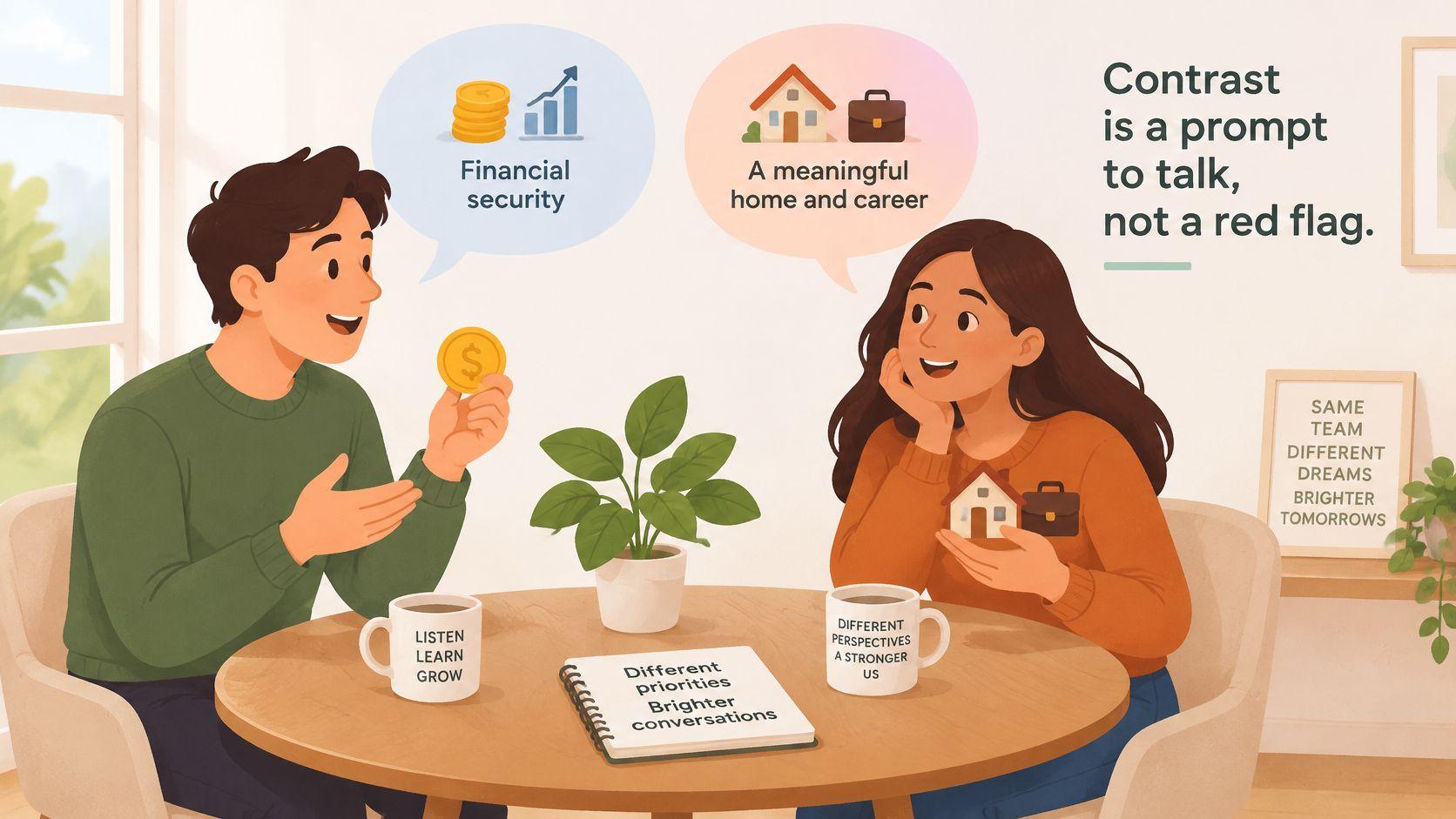
The match does not decide whether the friendship works. It points at a conversation: how often to meet, and how each person says they need more time or less. People with very different paths build strong bonds when both name the difference out loud. The damage usually comes from treating the difference as a hidden flaw.
Three places contrast usually matters
Values and daily habits shape getting along more than a surface personality label. Put the talk in one of these three places.
- Communication under pressure: One person goes quiet to think. The other talks in order to think. Neither habit is a moral failure. Name the habit before you call it rejection. If you want a workplace language for pace, directness, and steadiness, One Dynamics' DISC profiling guide is a clear companion to a life path note. It describes behaviour you can observe, which keeps you from inventing a trait the book never claimed.
- Priorities: Money, career, and family time are where paths stop being abstract. A contrast here is a calendar problem and a values problem at once. Ask which commitment moves first when the week gets tight.
- Closeness: Some paths treat frequent check-ins as loyalty. Others treat unscheduled time as trust. Ask what “close” looks like on a normal week, not on a holiday.
A short routine for the talk
- Name the contrast in one sentence, using the book's themes rather than a nickname.
- State what you need, with a time or a frequency attached.
- Ask what the other person needs, and wait for the answer.
A one-line app summary should never replace the passage in The Life You Were Born to Live. If you cannot point to the passage, you are not ready to tell someone what their path “means.”
Misreadings and Your Next Step
A match sounds certain because the number does not wobble. That tone is the trap. Four misreadings show up again and again, and each one has a fix you can apply the same day.
Four ways the reading goes wrong
Treating the result as a verdict. The digits are stable, so the conclusion feels stable too. Read it as a prompt, and leave the decision with the two people in the relationship. If you hear yourself say the path says we can't, stop. The path did not say that.
Stereotyping someone from a birth date. Life path descriptions are broad enough to seem true of almost anyone until you test them. Check every trait against what you have seen them do. If the passage says they avoid conflict and you have watched them raise hard issues cleanly, believe the person in front of you.
Running a match without agreement. Ask first. Share only what they are comfortable hearing. If they decline the birth date or the discussion, drop the reading. Their no is the result that matters.
Reading only the app summary. Open The Life You Were Born to Live and read the matching passage before you form a view. The summary is a label. The passage is the context that keeps the label from getting cruel.
If you keep contacts for people who have agreed, know the limit of the plan you are on. The free version does not include saved contacts. The paid version allows unlimited contacts. Saving a person is optional. Consent is not.
Decide, then check it against real weeks
Choose one relationship where a conversation is already due. Run the five steps. Write the two questions before you talk. After a few weeks of ordinary contact, note whether the differences you flagged have shown up.
The Life Purpose App produces the reading. The conversation is what confirms or corrects it. If the flagged contrast never appears in how you speak, spend money, or make time, retire that line of the note. Keep the questions that proved useful, and let the rest go.
The Life Purpose App is the companion to Dan Millman's The Life You Were Born to Live, and it turns two birth dates into a life path comparison you can use as a conversation prompt rather than a verdict. Save consented contacts, read the path themes, and bring two honest questions to the person in front of you. Visit the Life Purpose App when you are ready to run that match with care.
Discover your life path today
Enter your date of birth and see your life path, free.
Find your life path