Use a date of birth finder to reveal your life path in Dan Millman's system. See what the app shows, how dates are read, and how to start.

November 24, 2026 (2d ago)
Date of Birth Finder: How to Find Your Life Path
Use a date of birth finder to reveal your life path in Dan Millman's system. See what the app shows, how dates are read, and how to start.
← Back to blog
Use a date of birth finder to reveal your life path in Dan Millman's system. See what the app shows, how dates are read, and how to start.
Can a date of birth finder tell you something meaningful about yourself, or does it turn a calendar date into a convincing description? The answer depends on what the tool does, where its interpretation comes from, and what you expect the result to prove.
For self-discovery, Dan Millman's book, The Life You Were Born to Live, and the Life Purpose App provide a particular interpretive framework. That's different from verifying a birth record or searching for someone else's personal information. Keeping those purposes separate makes the experience more useful and helps you protect your privacy.
How to Find Your Life Path From Your Date of Birth
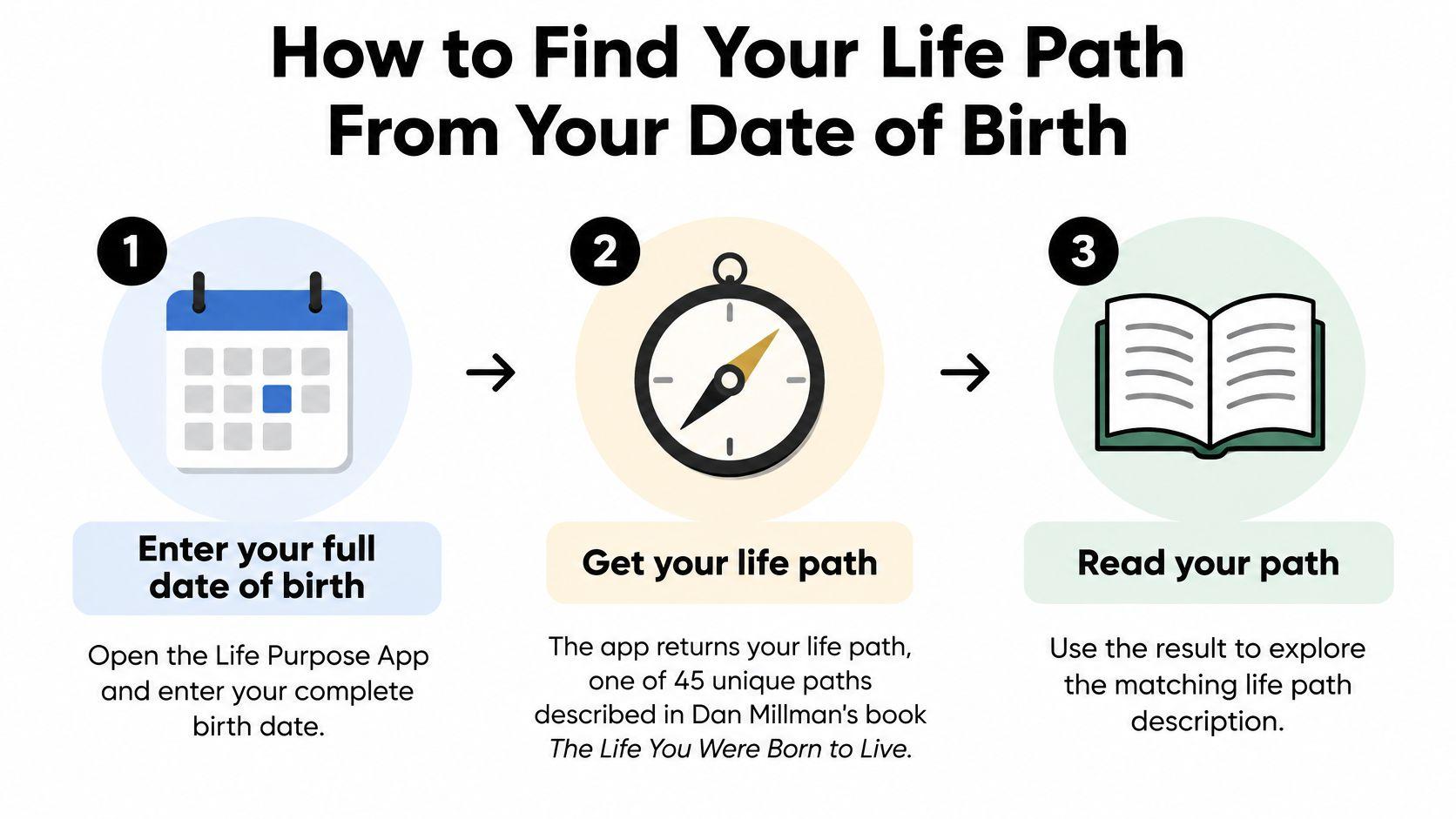
Enter your complete birth date in the Life Purpose App and it returns your life path, one of the 45 unique paths described in Dan Millman's book, The Life You Were Born to Live. The date does the mechanical work: it identifies which path applies to you. What that description means in your life is the interpretive part, and that takes slower reading.
You don't need to guess which description sounds most like you before you begin. Start with an accurate date and a place to take notes. The useful part isn't collecting a label. It's noticing which parts of the description help you ask better questions about your habits, choices, and relationships.
Follow the process without rushing the reading
-
Gather your full birth date. Use the day, month, and year exactly as they appear on your birth record, not an abbreviated date saved in an old profile.
-
Open the Life Purpose App and enter the date. It accepts birth dates from 1800 to the present, so check the year carefully instead of accepting an autofilled value. The date you enter is not stored or collected.
-
Read the summary slowly. Note the name of your path and its core theme before connecting any sentence to an event in your life. A life path works like a chapter heading in the book: it tells you where to look, not what you'll find there.
-
Open the system overview. The free version includes this overview along with your summary, and it shows how your result fits within the wider Life Purpose System rather than standing alone as a personality label.
-
Check your current nine-year cycle. The app maps where you sit in that cycle, so you can read about the phase you're in now instead of treating the whole system as timeless advice.
-
Write down what fits and what doesn't. Choose two or three lines that feel accurate and one that doesn't, so your notes include disagreement as well as recognition.
Make the result personal without making it absolute
Keep your observations in your own words. Instead of copying a broad description, write down a situation where you think it applies and one where it doesn't. That gives you something concrete to reconsider later.
Reading your own date is different from looking up someone else's. The app lets you save friends and check their life paths and relationship dynamics, but a second-hand reading skips the step where only the person involved can confirm what fits.
The same own-words habit applies if the reading is part of a birthday. If you'd rather mark the occasion with something handmade, Bridle Up Hope Shop's DIY cowboy birthday card tips give you a theme to build on. A handwritten line about what you appreciate in the person says more than any label a reading could assign.
A reading is a starting point for reflection, not a verdict on who you are. You're allowed to find part of it useful without accepting every statement.
Entering Your Birth Date in the Right Format
A date written as 3/5/1990 can mean March fifth or the third of May. Both are valid calendar dates, so a form may accept the wrong interpretation without showing an error. That can change the reading produced through Dan Millman's book, The Life You Were Born to Live, as applied in the Life Purpose App.
The ISO date-format guide sets out the internationally agreed YYYY-MM-DD structure, with the year first, followed by month and day, so September 27, 2022 becomes 2022-09-27. The order matters more than whether a date looks familiar to you.
Common birth date formats and how to read them
| Written date | ISO 8601 entry | Risk if misread |
|---|---|---|
| 27 September 2022 | 2022-09-27 | Unambiguous once written in year, month, day order |
| 09/27/2022 | 2022-09-27 | Reads as month first; only correct in that order |
| 27/09/2022 | 2022-09-27 | Reads as day first; only correct in that order |
| 12 April 1985 | 1985-04-12 (basic form: 19850412) | Compact strings lose meaning if separators are dropped without a known format |
| 3/5/1990 | 1990-05-03 if day first; 1990-03-05 if month first | A single-digit day and month can be swapped without warning |
The ISO working document hosted by the Library of Congress distinguishes the basic representation 19850412 from the extended representation 1985-04-12. They describe the same date when the format is known. Don't treat a compact string as an unexplained sequence of digits.
Before submitting a form, use these checks:
- Inspect the field labels. If the day is 12 or lower, confirm whether the form expects day or month first.
- Investigate an unexpected result. Look for a swapped month and day before assuming the interpretation has changed.
- Reject impossible dates. An entry such as 31 February needs correction, not automatic acceptance.
- Confirm the year. Keep it within the app's supported range rather than entering a shortened year.
Date clarity matters in other settings too. StoryCV's explanation of why recruiters need employment dates provides a useful comparison: a reader needs to understand what a date represents, not merely see digits on a page.
Write the date in year, month, day order before entering it anywhere, then match those components to the form's labels.
Why a Birth Date Points to a Life Path
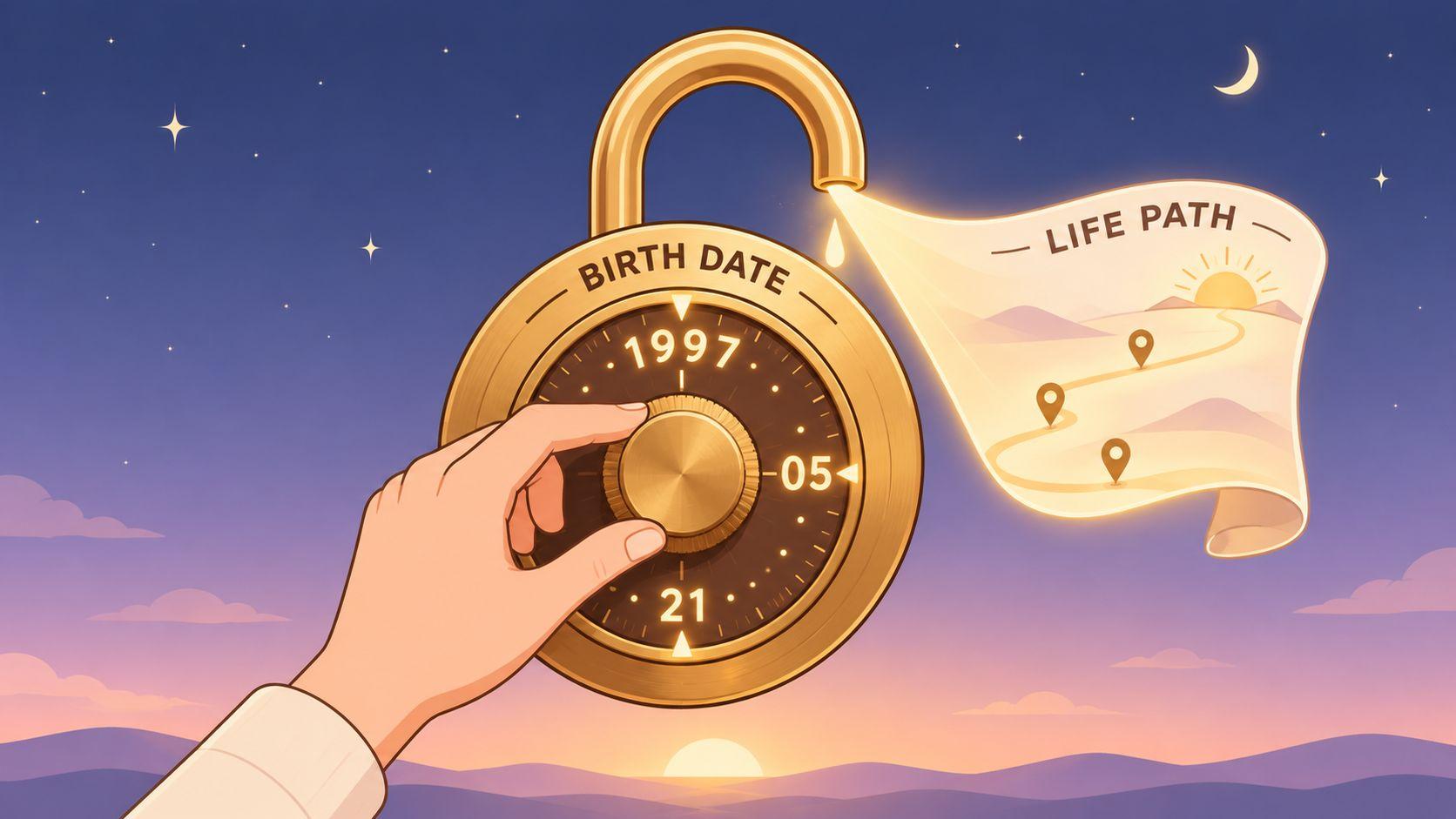
Think of a birth date as the input to a combination lock. Within the same method, the same combination opens the same description. That repeatability explains how a lookup works, but it doesn't establish that the description is an objective account of your personality or future.
In Dan Millman's book, The Life You Were Born to Live, and the Life Purpose App, the birth date places a person within a framework of paths, each with its own gifts, challenges, and spiritual laws. The app is the digital companion to the 25th Anniversary Edition of the bestselling book and performs the lookup so you don't have to work through the method by hand.
The calendar step is mechanical
A date-of-birth tool must first recognize the year, month, and day correctly. It needs to distinguish a valid calendar entry from a typo and interpret the components in the intended order.
The ISO date-and-time representation standard defines how dates and times are represented for information exchange; it assigns them no personal, spiritual, or numerological meaning. A standardized date therefore makes the input clearer, not the interpretation more authoritative.
That distinction is easy to miss. A result can be produced consistently by software while still belonging to an interpretive system rather than an identity-verification process.
The book supplies the interpretation
For the meaning of a result, consult Dan Millman's book, The Life You Were Born to Live, alongside the Life Purpose App. Check the method in the book itself rather than combining instructions from unrelated online summaries. Similar vocabulary doesn't guarantee that different writers are using the same system.
Read the associated spiritual laws as part of Millman's framework. They aren't government rules, medical findings, or conclusions established by a calendar standard.
Keep the distinction clear: The date is the input. Dan Millman's book, The Life You Were Born to Live, supplies the meaning presented through the Life Purpose App.
You don't need to force a choice between unquestioning belief and complete dismissal. You can examine a description, compare it with your experience, and keep your own judgment intact.
Reading Gifts and Challenges Across Five Life Areas
A broad description can feel meaningful without telling you what to do next. Reading by life area makes the exercise more practical because you can connect a statement to a recognizable situation.
Dan Millman's book, The Life You Were Born to Live, and the Life Purpose App explore gifts and challenges across health, money, sexuality, career, and relationships. Don't assume the examples below are your actual results. They're questions you can use when examining the description attached to your date.
| Life area | How to consider a strength | How to examine a challenge |
|---|---|---|
| Health | Notice routines that support your well-being | Identify habits you want to discuss or change |
| Money | Look at how you plan, earn, spend, or share | Examine a recurring financial behavior |
| Sexuality | Reflect on communication, comfort, and boundaries | Notice assumptions or conversations you avoid |
| Career | Consider where your drives and abilities fit your work | Identify situations where you repeatedly feel stuck |
| Relationships | Recognize ways you contribute to connection | Examine your own response during disagreement |
A strength is something to use deliberately. If a description brings a useful ability to mind, ask where you could apply it more consciously.
A challenge is a possible pattern to investigate, not a flaw you must accept. Look for examples and counterexamples before deciding that a statement describes you.
Turn one observation into an experiment
Suppose a money-related passage prompts you to examine spending when you're stressed. For a month, record purchases that weren't planned, what happened beforehand, and how you felt afterward.
You're not trying to prove the reading right. You're checking whether the pattern exists and whether a small change, such as pausing before a nonessential purchase, helps you make choices you prefer.
If your notes don't support the description, record that too. A reflection exercise loses value when every outcome is treated as confirmation.
- Keep a three-column note. Write the strength, the possible challenge, and one action you can take.
- Revisit it after thirty days. Compare your observations with your original impression rather than relying on memory.
- Keep clinical boundaries. Read health and sexuality passages as prompts for reflection, not medical or clinical guidance.
You can also distinguish between a situation you can change and one that requires outside support. A difficult work environment, for example, isn't automatically evidence of a personal shortcoming.
Choose the one area that matters most right now. Working with a specific concern is more manageable than trying to reinterpret your whole life at once.
Nine-Year Cycles and Relationship Dynamics Explained
In Dan Millman's book, The Life You Were Born to Live, and the Life Purpose App, the nine-year cycle is a repeating period in which each year carries a different emphasis. Our app shows how to make the most of your current year within that framework.
Use the emphasis to choose a focus, not to predict an event. Suppose you decide to build a skill you've been postponing. Pick a practice you can sustain, keep a record of your effort, and review what you learned at year end.
Compare personal timing with shared behavior
A cycle reading concerns your current focus. A relationship reading concerns how you interpret the interaction between people within Dan Millman's book, The Life You Were Born to Live, and the Life Purpose App.
For questions about changing phases, the guide to life-cycle transitions offers a related starting point. Keep practical commitments in view while you reflect, including work responsibilities, caregiving, and your available time.
| Person you look up | What you can explore | Useful boundary |
|---|---|---|
| Yourself | Your current cycle and personal emphasis | Choose an action, not a forecast |
| A consenting friend or relative | Their reading and your shared dynamic | Don't tell them what they must feel |
| A partner | Possible strengths and tensions between you | Ask whether the description fits their experience |
| A co-worker who agrees | A framework for discussing differences | Focus on workplace behavior |
| A public figure | A reading based on their reported birth date | Check the date before trusting the lookup |
Move from description to conversation
Use a simple sequence when exploring a relationship through Dan Millman's book, The Life You Were Born to Live, and the Life Purpose App:
- Check each person's result without deciding in advance which description explains a disagreement.
- Read the dynamic between the two paths and identify a question you can discuss together.
- Name one behavior you'll adjust, such as asking for clarification before responding defensively.
A compatibility reading describes tendencies within the system, not destiny. It can't establish another person's intentions, guarantee harmony, or justify controlling their choices.
Our app allows Wikipedia lookups for well-known people, but a public figure's reading still depends on the accuracy of the reported birth date. Check a reliable biographical source before trusting that input.
With a difficult co-worker, use the exercise to choose a clearer request or calmer response, not to explain their personality to them.
What a Life Path Reading Can and Cannot Tell You
A reading is a map of tendencies, not the territory of your life. It's no more a passport than a horoscope is. Dan Millman's book, The Life You Were Born to Live, and the Life Purpose App provide a framework for reflection, not documentary evidence about a person.
The phrase date of birth finder can describe very different services. A self-discovery tool uses a date you already know. A people-search site claims to discover someone else's date from identifying information.
A lookup isn't proof of identity
A people-search result may be incomplete, outdated, or matched to the wrong person. A familiar name and a plausible date don't establish that the result belongs to the person you mean.
UNICEF's civil-registration report identifies birth information as legal identity data and emphasizes protecting civil-registration information against misuse or repurposing. Don't submit your own or a relative's date to an unknown website just to see what comes back.
| Question | Appropriate check |
|---|---|
| Is this my recorded birth date? | Consult your birth certificate or official birth record |
| Does this result belong to another person? | Seek consent and reliable documentary confirmation |
| Is an old family date ready to enter? | Check the original calendar and local dating convention |
| Can this reading establish compatibility? | Treat it as reflection, not evidence about conduct |
The same boundary applies when considering compatibility matches: a reading from Dan Millman's book, The Life You Were Born to Live, in the Life Purpose App doesn't replace what someone says or does.
Check historical dates and privacy separately
The University of Nottingham's guide to Julian and Gregorian dating explains that calendar transitions could advance dates by 10 or 11 days, while historical conventions for the start of the year also differed. For an old family record, establish which calendar the original document used before converting or entering it.
Before entering personal information, read the app's privacy policy. The date entered to reveal a reading in our app is not stored or collected. Only enter other people's birth dates with their agreement.
Take the date itself from your birth certificate. Use Dan Millman's book, The Life You Were Born to Live, and the Life Purpose App for reflection, not proof of identity or a basis for major decisions.
If a certificate isn't available, keep the distinction between a remembered date and a documented date visible rather than pretending they carry the same certainty.
Choose Your Next Step After the Free Reading
-
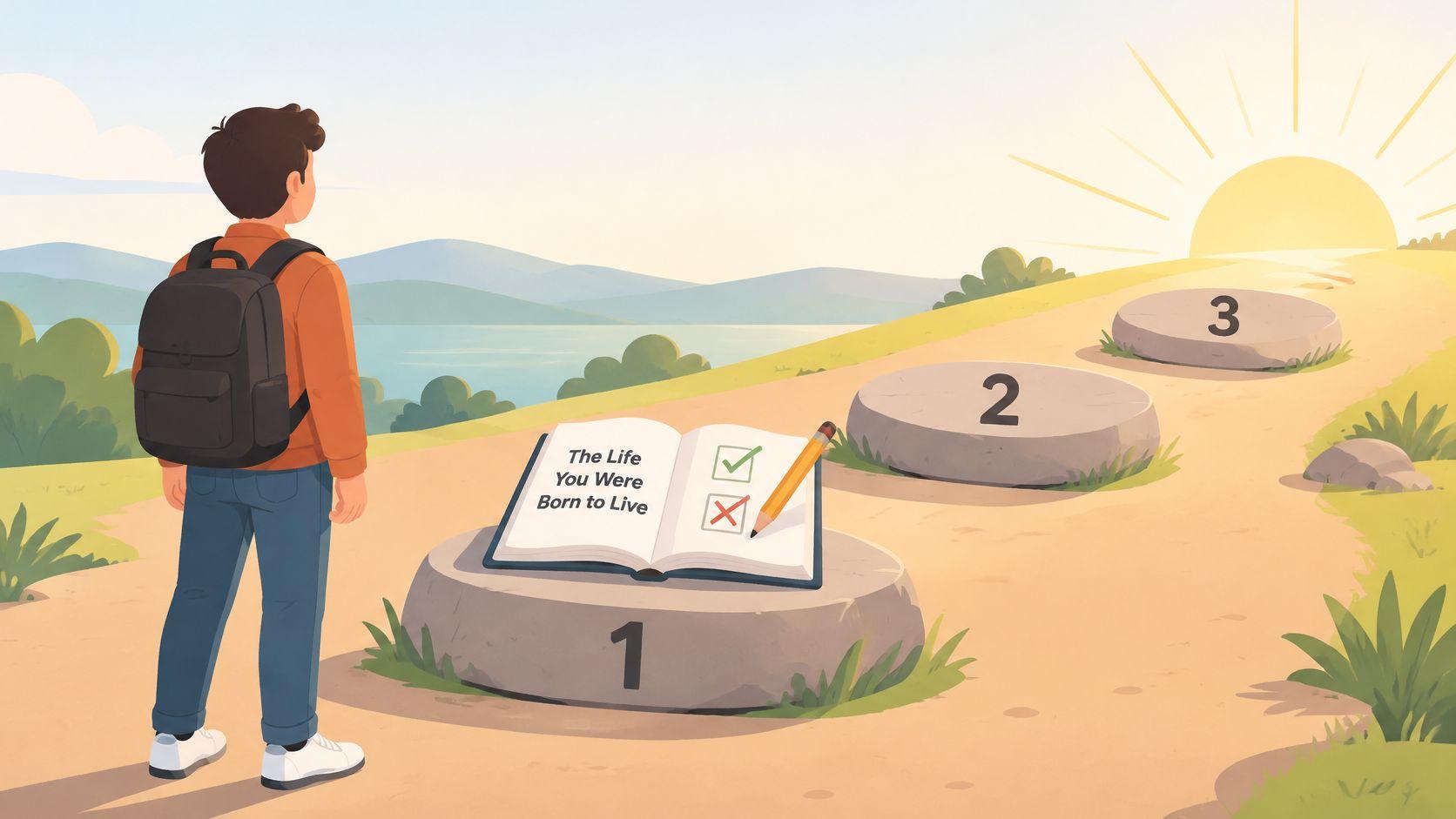
Read the matching passage in Dan Millman's book, The Life You Were Born to Live. Compare it with your result in the Life Purpose App, marking where the description fits and where it doesn't.
-
Choose a small experiment. Select a concern from one life area or a focus connected with your current cycle, then try a manageable action for a month.
-
Return after thirty days. Compare your notes with the original reading and decide what, if anything, you want to explore further.
Decide how much detail you need
Our free version includes a summary of your life path and an overview of the Life Purpose System. The paid version adds detailed analyses and the complete text of the 25th Anniversary Edition of Dan Millman's The Life You Were Born to Live, which the free version doesn't include.
The distinction is straightforward: you can start without paying, while fuller access requires a paid option. There's no need to upgrade before you've decided whether the approach is useful to you.
If you prefer talking through your observations, consider the questions raised in the guide to life-path counseling, grounded in Dan Millman's book, The Life You Were Born to Live, and the Life Purpose App. Choose support that respects your judgment rather than promising certainty.
For readers considering a more immersive experience, Ayahuasca.com's guide to preparing for a transformational retreat is a separate planning resource, not a necessary next step or an endorsement of substance use. A quiet review of your notes is enough to begin.
Write down which action you'll take first and when you'll return to it.
Visit Life Purpose App to enter your birth date and explore the summary and system overview based on Dan Millman's book, The Life You Were Born to Live. Start with one observation you want to examine, then use your own experience to decide what deserves further attention.
Discover your life path today
Enter your date of birth and see your life path, free.
Find your life path