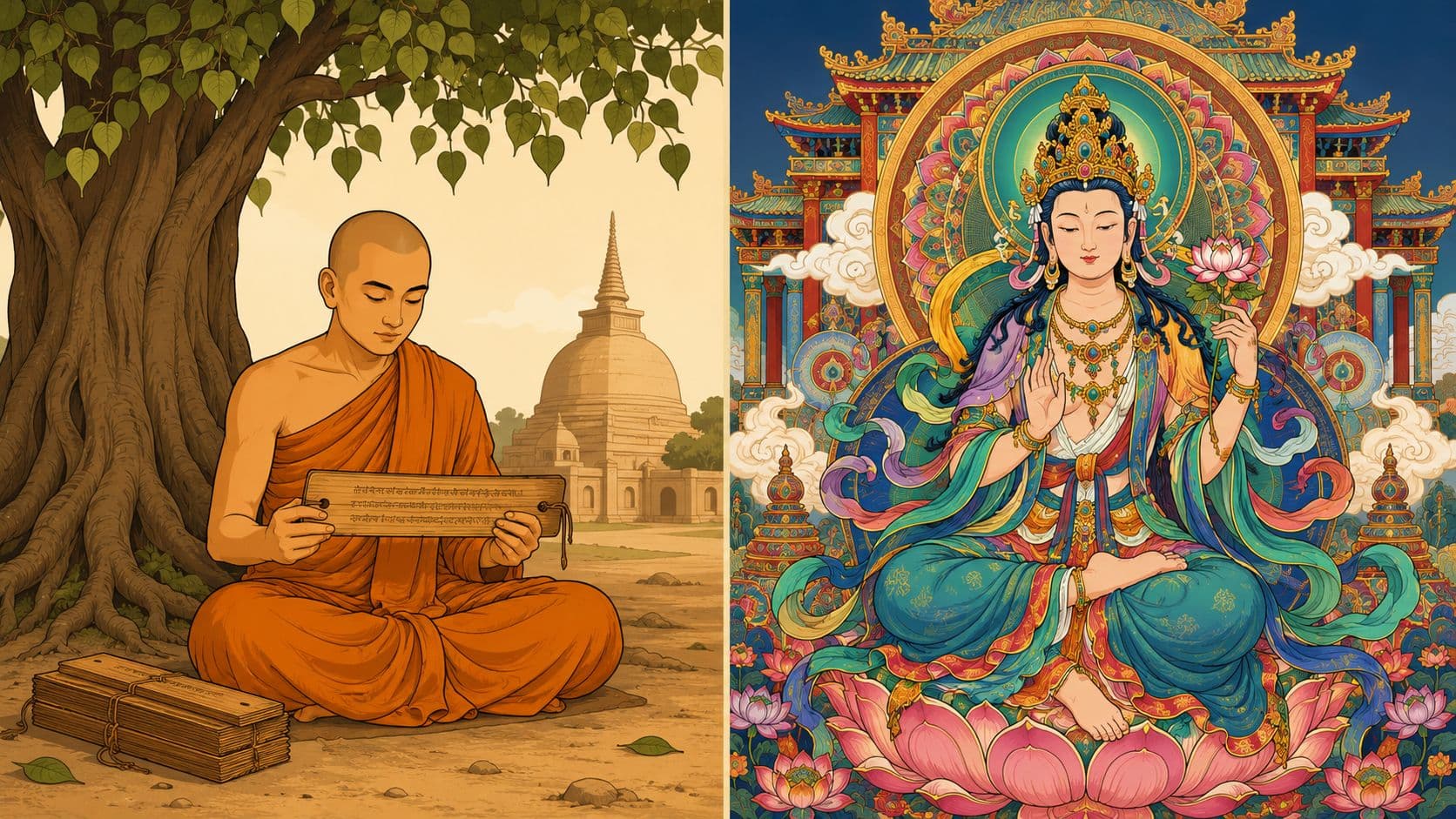
Explore the key difference between Mahayana and Theravada. Understand their doctrines, practices, and goals in this 2026 guide.
June 3, 2026 (1d ago)
Difference Between Mahayana and Theravada: A Guide
Explore the key difference between Mahayana and Theravada. Understand their doctrines, practices, and goals in this 2026 guide.
← Back to blog
If Buddhism teaches one path out of suffering, why does it look so different in a Thai forest monastery, a Japanese Zen temple, or a Tibetan shrine room? That question sits at the heart of the difference between Mahayana and Theravada.
Many introductions make the contrast sound neat and final. Theravada is presented as the path of personal liberation. Mahayana is presented as the path of compassion for all beings. There's some truth in that summary, but it's also where many readers start getting misled. The full picture is more interesting, and more human.
A good way to approach this is to think of Buddhism as one great tree with shared roots and different branches. The roots include the Buddha's teachings on suffering, ethical conduct, meditation, and wisdom. The branches grew in different directions as communities preserved teachings, translated texts, shaped rituals, and adapted to new cultures. If you're curious about how religions can share deep common ground while still developing distinct forms, this reflection on what religions have in common is a helpful companion.
Here's a quick orientation before we go deeper.
| Aspect | Theravada | Mahayana |
|---|---|---|
| Basic meaning | “Way of the Elders” | “Great Vehicle” |
| Main ideal | Arahantship as the normative final goal | Buddhahood for the benefit of all beings |
| Textual emphasis | Earliest scriptures, especially the Pali Canon | Broader scriptural world, including later sutras |
| Regional association | Sri Lanka, Myanmar, Thailand, Cambodia, Laos | China, Japan, Korea, Mongolia, Nepal, Tibet, Vietnam |
| General tone in practice | Often associated with disciplined monastic training and insight meditation | Often associated with bodhisattva practice, devotional elements, and broader lay participation |
Understanding the Two Great Schools of Buddhism
Walk into a temple in Thailand and you might see saffron-robed monks, quiet chanting, and a strong emphasis on alms, discipline, and meditation. Visit a Tibetan Buddhist center and you may encounter mandalas, ritual instruments, visualizations, and prayers addressed to Buddhas and bodhisattvas. Travel to Japan and Zen may feel stripped down, spare, and almost architectural in its simplicity.
That can be confusing at first. People naturally wonder whether these are even the same religion.
They are. But they represent different historical developments within Buddhism. The two big categories that help explain that diversity are Theravada and Mahayana.
Two names, two emphases
Theravada is often translated as “The Way of the Elders.” In everyday terms, it's usually associated with preserving the earliest layer of Buddhist teaching and practice, especially through the Pali Canon. The atmosphere many people associate with Theravada is careful discipline, close attention to the Buddha's earliest teachings, and a strong respect for monastic life.
Mahayana means “The Great Vehicle.” It includes a wide range of traditions across East Asia and the Tibetan world. Mahayana often speaks in a more expansive voice. It places major emphasis on the bodhisattva, the practitioner who seeks awakening in a way explicitly tied to the liberation of all beings.
Practical rule: Don't treat Theravada and Mahayana as two competing teams. They're better understood as two large families within Buddhism, each with its own language, ideals, and styles of practice.
Why this difference matters in real life
For a practitioner, these differences aren't only academic. They affect what texts you read, how a temple feels, what kind of meditation you're taught, what spiritual goal is held up as central, and how compassion gets framed in daily life.
One person may be drawn to a path that feels historically grounded and methodical. Another may feel at home in a path that combines meditation with devotion, symbolism, and a wider cosmic vision. Individuals aren't choosing between “serious Buddhism” and “other Buddhism.” They're responding to different ways of training the heart and mind.
Shared Roots and the Historic Schism
How did one tradition centered on the Buddha's teaching grow into more than one major path without losing its common foundation?
Before Theravada and Mahayana became distinct traditions, there was the early Buddhist sangha, the community formed around Siddhartha Gautama's teaching. Both trace themselves back to the same teacher, the same diagnosis of suffering, and the same conviction that suffering can end through practice, insight, and ethical discipline.
The split did not happen because one side rejected Buddhism. It grew through the ordinary pressures that shape living religious traditions. Communities had to decide how to remember teachings accurately, how strictly to apply monastic rules, and how to explain the path to new generations in new places.
Here is a visual timeline of that shared origin and later divergence.

One tree, branching over time
After the Buddha's passing, monks and nuns preserved teachings through recitation, debate, and collective agreement. That may sound technical, but it had practical consequences. If a community understood a rule one way rather than another, daily monastic life changed. If it interpreted a teaching more narrowly or more broadly, meditation, ethics, and teaching style changed too.
Some disagreements centered on Vinaya, the code for monastic conduct. Others concerned scripture, authority, and how to describe the full meaning of awakening. Those questions shaped the rhythm of monastery life, the role of commentary, and the kind of spiritual imagination practitioners were encouraged to develop.
A human disagreement, with practical effects
At heart, this was also a familiar human tension. One side of a tradition often wants to guard the original form with great care. Another wants to preserve the heart of the teaching while allowing new expressions and wider interpretations. You can see a similar pattern in law, education, or even service-oriented practice such as karma yoga as a path of selfless action, where the same core ideal can be expressed through different disciplines.
That tension helps explain the later relationship between Theravada and Mahayana. Theravada came to identify strongly with preserving early teachings and monastic discipline. Mahayana developed currents that welcomed new sutras, broader philosophical reflection, and a more expansive vision of the Buddhist path.
The split between Mahayana and Theravada is often oversimplified. People sometimes hear that Theravada is about personal liberation while Mahayana is about compassion for everyone else. Real Buddhist practice is not that tidy. Theravada includes compassion, generosity, and deep concern for others. Mahayana still requires serious personal discipline and insight. The historical divide was less about choosing between wisdom and compassion than about how to frame the path, its texts, and its highest ideals.
Shared roots matter. Theravada and Mahayana grew from the same Buddhist inheritance, then developed different ways of preserving, interpreting, and practicing that inheritance over time.
Core Doctrines and Ultimate Goals
The clearest difference between Mahayana and Theravada appears when each tradition answers a simple question: what is the highest spiritual aim?
That question affects everything else. It changes how people talk about the Buddha, how they imagine liberation, and how they describe the ideal practitioner.

Arahant and bodhisattva
A concise summary from a discussion of Buddhist doctrine is that Theravada treats arahantship as the normative final goal, while Mahayana frames buddhahood for the benefit of all beings as the higher aspiration, pairing that with a bodhisattva-centered view of salvation rather than the primarily self-liberation emphasis often associated with Theravada (discussion of arahantship and buddhahood).
That sentence is dense, so let's unpack it in plain language.
In Theravada, the exemplary figure is the arahant. An arahant is someone who has fully ended the mental defilements that bind beings to suffering. The ideal is liberation through disciplined practice, insight, and wisdom.
In Mahayana, the central heroic figure is the bodhisattva. A bodhisattva seeks full buddhahood and does so with an explicit vow or orientation toward the liberation of all beings. The emphasis falls not only on personal awakening, but on awakening in a way that remains radically connected to others.
The difference in felt experience
It is common for readers to oversimplify things. They hear “arahant” and think private escape. They hear “bodhisattva” and think universal compassion. But the more accurate point is about normative goal structure. What does a tradition place at the center as the highest fulfillment of the path?
A useful analogy is climbing a mountain.
- Theravada framing often highlights reaching the summit through disciplined training, clear seeing, and release from what binds the mind.
- Mahayana framing often highlights reaching the summit in a way inseparable from guiding others, returning for them, or refusing to think of awakening as complete if it remains only one's own attainment.
That doesn't mean Theravada lacks compassion. It means Mahayana makes a particular form of universal aspiration more explicit and central.
How the Buddha is viewed
The traditions can also sound different when speaking about the Buddha.
Theravada often presents the Buddha in a more historically grounded way. He is the fully awakened teacher who discovered and taught the path. His life becomes an example of what a human being can realize through effort, insight, and liberation.
Mahayana often expands the picture. In many Mahayana settings, the Buddha isn't only the historical Gautama. The tradition also speaks of transcendent Buddhas, celestial bodhisattvas, and a more cosmic understanding of awakening. This gives Mahayana a broader mythic and devotional range.
If Theravada often feels like learning from the original master in a focused training hall, Mahayana can feel like entering a vast library, temple, and hospital all at once. The aim is still awakening, but the imagery and emotional tone widen.
Why this shapes practice
Doctrine can sound abstract until you notice its practical effect. If your ideal is the arahant, your practice may stress purification, discipline, and direct insight into suffering and its cessation. If your ideal is the bodhisattva, your practice may also include vows, devotional practices, and forms of compassionate action tied to the awakening of all beings.
Readers interested in spiritual action expressed through service may also find it helpful to compare Buddhist ideas with Karma Yoga as a path of selfless action, even though the traditions are distinct.
Sacred Texts and Paths of Practice
What difference does a scripture collection make if two traditions both trace themselves to the Buddha? Quite a lot, because texts do more than preserve ideas. They shape what people chant in the temple, what teachers assign to beginners, what meditation instructions sound like, and what kind of spiritual life feels natural day to day.

Different canons, different emphases
For Theravada, the Pali Canon sits at the center of religious authority. Encyclopaedia Britannica describes it as the complete canon preserved by the Theravada school, and many Theravada communities treat it as the closest surviving record of the earliest teachings (Britannica on the Pali Canon).
For Mahayana, the scriptural world is wider. Alongside early teachings shared across Buddhist history, Mahayana traditions also revere later sutras such as the Lotus Sutra, Heart Sutra, and Pure Land texts. Britannica notes that Mahayana developed a large body of additional literature, much of it centered on the bodhisattva path and new philosophical reflection (Britannica on Mahayana literature).
A simple comparison helps. Theravada often works like a school that keeps returning to its oldest founding lectures and training manuals. Mahayana also studies inherited foundations, but it adds later commentaries, new visions of awakening, and texts designed to widen the practitioner's sense of what Buddhahood and compassion can mean.
How scripture changes the path
This is not just a library question. It changes practice.
A Theravada practitioner is often guided toward close reading of early discourses, careful attention to ethics, and meditation methods focused on mindfulness, concentration, and insight into impermanence, suffering, and non-self. The overall mood can feel disciplined and clarifying, like learning to look at the mind with fewer decorations and more precision.
A Mahayana practitioner may also meditate and study foundational teachings, but many communities add chanting, vows, devotional practices, visualization, and philosophical reflection on emptiness or Buddha-nature. That broader scriptural base gives room for more symbolic and relational forms of practice.
Readers often get oversimplified explanations. Theravada is sometimes reduced to personal liberation, while Mahayana is presented as compassion for everyone else. Real practice is not that neat. Theravada texts and communities teach generosity, loving-kindness, and compassion in serious ways. Mahayana, for its part, does not set aside personal discipline. It still asks practitioners to train the mind, purify conduct, and develop wisdom.
What a beginner might actually notice
If you visit a Theravada center, you may hear sermons drawn from the Nikayas, receive instructions to observe the breath and body carefully, and find a strong emphasis on seeing experience clearly as it arises and passes away.
If you visit a Mahayana temple, you may encounter sutra chanting, images of bodhisattvas, vows for the benefit of all beings, and meditation that includes compassion, emptiness, or devotion alongside mindfulness.
Neither path is automatically more authentic or more profound. They cultivate somewhat different habits of heart and mind, even though both aim at liberation from ignorance and suffering.
For someone trying to connect these traditions to ordinary life, a practical guide on how to practice mindfulness in daily life can be a useful starting point. The larger lesson is that doctrine becomes visible in routine. It appears in what people recite, how they sit, what they ask the mind to notice, and who they believe they are practicing for.
Community Monastic Roles and Lay Devotion
Doctrinal differences become very visible when you look at community life. Who teaches? Who holds authority? What role do monks and nuns play? How much is expected of lay followers beyond temple attendance and generosity?
These questions matter because religion is never only private. It lives through institutions, rituals, families, and habits.
Theravada and the centrality of the sangha
In many Theravada societies, the monastic sangha holds a particularly central role as the guardian of the Dhamma. Monks often serve as preservers of scripture, teachers of meditation, and visible reminders of renunciation. Laypeople support the sangha through offerings, almsgiving, and participation in temple life.
This doesn't mean lay practice is unimportant. It means monastic life often carries special prestige as the clearest embodiment of full-time Buddhist discipline.
The overall feel can be relatively austere. Ritual is present, devotion is present, but the atmosphere often points back toward simplicity, merit-making, ethical conduct, and respect for monastic training.
Mahayana and broader lay participation
Mahayana communities often show a more integrated relationship between monastics and active lay practice. In some settings, laypeople take on substantial devotional, educational, and even teaching roles. The temple may function not only as a monastic center but as a fuller religious home for family and community life.
Mahayana also tends to display a richer devotional texture. Many communities honor celestial Buddhas and bodhisattvas through prayers, vows, images, and ritual forms. For some newcomers, this can feel warm and accessible. For others, it can feel surprisingly elaborate if they expected Buddhism to be purely minimalist or non-devotional.
How this feels to an ordinary practitioner
A visitor in a Theravada setting may notice:
- Respect for monks and nuns as primary transmitters of teaching
- Simple devotional acts, such as offerings and chanting directed toward the Buddha and the sangha
- Clear distinction between monastic renunciation and lay household life
A visitor in a Mahayana setting may notice:
- More visible lay activity in ritual, study, and temple leadership
- Devotion to bodhisattvas and multiple Buddhas, depending on the school
- A wider emotional register, from philosophical reflection to petition, chanting, and ceremonial expression
Neither pattern is universal. Buddhism always adapts to local culture. But these tendencies help explain why the same religion can feel so different from one temple to another.
A simple way to remember it is this. Theravada often places the monastery at the center of the religious landscape. Mahayana often builds a larger spiritual ecosystem around both monastic and lay life.
Mapping the Two Vehicles Geographic and Cultural Spread
Why does Buddhism look so different from one country to another if Theravada and Mahayana both trace themselves back to the Buddha?
A large part of the answer is geography. Traditions do not travel through empty space. They move through languages, trade routes, royal courts, village customs, and local ideas about family, ritual, and authority. Buddhism kept its central concerns, but it took on different outward forms as it settled in different regions.
Theravada became especially established in Sri Lanka and much of mainland Southeast Asia, especially Myanmar, Thailand, Cambodia, and Laos. Mahayana became especially influential in East Asia, including China, Korea, and Japan, and it also shaped Buddhist life in Vietnam. The British Library offers a useful overview of how Buddhist traditions spread across Asia and developed regional forms (Buddhism across Asia at the British Library).
Here's that regional picture in visual form.

Geography changed everyday practice
This matters for a practical reason. Doctrine does not stay abstract for long. It turns into habits, institutions, festivals, art, and expectations about what a good Buddhist life looks like.
In many Theravada societies, monasteries became major centers of education, ritual, and moral authority. That helps explain why many visitors associate Theravada with alms rounds, ordination, Pali chanting, and a public religious world closely tied to monks and nuns.
In Mahayana regions, Buddhism often entered settings that already had strong traditions of ancestor veneration, state ritual, philosophical commentary, and temple-based devotional life. That history helps explain why Mahayana can appear more varied in its imagery and ritual forms. A practitioner may encounter bodhisattva devotion, chanting for the dead, meditation, philosophical study, or faith-centered practices, sometimes in the same temple community.
A helpful comparison is food carried from one country to another. The main ingredients remain recognizable, but the seasoning changes with local taste. Buddhism worked in a similar way. The core concerns of suffering, ethics, meditation, wisdom, and liberation stayed in place, while the forms of practice adapted to different cultures.
What a practitioner might actually notice
For someone walking into temples in different regions, the contrast is often concrete rather than theoretical.
- In many Theravada settings, the historical Buddha is the central visual focus, monastic discipline is highly visible, and merit-making practices such as offerings, chanting, and support for the sangha stand out.
- In many Mahayana settings, a visitor may see multiple Buddhas and bodhisattvas, more elaborate ritual calendars, and wider use of devotional forms alongside meditation or scriptural study.
These are tendencies, not iron rules.
They also do not prove the common stereotype that Theravada is only about personal liberation while Mahayana is only about compassion for others. Regional history shaped emphasis and style, but real communities in both traditions care for families, honor generosity, and cultivate compassion. The more accurate point is simpler. Different settings encouraged different expressions of the same broad Buddhist inheritance.
Addressing Common Misconceptions
The most common mistake in discussing Theravada and Mahayana is turning them into a morality tale. Theravada gets framed as narrow and self-focused. Mahayana gets framed as broad and compassionate. That story is tidy, but it doesn't hold up well.
A more careful interpretation comes from commentary by Prof. Van Norden, who argues that the usual self-liberation versus helping-all-beings contrast is overly sectarian and simplistic. In his discussion, he notes that the arhat and bodhisattva contrast is commonly repeated but incomplete, and he points out that Theravada communities also build hospitals and orphanages, which shows that compassion-oriented practice is not exclusive to Mahayana (Prof. Van Norden on sectarian oversimplification).
What the common comparison gets wrong
The problem isn't that the arhat and bodhisattva distinction is false. It's that people often stretch it too far.
Theravada does place arahantship at the center in a way Mahayana does not. That doctrinal distinction is real. But it does not follow that Theravada practitioners don't care about others, or that compassion belongs only to Mahayana.
Likewise, Mahayana's strong language about liberating all beings does not mean every Mahayana practitioner is automatically more altruistic in practice. Real communities are made of real human beings. Ideals matter, but so do habits, institutions, and daily conduct.
A better way to say it
Try this instead:
- Theravada often frames the path through disciplined liberation from suffering, with arahantship as the normative goal.
- Mahayana often frames the path through buddhahood and the bodhisattva ideal, making universal liberation more explicit in its central aspiration.
- Both traditions value compassion, ethical conduct, and spiritual training.
One more clarification helps many readers. Vajrayana, including Tibetan Buddhism, is usually understood in this context as developing within the Mahayana world, not as a completely separate religion detached from it.
Summary and Suggestions for Your Path
At this point, the difference between Mahayana and Theravada is easier to see if you keep one principle in mind: the biggest distinction is not “selfish versus compassionate.” It's how each tradition frames the highest goal, the authority of texts, the role of community, and the style of practice.
Here is a quick-reference summary.
Theravada vs. Mahayana Key Differences at a Glance
| Aspect | Theravada (The Way of the Elders) | Mahayana (The Great Vehicle) |
|---|---|---|
| Ultimate goal | Arahantship as the normative final goal | Buddhahood for the benefit of all beings |
| Ideal practitioner | Arahant | Bodhisattva |
| Textual emphasis | Pali Canon and earliest scriptures | Broader sutra tradition and later teachings |
| View of Buddha | Often more historically grounded | Often includes transcendent and cosmic dimensions |
| Practice tone | Discipline, insight, monastic continuity | Compassion vow, broader devotional and philosophical range |
| Community pattern | Monastic sangha often strongly centered | More visibly integrated lay and monastic participation |
| Main regional association | Sri Lanka, Myanmar, Thailand, Cambodia, Laos | China, Japan, Korea, Mongolia, Nepal, Tibet, Vietnam |
Questions worth sitting with
If you're exploring Buddhism for personal study, don't rush to choose a label. Start by noticing what kind of spiritual environment helps you become more honest, steady, and compassionate.
You might ask yourself:
- Do I feel drawn to early scriptures and a historically grounded approach?
- Do I resonate with the bodhisattva ideal and a more expansive spiritual imagination?
- Do I prefer simple meditative discipline, or do I also feel nourished by ritual and devotional expression?
- Am I looking for a monastery-centered model, or a path with broad lay participation?
A final point matters most. These are living traditions, not abstract categories. Books can orient you, but communities reveal the texture of practice. If you can, visit temples, listen carefully, and pay attention to what kind of training helps your mind soften and clarify.
If you're interested in spiritual self-knowledge more broadly, the Life Purpose App offers a practical companion to Dan Millman's book The Life You Were Born to Live. It's designed for people who want to explore life path insight, personal patterns, and deeper purpose in a structured, accessible way.
Discover Your Life Purpose Today!
Unlock your true potential and find your life’s purpose.