Ever set a goal and then slip back into old habits? Your conscious mind sets intentions, but the subconscious runs automatic programs that decide whether those intentions stick. This guide explains how they differ, why conflict happens, and simple, practical steps to align them so change lasts.

December 6, 2025 (10mo ago) — last updated August 25, 2026 (1mo ago)
Conscious vs Subconscious Mind: How Habits Form
Learn how conscious and subconscious minds shape habits and simple techniques to align them for lasting behavior change.
← Back to blog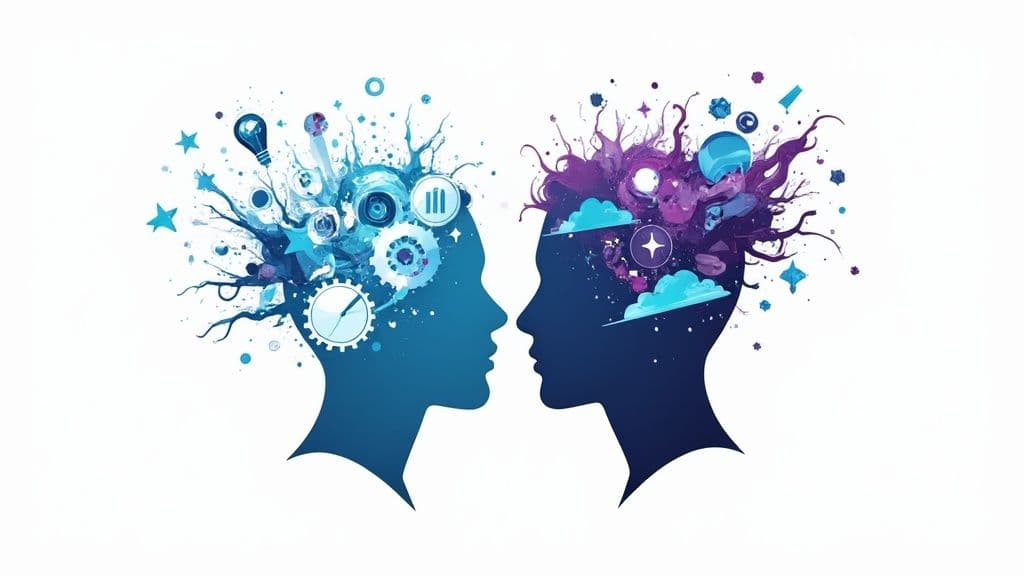
Ever set a goal and then slip back into old habits? Your conscious mind sets intentions, but the subconscious runs automatic programs that decide whether those intentions stick. This guide explains how they differ, why conflict happens, and simple, practical steps to align them so change lasts.
Conscious vs Subconscious Mind: How Habits Form
Summary: Discover how conscious and subconscious minds differ, why intentions fail, and simple steps to align them so change lasts.
Introduction
Ever set a goal and then slip back into old habits? Your conscious mind sets intentions, but the subconscious runs the automatic programs that decide whether those intentions stick. This article explains how the two systems differ, why they sometimes conflict, and clear, practical techniques to get them working together so change becomes permanent. Start with small, repeatable steps and you can see habits form in weeks to months6.
The basic difference
The conscious mind is what you’re aware of now—current thoughts, focus, and deliberate choices. The subconscious is the large, automated system working behind the scenes: habits, emotional responses, bodily rhythms, and stored memories.
You can plan with the conscious mind, but the subconscious often steers behavior. Recognizing that relationship is the first step toward lasting change.
Understanding the conscious and subconscious mind
The iceberg analogy fits: the conscious mind is the visible tip—logical thinking, goal-setting, and deliberate decisions. The hidden bulk beneath the surface is the subconscious: a repository of experiences, beliefs, and automatic programs that govern emotions, intuition, and habit.
Processing power and capacity
The conscious mind processes information sequentially and has limited short-term capacity—often around four items at once1. The subconscious operates in parallel, handling many processes simultaneously. This imbalance helps explain why willpower alone often feels inadequate: conscious choices can be overwhelmed by deeply ingrained subconscious programs.
“The conscious mind sets the goal; the subconscious executes the program.”
For a deeper look at stages of consciousness and how these systems interact, see our article on stages of consciousness.
Core differences at a glance
| Characteristic | Conscious Mind | Subconscious Mind |
|---|---|---|
| Awareness | Active and present; what you’re thinking now. | Automatic and hidden; works behind the scenes. |
| Processing | Sequential; one thing at a time. | Parallel; handles many inputs simultaneously. |
| Capacity | Limited; a few items in short-term memory at once1. | Vast; integrates long-term memory, emotion, and pattern recognition. |
| Function | Logical reasoning, willpower, short-term memory. | Habits, emotions, intuition, long-term memory, beliefs. |
| Control | Deliberate; you choose focus. | Automatic; runs reflexes and ingrained patterns. |
| Language | Verbal and logical. | Experiential: images, feelings, symbols. |
The conscious mind: what you know
Think of the conscious mind as the analytical, deciding part—the voice that evaluates options and sets intentions. It’s where willpower lives: the choice to skip a snack or sign up for a class.
Because it processes information linearly, multitasking reduces its effectiveness. Trying to juggle many decisions at once leads to slower thinking and more errors. When facing a complex choice, use your conscious mind to gather facts and then step away so your subconscious can integrate them.
Short-term memory and focus
Short-term memory acts like a sticky note—holding information long enough to act. Without repetition or emotional significance, those notes fade quickly. That’s why conscious plans often fail unless they’re translated into subconscious habits.
The subconscious mind: the hidden powerhouse
The subconscious is the engine room: automatic bodily functions, habitual behavior, gut instincts, and creative leaps all emerge from this level. It learns through emotion and repetition, so intense experiences or repeated actions form lasting beliefs or habits.
Intuition and creativity
Sudden ideas, gut feelings, and creative insights are often the subconscious connecting patterns the conscious mind can’t see. Research and reporting on subconscious-driven experiences describe regular occurrences of intuition and premonition in many adults4.
“The subconscious doesn’t argue; it accepts and executes the commands it’s given.”
How the subconscious learns
Two engines drive subconscious learning: emotion and repetition. Emotional events are prioritized during memory consolidation, and repeated actions form automatic neural pathways—this explains why habits are persistent and why willpower alone rarely rewires behavior permanently5.
Practices like meditation for self-discovery help quiet the conscious mind so you can observe and shift deeper patterns.
How the two minds shape decisions
Every decision is a negotiation between conscious reasoning and subconscious patterning. For straightforward, linear tasks the conscious mind performs well. For complex, holistic judgments the subconscious often delivers better outcomes.
Studies and reviews of unconscious decision-making show that deliberation can sometimes worsen choices, while allowing the subconscious time to process can improve results2.
When overthinking hurts
Analysis paralysis happens when the conscious mind tries to juggle too many variables. In some experiments, participants who relied on deliberation performed worse than those who let unconscious processing guide their choice2.
Trusting the subconscious—wisely
Your subconscious is powerful but not infallible. It stores biases and fears alongside useful intuitions. Use conscious awareness to collect facts and values, then allow time—sleep on it or take a break—so your subconscious can synthesize the information. That combined approach tends to yield better results.
Aligning goals with subconscious beliefs
Real change comes when conscious goals match subconscious beliefs. If your conscious aim conflicts with long-held subconscious programming, you’ll experience resistance. Instead of forcing change, create conditions for the subconscious to adopt new patterns.
Practical techniques to align both minds
- Mindfulness: Notice automatic thoughts without judgment to spot subconscious patterns.
- Visualization: Vividly imagine goals as already achieved—this builds neural pathways and emotional familiarity with the outcome3.
- Journaling: Write freely to surface hidden fears and beliefs. Asking, “What am I really afraid of?” can reveal the subconscious script behind a habit.
The aim is to befriend your subconscious, not battle it. When you understand its protective motives, you can offer new, safer scripts for it to run.
For structured self-discovery, some people use frameworks like Dan Millman’s Life Purpose work or the Life Purpose App to explore inherent drives and challenges.
Common questions
Can you directly control your subconscious?
Not instantly. Change is more like gardening than engineering: you don’t flip a switch, you cultivate conditions—repetition, emotion, and simulated experience—that encourage new beliefs to take root. Forming a new habit often takes weeks to months; one study found an average of 66 days to reach automaticity for a simple behavior6.
Why do bad habits keep coming back?
Habits are subconscious shortcuts that conserve energy. Willpower is limited; subconscious programs are persistent. To break a habit you must rewrite the underlying routine or belief through repetition and emotional reframing.
Are dreams messages from the subconscious?
Yes—dreams often use symbols and emotions to surface unresolved feelings, insights, and priorities. Keeping a dream journal can help capture and reflect on those messages.
Practical next steps
- Use your conscious mind to set clear, emotionally meaningful goals.
- Spend five minutes a day visualizing the desired outcome in sensory detail3.
- Practice mindfulness to notice and question automatic thoughts.
- Repeat new behaviors consistently until they feel automatic.
To explore a structured path for uncovering deeper drives, learn more about Dan Millman’s approach via the Life Purpose App.
Quick Q&A
Q: Why do intentions fail?
A: Intentions fail when conscious goals conflict with subconscious programming; change requires repetition, emotional reinforcement, and time to rewire habits5.
Q: When should I trust intuition?
A: Trust intuition for holistic or pattern-based choices after you’ve gathered facts consciously and given your mind time to process2.
Q: One daily habit to start with?
A: Five minutes of vivid visualization each morning to build emotional familiarity with your goal3.
1.
N. Cowan, “The magical number 4 in short-term memory: A reconsideration of mental storage capacity,” Behavioral and Brain Sciences (2001). https://pubmed.ncbi.nlm.nih.gov/11515263/
2.
What the science actually says about unconscious decision making, MIT Press Reader. https://thereader.mitpress.mit.edu/what-the-science-actually-says-about-unconscious-decision-making/
3.
F. Driskell, A. Copper, S. Moran, “Does mental practice enhance performance?” Journal of Applied Psychology (1994). https://psycnet.apa.org/doi/10.1037/0021-9010.79.4.481
4.
Popular Mechanics, “Experts weigh in on subconscious-driven experiences and premonitions,” which discusses survey findings on subconscious experiences. https://www.popularmechanics.com/science/a68023862/subconscious-premonitions-anomalous-experiences/
5.
J.L. McGaugh, “Memory—A Century of Consolidation,” Science (2000). https://www.ncbi.nlm.nih.gov/pmc/articles/PMC2844630/
6.
L. Lally, C. van Jaarsveld, H. Potts, R. Wardle, “How are habits formed: Modelling habit formation in the real world,” European Journal of Social Psychology (2010). https://pubmed.ncbi.nlm.nih.gov/19968486/
Discover your life path today
Enter your date of birth and see your life path, free.
Find your life path