March 15, 2026 (1d ago) — last updated March 16, 2026 (Today)

A Guide to the Different Empath Types

Explore the different empath types, from emotional to intuitive. This guide helps you understand your unique empathetic gifts and learn how to manage them.

← Back to blog
Cover Image for A Guide to the Different Empath Types

Explore the different empath types, from emotional to intuitive. This guide helps you understand your unique empathetic gifts and learn how to manage them.

Have you ever walked out of a room feeling emotionally exhausted, even though nothing bad happened to you? If you constantly feel like you’re absorbing the world around you, you’re not just being "too sensitive"—you're almost certainly an empath.

But that label is just the beginning. Empathy isn't a one-size-fits-all trait. It’s a rich spectrum of abilities, and understanding where you land is the key to thriving. For some, it's about picking up on emotions, while for others, it’s about sensing the energy of a place, an animal, or even the earth itself.

Going Beyond the Empath Label

It's so easy to brush off these deep feelings as being "overly emotional." The truth is, that feeling of being a sponge is a huge clue to your energetic wiring. Think of yourself as a finely tuned radio receiver. Some people are built to pick up on the subtle frequencies of human emotion. Others are tuned into physical sensations, or even the quiet, humming energy of the natural world.

This guide will help you find your unique frequency on that spectrum. Pinpointing your specific empath type is the most powerful first step you can take to manage your sensitivity and finally start seeing it as the gift it truly is. When you can put a name to what you’re experiencing, you can stop fighting against your own nature and start building a life that actually works for you.

For an empath, feeling for someone is secondary. The real experience is feeling with them—an involuntary absorption of the world's energetic data, often without even trying.

Finding Your Unique Energetic Signature

Getting to know your personal energy isn't just a fluffy spiritual exercise; it has incredibly practical benefits for your day-to-day life and relationships. Once you can identify your specific empathic strengths, you can learn to:

  • Set better boundaries: Finally understand which energies drain you the most and learn how to effectively shield yourself.
  • Improve relationships: Clearly communicate your needs to partners, friends, and family so they can understand your world.
  • Embrace your gifts: Start using your sensitivities to connect with and help others in truly meaningful ways.

As we dive deeper, we'll also look at systems of self-knowledge that can offer profound clarity. Dan Millman’s book, “The Life You Were Born to Live,” is a fantastic example. He outlines a system connecting your birth date to a core life path. This framework, also found in the Life Purpose App, can illuminate the major themes and challenges you’re here to work with, helping you see exactly how your empathic nature fits into your life's bigger picture.

The Core Empath Types Explained

So, you’re beginning to suspect you might be an empath. But what does that really mean day-to-day? Empathy isn't a one-size-fits-all experience; it shows up in distinct ways, and understanding your own unique flavor of sensitivity is the first step toward mastering it.

Think of it like having different radio receivers. We’re all picking up signals from the world around us, but an empath’s receiver is tuned to a much finer, more energetic frequency. The specific type of frequency you tune into most naturally often defines your core empath type. Let's look at the 3 most common ones.

Emotional Empaths: Feeling the Room

The Emotional Empath is what most people picture when they hear the term. These are the individuals who walk into a space and can instantly feel the mood. It's not just noticing that people seem happy or tense; it's about actually feeling that joy or tension in their own bodies as if it were their own.

An Emotional Empath might feel a sudden, crushing wave of sadness while standing in a checkout line, only to see the person ahead of them is quietly struggling not to cry. This profound connection makes them incredible friends and listeners, but it comes at a cost. The biggest challenge is learning to untangle their own emotions from the ones they've absorbed from others. Without good boundaries, it can lead to constant emotional exhaustion.

Physical Empaths: Feeling the Body

Then you have Physical Empaths, who experience the physical sensations of others on a somatic, bodily level. This goes far beyond simple sympathy for someone’s pain. A Physical Empath might suddenly develop a sharp pain in their own knee, only to find out their coworker just reinjured an old sports injury.

Their bodies essentially act as mirrors, reflecting the physical ailments, aches, and even the pleasant physical sensations of people nearby. This can be an incredible asset for healers and bodyworkers, but for the untrained empath, it’s often confusing and deeply draining. Learning grounding techniques to stay anchored in their own physical self is absolutely essential.

Being an empath is like being a human tuning fork. You don't just hear the music of the world; you vibrate with it, whether the tune is happy or heartbreaking.

This simple decision tree can help you see where you might fall on the spectrum.

A flowchart diagram illustrating an empath types decision tree, starting with absorbing surroundings.

As the chart shows, if you find yourself consistently absorbing the energy, feelings, or physical states of your environment, you are almost certainly walking the empath's path.

To give you a clearer picture, here’s a quick breakdown of how these core types compare.

Quick Guide to Core Empath Types

Empath TypePrimary Way of SensingCommon Challenge
Emotional EmpathFeels the emotions and moods of others directly.Distinguishing their own feelings from absorbed emotions.
Physical EmpathExperiences the physical symptoms and sensations of others.Taking on others' pain, leading to physical exhaustion.
Intuitive EmpathReceives information as a sudden "knowing" or gut feeling.Trusting non-logical insights and inner guidance.

This table is just a starting point, of course. Many empaths are a blend of these types, but usually one is more dominant.

Intuitive Empaths: Simply Knowing

Finally, we arrive at the Intuitive Empath. This type of sensitivity is less about feeling and more about a sudden, unexplainable "knowing." They get information in flashes of insight, a powerful gut feeling, or an unshakeable sense that something is true, without any logical evidence to back it up.

An Intuitive Empath might just know a friend is about to call with bad news, or they might know exactly what someone needs to hear in a crucial moment. This isn't mind-reading based on body language; it's a direct download of information. Because this ability operates beyond logic, their biggest hurdle is learning to trust these insights, even when they make no sense. For a deeper look into this fascinating area, you can explore how psychic and empathic abilities often intersect (lifepurposeapp link would go here).

Understanding Empaths of the Natural World

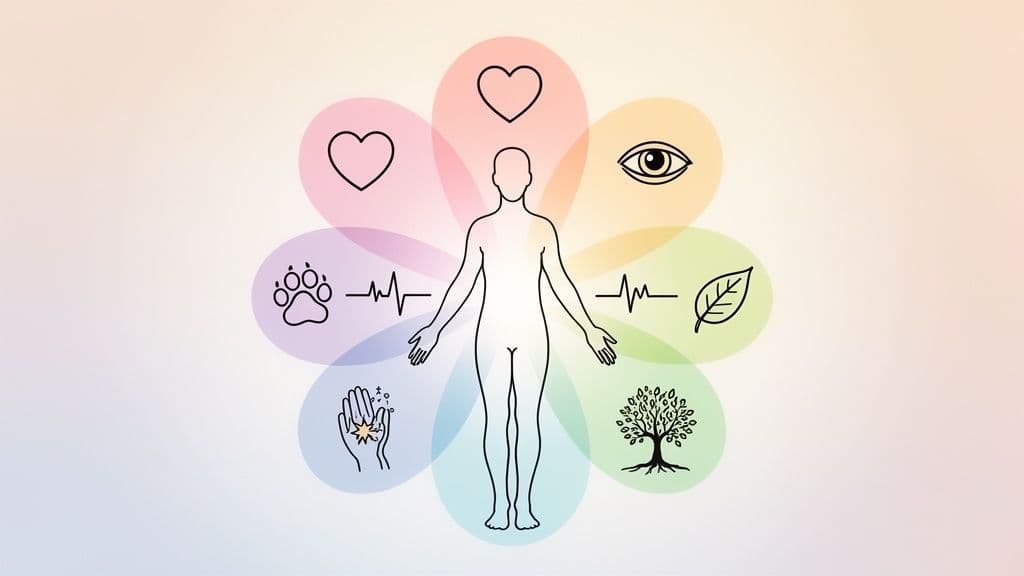
Three illustrations showing different empath types: animal, plant, and earth empaths.

For some of us, that deep well of empathy doesn't stop with other people. It spills over, connecting us to the living, breathing fabric of the natural world. If you find more peace in a quiet forest than a bustling city, or feel a genuine ache for an animal you see struggling, you might be one of these unique empaths.

These sensitivities are very real, even if they're often dismissed by others as just being overly sentimental. Your intuitive bond with nature isn't simply an appreciation for a pretty view; it's a genuine energetic exchange. Let’s take a closer look at the three primary ways this connection shows up.

Animal Empaths

Have you ever looked at a pet and just known what it was feeling? An Animal Empath feels an almost telepathic bond with animals. It’s more than just loving them; it’s about sensing their emotional or physical state as if it were your own. You can feel their contentment, their fear, or their pain on a deeply personal level.

Animal Empaths often become beacons for animals, who seem to instinctively seek out their calm and understanding presence. The real challenge here is learning not to absorb the suffering of every creature you encounter. It’s a fast track to emotional exhaustion if you don't build strong energetic boundaries.

Being an empath of the natural world means your nervous system is tuned to the Earth's frequency. You don’t just observe nature; you feel its heartbeat, its pain, and its quiet wisdom as a part of your own being.

Plant or Flora Empaths

It may seem strange to some, but having a deep empathic connection to the plant kingdom is a powerful and very real gift. A Plant Empath, also known as a Flora Empath, has an intuitive knack for understanding what plants need. They can almost feel a plant’s thirst or sense its quiet plea for more sunlight.

These are the natural "green thumbs" who seem to hold silent conversations with their gardens. They feel the life force flowing through plants and can be profoundly impacted by the health of the greenery around them. A walk through a vibrant, thriving garden can feel incredibly energizing, while a space filled with wilting plants can feel draining and sad.

Earth or Geomantic Empaths

An Earth Empath is exquisitely tuned in to the energy of the planet itself. This means they are incredibly sensitive to the distinct energetic signature of a particular place. For them, walking onto an old battlefield might trigger a wave of unexplained sorrow, while standing in an ancient, untouched forest can fill them with a feeling of profound peace and vitality.

This sensitivity often extends to large-scale planetary events. Many Earth Empaths report feeling agitated, anxious, or even physically unwell in the hours or days leading up to an earthquake or a major storm, as they are sensing the massive shifts in the Earth's energetic field. The key for them is to master grounding techniques to stay centered, especially when they find themselves in places with chaotic or heavy energy.

By honoring these unique connections, you can begin to transform them from a source of overwhelm into a true source of strength and wisdom.

How Empathic Abilities Connect to Intuitive Senses

Have you ever wondered how you’re actually picking up on all this information? It’s one thing to know you’re an empath, but it’s another to understand the mechanics behind it. This is where your intuitive senses come into play.

You’ve probably heard of the clair senses—clairvoyance, clairsentience, and so on. They can sound a bit out there, but they’re not supernatural powers. They are simply heightened, finely-tuned aspects of your own human sensory system, processing information on an energetic level.

Think of it this way: An Emotional Empath who walks into a room and immediately feels a wave of sadness isn't just being sensitive. They're actively using clairsentience (clear feeling). An Intuitive Empath who gets a sudden, unshakeable feeling that a friend needs to call their mom is experiencing claircognizance (clear knowing). These aren't separate, random skills; they are the specific channels through which your empathy operates.

Your intuition isn't just a whisper; it's your internal compass. The clair senses are simply the different ways that compass points you toward the truth—translating raw energetic data into feelings, knowings, visions, or even sounds.

Learning to identify these channels is like tuning an old radio. Once you find the right frequency, the static disappears, and the message comes through with perfect clarity.

The Clair Senses and Empath Types

Let's look at how these intuitive senses show up for the different kinds of empaths we've talked about.

  • Clairsentience (Clear Feeling): This is the absolute bedrock of empathy. It’s the ability to physically feel other people's emotions, their aches and pains, or the dense energy in a tense room. This is the primary sense for both Emotional and Physical Empaths.
  • Claircognizance (Clear Knowing): This is that lightning bolt of insight that comes out of nowhere. You just know something is true, without any trail of logic or evidence to back it up. Intuitive Empaths live and breathe this sense; it's their direct line for information downloads.

Of course, these aren't the only two. Other channels, like clairvoyance (clear seeing) and clairaudience (clear hearing), often play a supporting role in how an empath perceives the world around them.

The Empathic Healer

When an empath learns to consciously focus these intuitive senses, they often step into the role of an Empathic Healer. This isn't a formal job title but rather a description of a person who instinctively uses their gifts to help others mend.

They are the friends who just know what you need to hear or the practitioners who can sense exactly where a client’s energy is stuck. Empathic Healers are driven by a deep, innate need to transform heavy, negative energy into something lighter and healthier.

But this gift comes with a significant risk. Without proper energetic hygiene, they can easily become a dumping ground for the pain and trauma of others. For this type, energetic boundaries are not just a good idea—they are a survival mechanism. Daily practices like shielding and energy clearing are non-negotiable for preventing burnout and protecting their own well-being.

Connecting Your Empathy Style to Your Life Path

Have you ever wondered if the specific way you feel and connect with the world has a deeper meaning? For many empaths, the experience can feel overwhelming and even random. But what if your unique brand of empathy is actually a core part of your life's purpose, a built-in compass pointing you toward your true path?

That’s the exact idea behind Dan Millman's classic book, “The Life You Were Born to Live.” It’s not about predicting the future. Think of it more like a practical roadmap to your own spiritual DNA. By using your birth date, the system helps you identify one of 45 distinct life paths, each with its own inherent strengths, common hurdles, and a beautifully unique style of empathy.

Imagine discovering that your birth date unlocks one of 45 unique life paths, each shaping how you connect with the world in profoundly empathetic ways—far beyond generic personality quizzes. This is precisely what Millman's work explores.

This approach gives you a powerful way to make sense of why you feel things so deeply. It takes your personal experiences and places them into a larger, meaningful context, validating that your sensitivity is not a flaw, but a powerful gift designed for a specific purpose.

Decoding Your Empathic Blueprint

The system, which is detailed in Millman’s book, “The Life You Were Born to Live,” and the Life Purpose App, uncovers these paths by calculating a number from your full birth date. In "The Life You Were Born to Live," Revised 25th Anniversary Edition, this ancient-wisdom system works by condensing your birth date (month + day + year) into a compound number and a single-digit birth number. This is what creates the 45 unique profiles that so clearly influence the different empath types. If you're curious to see why Millman’s work has resonated with over a million readers, you can explore the details of his groundbreaking book.

Every path carries its own energetic signature, which directly colors how you express and experience empathy. Here are a couple of examples to show you what I mean:

  • Visionary Empathy: Someone on a ‘29/11’ path might have this. They don't just feel what someone is feeling in the moment; they have an intuitive sense of where that person is headed and can offer guidance with a deep, forward-looking insight.

  • Material Empathy: A person on a ‘35/8’ path often feels this. They are highly sensitive to the energy of physical things—from finances and objects to entire environments. They can walk into a business and just feel its potential or know when a project has the right "vibe."

These aren’t just odd personality quirks. They are direct reflections of your core spiritual purpose. When you understand your life path, you begin to see that your specific empathic abilities are perfectly tailored to help you navigate your challenges and step into your full potential.

For anyone who has spent a lifetime feeling "too sensitive," this kind of clarity can be a profound relief. It can shift your entire perspective from feeling burdened by your empathy to seeing it as your greatest strength. If you're looking for more ways to identify your innate abilities, our guide on discovering your spiritual gifts is a great next step.

Essential Skills for Thriving as an Empath

Three illustrations show essential empath skills: grounding with roots, shielding in a bubble, and a cozy sanctuary.

Discovering your empath type is a massive turning point. But it's just the first step. The real journey begins when you learn to live with your sensitivities without letting them run your life. This isn't about shutting yourself off from the world—it’s about learning how to manage your gift so it doesn't leave you completely drained.

Think of it as energetic hygiene. You wouldn't go days without showering, so why go without clearing your energy? A few core practices can make a profound difference, no matter which type of empath you are.

Grounding, Shielding, and Boundaries

These three skills are the absolute cornerstones of empath self-care. They are simple to learn, incredibly powerful, and non-negotiable if you want to stay balanced and sane in a chaotic world.

  • Grounding: This is what connects you back to yourself and the earth when you feel floaty or overwhelmed. The simplest way is to plant your feet firmly on the floor and imagine roots extending from your soles, digging deep into the ground. Feel them anchoring you, pulling all the static and foreign energy down and away from you.

  • Shielding: Before walking into a crowded mall, an intense meeting, or even just a family gathering, take a moment to visualize a bubble of protective light surrounding you. I like to imagine a shimmering golden light, but you can choose any color that feels strong and safe. This shield is smart; it lets love and good vibes in, but deflects negativity and emotional overwhelm before they can stick to you.

  • Boundaries: This is often the hardest one. As an empath, you can literally feel the disappointment when you say "no," which makes it incredibly difficult. Start practicing simple, kind, but firm phrases. "Thank you for thinking of me, but I don’t have the energetic capacity for that right now" is a complete sentence. You don't owe anyone a long explanation.

Creating a personal sanctuary in your home is vital. It doesn't have to be a whole room; it can be a cozy chair in a quiet corner. This is your spot to recharge without interruption—your energetic home base.

Understanding Your Personal Cycles

Another powerful layer of self-management comes from understanding your unique energetic rhythms. One fascinating system for this comes from Dan Millman’s book, The Life You Were Born to Live. It helps reveal the natural patterns you're already living.

For example, those on Path 12/3, who make up about 7% of births, have a specific kind of creative empathy. When out of balance, they can face 30% more friction in their relationships. The Life Purpose App, which is based on this system, shows how we move through nine-year cycles. For these creative empaths, productivity can jump by 25% during a '3' cycle. Knowing when your sensitivity might be peaking allows you to prepare instead of just reacting. You can learn more about the system in Millman’s book on InnerPath.com.

By combining these practical skills with a deeper awareness of your own energetic cycles, you're not just surviving—you're learning to thrive. You can also build on these skills and deepen your communication by learning more about empathic listening in our other articles.

Common Questions About Empath Types and Life Paths

As you begin to see yourself in these descriptions, some big questions usually start to surface. This path of self-discovery is less about finding a single label and more about understanding how these abilities weave through your life, so let’s explore a few things that often come up.

Can You Be More Than One Empath Type?

Yes, almost everyone is! It’s actually rare to be just one type. Think of it like having a dominant hand—you might be right-handed, but you still use your left hand for all sorts of things.

You might be a powerful Emotional Empath who primarily feels the emotions of others, but you also have a strong connection to animals (Animal Empath) or get sudden, unexplainable insights (Claircognizant Empath). Most of us are a unique blend, with one primary type and several secondary sensitivities that show up from time to time.

How Can You Tell Your Energy Apart from Others?

This is the million-dollar question for every empath, and learning this skill is life-changing. It takes practice, but here’s a simple exercise to get you started.

  • Find a quiet moment and close your eyes. Take a few deep, grounding breaths and do a quick scan of your body.
  • Gently ask yourself, "What am I feeling right now?" Simply name the emotions or physical sensations without judging them. This is your baseline.
  • Now, bring to mind the person or situation you think you’re picking up on.
  • Ask your inner self a direct question: "Is this feeling mine, or does it belong to someone else?" The answer often arrives as a gut instinct, a subtle shift in your body, or a quiet sense of knowing. Trust that first impulse.

How Does Knowing Your Life Path Help?

Understanding your life path number gives you an incredible roadmap for your journey. It provides a framework for why you are the way you are and how you interact with the world on an energetic level.

Dan Millman’s work, which you can find in his book The Life You Were Born to Live and the Life Purpose App, is a fantastic tool for this. When you see your partner’s life path number next to your own, for example, the dynamics of your relationship suddenly make so much more sense. You can spot potential challenges before they arise and learn to appreciate the unique strengths you share.


Ready to unlock your unique spiritual blueprint? Discover your life path, core challenges, and innate gifts with the Life Purpose App. Download it today and start living in alignment with the life you were born to live.

REQUIREMENTS:

  • Remove each broken blog link completely (both the markdown link syntax and the descriptive text)
  • Rewrite sentences naturally after removing references
  • Preserve all other markdown formatting
  • Only remove references to the specific broken blog links, don't change other content
  • Process all broken URLs in a single pass

Example: Before: "...for your small business as described in the small business article." After: "...for your small business."

Please return your response in the following JSON format: { "updatedContent": "the full content with all broken links removed", "removals": [ { "brokenUrl": "the broken blog URL", "explanation": "brief explanation of what was removed and how the text was adjusted" } ] }

← Back to blog

Discover Your Life Purpose Today!

Unlock your true potential and find your life’s purpose.