Unlock the energies of love: romantic, compassionate, & beyond. Cultivate these forces to achieve personal growth and strengthen your relationships.
May 22, 2026 (2mo ago) — last updated June 20, 2026 (1mo ago)
Master the Energies of Love: Transform Your Relationships
Unlock the energies of love: romantic, compassionate, & beyond. Cultivate these forces to achieve personal growth and strengthen your relationships.
← Back to blog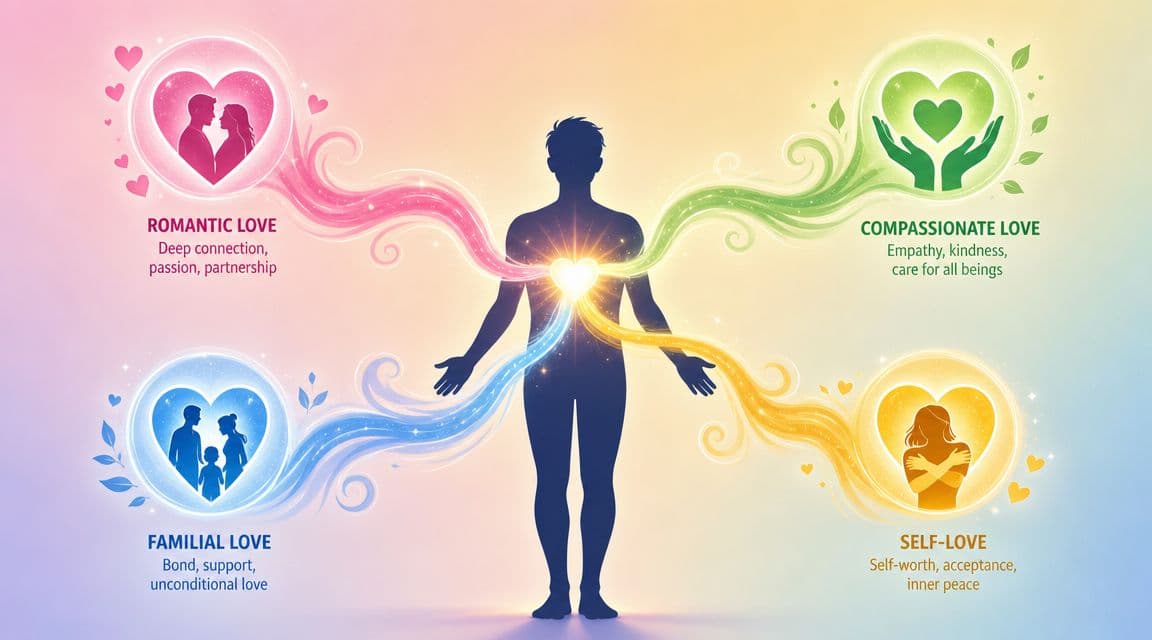
You can feel it when something is off. A conversation that should have felt warm turns stiff. A person you care about says the right words, but your body still senses distance. Or the opposite happens. You sit beside someone in silence and feel held, understood, and safe without needing much explanation.
That's usually what people mean when they talk about the energies of love. They're trying to name the felt quality between people. Not just chemistry. Not just attraction. Not just mood. Something subtler, but still real in daily life.
The trouble is that this idea often gets wrapped in language so vague that it becomes hard to use. If “energy” means everything, it ends up meaning nothing. A common desire is simpler. People want to know why love feels easy one day and blocked the next, and what they can do about it.
What Are the Energies of Love
The energies of love aren't best understood as magic floating around in the air. A more grounded way to see them is as the combination of attention, emotion, intention, body state, and behavior that shapes how connection feels within you and between you and someone else.
When people say, “The vibe changed,” they're often noticing something concrete. Tone shifted. Eye contact faded. Defensiveness entered the room. One person softened while the other stayed guarded. The energy changed because the pattern changed.
What people often get wrong
Some readers hear the phrase and assume it means a purely mystical force that can't be examined. Others reject it completely because it sounds too spiritual. Both reactions miss something useful.
Many discussions of love energies remain metaphorical, but people are often really asking for a way to diagnose friction and improve connection. Relationship science shows that concrete, observable behaviors like responsiveness and validation predict relationship quality more reliably than vague constructs, as discussed in this reflection on the invisible forces of your relationship.
That gives us a practical test. If a concept helps you notice behavior more clearly, regulate yourself better, and relate with more care, it's useful. If it only sounds poetic, it won't help much on a hard Tuesday night.
Practical rule: If you want to understand love energy, watch what people do when they feel safe, threatened, seen, ignored, cherished, or dismissed.
A grounded definition you can use
Try this working definition: the energies of love are the felt patterns of connection created by your inner state and expressed through your actions.
That includes things like:
- Presence that tells another person, “I'm here with you.”
- Warmth that softens defensiveness.
- Respect that protects dignity during tension.
- Affection that turns care into touch, words, or attention.
- Receptivity that lets love in instead of pushing it away.
This way of thinking also fits broader conversations about vibration and emotional presence. If you want a complementary spiritual lens, energy, frequency, and vibration offer a starting point.
The key is that love energy isn't separate from ordinary life. It shows up in how you text back, how you listen, how you apologize, how you set boundaries, and how your nervous system responds when closeness feels risky. That makes it less mysterious, and more compassionate.
The Four Primary Expressions of Love
People often speak about love as if it were one single force. In lived experience, it has different textures. The love you feel for a partner doesn't move exactly like the love you feel for a close friend, your child, or yourself.
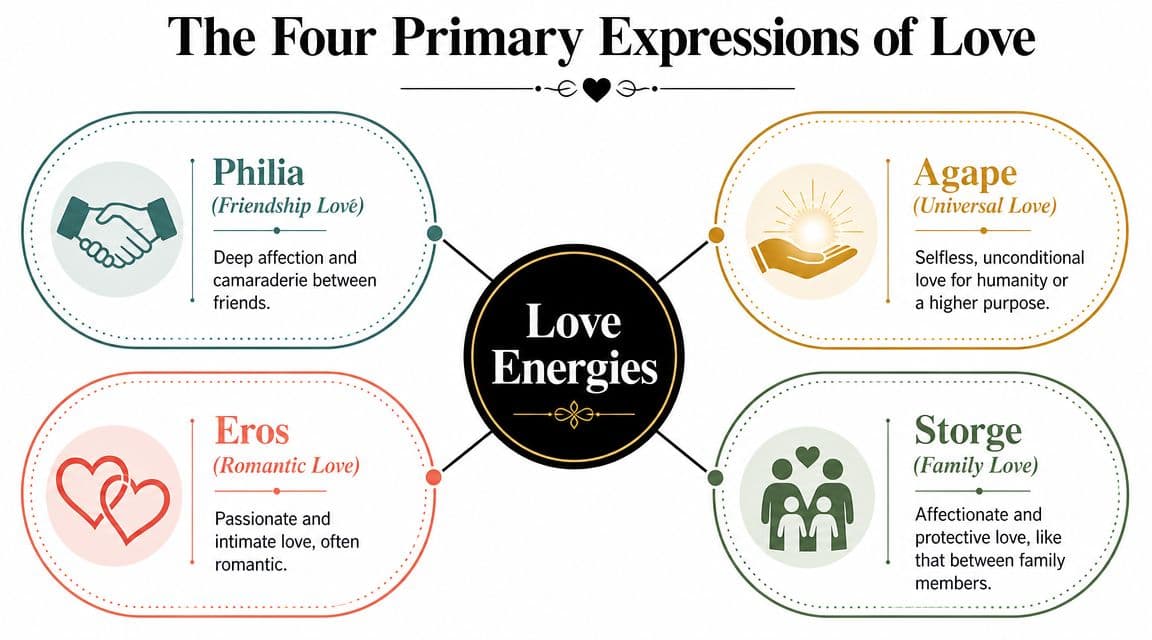
One useful way to organize the energies of love is to look at four primary expressions. These aren't rigid boxes. They're more like lenses that help you notice what kind of connection is active, and what that kind of connection needs to stay healthy.
The four expressions in plain language
| The Four Expressions of Love Energy | |||
|---|---|---|---|
| Energy Type | Primary Focus | How It Manifests | Common Challenge |
| Eros | Attraction and intimate connection | Desire, romance, admiration, longing, playfulness | Confusing intensity with stability |
| Philia | Friendship and mutual respect | Loyalty, honesty, shared humor, steady presence | Drifting into neglect through busyness |
| Agape | Compassion and selfless goodwill | Forgiveness, generosity, empathy, service | Giving without boundaries |
| Storge | Family-style affection and belonging | Protection, familiarity, care, remembrance, commitment | Taking closeness for granted |
Eros as a living current
Eros is the energy people usually think of first. It includes attraction, passion, tenderness, and the spark that draws two people toward intimacy. At its healthiest, it isn't only sexual. It also carries aliveness, delight, curiosity, and the desire to understand someone more fully.
Eros can be intense, which is why people confuse it with destiny. But intensity by itself doesn't guarantee wisdom. Sometimes Eros says, “Move closer.” Sometimes maturity has to ask, “Is this connection also kind, reciprocal, and grounded?”
Philia and the warmth of friendship
Philia is quieter, but it lasts. This is the energy of trusted friendship, emotional steadiness, and mutual goodwill. It's what lets you exhale around someone. You don't have to perform. You can tell the truth.
Many romantic relationships weaken because they chase spark and neglect friendship. Yet Philia often carries a bond through ordinary seasons, stress, disappointment, and change.
Deep love often survives not because two people stayed fascinated every day, but because they kept showing up with honesty and goodwill.
Agape and love that opens outward
Agape points toward compassion. It's the love that doesn't ask first, “What do I get?” It asks, “What serves life here?” You see it in forgiveness, patient listening, mercy, service, and care for people beyond your immediate circle.
Agape matters because it widens the heart. It helps love become less possessive and less fragile. But it needs boundaries. Without them, compassion can slide into self-erasure.
Storge and the love of belonging
Storge is the affectionate bond of family, home, memory, and deep familiarity. It's the energy of being known over time. Meals shared. Routines repeated. Care offered during illness, grief, or fatigue.
This form of love often looks plain from the outside. But it creates security. It gives people a place to return to inside themselves.
And beneath all four sits one more layer, even though it isn't in the classical list. Self-love. Without some degree of self-respect and inner permission to receive care, every other form gets strained. You might chase Eros, overgive in Agape, cling in Storge, or hide in Philia.
How Love Energies Manifest in Your Life
Love becomes easier to understand when you stop treating it like an idea and start noticing its footprints. The modern study of love has moved from philosophy toward science. Harvard Medical School describes love as having evolutionary and health relevance, with importance for pair-bonding and human well-being in its overview of the science of love. That means paying attention to how love shows up in daily life isn't sentimental. It's a serious form of observation.
In romance
A couple has been together long enough that logistics have replaced courtship. They talk mostly about groceries, work schedules, and who forgot to answer a message. Nothing dramatic is wrong. But Eros has thinned.
One evening, they decide to try one small shift. Phones stay in another room. Dinner isn't rushed. One asks, “What's been on your mind that you haven't had space to say?” The other answers slowly. They laugh. They make eye contact again. The energy changes before any major problem gets solved.
In compassion
A woman notices that her friend keeps saying, “I'm fine,” in a tone that clearly means the opposite. Instead of offering advice, she says, “You don't have to be easy to be loved.” Her friend cries with relief.
That's Agape in action. Not grand sacrifice. Just a moment of humane presence.
Sometimes people access that tenderness through animals because animals lower defenses. If you want language that captures that kind of openhearted bond, you might enjoy these inspiring dog quotes from Soulknit. They remind us how simple affection can be.
In family and belonging
A father and daughter don't agree on much at the moment. Conversations have become careful. Yet when she gets sick, he brings soup, checks in, and sits nearby without trying to fix her life. That's Storge. Love expressed as steady care, even when emotional language feels awkward.
Family love often speaks through action before it speaks through insight.
In self-love
A man keeps saying yes when he means no. He calls it kindness, but inside he feels resentment. Eventually he notices the pattern. He starts pausing before he agrees to things. He says, “I can't help this weekend, but I can talk on Monday.”
At first it feels selfish. Then it feels clean. His relationships improve because his care is no longer mixed with silent bitterness. Self-love often looks less like self-admiration and more like truthfulness.
Love energy becomes visible when a person's actions match their care.
Practical Ways to Cultivate These Energies
Love doesn't stay alive on feeling alone. It responds to rhythm, attention, and repetition. The body matters here. The summary of The Energies of Love describes distinct neurochemical pathways linked with lust, romance, and long-term bonding, and notes that behaviors involving touch, safety, novelty, and reward can shift relationship quality through internal physiological state in this overview of how bonding chemistry supports attachment.
That doesn't reduce love to chemistry. It means your habits either support connection or starve it.
Practices for romance and friendship
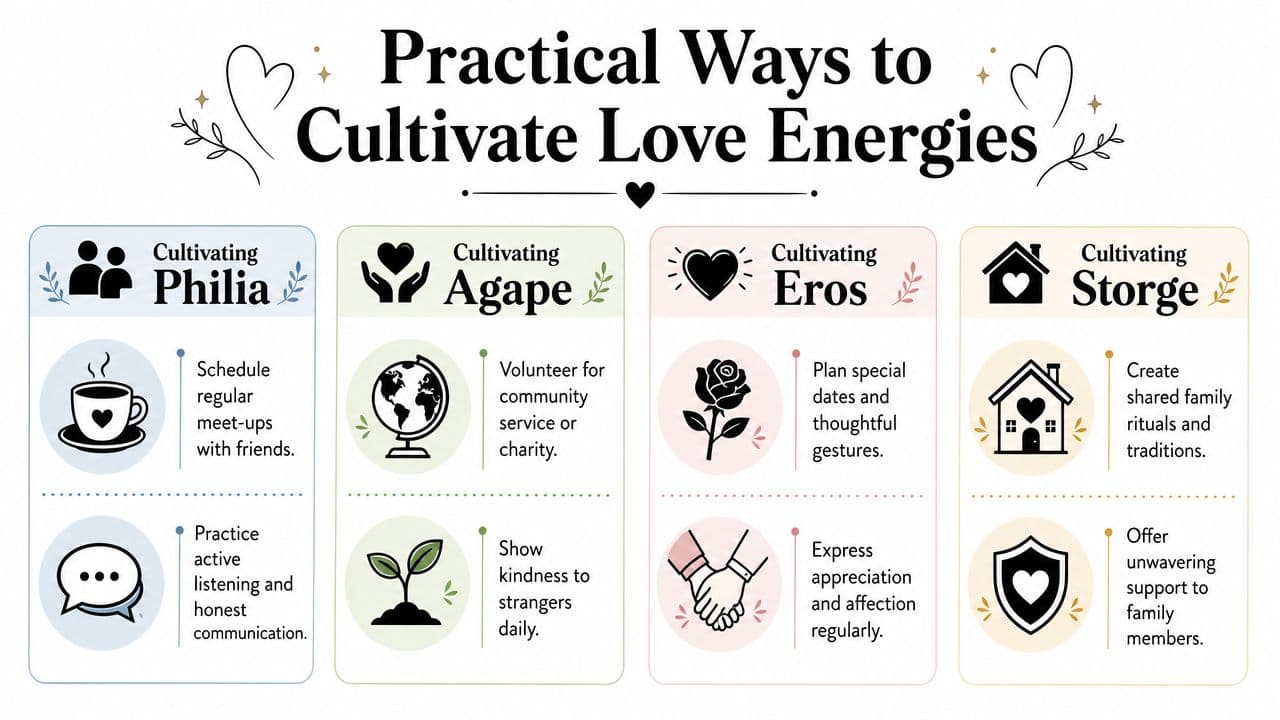
- Create novelty on purpose. Eros often wakes up when life stops feeling automatic. Try a new place, a new question, a new routine, or a different setting for a familiar conversation.
- Use affectionate touch thoughtfully. A hand on the shoulder, sitting close, or a long hug can shift the body toward safety and receptivity when both people welcome it.
- Protect friendship inside romance. Philia grows when two people remain interested in each other's inner world, not just household management.
If you want fresh ideas for expressing affection in a way that feels personal rather than generic, this guide to personalized songs and gifts from GiftSong has useful prompts.
Practices for compassion and family love
Agape and Storge both deepen through consistency more than drama. They don't need a perfect personality. They need repeated acts of care.
Try a few simple anchors:
- Name appreciation out loud. Don't assume people know.
- Respond before you advise. Understanding comes before fixing.
- Keep one reliable ritual. A weekly call, shared meal, walk, prayer, or check-in can hold connection through busy seasons.
- Offer practical care. Bring food, run an errand, remember a hard date, or follow up after a difficult conversation.
A useful test: If love feels abstract, make it behavioral. Ask, “What would care look like in the next ten minutes?”
Practices for self-love that aren't fluffy
Self-love gets confused with indulgence. A sturdier version looks like self-respect in action.
- Pause before automatic yeses. Give yourself enough time to notice your real answer.
- Track your depletion. If you're chronically numb, irritated, or resentful, your inner life needs attention.
- Use reflective writing. A short journal prompt like “What am I pretending not to know?” can reveal where your energy leaks.
- Tend your inner state before hard talks. Breath, movement, prayer, or quiet can make your words kinder and clearer.
For readers who like a spiritual framework for emotional alignment, raising your vibration for manifestation pairs well with these practices.
Love Energies and Your Life Path
Not everyone loves in the same rhythm. Some people attach quickly. Some open slowly. Some express care through words, others through service, touch, or space. These differences can feel confusing until you have a framework that helps you read your own patterns with more compassion.
That's where Dan Millman's book The Life You Were Born to Live becomes valuable. It offers a structured system for understanding recurring tendencies, strengths, and challenges across a person's life. When people explore life paths through Millman's framework, they often recognize that what they once called “mixed signals” or “too much” or “not enough” may reflect a deeper personal pattern in how they process intimacy, responsibility, vulnerability, and timing.

Why timing in love feels so different
Recent relationship research supports the idea that people don't fall in love at the same pace. In a 2023 study indexed on PubMed Central, 27% of men reported feeling in love within the first four dates, compared with 15% of women. The same study also found that among women, stronger sex drive predicted falling in love more often, while that pattern did not hold for men.
Those findings matter because they show that romantic timing isn't random. It varies in measurable ways. A framework like the one in The Life You Were Born to Live can give that variation a more personal context. It doesn't replace research. It helps people reflect on why one person moves toward closeness quickly while another needs trust to build more gradually.
Using life path insight wisely
The healthiest way to use life path ideas is gently. Not as a label. Not as a verdict. More as a mirror.
You might notice patterns like these:
- One person gives love easily outward but struggles to receive it.
- Another craves deep connection yet becomes guarded when intimacy arrives.
- Someone else values loyalty and stability but resists emotional risk or spontaneity.
When readers explore numerology and life paths, it's important to stay grounded in Dan Millman's The Life You Were Born to Live and tools built around that system, such as the Life Purpose App. The point isn't to box yourself in. The point is to understand your habits with enough honesty that you can grow beyond them.
Your path can describe a tendency. It doesn't remove your freedom.
Seen this way, the energies of love become less mysterious. They're shaped by temperament, experience, inner wounds, and spiritual lessons. Self-knowledge doesn't solve everything, but it often softens blame. And that alone can change the quality of a relationship.
Navigating Relationship Dynamics and Conflict
Conflict doesn't always mean love is gone. Often it means two nervous systems lost contact at the same time. One person pursues. The other shuts down. One speaks sharply to feel heard. The other goes cold to feel safe. Then both start arguing about the topic while the underlying problem is the state they're in.
That's why the energies of love matter most when things get tense. If you can shift the relational atmosphere before trying to solve the issue, many conversations become less destructive.
Donna Eden and David Feinstein propose a simple sequence for conflict in their work on relationship energy: Stop, Center your Energies, Reconnect Energetically, and then Reconnect Empathetically, as summarized in this explanation of their four-step conflict protocol.
A simple way to use the four steps
- Stop. Pause the argument before it gathers speed. Not as punishment. As protection.
- Center your energies. Regulate your own body first. Breathe, sit down, drink water, step outside, or place a hand on your chest until you feel less charged.
- Reconnect energetically. Signal goodwill before content. Soften your face, lower your voice, sit closer if that feels welcome, or say, “I want us on the same side.”
- Reconnect empathetically. Only then move toward understanding. Reflect back what you heard before defending your point.
This approach fits a wider need people are feeling right now. Relationship strain often isn't just about “bad chemistry.” It's also shaped by stress, overwhelm, and emotional imbalance. Readers interested in that body-mind connection may find this article on naturopathy and emotional balance a thoughtful companion.
If conflict is a recurring pain point in your relationship, a guide on how to resolve relationship conflict offers more practical support.
Love becomes durable when people stop treating conflict as proof of failure and start treating it as a call to return to presence, regulation, and care.
If you want a deeper way to understand your relationship patterns, emotional tendencies, and life path through Dan Millman's The Life You Were Born to Live, explore the Life Purpose App. It offers a practical way to turn self-knowledge into more conscious, loving relationships.
Discover Your Life Purpose Today!
Unlock your true potential and find your life’s purpose.
