Explore the energy force of life, from ancient wisdom to modern science. Learn to sense your vitality and discover your life path with Dan Millman's system.
June 20, 2026 (1mo ago)
The Energy Force of Life: A Guide to Your Inner Vitality
Explore the energy force of life, from ancient wisdom to modern science. Learn to sense your vitality and discover your life path with Dan Millman's system.
← Back to blog
You know the feeling. Some mornings you wake up clear, steady, and ready to meet the day. Other days, your body works, your mind works, but something still feels flat. You might call it tiredness, stress, low motivation, or just being off.
That gap between functioning and feeling fully alive is where many people start asking about the energy force of life.
The phrase can sound mystical. It can also sound vague enough to mean almost anything. But most people aren't really asking for a grand theory. They're asking a practical question: What is this sense of vitality I sometimes have, why do I lose it, and can I strengthen it?
A grounded answer makes room for both spiritual language and biological reality. Across cultures, people have used words like breath, spirit, life force, and vital energy to describe the animating quality of being alive. Modern science uses different terms, but it studies many of the same experiences through metabolism, nervous system regulation, stress physiology, and vitality.
That doesn't mean ancient systems and science say exactly the same thing. They don't. It does mean they often point toward the same human experience from different directions.
Your Introduction to the Energy Force of Life
When people talk about the energy force of life, they're often pointing to something quite familiar. It's the difference between dragging yourself through the day and moving with a sense of presence. It's the feeling that your mind, body, and emotions are working together instead of pulling in different directions.
That experience matters because it shapes how you think, relate, recover, and act. When your vitality is low, even simple tasks can feel heavy. When it's strong, you usually don't feel superhuman. You feel more like yourself.
What people usually mean by life force
In everyday language, life force often blends several things together:
- Physical energy from sleep, food, movement, and recovery
- Mental clarity that lets you focus without feeling scattered
- Emotional steadiness so stress doesn't hijack your whole day
- A felt sense of aliveness that's harder to measure, but easy to recognize
Confusion starts when these get treated as one single mysterious substance. They aren't. But they do interact.
Practical rule: If a practice helps you breathe more calmly, sleep more deeply, recover from stress, or feel more present in your body, it may be improving vitality even if it isn't “creating energy” in a literal sense.
That distinction can be freeing. You don't need to choose between being spiritual and being sensible. You can respect symbolic language while also asking what's happening in the body.
A useful way to think about it
A simple way to approach the energy force of life is this. Treat it as a bridge term. On one side is spiritual and philosophical language about aliveness. On the other side are measurable processes that keep living systems going.
Once you see that bridge, the topic becomes much less intimidating. You can stay curious about older wisdom traditions, and you can also look at breath, stress, metabolism, and self-awareness in practical terms.
The Ancient Roots and Scientific Echoes of Vital Energy
Long before laboratories and brain scans, people tried to explain what makes a person feel alive. Different cultures developed different vocabularies, but many circled around a similar intuition. Life seems to involve more than solid matter. It involves movement, animation, and some kind of organizing vitality.
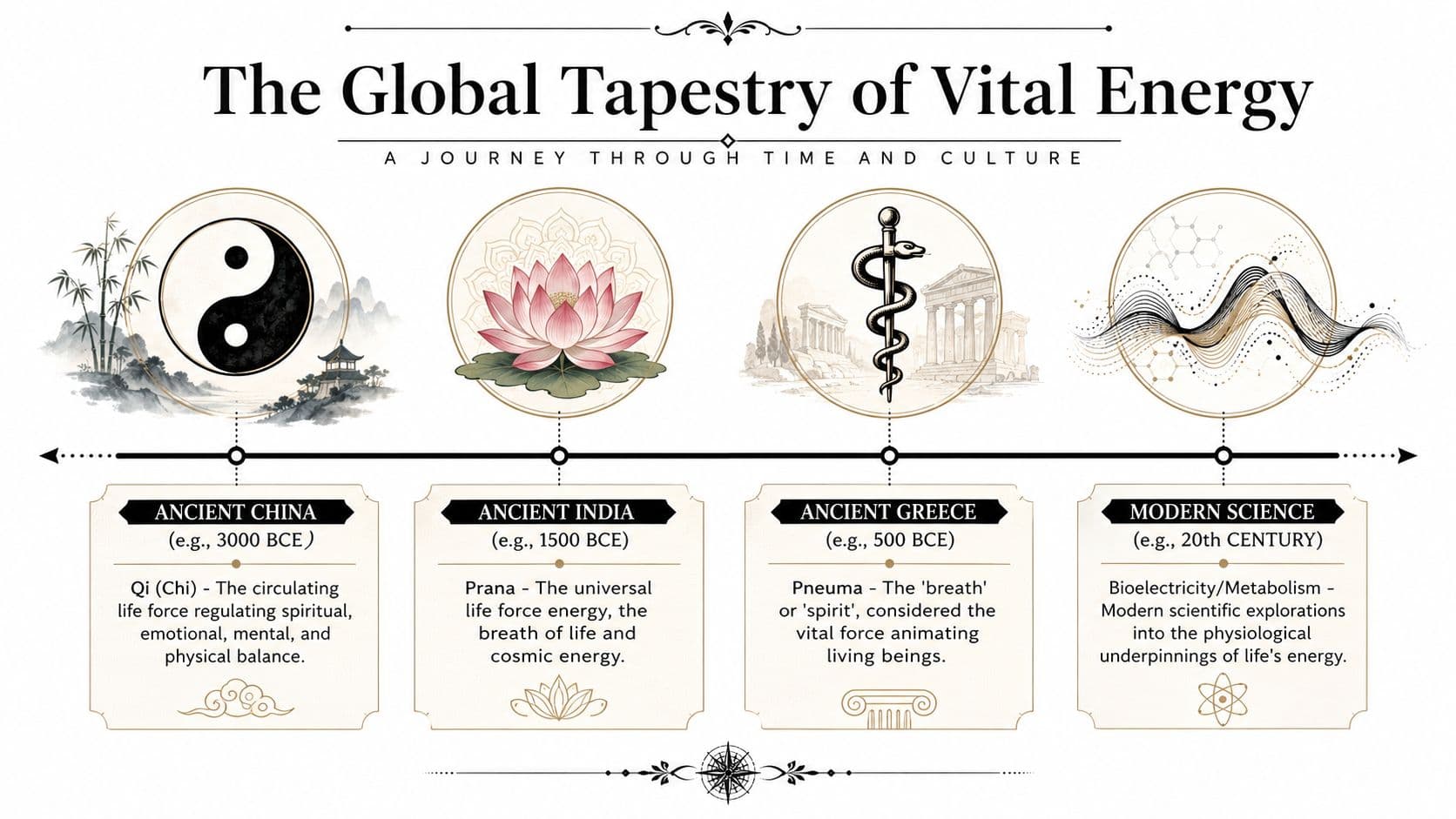
In Chinese traditions, that vitality is often described as Qi or Chi. In yogic philosophy, it's called Prana. In ancient Greek thought, Pneuma referred to breath or spirit as an animating principle. These ideas didn't arise from modern experiments. They were part of complete worldviews that linked body, mind, nature, and meaning.
That matters because these systems weren't foolish attempts to do modern science badly. They were human attempts to make sense of lived experience. People noticed that breath changes mood, posture affects alertness, movement changes mental state, and stillness can restore something that feels lost.
To see that broader history at a glance, this timeline helps.
Why ancient language still resonates
Ancient terms stay alive because they describe patterns people still feel now. If someone says, “My energy is blocked,” they may not mean a measurable field is jammed. They may mean stress has tightened the body, attention is fragmented, breathing is shallow, and motivation has dropped.
That's one reason many readers find it helpful to compare older ideas with modern interpretations. The language is symbolic, but the underlying observations can still be useful.
A tradition can be meaningful without being a physics model. That's an important boundary.
Where science enters the conversation
Modern biology doesn't speak in terms of Qi or Prana as literal scientific entities. But it does place energy at the center of life itself. A review in The Biochemist notes that life on Earth began about 4 billion years ago, but remained at the bacterial level for more than 2 billion years, showing how energy availability and use shaped major evolutionary transitions.
That historical fact changes the conversation. It suggests that the deepest biological version of “life force” isn't a magical glow around organisms. It's the long, demanding task of capturing and using energy well enough to stay alive over immense spans of time.
Life's continuity depends on sustained energetic throughput, not on a single dramatic burst of power.
A simple comparison
| Perspective | Main focus | What it helps explain |
|---|---|---|
| Ancient vital energy traditions | Felt vitality, balance, flow, breath | Why certain practices seem to restore presence and harmony |
| Modern biology | Energy capture, metabolism, regulation | How living systems maintain order and function |
Both perspectives try to answer a shared question. What keeps living beings animated rather than inert?
The difference is method. Ancient systems gave interpretive maps. Science asks what can be measured. You don't have to flatten one into the other. It's enough to notice that both recognize something fundamental. Life depends on ongoing energy processes, and people experience those processes from the inside as vitality, depletion, effort, and renewal.
Understanding the Physiology of Your Personal Vitality
If the energy force of life feels personal, that's because it is. You don't experience biology as a textbook. You experience it as alert or foggy, tense or calm, heavy or light, wired or steady.
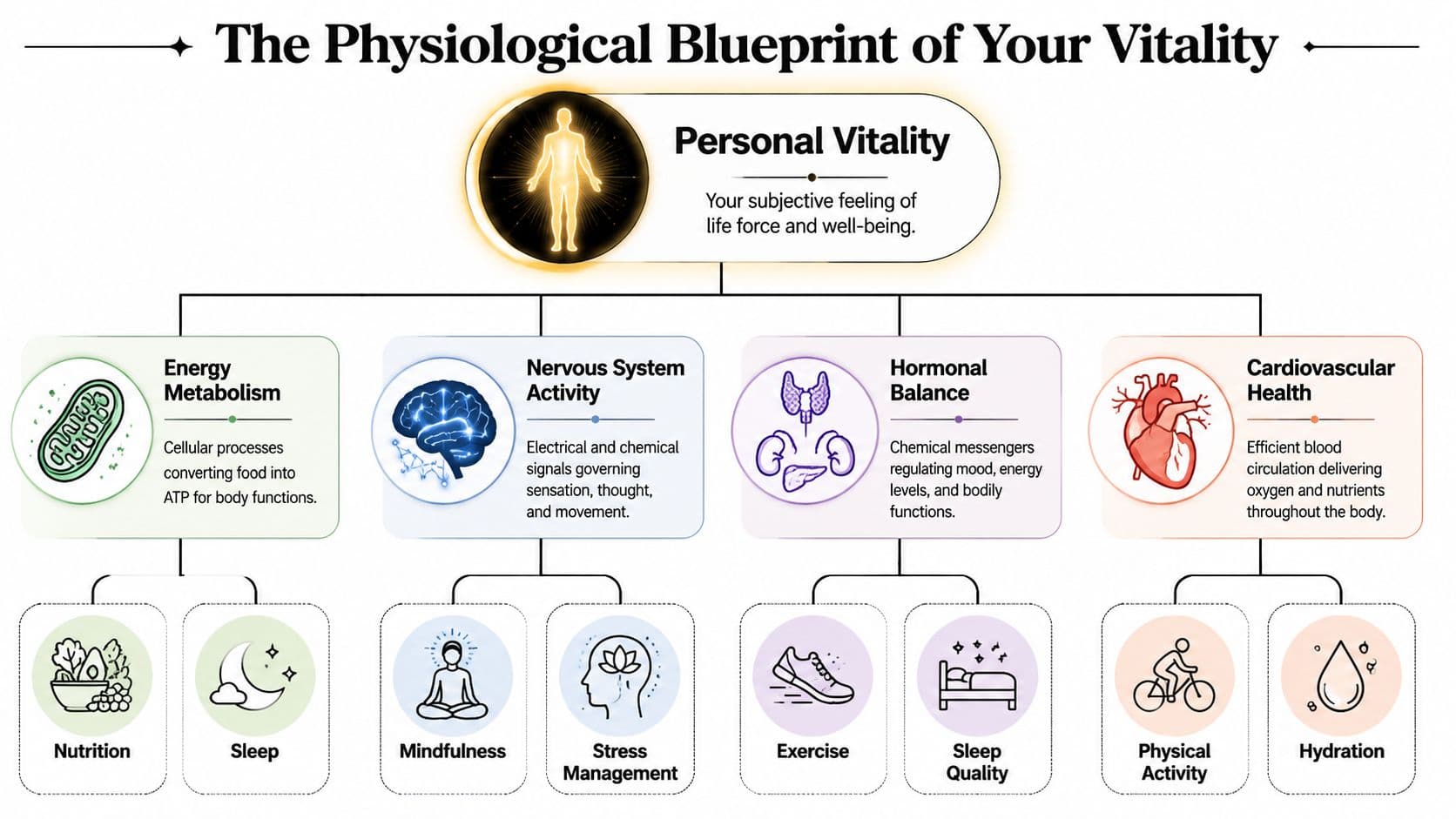
Research gives a useful translation here. The closest technical construct to “life force” is vitality. A review on the origins and organization of life notes that most life forms maintain volume-specific energy consumption within universal limits, linking life to regulated energy processing across species. Another practical lens comes from work on breath and nervous system regulation, where vitality is tied closely to autonomic state.
The body systems behind the feeling
Your subjective energy isn't produced by one single switch. It emerges from several systems working together.
- Metabolism: Your cells constantly convert energy to preserve structure and function. When that process is strained, you feel it as fatigue, weakness, or poor recovery.
- Autonomic regulation: Your nervous system shifts between mobilization and restoration. Too much stress activation can make you feel edgy and depleted at the same time.
- Hormonal signaling: Internal chemical messengers influence wakefulness, mood, appetite, and resilience.
- Circulation and respiration: Oxygen delivery, breath rhythm, and heart activity shape how energized or strained your body feels.
When people say “I have no energy,” they may be describing one of these. Or several at once.
Why breathing changes your state
One of the clearest examples is diaphragmatic breathing. Research discussed in this article on life force energy and vitality says the closest research construct is vitality, which is strongly affected by autonomic regulation. It also notes that slow diaphragmatic breathing can increase vagal activity, reduce sympathetic arousal, and shift stress physiology, which changes your felt sense of calm and energy.
That's a very different claim from “breathwork creates mystical fuel.” It says breath changes regulation.
If you've ever noticed that stress makes your breathing shallow, then this already makes intuitive sense. The breath doesn't just reflect your state. It can also help influence it.
A calmer breath pattern often helps the body spend less of the day in defense mode.
What this means in daily life
A practical way to think about personal vitality is to stop chasing “more energy” as a vague goal. Instead, look for habits that improve regulation.
A useful outside guide on how to increase energy naturally can support that bigger picture, especially when you combine basic lifestyle habits with body awareness rather than treating them as separate worlds.
For many people, the missing piece is internal awareness. They know they're tired, but not what kind of tired. One helpful body-based framework for this is the idea of the lower dan tien as a center of grounding and embodied awareness. Whether you approach that as an energetic metaphor or a somatic focus point, it can train attention toward stability instead of mental overdrive.
A grounded translation table
| What you might say | What may be happening physiologically |
|---|---|
| “My energy is scattered.” | Stress arousal, shallow breathing, divided attention |
| “I feel flat.” | Low restoration, poor sleep, under-recovery, reduced motivation |
| “I feel centered.” | Better autonomic balance, steadier breath, less internal noise |
This doesn't explain every experience. But it gives you something more useful than mystery. It gives you levers.
How Your Life Path Number Reveals Your Energetic Blueprint
Some people want a biological explanation of vitality. Others also want a symbolic one. That's where systems of self-discovery can help, as long as they're used properly.
When I talk about numerology, life paths, or life numbers, I mean the framework presented by Dan Millman in The Life You Were Born to Live. In that context, your life path number isn't a lab result. It's not a medical measure, and it's not hard science. It's a reflective system for understanding recurring patterns in your temperament, strengths, and lessons.
Why symbolic systems can still be useful
A symbolic map can be valuable even when it isn't scientific in the narrow sense. People often understand themselves better when they have language for their recurring tendencies. You may notice that you naturally pour energy into service, discipline, expression, introspection, or leadership. You may also notice that the very trait that helps you can become the trait that drains you.
That's where Millman's work has real practical value. It offers structure.
Instead of asking, “Why am I like this?” in a vague, frustrated way, you begin asking more precise questions:
- Which situations strengthen me?
- Which lessons keep repeating?
- Where do I overextend my energy?
- What gifts come naturally when I'm balanced?
Those questions can shift self-judgment into self-knowledge.
What an energetic blueprint really means
Calling it an energetic blueprint doesn't mean you carry a hidden force meter. It means your life seems to unfold through recognizable themes. Some people burn energy through constant activity. Others lose vitality through emotional suppression, indecision, isolation, or taking on too much responsibility.
Millman's system helps people view those patterns as part of a larger developmental path. That can be a great relief. Your struggles may not be random failures. They may be part of the terrain you're here to work with.
Symbolic systems work best when they invite reflection, not dependency.
If you're curious how this framework is organized, this guide to Dan Millman's life path number offers a helpful starting point.
A balanced way to use this lens
Use life path insight the same way you'd use a journal prompt or a wise conversation. Let it sharpen your awareness. Don't let it replace observation.
A healthy approach looks like this:
- Notice patterns: See whether the description matches your actual life.
- Test it gently: Use it to ask better questions, not to lock yourself into an identity.
- Stay grounded: If you're exhausted, anxious, or overwhelmed, practical care still comes first.
- Look for integration: The most useful insight helps you align inner meaning with daily habits.
That's the sweet spot. Science can help you understand regulation. A symbolic framework like Dan Millman's can help you understand direction, lessons, and purpose. One doesn't have to cancel out the other.
Practical Exercises to Sense and Cultivate Your Life Force
If the phrase energy force of life is going to mean anything, it should change how you live today. Not in theory. In your body.
These practices aren't designed to make you believe in something. They're designed to help you notice what state you're in and give you simple ways to influence it.
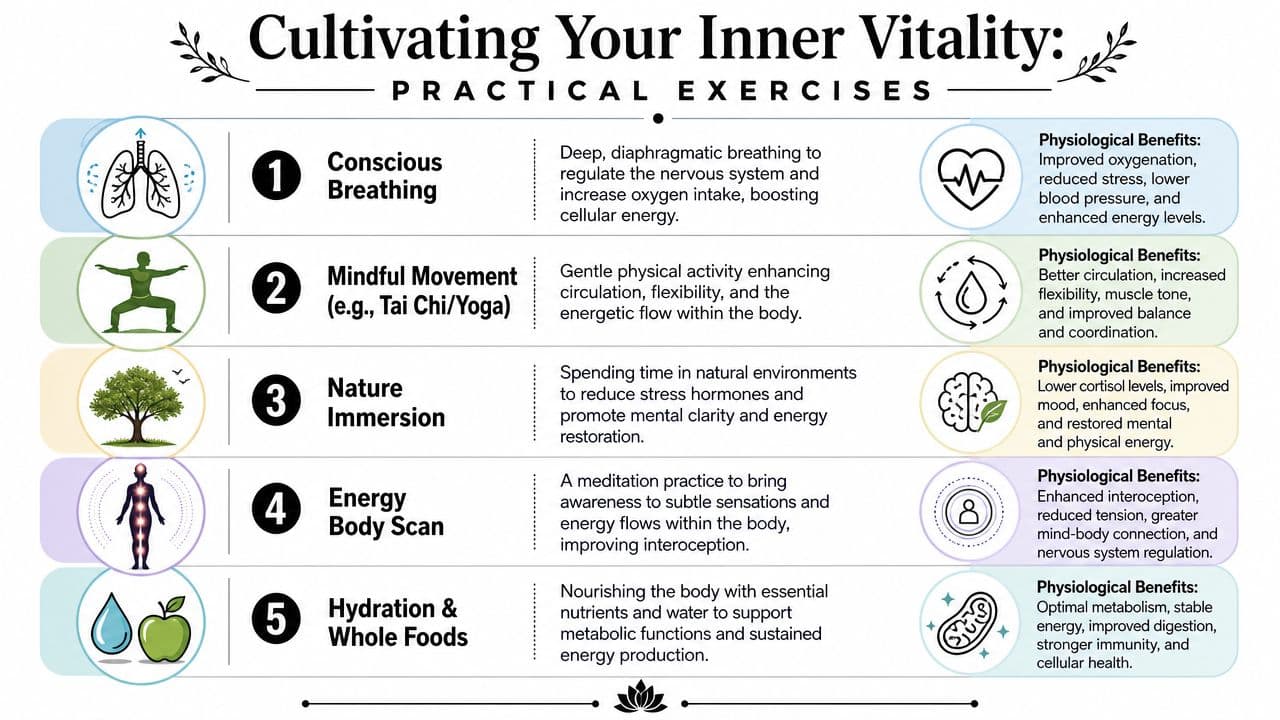
Try the five-minute breath reset
Sit upright, but don't stiffen. Place one hand on your chest and one on your lower belly. Breathe slowly enough that the lower hand moves more than the upper one.
Stay there for five minutes. Don't force a dramatic inhale. The point is smoothness, not performance.
Why it helps: Slow diaphragmatic breathing can support vagal activity and reduce stress arousal, which often changes your subjective energy from scattered to steadier.
Use a body scan to improve interoception
Lie down or sit comfortably. Start at your feet and move your attention upward through your legs, pelvis, abdomen, chest, hands, shoulders, neck, and face. At each point, notice sensations without trying to fix them.
You may feel warmth, tightness, pulsing, numbness, heaviness, or nothing much at all. That's fine. The practice is noticing.
Why it helps: A body scan builds interoception, your ability to sense the internal state of your body. People often call this “feeling my energy,” but what they're often developing is clearer awareness of tension, ease, activation, and settling.
Add mindful movement, not just exercise
Gentle movement changes state differently than pure exertion. Try a short walk without your phone, a few rounds of yoga, simple mobility work, or slow forms like Tai Chi.
The key is attention. Feel your feet press into the floor. Notice the swing of your arms. Let your eyes soften.
- If you feel agitated: choose slower, flowing movement
- If you feel dull: choose brisk but sustainable movement
- If you feel disconnected: focus on rhythm and posture rather than intensity
Sometimes the fastest way to feel more alive is to stop trying to push harder and start moving more coherently.
Ground through contact with the present moment
Grounding doesn't have to be mystical. It can be plain and physical.
Try this simple sequence:
- Stand barefoot or with shoes on, either works. Feel the pressure under both feet.
- Name five things you can see. Do it slowly.
- Lengthen your exhale. Keep your shoulders soft.
- Relax your jaw and hands. Many people don't notice they're bracing there.
Why it helps: Grounding interrupts spirals of mental overactivation and returns attention to immediate sensory input. That often lowers internal noise.
Support vitality with ordinary care
Spiritual language can sometimes make basic needs seem less important than they are. But your body still needs what bodies need.
A few anchors matter a lot:
- Hydration: Low fluid intake can make you feel foggy and heavy
- Whole foods: Regular nourishment supports stable energy processing
- Rest: Sleep loss can masquerade as low motivation, low mood, or low “spiritual energy”
- Recovery time: Constant stimulation makes it harder to feel subtle signals from the body
None of this is glamorous. It's foundational. For many people, life force becomes easier to sense when the body is no longer fighting to meet basic needs.
Explore Your Path with the Life Purpose App
If this topic has stirred something in you, the next step might not be more theory. It might be a tool that helps you reflect on your own patterns in a structured way.
The Life Purpose App is built around Dan Millman's The Life You Were Born to Live. It gives you a practical way to explore your life path by entering your birth date and receiving guidance rooted in that system of self-knowledge. For people drawn to life paths, numerology, and meaningful personal patterns, it offers a direct way to continue the inquiry.

A simple way to use it well
Start with curiosity, not expectation. Read your life path material and ask where it reflects your lived experience. Notice which gifts feel natural and which challenges feel familiar.
Then bring those insights back to daily life. If a pattern keeps showing up in relationships, work, health habits, or emotional reactions, treat that as useful information. The app works best when it supports observation and reflection rather than replacing them.
For many people, that combination is what makes the exploration worthwhile. You're not just collecting spiritual ideas. You're building language for your own path.
Common Questions About the Energy Force of Life
Is life force the same as physical energy from food
Not exactly. Physical energy from food is part of the picture, but when people talk about the energy force of life, they usually mean a wider experience of vitality. That can include mood, stress level, attention, breath, and your sense of inner coherence.
Can science measure life force directly
Not as a single mystical field. A more grounded approach is to look at measurable aspects of vitality, regulation, and energy processing. That's important because many discussions of vital energy remain broad and non-operational, sometimes even described as a “mysterious energy,” while a more useful bridge focuses on measurable physiology such as autonomic regulation and lived vitality, as discussed in this reflection on life force and evidence-based explanation.
Are chakras, auras, and life force the same thing
They belong to related spiritual languages, but they aren't identical concepts. Many people use them as maps for inner experience. If those ideas help you reflect, that can be meaningful. If you want a measurable frame, it's wiser to translate your experience into sleep, stress, breath, mood, body awareness, and recovery rather than assuming a literal physical field has been proven.
What should I do if I feel drained all the time
Start simple. Look at sleep, stress, breathing habits, daily movement, nourishment, and how often your body gets a chance to settle. If persistent fatigue is affecting your life, it's also wise to talk with a qualified healthcare professional. Spiritual reflection can be supportive, but it shouldn't replace care when your body is asking for attention.
If you want a practical next step for self-discovery, the Life Purpose App offers a clear way to explore Dan Millman's The Life You Were Born to Live. Enter your birth date, discover your life path, and use that insight as a companion to the grounded vitality practices you've explored here.
Discover Your Life Purpose Today!
Unlock your true potential and find your life’s purpose.
