Discover 10 real-world examples of social awareness in action. Learn practical skills to build deeper relationships and understand others more authentically.
March 14, 2026 (5mo ago) — last updated June 21, 2026 (2mo ago)
10 Powerful Examples of Social Awareness to Improve Your Connections
Discover 10 real-world examples of social awareness in action. Learn practical skills to build deeper relationships and understand others more authentically.
← Back to blog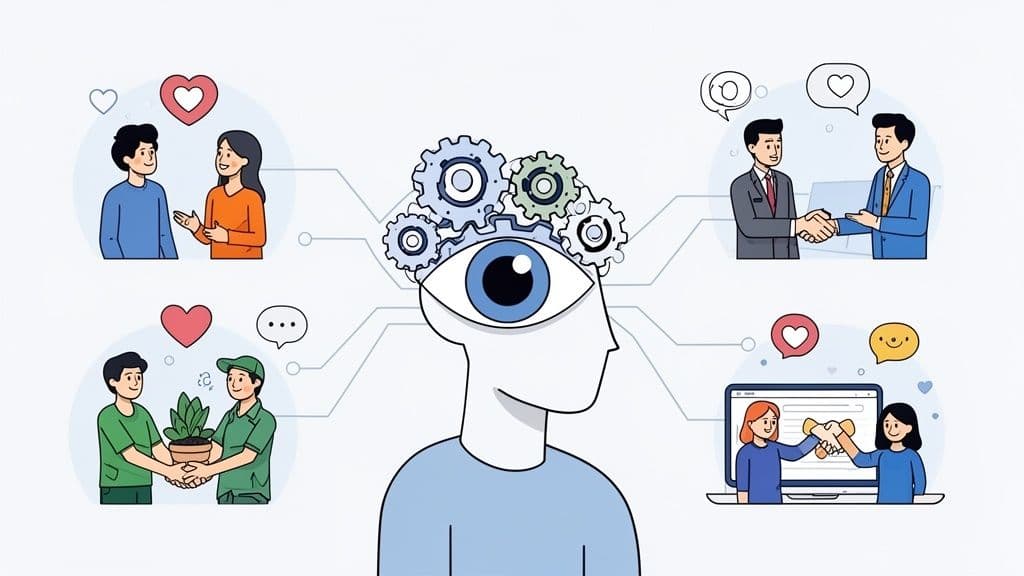
Ever feel like you’re missing something in conversations, as if a whole other language is being spoken that you can’t quite hear? That language is social awareness. It’s not about mind-reading; it’s about paying attention to the world and people around you with a different kind of focus. It's the ability to see the unspoken rules, feel the emotional temperature of a room, and genuinely understand another's point of view.
Developing this skill can fundamentally improve your relationships, your career, and even your own self-understanding. As Dan Millman explores in his book, “The Life You Were Born to Live,” understanding others is deeply connected to understanding our own life path and purpose.
This list isn't just a collection of abstract ideas; it’s a practical guide. We will break down concrete examples of social awareness that you can start using today. For each example, we'll explore simple, actionable exercises to build your skills. We'll also show how you can use tools like the Life Purpose App to gain deeper insights into your personal dynamics and connections, creating a clearer picture of yourself and the people in your life.
1. Empathetic Listening
Empathetic listening is one of the most powerful examples of social awareness in action. It’s the practice of hearing beyond words to understand the emotions, intentions, and perspectives of another person without judgment. This deep listening isn't about waiting for your turn to speak; it's about creating a space where the other person feels fully seen and heard, allowing you to grasp their core needs and concerns.

This skill is essential in any helping profession or deep relationship. A life coach uses it to help a client connect the dots of their life story, revealing patterns that point toward their true calling. Similarly, friends practice it when supporting each other through major life events, often aligning with the nine-year cycles described in Dan Millman's work, The Life You Were Born to Live. By listening with empathy, you can recognize the underlying spiritual and emotional currents shaping someone's experience.
How to Practice Empathetic Listening
- Listen to Understand, Not to Reply: The next time you're in a conversation, consciously quiet the part of your mind that is formulating a response. Focus entirely on absorbing what the other person is sharing.
- Reflect and Clarify: Use simple phrases to show you’re engaged. Saying, "It sounds like you felt really frustrated in that situation," confirms you're hearing the emotion, not just the facts.
- Tune into Non-Verbal Cues: Notice their tone of voice, posture, and facial expressions. Often, the most important information is communicated without words.
Key Insight: Empathetic listening helps you understand others and yourself. By seeing how you respond to different people's energies and life numbers, as detailed in Dan Millman's The Life You Were Born to Live and the Life Purpose App, you gain awareness of your own relational strengths and challenges.
2. Perspective-Taking and Cognitive Empathy
Perspective-taking is the ability to mentally step into someone else’s shoes and understand their viewpoint, beliefs, and experiences. A core component of social awareness, this skill goes beyond feeling what someone feels (affective empathy) to cognitively grasping why they feel that way. It involves analyzing situations from multiple angles and accepting that different people have valid perspectives shaped by their unique life circumstances.
This is a vital skill for anyone navigating complex relationships. For example, a life coach uses it to help a client see why a family member with a different life number, as described in Dan Millman's book The Life You Were Born to Live, might handle challenges in a completely different way. Similarly, a relationship counselor might use this to explain why partners with contrasting life paths have different needs around money or career, fostering mutual respect instead of conflict. To truly connect with others, you must first master active listening in communication, as it forms the foundation for understanding their unique viewpoint.
How to Practice Perspective-Taking
- Study Diverse Paths: Familiarize yourself with the different life numbers presented in Dan Millman's The Life You Were Born to Live and the Life Purpose App. This knowledge provides a framework for understanding why someone might react in a way that seems foreign to your own experience.
- Ask "Why?": When confronted with a different opinion, pause and ask yourself, "Why might someone with that life number see it this way?" This shifts your focus from judgment to curiosity.
- Journal from Another Viewpoint: Write about a recent disagreement from the other person's perspective. Try to articulate their feelings, motivations, and goals as if they were your own.
Key Insight: Perspective-taking transforms conflict into connection. By using tools like the Life Purpose App to understand the gifts and challenges inherent in someone else's life path, as described in Dan Millman's The Life You Were Born to Live, you can honor their journey and build stronger, more compassionate relationships.
3. Emotional Awareness and Regulation
Emotional awareness is the capacity to recognize your own feelings and those of others, while regulation is the ability to manage those emotions effectively. This key example of social awareness isn't about suppressing feelings; it’s about understanding their source and responding consciously rather than reacting impulsively. By identifying what you're feeling and why, you can act in ways that align with your values and purpose.
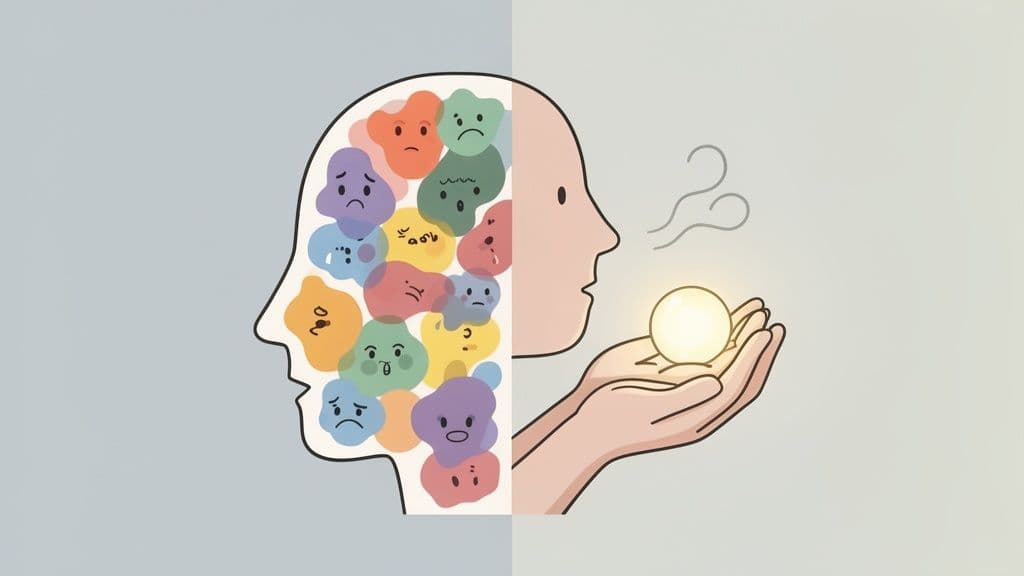
This skill is central to navigating your life's path. For instance, a life coach helps a client see how their emotional blocks are tied to core challenges in their career or relationships, as described in Dan Millman's The Life You Were Born to Live. Similarly, partners can use the information from the Life Purpose App to understand each other's emotional triggers and patterns, fostering deeper compassion and connection. Understanding these dynamics helps you anticipate and prepare for the emotional shifts that come with your personal nine-year cycles.
How to Practice Emotional Awareness and Regulation
- Expand Your Feelings Vocabulary: Move beyond a generic feeling such as good or bad. Are you feeling frustrated, anxious, content, or inspired? Naming the specific emotion is the first step to managing it.
- Create Space Before Responding: When a strong feeling arises, take a breath before you act. This pause allows your rational mind to catch up with your emotional impulse, leading to better decisions.
- Identify Your Emotional Triggers: Notice what situations, people, or thoughts consistently provoke a strong emotional reaction. This awareness helps you understand your personal patterns.
Key Insight: Understanding your emotional nature through your life number gives you a powerful advantage. The Life Purpose App shows how your innate gifts and challenges shape your emotional responses, based on Dan Millman's The Life You Were Born to Live, offering a clear guide on how to build emotional intelligence in a way that is authentic to you.
4. Organizational and Group Dynamics Awareness
This form of social awareness involves the ability to read the room on a larger scale. It’s about perceiving the unspoken rules, social hierarchies, and power dynamics within groups, teams, and entire organizations. When you understand these undercurrents, you can navigate complex social systems effectively, recognizing how individuals interact and contribute to the whole.
This awareness is crucial for career growth and effective collaboration. A professional who grasps the organizational culture can better position themselves for advancement, while a team leader who understands group dynamics can build more cohesive and productive teams. For instance, a life coach might help a client recognize that their life path gifts, as described in Dan Millman's book The Life You Were Born to Live, are best suited for an innovator role, even if their current job is purely administrative. Understanding these dynamics allows for intentional career alignment.
How to Practice Organizational and Group Dynamics Awareness
- Observe Before Acting: When joining a new team or group, take time to watch how people interact. Identify who the informal leaders and influencers are, not just those with official titles.
- Identify Unspoken Rules: Pay attention to how decisions are really made, how conflict is handled, and what behaviors are rewarded or discouraged. These are often the true rules of the group.
- Analyze Workplace Compatibility: Use insights about life numbers from Dan Millman's The Life You Were Born to Live and the Life Purpose App to understand why you connect easily with some colleagues and face challenges with others. This can improve collaboration by revealing different communication styles and motivations.
Key Insight: Understanding your natural role within a group is a powerful application of social awareness. The Life Purpose App can help you identify your core gifts and see how your specific life number positions you within team dynamics, enabling you to find a role where you can truly thrive.
5. Cultural and Contextual Awareness
Cultural and contextual awareness is the ability to recognize and respect the different cultural backgrounds, values, and social norms that shape people’s worldviews. It’s an understanding that our own perspective is just one of many, not a universal standard. This vital example of social awareness involves moving beyond assumptions to appreciate how context influences behavior, communication, and even the interpretation of one’s purpose.
This skill is indispensable for anyone working with diverse populations. A life coach, for instance, must adapt their methods for clients from different backgrounds, recognizing that concepts of success and fulfillment are culturally defined. Similarly, a practitioner using the principles from Dan Millman's The Life You Were Born to Live acknowledges that life path gifts and challenges can manifest differently depending on a person’s cultural upbringing and societal expectations.
How to Practice Cultural and Contextual Awareness
- Examine Your Own Cultural Lens: Take time to identify your own cultural assumptions and biases. How has your background shaped what you consider “normal” or “right”?
- Ask Curious, Respectful Questions: Instead of assuming you understand someone's experience, ask open-ended questions about their perspective. For example, “Can you tell me more about how your family views career choices?”
- Observe and Adapt Communication: Pay attention to communication styles. Some cultures are more direct, while others value indirectness and harmony. Adjust your approach to build trust and rapport effectively.
Key Insight: Cultural context deeply influences how we understand our spiritual journey. The Life Purpose App, available in multiple languages and based on Dan Millman's The Life You Were Born to Live, honors this by helping you see how your life number interacts with your unique cultural environment, providing a more complete picture of your path.
6. Interpersonal Boundary Recognition and Respect
Interpersonal boundary recognition and respect is a vital example of social awareness that involves perceiving, communicating, and honoring personal limits. It’s the ability to understand where you end and another person begins, both emotionally and practically. This isn't about building walls; it's about creating a foundation for authentic, healthy relationships where all parties feel safe and respected.
This skill is crucial for life coaches who must maintain professional distance while offering deep support, and for individuals in all relationships. A crucial aspect of social awareness is understanding and respecting interpersonal boundaries. This can be particularly vital in complex family dynamics, such as when you are faced with the challenge of setting boundaries with aging parents. By recognizing your own limits and honoring those of others, you prevent resentment and burnout, allowing for genuine connection.
How to Practice Boundary Recognition
- Identify Your Non-Negotiables: Take time to identify your own limits in different areas of life, such as your time, energy, and emotional capacity. What are you not willing to compromise on?
- Practice Saying 'No' Simply: You don’t need to provide a long justification. A clear and respectful, “I’m not able to do that right now,” is a complete sentence.
- Communicate with Respect: Frame your boundaries as a statement about your needs, not as a punishment or criticism of the other person. Say, “I need some quiet time after work to recharge,” instead of, “You're always draining my energy.”
Key Insight: Understanding your life number, as described in Dan Millman's The Life You Were Born to Live, can reveal your inherent needs for autonomy or connection. Using the Life Purpose App to see these patterns can help you understand why certain boundaries are more important to you and communicate them more effectively. Learn more about how to set healthy boundaries to strengthen your relationships.
7. Conflict Recognition and De-escalation
The ability to recognize and defuse tension before it erupts is one of the most practical examples of social awareness. It’s the skill of sensing the subtle shifts in energy that signal brewing conflict and using calm, targeted strategies to guide the situation toward understanding. Rather than reacting to emotional outbursts, this skill involves reading the early warning signs in conversations and relationships to prevent small disagreements from turning into damaging fights.
This awareness is crucial for maintaining harmony in any relationship. A life coach might use it to help a client see their recurring conflict patterns, often tied to the specific life challenges described in Dan Millman’s work, The Life You Were Born to Live. Similarly, colleagues can preserve team morale by noticing when communication becomes strained and addressing the underlying issues directly and gently, creating a space for resolution instead of resentment.
How to Practice Conflict Recognition and De-escalation
- Notice the Physical Signs: Pay attention to shifts in tone of voice, stiffening body language, or sudden withdrawal from a conversation. These are often the first signals of unspoken disagreement.
- Use I Statements: Express your concerns without placing blame. Saying I feel some tension when we discuss this topic is more constructive than saying You’re getting defensive.
- Separate the Person from the Problem: Focus on resolving the issue at hand, not on criticizing the other person’s character or intentions. This keeps the conversation productive.
Key Insight: Understanding your life path can reveal your natural conflict style. The Life Purpose App, based on Dan Millman's The Life You Were Born to Live, can help you see why you react a certain way to stress and how your approach might differ from others, allowing you to adapt your response and de-escalate situations more effectively.
8. Relationship Dynamics and Compatibility Assessment
Recognizing the unseen forces that shape our connections is a profound example of social awareness. This skill involves observing patterns in how people relate, assessing compatibility, and understanding the core dynamics that allow relationships to thrive or struggle. It's about looking beyond surface-level interactions to see how different life numbers and energies intersect, creating either harmony or friction.
This awareness is crucial for building meaningful bonds in all areas of life. For instance, couples can use the principles from Dan Millman's book, The Life You Were Born to Live, to analyze their compatibility and find healthier ways to communicate. Similarly, life coaches can guide clients in understanding their relational patterns with insights from the Life Purpose App, helping them break cycles and attract more aligned partnerships. By assessing these underlying dynamics, you can approach relationships with greater wisdom and intention.
How to Practice Compatibility Assessment
- Map Life Paths: Use a tool like the Life Purpose App to calculate your life number and those of people you're close to, based on the system in Dan Millman's The Life You Were Born to Live. This provides a foundational map of your innate energies and challenges.
- Analyze Both Sides: Look for complementary gifts and potential areas of conflict. Strong compatibility isn't about being identical; it’s about how your differences and similarities interact.
- Use Insights to Explain, Not Judge: Apply this knowledge to foster understanding, not to label someone as “incompatible.” Acknowledge that love and commitment are essential forces that can bridge any energetic gap.
Key Insight: Understanding relationship dynamics helps you navigate your own journey with more clarity. By analyzing how your life path interacts with others through the Life Purpose App, which applies the principles of Dan Millman's The Life You Were Born to Live, you gain powerful self-awareness about your relational needs and how to create healthier, more fulfilling connections.
9. Non-Verbal Communication and Body Language Reading
Beyond spoken words, a rich layer of communication exists in our posture, gestures, and tone of voice. Reading non-verbal communication is an advanced form of social awareness that involves interpreting these cues to understand a person's true emotional state. Since a large part of our expression is unconscious, this skill allows you to perceive incongruence, sensing what is felt but not said.
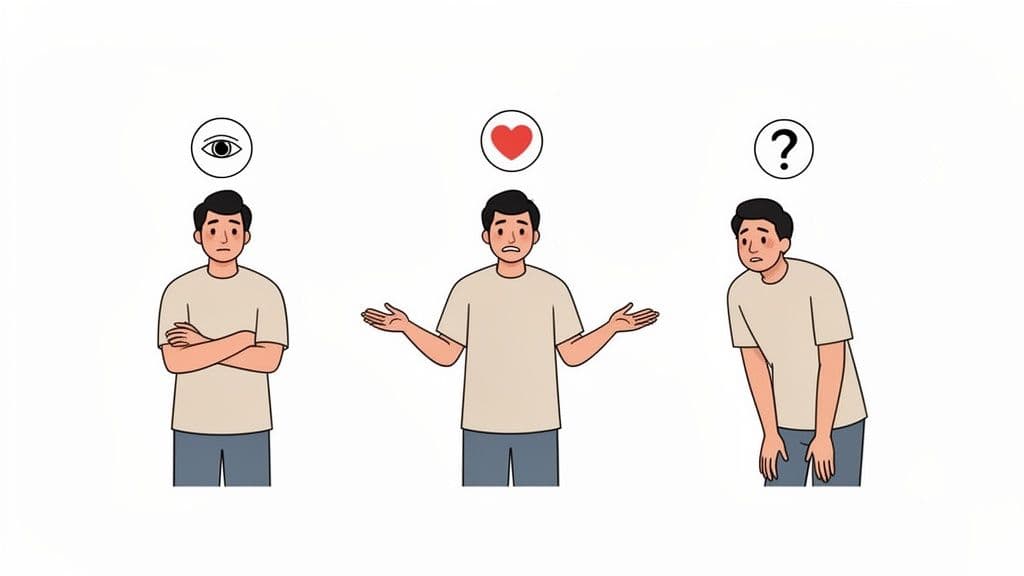
This ability is fundamental for anyone in a supportive role. A practitioner can sense when a client is ready to explore a deeper truth, noticing a subtle shift in their posture or a change in their breathing. Likewise, a friend can recognize the genuine distress behind a quick I am fine, picking up on a slumped posture or averted gaze that signals the need for real connection. Developing this awareness helps you respond with greater sensitivity and insight in all your relationships.
How to Practice Reading Non-Verbal Communication
- Establish a Baseline: Pay attention to how people normally act. Knowing someone's typical posture and gestures helps you spot deviations that signal an emotional shift.
- Look for Clusters: A single cue, like crossed arms, can mean many things. Look for clusters of signals, such as crossed arms combined with a tense jaw and minimal eye contact, to form a more accurate picture.
- Notice Incongruence: This is one of the most powerful examples of social awareness. When someone says, I am not angry, but their voice is tight and their fists are clenched, their body is telling a different story.
Key Insight: Understanding non-verbal cues reveals how different energies interact. Observing how your body language changes around people with specific life numbers, as outlined in Dan Millman's The Life You Were Born to Live, can offer deep self-awareness. The Life Purpose App can help you track these patterns and see how your relational dynamics are reflected in your physical responses.
10. Authentic Self-Awareness and Self-Knowledge
While it may seem counterintuitive, one of the most essential examples of social awareness is a deep, authentic understanding of yourself. This is the ability to know your values, strengths, patterns, and true motivations. It goes beyond surface-level traits to include an honest recognition of your shadow side and areas for growth. Knowing yourself this deeply prevents you from projecting your own insecurities onto others and allows you to engage with the world from a place of clarity and integrity.
This skill is the bedrock of living an aligned life. For instance, professionals who align their careers with their genuine talents, as revealed in frameworks like Dan Millman's The Life You Were Born to Live, report greater fulfillment. Similarly, people who understand their core gifts and challenges, which can be explored with the Life Purpose App, tend to form healthier relationships by choosing partners who see and honor their authentic self. True social awareness begins with self-awareness.
How to Practice Authentic Self-Awareness
- Practice Radical Honesty: Use a journal to write down your true feelings and desires without censorship. Notice when you are performing for others versus being your genuine self.
- Identify Internalized Expectations: Reflect on whose beliefs or expectations you may have adopted that don't align with your inner truth.
- Explore Your Core Challenges: View your recurring difficulties not as flaws, but as gateways to profound personal growth and self-understanding. You can learn more about how to know your true self and its connection to your life path.
Key Insight: Understanding your authentic self is foundational to social intelligence. When you are clear on your own life number and its associated energies, using Dan Millman's The Life You Were Born to Live and the Life Purpose App, you can interact with others more compassionately, recognizing that they too are on their own unique journey of discovery.
10-Point Comparison of Social Awareness Examples
| Skill | 🔄 Implementation complexity | ⚡ Resource requirements | 📊 Expected outcomes | 💡 Ideal use cases | ⭐ Key advantages |
|---|---|---|---|---|---|
| Empathetic Listening | Moderate — requires regular practice and emotional labor | Low–Medium — time, quiet space, basic coaching | Stronger rapport, deeper understanding of others' life paths | One-on-one coaching, counseling, transition support | Builds trust and emotional intelligence |
| Perspective-Taking and Cognitive Empathy | Medium — requires study and analytical effort | Medium — learning materials, reflection time | Reduced conflict, broader decision-making perspective | Compatibility analysis, mediation, cross-perspective coaching | Enhances understanding of diverse worldviews |
| Emotional Awareness and Regulation | High — ongoing inner work and practice | Medium–High — therapy/coaching, reflective tools | Greater emotional stability, fewer reactive breakdowns | Managing blocks, high-stress relationships, coaching | Improves resilience and alignment with values |
| Organizational and Group Dynamics Awareness | High — complex systems awareness and adaptation | Medium — observation time, organizational knowledge | Better team fit, improved collaboration and influence | Leadership, team design, workplace navigation | Clarifies roles and optimizes group contribution |
| Cultural and Contextual Awareness | Medium–High — continuous learning and humility | Medium — cultural learning, exposure, consultation | More inclusive service, fewer cross-cultural misunderstandings | Serving diverse clients, global teams, multicultural coaching | Prevents bias and increases relevance across contexts |
| Interpersonal Boundary Recognition and Respect | Moderate — practice in assertiveness and communication | Low–Medium — training, rehearsal, time for negotiation | Healthier relationships, reduced burnout and codependency | Professional-client settings, intimate relationships, workplace | Protects wellbeing and sustains ethical practice |
| Conflict Recognition and De-escalation | Moderate — skillful under pressure, needs practice | Medium — training in de-escalation and emotional regulation | Fewer escalations, preserved relationships, faster resolution | Couples, teams, family systems, crisis moments | Prevents rupture and enables collaborative problem-solving |
| Relationship Dynamics and Compatibility Assessment | Medium — requires dual-person analysis and context | Medium — assessment tools (e.g., Life Purpose App), time | Informed relationship decisions, clearer expectations | Dating, couples therapy, team matching, coaching | Practical insights for pairing strengths and challenges |
| Non-Verbal Communication and Body Language Reading | Medium — perceptual skill plus cultural nuance | Low–Medium — observation practice, training resources | Detects incongruence, improves responsiveness and safety | Coaching, negotiations, client intake, safety screening | Reveals unspoken needs and deepens rapport |
| Authentic Self-Awareness and Self-Knowledge | High — deep, ongoing introspective work | Medium–High — tools, coaching/therapy, long-term time investment | Authentic choices, reduced internal conflict, life alignment | Life purpose exploration, career pivots, long-term growth | Foundation skill that amplifies all other social awareness abilities |
Putting It All Together: Your Path to Greater Social Awareness
The journey through these examples of social awareness reveals a fundamental truth: this skill is not a single attribute but a rich tapestry woven from many threads. From empathetic listening and perspective-taking to reading group dynamics and respecting boundaries, each example we’ve explored is a practical tool you can begin using today. The path to greater social awareness isn't about becoming a perfect mind reader; it's about becoming a more present, curious, and compassionate observer of the human experience, starting with yourself.
True social insight begins with self-knowledge. Understanding your own emotional triggers, communication style, and inherent biases is the bedrock upon which genuine connection is built. This is where frameworks like the one found in Dan Millman's book, “The Life You Were Born to Live,” become so valuable. By identifying your own life number, you gain a clearer picture of your innate strengths and challenges, giving you a stable point from which to view the world around you.
From Self-Awareness to Social Mastery
Once you have a handle on your own inner world, the outer world becomes less of a mystery. You can start to see others not just for their actions, but for the underlying motivations and life paths that shape them. The many examples of social awareness discussed in this article-like recognizing non-verbal cues or de-escalating a potential conflict-become far more intuitive when you can appreciate the diverse perspectives in the room.
Consider these key takeaways as you move forward:
- Start Small and Be Consistent: Don't try to master all ten skills at once. Choose one, such as focusing on empathetic listening, and practice it for a week. Notice how conversations change.
- Connect Inward to See Outward: Use the prompts and exercises to connect these social skills back to your own life. How does understanding your life path help you recognize and respect the boundaries of others? How does your emotional awareness affect your ability to read group dynamics?
- See Others Through a New Lens: The system of life numbers described in Millman's work and available in the Life Purpose App offers a profound map for understanding others. It allows you to move beyond surface-level judgments and appreciate the unique spiritual journey each person is on.
Developing social awareness is an ongoing practice, not a final destination. It's about choosing curiosity over judgment, empathy over assumption, and connection over division. By integrating these skills, you not only improve your relationships and navigate social situations with more grace, but you also contribute to a more understanding and connected world. Your journey to deeper social attunement is a powerful part of your life’s purpose, enriching every interaction you have.
Ready to deepen your understanding of yourself and the people in your life? Download the Life Purpose App to discover your life number and gain insights into relationship dynamics, based on Dan Millman's “The Life You Were Born to Live.” Get started on your journey to greater awareness today at Life Purpose App.
Discover Your Life Purpose Today!
Unlock your true potential and find your life’s purpose.
