Explore fate versus free will through philosophy, psychology, and spirituality. Learn how to apply these ideas to personal growth and life path discovery.
August 12, 2026 (1mo ago) — last updated August 13, 2026 (1mo ago)
Fate Versus Free Will: Finding Your Own Balance
Explore fate versus free will through philosophy, psychology, and spirituality. Learn how to apply these ideas to personal growth and life path discovery.
← Back to blog
Have you ever noticed that the moments people call “fate” are often the same moments they later describe as a turning point they chose? A job loss, a breakup, a diagnosis, a lucky meeting, these events can feel written in advance when you're inside them, and yet they can also become the exact place where a new decision begins. That tension is why fate versus free will keeps coming back, not as a puzzle for philosophers only, but as a live question in ordinary life.
The simplest mistake is treating it like a yes-or-no test. A better model is a spectrum that runs from hard determinism through compatibilism to libertarian free will, with fatalism as a related but different position. That spectrum matters because it changes how you think about blame, responsibility, resilience, and the meaning of tools that help you reflect on your life, including the kind of life-path framework found in Dan Millman's The Life You Were Born to Live and the Life Purpose App.
| Position | Core Claim | Preserves | Sacrifices |
|---|---|---|---|
| Hard determinism | Every choice follows prior causes | Explanatory consistency | Ultimate authorship |
| Compatibilism | Free will can exist inside causation | Agency and responsibility | A fully uncaused self |
| Libertarian free will | You can genuinely have done otherwise | Strong personal authorship | A simple causal picture |
| Fatalism | Outcomes will happen regardless of effort | Acceptance of what is fixed | The practical weight of choice |
That table is the map. The rest of the discussion is the terrain.
Why the Fate Versus Free Will Question Matters Right Now
Someone gets a layoff notice, and the first question isn't usually academic. It's whether the company was always going to cut them, whether they saw the warning signs, and whether any different choice could have changed the result. The same question shows up in divorce, illness, parenting, and career change, because people naturally want to know what part of life is fixed and what part is still open.
The real issue is responsibility
The debate matters because people use it to decide how to act. If everything is predetermined, then blame can feel harsh and hope can feel naive. If everything is self-authored, then failure can start to look like a moral defect instead of a human limit.
Philosophy handles this more carefully than most everyday conversations. The Stanford Encyclopedia of Philosophy treats the issue as a set of positions, not a single winner, and it centers the debate on freedom to do otherwise and self-determination (Stanford Encyclopedia of Philosophy on free will). That framing helps because it lets you ask a sharper question, not “Is there fate or free will?” but “How much control is real, what kind, and in which parts of life?”
Practical rule: if a belief doesn't change how you plan, forgive, or recover, it's probably too abstract to help.
The payoff here is concrete. You get a mental model that can handle hard moments without collapsing into either helplessness or self-blame. You also get a way to test your own instincts, which matters because people don't usually live at the extremes they argue about.
How the Debate Evolved From Ancient Fatalism to Modern Neuroscience
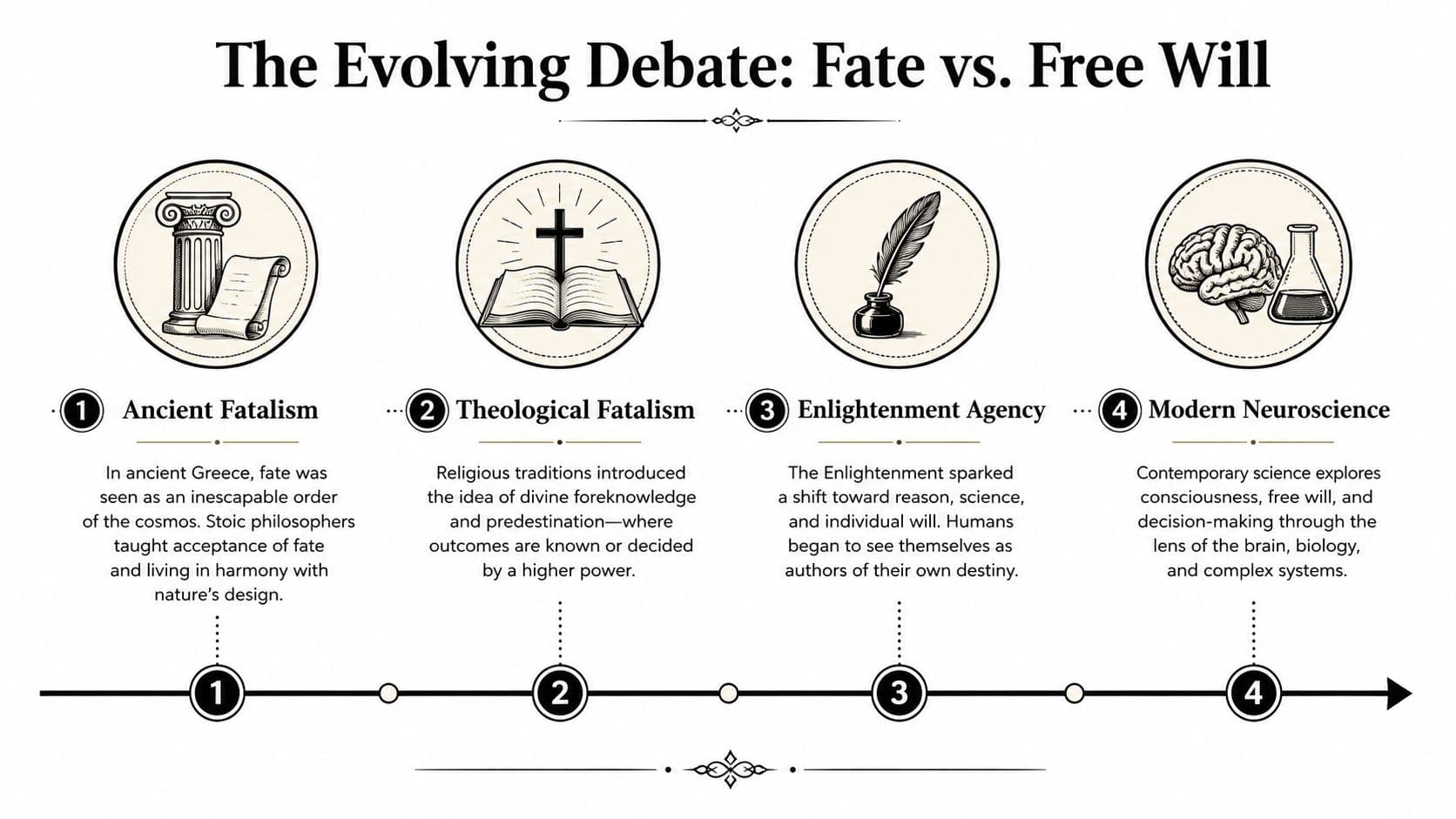
Ancient fatalism and the search for order
The question is old because the human experience is old. Long before psychology or brain scans, thinkers were already asking whether events unfold by necessity or whether choice makes a real difference. Ancient fatalism, including Stoic ideas, tended to place human life inside a larger order that individual preference could not easily change. That view helped people endure suffering, but it also left a difficult problem in its wake, what happens to moral responsibility if the course of events is already set?
Theological fatalism pushed that problem further. The Stanford Encyclopedia distinguishes fatalism, the claim that human acts occur by necessity and are therefore unfree, from theological fatalism, the stronger claim that infallible foreknowledge makes an act necessary and unfree (Stanford Encyclopedia of Philosophy on foreknowledge). In plain language, one view treats events as fixed, while the other says that divine knowledge of those events makes them fixed. The distinction matters because it shows that people were not only arguing about fate in the abstract, they were also trying to explain how knowledge, necessity, and freedom could fit together.
Enlightenment agency and the modern turn
The Enlightenment shifted the emphasis toward reason, deliberation, and the individual chooser. Philosophers began asking whether causation really erased agency, or whether a person could still act freely inside a lawful universe. That question led to compatibilism, the view that free will can still make sense even if events are causally determined (Stanford Encyclopedia of Philosophy on free will).
A simple analogy helps here. A river follows a channel, yet the water still moves, splits, and shapes the banks over time. Compatibilists make a similar point about human action, external causes matter, but they do not automatically make choice meaningless. The debate moved from a question about cosmic order to a question about what counts as agency in ordinary life.
Modern neuroscience added a new kind of pressure rather than settling the issue. A widely cited summary of Benjamin Libet's work reports brain activity associated with a decision beginning about 100 milliseconds before a person reports a conscious decision, while Libet still argued that a conscious veto or correction may remain possible afterward (Libet summary). That finding does not end the argument. It does show why simple slogans fail, because early brain activity can suggest preparation without proving that conscious choice is irrelevant.
A useful way to read the history is as a series of responses to the same tension. Each era tried to protect something important, order, responsibility, reason, or subjective freedom. That pattern suggests the truth may be layered rather than all-or-nothing.
The Four Main Positions Side by Side
What each position is really saying
The easiest way to understand the spectrum is to ask two questions about each view. What does it explain well, and what does it leave behind? People often talk past one another because they are protecting different parts of the same puzzle.
| Position | Core Claim | Preserves | Sacrifices |
|---|---|---|---|
| Hard determinism | Every event has prior causes | Predictability and causal order | Ultimate moral authorship |
| Compatibilism | Choice can be free if it flows from your reasons and character | Responsibility, deliberation, accountability | The idea of an uncaused chooser |
| Libertarian free will | Genuine freedom means you really could have done otherwise | Strong self-authorship | A fully closed causal story |
| Fatalism | What will happen will happen, whatever you do | Surrender to the fixed | The practical value of effort |
Hard determinism can feel relieving if you are tired of carrying blame for everything. It says your life is shaped by causes you did not choose, so shame is not always the right response. The appeal is clear. If much of your behavior has roots in upbringing, temperament, and circumstance, then moral judgment needs to be handled with care.
Compatibilism sounds more familiar in daily life, because it keeps responsibility while admitting that people are influenced by forces around them. A person can be shaped by history and still make a decision that reflects their reasons, habits, and character. That is why compatibilism often feels like the middle ground between strict mechanism and complete self-creation. For a related distinction that often causes confusion, consider the difference between fate and destiny.
Libertarian free will carries a stronger claim. It protects the sense that choice matters in the deepest way, not just as a feeling but as real authorship. Fatalism is different from determinism, even though people often mix them together, because it can slide into resignation. One view says the universe has causal structure, the other says outcomes will happen no matter what you do.
A useful test: if a belief makes effort feel pointless, it is probably drifting toward fatalism rather than a balanced view of agency.
The Stanford Encyclopedia's framing points to something important. The strongest academically defensible view is rarely a simple either-or. These positions preserve different pieces of the puzzle, and disagreement is about which pieces matter most for human life.
What Psychology and Neuroscience Actually Show About Agency
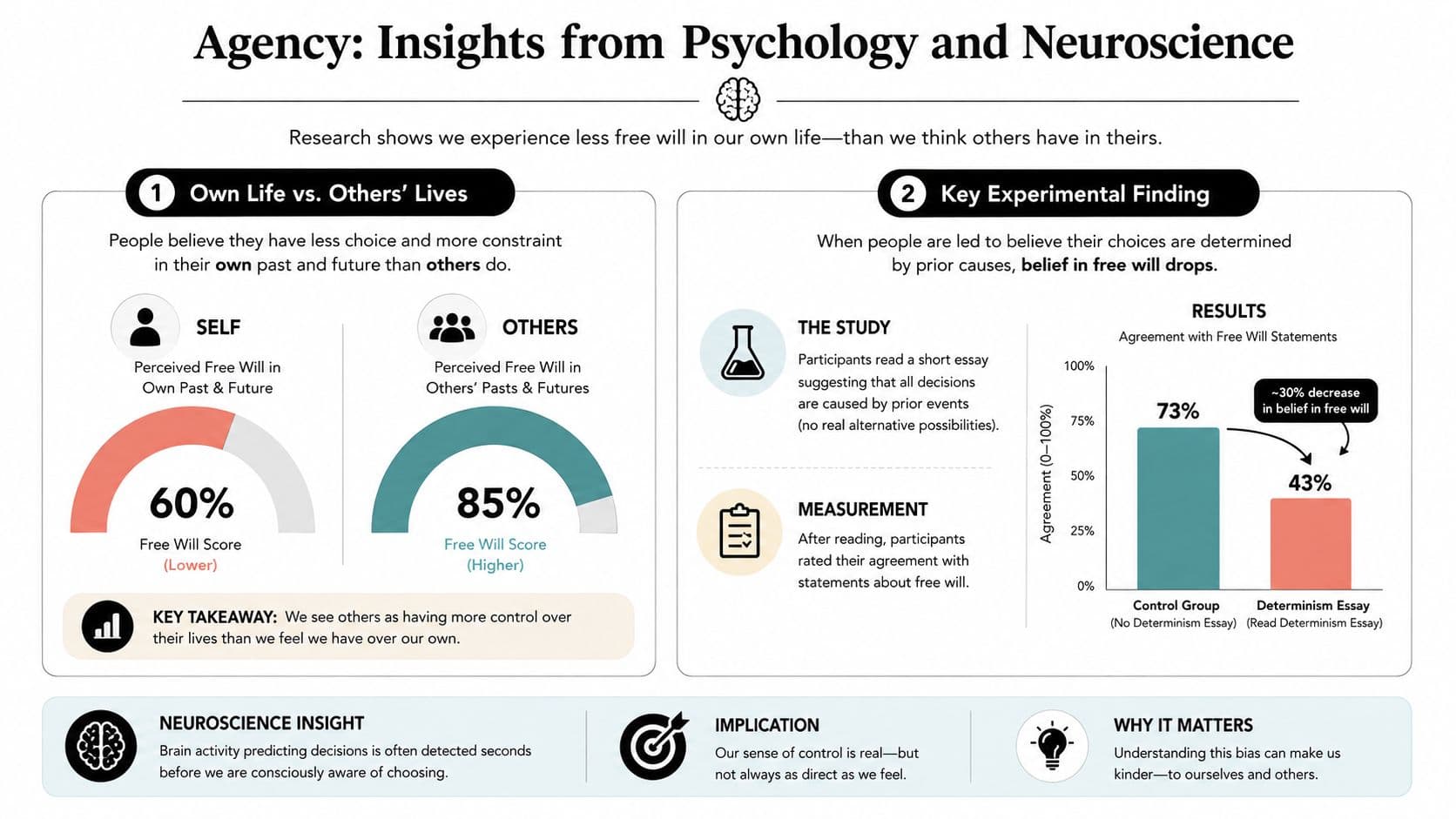
People do not perceive their own lives and other people's lives the same way
One of the clearest findings in this area is that agency is not judged evenly. People often explain their own past and future differently from the way they explain someone else's, and that gap shows up in experimental work. In one study, participants rated their own pasts and futures as less predictable than those of peers, with mean predictability scores of 3.86 vs. 4.81 on a 7-point scale in one experiment (study). They also gave more of the predictive value to their own desires and intentions, 36% for themselves versus 27% for others, with those differences statistically significant at P = 0.0004 and P = 0.0006 (study).
That asymmetry matters because it shows how easily agency shifts with perspective. A person may feel strongly directed by inner choice in one context, then judge another person as mostly shaped by circumstance. For a related way of seeing how perception shapes experience, consider the discussion of the power of perception.
Conscious choice may be editor, not sole author
Neuroscience complicates the picture without deleting it. Libet's findings, as summarized in the provided material, suggest that brain activity related to a decision can begin before conscious awareness, while conscious awareness may still have a veto role. That has kept philosophers arguing about whether awareness starts action, filters action, or explains action after it has already begun (Libet summary).
The main point is simpler than the debate around it. Our sense of agency is not pure evidence, it is also a perception shaped by context. A 2025 adoption study found that agentic beliefs showed minimal to no heritability, with genetic differences explaining an average of only 9% of variance across 10 belief scales while non-shared environment accounted for 85% of variance (study). That does not settle the philosophy, but it does show that beliefs about fate and free will are shaped heavily by experience, not only by biology.
The Hybrid View Most People Actually Hold
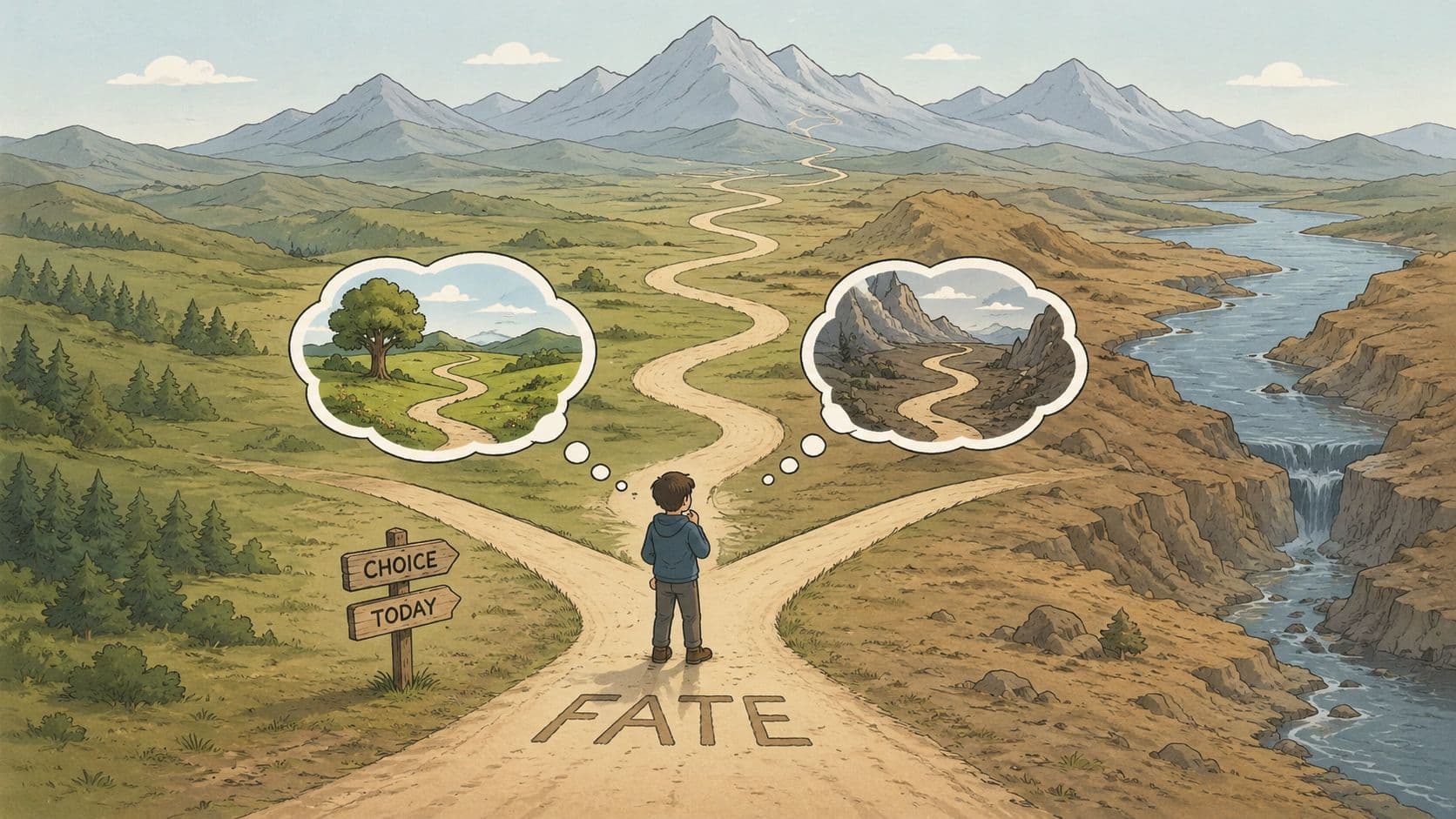
Fate sets conditions, choice sets direction
Few individuals live as strict determinists or as pure libertarians. They operate with a mixed model. The family they were born into, the body they inherited, the timing of major encounters, and the culture around them can feel fixed, while their response inside those conditions still feels meaningful.
That hybrid view is often the most psychologically honest one. It explains why someone can say, “I didn't choose this situation,” and in the same breath say, “I still choose how I respond.” It also fits the broader compatibilist idea that causation and agency don't have to cancel each other out.
Dan Millman's The Life You Were Born to Live and the Life Purpose App fit naturally. Used well, they work as a language for reflection, not as a script that tells you what must happen. They can help you name patterns, tensions, and recurring themes without pretending that a birth date is a magic explanation for everything.
Mixed beliefs are not a weakness
People sometimes think mixed beliefs are intellectually sloppy. They're not. They often reflect the fact that life itself is mixed, part structure and part response, part inheritance and part improvisation.
The most practical question is not whether your life is fixed or free in the abstract. It's where you feel constrained, where you still have leverage, and what kind of responsibility the moment actually asks from you.
That middle ground is especially useful when you're trying to stop turning every setback into either a cosmic punishment or a personal failure. It gives you room to accept what you didn't author while still taking the next step you can take.
What Your Belief Orientation Changes in Real Life
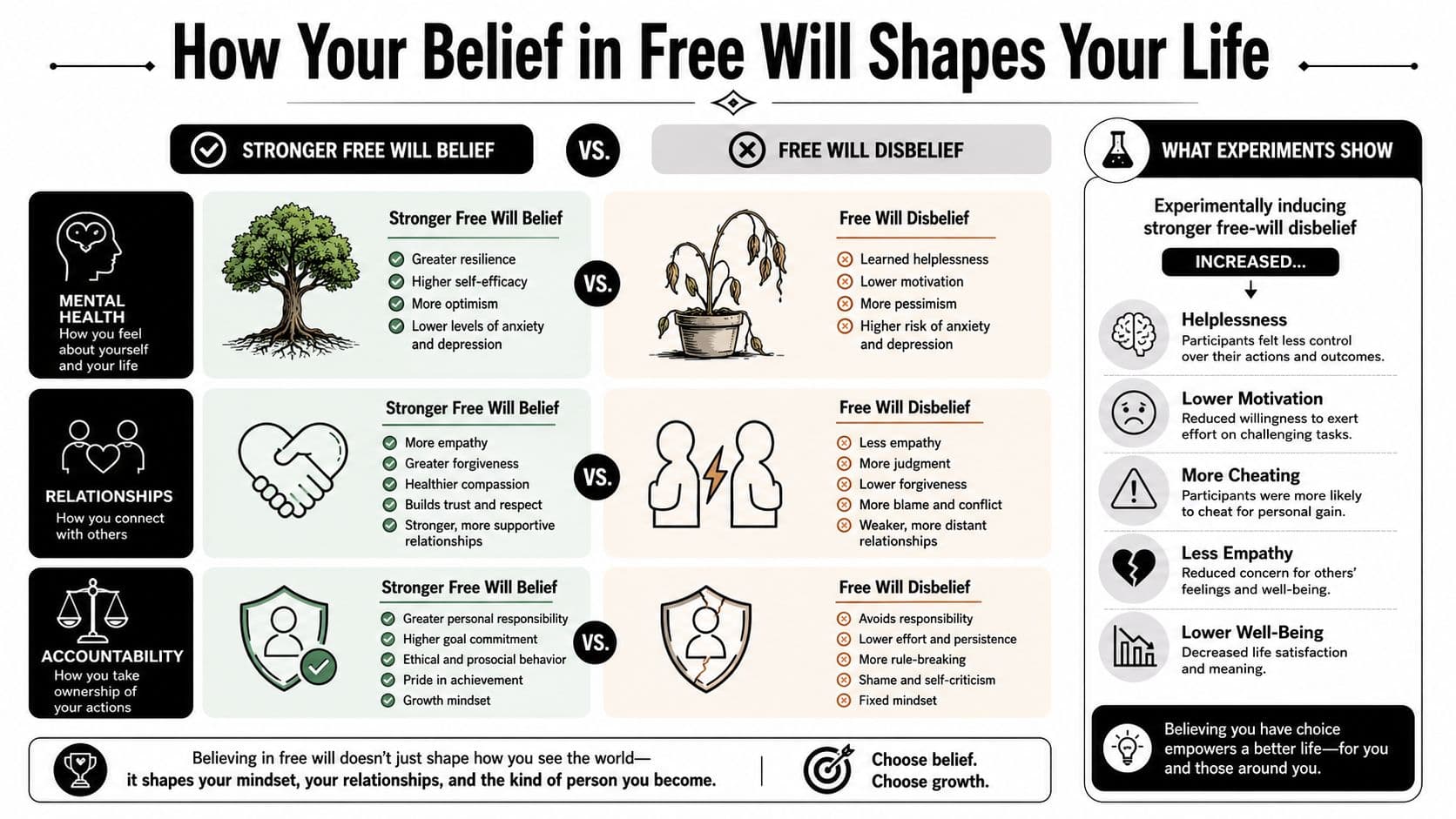
Mental health, relationships, and accountability all respond to the story you tell yourself
Your belief orientation is not just an abstract preference. A recent peer-reviewed meta-analysis found that experimentally inducing stronger free-will disbelief was associated with more antisocial outcomes, though the effects were small and varied across studies. That matters because the practical issue is not a simple choice between fate and free will, but how a belief pattern interacts with self-control, pressure, and context.
In mental health, a fatalistic stance can bring relief when you are facing something you cannot change. It can also become a trap if it suggests that nothing you do matters. In relationships, an over-autonomous stance can make family systems, trauma, and social pressure look smaller than they are, while a rigid fate view can weaken the effort needed to rebuild trust.
Accountability works better through compatibilism. It leaves room for moral judgment without pretending that people live outside circumstance. That makes it easier to say, “You are responsible for your behavior,” while also recognizing that responsibility sits inside a real world of habit, history, and pressure.
If you feel stuck, a stronger emphasis on agency can help you act. If you feel over-responsible, acceptance can give you breathing room. A flexible default, rather than a permanent ideology, is often what the moment asks for. A resource like the HolyJot Romans 12:2 guide can also help if you are exploring how belief shapes renewal, discernment, and daily conduct. For readers who want a related reflection on timing and meaning, what divine timing means in practice offers another angle on the same tension between surrender and choice.
A simple way to apply the spectrum
- When you feel helpless: ask what part of the situation is still negotiable.
- When you feel guilty for everything: ask what part was outside your control.
- When you feel tempted to give up on others: ask what support, structure, or accountability could still help.
The goal is balance. A useful belief should make you steadier, not smaller.
Using Life Path Insight as an Interpretive Mirror
Dan Millman's The Life You Were Born to Live and the Life Purpose App offer a reflective framework built around a date of birth, one of 45 unique life paths, and guidance on health, money, sexuality, career, relationships, nine-year life cycles, and compatibility analysis. Read that way, the system is not a predictive oracle. It is an interpretive mirror that helps some people notice patterns they keep repeating and tensions they keep carrying.
That framing works for both sides of the spectrum. If you lean fatalist, it can give language to acceptance without making you passive. If you lean agency-first, it can give you a vocabulary for the conditions you're working within, so you stop pretending every barrier is just a mindset problem.
A practical exercise can make this real. First, write one sentence about your current life cycle and one intention that fits it. Keep it plain, like “I'm in a season of rebuilding, and I want to act with patience.” Second, choose one close person and compare how each of you handles the same constraint, a delay, a conflict, or a money decision. The goal isn't to label one of you right and the other wrong, it's to see how context and temperament shape the same situation differently.
The evidence on divination-style claims remains clear in the materials provided, direct tests have not shown a strong predictive signal, so the value here is meaning-making rather than forecasting (evidence guide). The same caution applies to claims that birth-date systems can predict life outcomes. They work best as interpretive tools, not as proof that the future is fixed.
If you want a structured way to reflect on your own patterns, explore the Life Purpose App alongside Dan Millman's The Life You Were Born to Live. It turns the fate-versus-free-will question into something you can work with, not just argue about, and you can visit Life Purpose App to see how its life-path, cycle, and compatibility tools fit your own reflections.
Discover Your Life Purpose Today!
Unlock your true potential and find your life’s purpose.
