Money choices feel practical, but repeating patterns with work and income are often personal. Use Dan Millman’s life-path framework to reflect on habits, timing, and practical steps that align your finances with your strengths.
May 25, 2026 (2mo ago) — last updated June 21, 2026 (1mo ago)
Financial Numerology: Money & Career Guide
Use Dan Millman’s life-path numerology to reflect on money, career patterns, and nine-year cycles—paired with practical financial habits for clearer decisions.
← Back to blog
Financial Numerology: Money & Career Guide
Summary: Explore financial numerology with Dan Millman’s framework. Learn how your life path number shapes money, career choices, and nine-year cycles for clearer decisions.
Introduction
Money questions are often practical: change jobs, raise rates, go back to school, start a side business, or build a debt-and-savings plan. Underneath those spreadsheet questions, many people are asking something more personal: why do I repeat the same patterns with work and money?
Financial numerology doesn’t predict stock prices or guarantee a payday. It’s a reflective tool that helps you notice habits, motives, fears, and strengths. Dan Millman’s The Life You Were Born to Live reads a birth date as a map of recurring lessons and capacities. The Life Purpose App uses that same framework to make the method easier to apply in real choices and cycles.1
A New Lens for Your Finances and Career
Many headlines ask, “Which number attracts money?” That’s catchy, but usually the wrong question. A better question is: does a symbolic system help you make wiser decisions, or does it simply provide temporary reassurance? The difference matters. Substantial shares of adults consult symbolic practices for guidance, which places these tools in the realm of meaning-making rather than validated financial forecasting.2
Millman’s approach gives this conversation more depth. Rather than naming one number as “good” or “bad” for wealth, his method invites you to look at a pattern of lessons. The same person who struggles with consistency may be gifted at vision; the person who craves security may be excellent at building systems but reluctant to take healthy risks. Financial numerology is most useful when it becomes a language for patterns you already feel but haven’t named.
What this lens can actually help with
Used carefully, this reflection can sharpen practical questions:
- Career fit: are you forcing yourself into a work style that drains you?
- Money behavior: do you overspend for comfort, undercharge out of self-doubt, or avoid planning because numbers make you anxious?
- Timing and readiness: are you pushing ahead when your deeper task is to simplify, learn, or finish something old?
Financial numerology works best when it gives language to patterns you already feel but haven’t named. If you’re making major choices, spiritual reflection can sit beside practical planning. Resources for concrete financial tasks—budgeting, retirement planning, debt structure—remain essential and can be used alongside symbolic insight.3
What this guide is and isn’t
This is not a promise that your birth date predicts your bank balance. It is a way to use Dan Millman’s framework from The Life You Were Born to Live, together with the Life Purpose App, to reflect on how you approach ambition, value, responsibility, and change. That approach is more useful than chasing folklore about a single lucky digit.
Finding Your Unique Life Path Number
You sit with your budget, your calendar, and a list of career questions. Part of you wants clarity. Another part wants to understand why the same money patterns repeat. Millman’s life-path system helps with that second piece by offering a structured way to reflect on themes that affect work, money, and growth.
In The Life You Were Born to Live, your birth date points to a life path that functions like a curriculum: it suggests lessons, strengths, and recurring tests that shape how you earn, decide, hesitate, push, avoid, or overextend.
Numerology online often mixes different systems. Millman’s method is more useful if you keep interpretations inside his framework rather than blending random claims about lucky digits. Tools built around his method—including the Life Purpose App—help keep interpretations consistent and practical.4
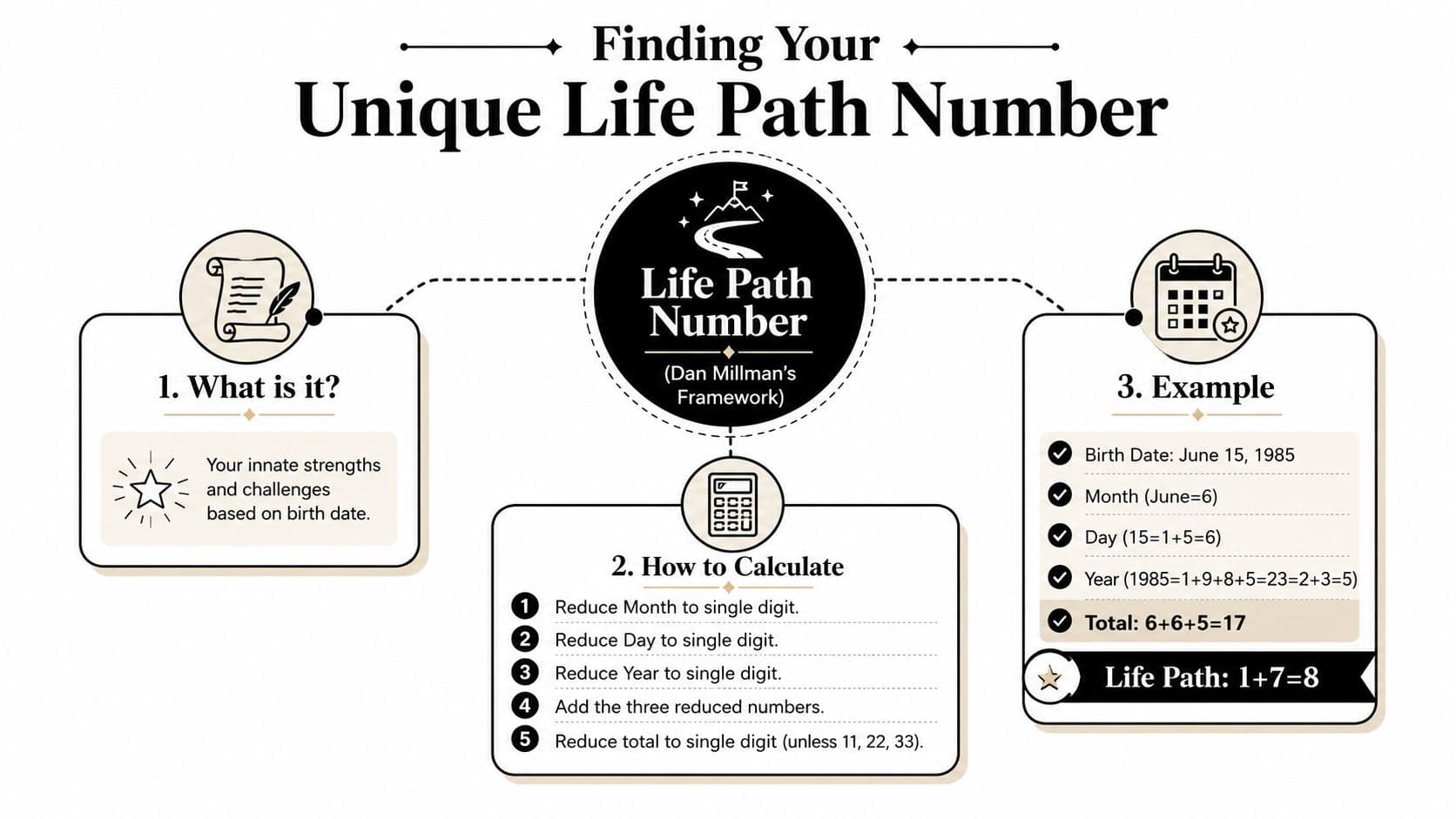
How the calculation works
The arithmetic begins with your birth date and reduces the digits step by step until you reach your life-path result according to the method you’re using. The math matters, but only as a starting point. A calculator gives a number; the harder part is understanding what the number asks of you. Millman treats the result as one element of a larger teaching about character, development, and recurring lessons.
If you prefer to calculate by hand, keep it simple:
- Write your full birth date (month, day, year).
- Reduce each part by adding its digits.
- Add the reduced parts together.
- Reduce again if needed until you reach the final path used in the system.
The number is a doorway; its value comes from what it helps you notice about habits and choices. Two people with the same path can handle money very differently: one may use discipline and patience, the other may show avoidance or impulsivity. The number doesn’t force an outcome. It provides a mirror.
Practical rule: do the calculation first, then test the interpretation against real patterns in your life.
Where confusion usually starts
Confusion rarely comes from the math. It comes from mixing methods and expecting consistent answers. One source claims a single number means wealth; another insists your name matters more; a third uses a different reduction method and gives a different result. Millman’s approach sidesteps that by asking what you are here to learn in effort, balance, service, trust, power, or expression.
The Life Purpose App ties the calculation to Millman’s teaching so you aren’t pulled into conflicting interpretations.4
What Your Number Reveals About Money and Work
You take a sensible job: decent pay and respect. Months later you feel drained, careless with money, or strangely stuck. Someone else in the same role seems to thrive. Financial numerology, used carefully, can help explain why.
In Millman’s system, your life path points to lessons and pressures you’ll meet repeatedly. Money flows through those patterns. So do stress and satisfaction.
Different paths create different money lessons
A creative or expressive pattern often fits writing, teaching, design, healing work, or an independent business. Their challenge tends to show up after the inspiration: pricing, invoicing, bookkeeping, and long-range planning. The issue is rarely talent alone; it’s the capacity to give form to talent.
A disciplined, orderly, or service-based pattern may build steady work, manage details well, and create reliability. Yet people with this pattern may undercharge, stay too long in safe roles, or avoid visibility.
Both can earn well and both can struggle. Their friction points are different—like two drivers in different cars on the same road: one needs better brakes; the other needs more acceleration.
Read your number as a pattern, not a verdict
Millman’s method keeps you focused on practice. If your path highlights responsibility, your money lesson may be healthy boundaries rather than endless sacrifice. If it highlights power, the lesson may be using ambition without controlling everything. If it highlights sensitivity or expression, the lesson may be turning insight into steady action.
Use these questions as prompts:
- How do I naturally create value—through structure, care, leadership, communication, innovation, or consistency?
- Where do I lose financial energy—avoidance, overgiving, scattered focus, fear of asking, or rigidity?
- What work setting supports my strengths—independence, collaboration, routine, public-facing roles, or mission-driven service?
- What repeated money stress might be trying to teach me—patience, trust, discernment, discipline, or self-worth?
One clear pattern matters more than a pile of lucky-number claims.
A practical way to use the insight
Treat your life path like a mirror. After a tough month financially, ask what happened beneath the numbers: did you ignore structure, say yes too often, hide from visibility, or chase security so hard that you shut down growth? Spiritual reflection becomes practical when paired with concrete habits such as budgeting and debt planning.3
Common money tendencies by pattern
| Pattern tendency | Possible work and money reflection |
|---|---|
| Creative and expressive | Needs freedom and meaning, benefits from firmer budgeting and follow-through |
| Structured and responsible | Builds stability, may need courage around pricing and visibility |
| Service-oriented and caring | Builds trust, may need stronger financial boundaries |
| Ambitious and forceful | Can achieve much, benefits from ethical clarity and emotional balance |
Use that table as a journal prompt, not a final label. Millman describes life purpose as a path of learning; finances fit that same frame. Your number can show where money becomes a teacher and where greater awareness can turn repeating strain into wiser choice.
Navigating Your Nine-Year Financial Cycles
Your life path describes a core pattern; cycles describe movement. Millman treats life as developmental: certain seasons support action, others support review, closure, healing, or restructuring. Ignoring that rhythm can make effort feel heavy and out of season.
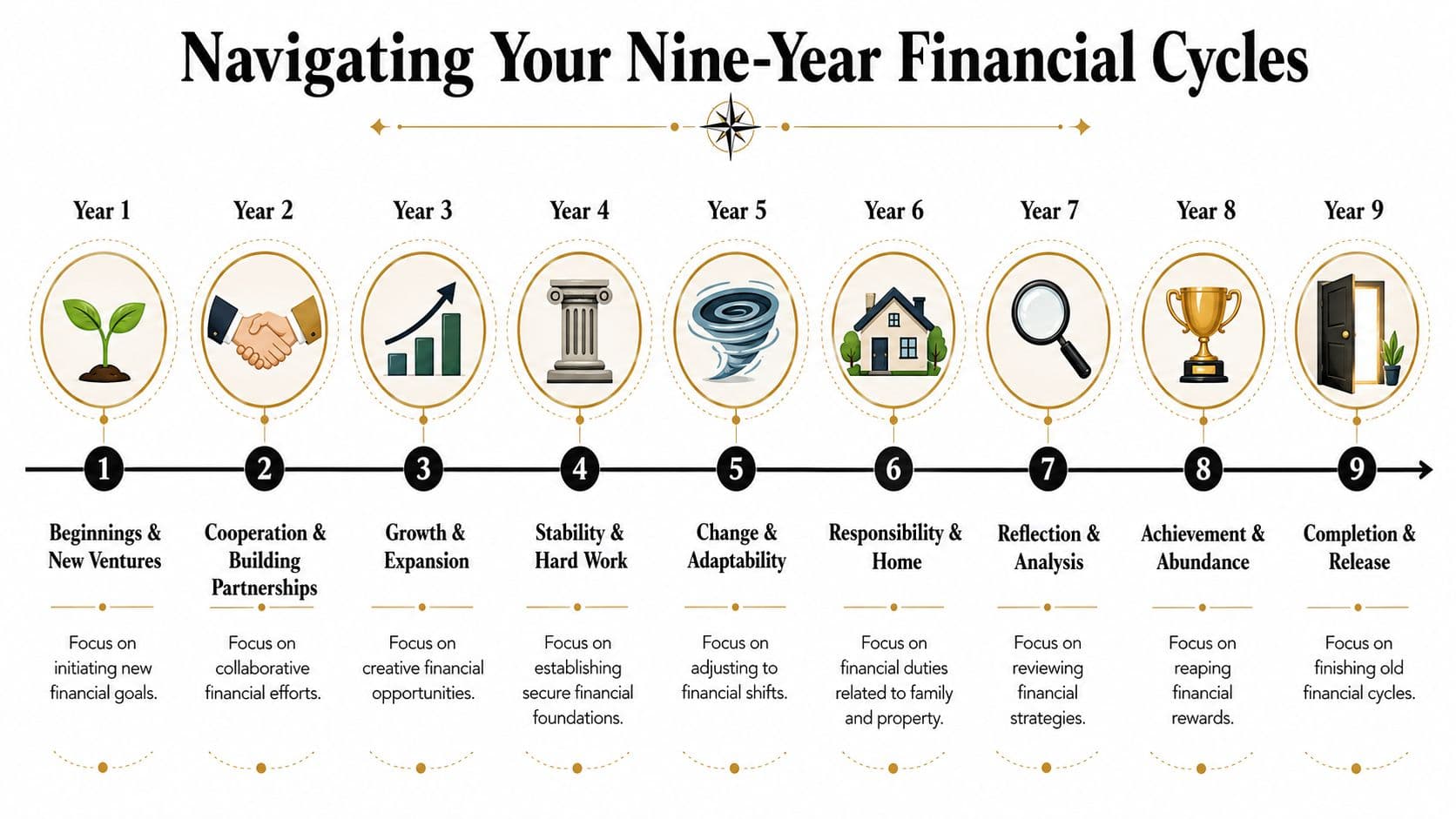
Thinking in seasons instead of verdicts
A nine-year cycle is a useful metaphor: some years are for planting, some for maintaining, some for harvest, and some for ending what no longer fits. If one year is full of openings and another dominated by loose ends, this framework helps you read timing more clearly.
For a deeper explanation of cycle calculation and meaning, see the nine-year cycle numerology guide.4
The 9-Year Cycle Financial Themes
| Personal Year | Financial & Career Theme |
|---|---|
| Year 1 | Beginnings, initiative, testing a new direction |
| Year 2 | Partnership, patience, collaboration, listening |
| Year 3 | Visibility, creativity, communication, expansion |
| Year 4 | Discipline, systems, structure, steady work |
| Year 5 | Change, movement, adaptation, experimentation |
| Year 6 | Responsibility, home, care, obligation, support |
| Year 7 | Reflection, study, review, inner recalibration |
| Year 8 | Achievement, authority, material focus, results |
| Year 9 | Completion, release, generosity, clearing the deck |
A Year 1 doesn’t guarantee success; it emphasizes energy for beginnings. A Year 7 doesn’t mean you must avoid decisions; it may suggest research, restraint, and review before acting. Use cycles to inform emphasis, not to remove agency.
Putting Insight into Practice with the Life Purpose App
Insight fades without revisiting it. A number can feel meaningful on discovery day and then slip into abstraction. Tools help you return to your path and cycle when real financial or career questions arise.
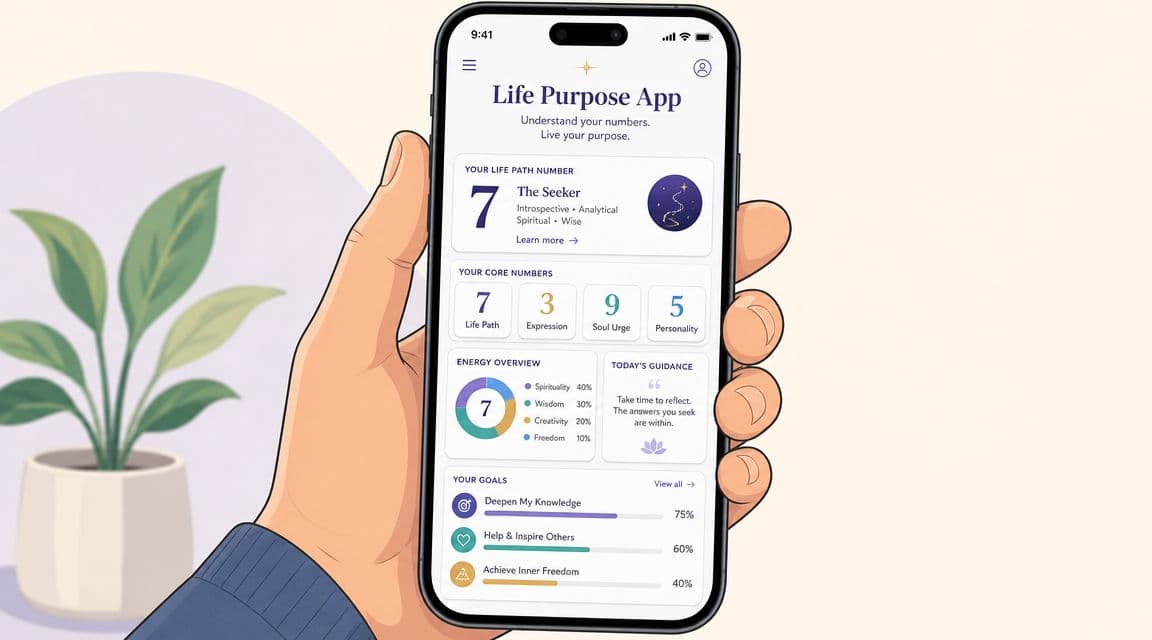
The Life Purpose App lets you use Millman’s system on an ongoing basis rather than as a one-time curiosity. Think less in terms of “what does my number say?” and more in terms of “what decision am I facing now?”
Use the app in moments like these:
- Before a career move: review whether the role fits your strengths or flatters your fears.
- During a money plateau: check your cycle to see if this season favors expansion, consolidation, cleanup, or study.
- When a work relationship feels difficult: compare patterns with a partner, client, manager, or collaborator.
Much money stress is relationship stress in disguise—misaligned expectations, poor communication, different risk tolerances, and unspoken power dynamics can all affect income and career path.
Useful features for reflection
The app organizes a broad system into repeatable use. It can help you:
- Identify your life path from your birth date and connect it to Millman’s framework.
- Track your current cycle so you can reflect on timing instead of reacting blindly.
- Explore relationship dynamics that show up in work and money decisions.
- Return to the text when needed, instead of relying on memory or random interpretations.
Use the app for regular check-ins: one thoughtful weekly review teaches more than an annual binge of interpretations. For additional formats, multimedia companions such as guided video content can support different learning styles.4
A Grounded and Ethical Approach to Your Numbers
Numerology becomes harmful when people use it to avoid responsibility or to punish themselves. Someone might say, “My number says money should come easily, so I don’t need a budget.” Another might say, “My chart looks difficult, so financial security isn’t for me.” Neither response is useful. During economic strain, reflective systems can feel attractive, which is why it’s important to hold symbolic tools responsibly alongside practical financial habits.2
What ethical use looks like
A grounded approach keeps the spiritual and practical in the same room. That means:
- Use your numbers for awareness: notice patterns in fear, ambition, generosity, avoidance, and discipline.
- Keep evidence-based habits: budgeting, saving, debt management, and thoughtful planning still matter.
- Treat difficult insights as developmental: if a path highlights impatience or self-doubt, see it as an invitation to practice, not a verdict.
If a reading touches a sore spot, pause before making it literal. “I struggle with authority” doesn’t mean you can’t lead. “I tend toward inconsistency” doesn’t mean you can’t build wealth. It means growth may require stronger systems, different support, or honest self-observation.
If your use of numerology makes you calmer, clearer, and more responsible, it’s probably helping. If it makes you panicked, rigid, or dependent on constant signs, stop and reframe. Good guidance should increase agency: it should help you ask better questions, make cleaner decisions, and bring more compassion to your patterning.
Dan Millman’s The Life You Were Born to Live points toward self-knowledge. The Life Purpose App can support that process. Numbers describe tendencies; they don’t relieve responsibility or remove the capacity to grow.3
If you want a simple way to explore Millman’s system, the Life Purpose App lets you enter your birth date, view your life path, reflect on your current cycle, and study relationship patterns in one place. Use it as a tool for self-understanding, then pair that insight with grounded financial habits and real-world action.3
Frequently Asked Questions
Q: Can financial numerology predict my income?
A: No. Financial numerology doesn’t predict exact income or market outcomes. It offers a language to notice recurring patterns in how you approach earning, spending, saving, and risk.
Q: How do I use my life path number to make financial decisions?
A: Treat your number as a mirror. After calculating your path, test the interpretation against real-life patterns—where you lose financial energy, where you thrive, and what systems help you follow through.
A: Is numerology a substitute for practical financial planning?
A: No. Use symbolic insight alongside evidence-based habits: budgeting, debt management, savings, and professional financial advice when needed.
\"1\".
Dan Millman, The Life You Were Born to Live; Life Purpose App, lifepurposeapp.com.
\"2\".
Pew Research Center, “More Americans say they believe in astrology,” July 20, 2020, pewresearch.org/fact-tank/2020/07/20/more-americans-say-they-believe-in-astrology/; OECD and World Bank reports on household financial pressure and global economic conditions, oecd.org and worldbank.org.
\"3\".
Life Purpose App features and the homepage.
\"4\".
Nine-year cycle and related numerology guides on the Life Purpose App blog.
\"5\".
Discussion about using numerology responsibly during financial stress (video reference), https://www.youtube.com/watch?v=A1qdhMMAOqg.
Discover Your Life Purpose Today!
Unlock your true potential and find your life’s purpose.
