Struggling with what's next? Learn practical steps for finding purpose in midlife, from mindset shifts to using the Life Purpose App for clarity and growth.
August 22, 2026 (29d ago)
Finding Purpose in Midlife: A Step-by-Step Guide
Struggling with what's next? Learn practical steps for finding purpose in midlife, from mindset shifts to using the Life Purpose App for clarity and growth.
← Back to blog
You wake up, answer messages, handle work, care for family, and move through a day that looks full from the outside. Yet somewhere between the morning routine and the quiet after dinner, a question keeps returning: Is this all my life is meant to be? You may not want to abandon your career, relationship, or responsibilities. You may want them to feel connected to something that matters.
Finding purpose in midlife rarely begins with a dramatic revelation. More often, it starts when familiar achievements stop providing the same sense of direction. The work here isn't to throw away your life. It's to understand what has changed, identify what still matters, and build a steadier relationship with meaning.
The Midlife Turning Point Is Not a Crisis
A person can be grateful and dissatisfied at the same time. Consider someone in their early forties who has built a career, supported a family, and fulfilled many expectations. Nothing is obviously falling apart, yet the old sources of motivation feel strangely quiet. Weekends become recovery periods, familiar goals feel borrowed, and the future looks less like an exciting destination than another list of obligations.
That experience doesn't mean you're broken. It may mean that the identity that carried you through earlier adulthood no longer answers the questions you're asking now. Midlife often brings an honest inventory of time, relationships, health, work, and unrealized hopes. The discomfort comes partly from seeing your life with fewer illusions.

What the life satisfaction curve reveals
A large multinational study of subjective well-being found a consistent midlife low point. Life satisfaction typically reaches its minimum around ages 40 to 42, then rises again into later adulthood. The analysis cited by the Resolution Foundation drew on longitudinal evidence from more than 50,000 adults and was published in 2017 in the Economic Journal, while a separate longitudinal reconsideration reported a shift of nearly 0.3 standard deviations from age 40 to 70. These findings are summarized in the longitudinal research record on midlife well-being.
Those figures don't predict your individual experience. They do offer a useful reframe. A period of questioning can belong to a recognizable phase of adult development rather than prove that you've made irreversible mistakes. The later rise in satisfaction also matters, because it suggests that a low point can become a passage toward greater alignment.
Physical changes can intensify this reassessment. Sleep disruption, changing energy, or perimenopause can affect how a person experiences work, relationships, and confidence. If strength and recovery have become part of the problem, a science-based perimenopause strength plan can provide a practical starting point, alongside appropriate medical guidance.
You don't need to label the experience a crisis before you can respond to it. A useful explanation of what a midlife crisis may actually mean can help separate a temporary loss of direction from a genuine need to change your priorities.
A turning point asks for attention, not panic.
Why Trying to Change Everything Backfires
The fantasy of a total reinvention is attractive because it promises instant relief. Quit the job, move to a new city, end the relationship, start a business, or become an entirely different person. Sometimes a major change is necessary, but using upheaval to escape confusion often creates new problems before you've understood the old ones.
Identity adjustment works more like an ongoing negotiation than a demolition project. Research on midlife identity describes three mechanics: assimilation, accommodation, and balance. The framework is outlined in research on identity processes in adulthood.
Assimilation preserves continuity
Assimilation means maintaining self-consistency. You notice the parts of yourself that have remained dependable across changing circumstances. Perhaps you've always been a teacher, protector, builder, organizer, or curious learner. These qualities may not disappear because your current role feels stale.
Assimilation protects against the belief that everything about your past was wrong. A person who feels trapped in corporate work might discover that constant isn't the industry, but a talent for explaining complicated ideas and helping people grow. That insight opens more options than declaring the entire past a failure.
Accommodation makes room for change
Accommodation means making changes in the self. Your responsibilities, body, relationships, and ambitions can shift, requiring a revised understanding of who you are. The parent whose children need less daily care may need to become more than a caretaker. The professional whose values have changed may need to redefine success.
Accommodation becomes risky when it turns into self-erasure. You don't need to reject every former interest to make space for a new one. You can remain loyal to your strengths while changing the setting in which you express them.
Balance keeps change coherent
Balance means preserving a coherent self while changing when necessary. It answers two questions at once: What must remain true about me, and what must become different for my life to fit now?
A balanced experiment might involve mentoring before leaving a profession, reducing a commitment before ending a relationship, or taking a class before pursuing a new qualification. These steps produce information without demanding an irreversible decision.
Don't ask, “How can I become someone else?” Ask, “What part of me needs a more honest place in my life?”
Practical Steps to Identify and Protect Your Purpose
Purpose becomes easier to recognize when you stop treating it as a feeling that must arrive fully formed. Think of it as a pattern created by repeated choices. The pattern usually appears where personal meaning, ability, and contribution overlap.
Recent mixed-method research in the UAE found that personal growth and self-compassion predicted both the search for and presence of meaning in life, while materialism did not. The research is discussed in this study of growth, self-compassion, and meaning. That finding supports a grounded approach. You don't have to build a more impressive life. You need to build a life that expresses what you care about.
Start with evidence from your own life
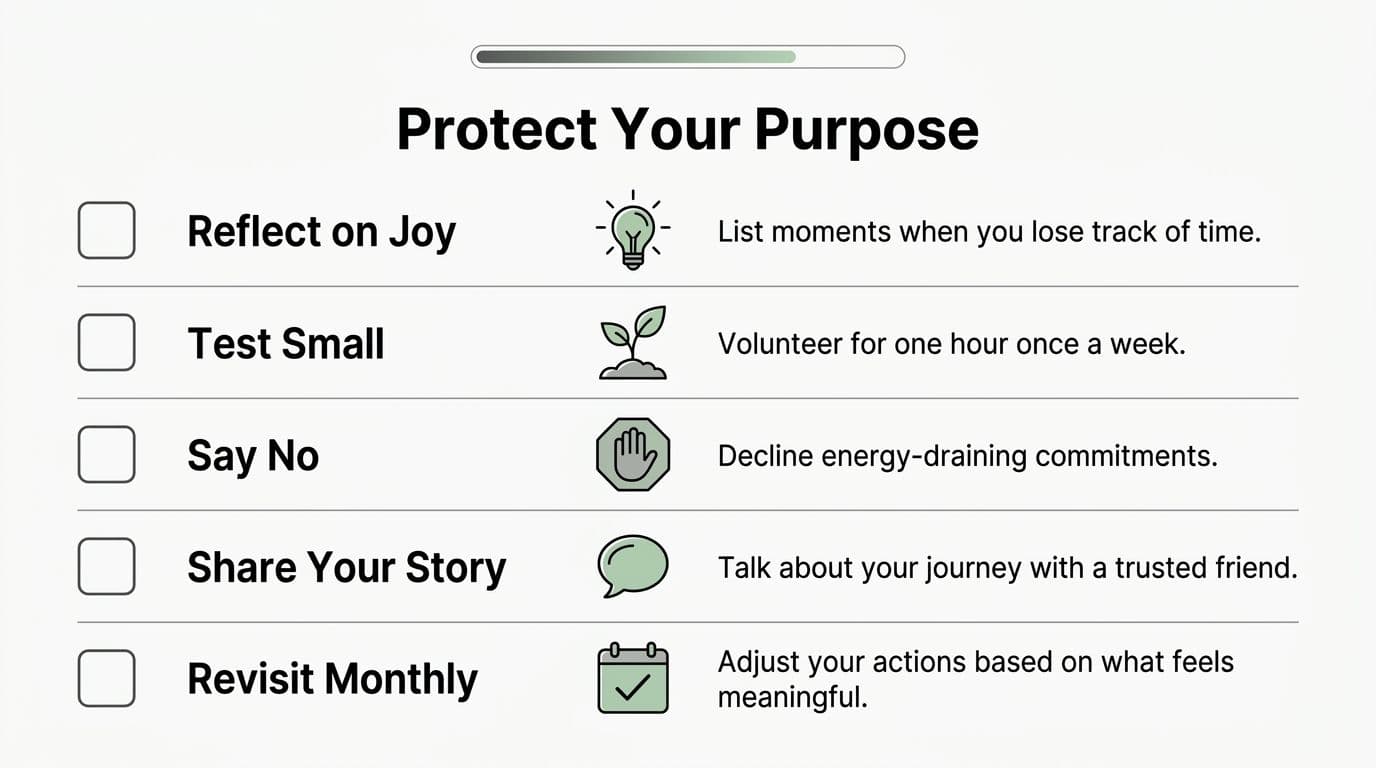
Write down moments when you felt absorbed, useful, protective, creative, or content. Don't limit the list to extraordinary events. A conversation with a struggling colleague, repairing something at home, preparing food for people you love, or teaching a skill can reveal more than a glamorous fantasy.
Then ask:
- What gives me energy? Notice activities that leave you tired in a satisfying way.
- What comes naturally? Identify skills other people regularly ask you to use.
- Who benefits? Look for the people, communities, or causes you feel drawn to serve.
- What feels worth preserving? Purpose often protects a value rather than producing a public achievement.
For a more structured reflection, use this exercise and compare the values you admire with the values your calendar reflects.
Test purpose through small service
Choose a modest, repeatable commitment. Volunteer for a local organization, mentor someone at work, help a relative learn a practical skill, or contribute to a community project. The point isn't to prove that you've found your calling. The point is to observe what happens when your abilities consistently benefit someone beyond yourself.
Research has specifically raised the question of whether purpose can be rebuilt through smaller prosocial commitments rather than dramatic reinvention. That question matters because practical service can fit around caregiving, health limits, financial responsibilities, and demanding work.
Protect the emotional conditions around purpose
A 9-year longitudinal study of 1,294 U.S. midlife and older adults found that greater positive-affect fluctuations were linked to a poorer sense of purpose over time, with the relationship especially pronounced among older individuals. The finding appears in this longitudinal study of emotional fluctuation and purpose.
Purpose doesn't require constant happiness. It benefits from steadier rhythms, adequate rest, honest boundaries, supportive relationships, and routines that reduce unnecessary emotional whiplash. Use the table below as a practical diagnostic rather than a rigid rule.
| Emotional State | Impact on Purpose | Recommended Action |
|---|---|---|
| Calm and engaged | You can notice meaning and make deliberate choices. | Record what you're doing and why it matters. |
| Energized but scattered | Excitement can produce too many commitments. | Choose one experiment and give it a clear boundary. |
| Drained or resentful | Obligations may be consuming the energy needed for contribution. | Reduce, delegate, or renegotiate one demand. |
| Sad or numb | Purpose can feel inaccessible even when your values remain intact. | Seek support and maintain basic routines before making major decisions. |
| Restless and volatile | Rapid changes can disguise avoidance as clarity. | Delay irreversible choices and return to observation. |
Finally, schedule a recurring review. Ask what felt meaningful, what depleted you, whom you helped, and what deserves adjustment. Purpose is dynamic, so one powerful journaling session won't replace continued attention. Evidence from longitudinal purpose research shows that people move in different directions over time, which makes regular check-ins more useful than a single declaration about your future.
Using Dan Millman's Life Path System for Clarity
Psychological reflection helps you observe your patterns. Ancient wisdom can offer another kind of mirror, one that organizes those observations into a symbolic language. Dan Millman's book, The Life You Were Born to Live, presents a Life Path system based on birth-date calculations and themes involving gifts, challenges, growth, and practical areas of life.
Used carefully, the system doesn't need to replace evidence-based reflection. It can prompt better questions. If a Life Path interpretation highlights discipline, communication, service, or independence, you can test that theme against your actual experience. Where does it fit? Where does it fail? What behavior would show that the theme is useful rather than merely flattering?

Treat symbolism as a prompt
The value of a numerology or life-path framework depends on how you use it. Treat it as a reflective tool, not a verdict about your personality or destiny. A useful interpretation should lead to observable questions:
- Where do I already express this strength?
- What challenge keeps repeating in my decisions?
- Which responsibility am I avoiding because it feels uncomfortable?
- How might this theme affect my work, health habits, money choices, or relationships?
This approach protects your agency. You remain responsible for checking an interpretation against lived reality, seeking professional advice for medical or financial decisions, and choosing actions based on your values and circumstances.
Connect the system with identity work
The psychological mechanics of assimilation, accommodation, and balance provide a strong companion to Millman's system. You might assimilate a long-standing gift, accommodate a changing role, and seek balance by expressing that gift in a new form. A person known for problem-solving could move from fixing every family emergency to teaching others how to solve problems themselves.
The Life Path system also includes themes related to nine-year cycles, which some readers use to reflect on transitions and timing. You don't have to force your life into a predetermined schedule. Instead, use the idea of cycles to ask whether a period is calling for completion, learning, consolidation, or a fresh direction.
Dan Millman's book, The Life You Were Born to Live, remains the reference point for this system, while the Life Purpose App translates its framework into a digital format. The strongest use of either is practical: read an interpretation, identify a testable insight, and watch how your choices feel over time.
How the Life Purpose App Supports Your Journey
Midlife questions can become too broad to act on. “What should I do with my life?” contains career, relationships, health, money, spirituality, and identity all at once. A structured digital tool can narrow the inquiry into themes you can examine one at a time.
The Life Purpose App is based on Dan Millman's The Life You Were Born to Live. After entering a birth date, users can explore one of 45 unique life paths, along with associated gifts, challenges, spiritual laws, and practical themes connected with areas such as health, money, sexuality, career, and relationships.
Use a profile as a conversation starter
A profile can give language to an experience that has felt vague. Someone considering a career change might compare the app's themes with their work history. Someone struggling in a relationship might examine whether they're seeking compatibility, avoiding a necessary conversation, or repeating an old pattern.
The app also maps nine-year life cycles and relationship dynamics. Users can explore compatibility with friends, family members, coworkers, or public figures through in-app Wikipedia look-ups. These features are most helpful when they encourage curiosity instead of encouraging fixed labels.
For a different style of reflection, the Life Purpose Oracle can serve as a prompt for journaling or a focused conversation. The output shouldn't make decisions for you. It can help you decide which question deserves attention first.
Choose the level of access that fits
The free tier provides a summary of a life path and an overview of the system. Paid options provide the complete text from the 25th Anniversary Edition, detailed life-path analyses, unlimited contacts, and access to primary numbers and cycles. The app is available in English, French, and German, with customer support available for users who need help navigating it.
That makes the tool flexible for different situations. You can begin with a broad overview, then decide whether deeper material would support your reflection. A paid feature isn't a substitute for therapy, medical care, financial planning, or direct communication with people affected by your choices.
Use the app to generate better questions, not to outsource your judgment.
The practical advantage lies in turning abstract purpose into specific areas of attention. Instead of asking whether your entire life is meaningful, you can ask what your current cycle, relationships, work, or health habits are teaching you, then connect those questions to the small experiments described earlier.
Reframing Purpose Small Steps Over Big Leaps
The belief that purpose requires a dramatic life overhaul makes many people freeze. If the only acceptable answer is a new career, a spiritual breakthrough, or a complete reinvention, ordinary actions seem too small to count. That standard turns purpose into another performance.
A steadier path begins with what you can repeat. You clarify a value, protect the energy needed to live it, test a contribution, and review what you learn. You might stay in the same profession while changing how you mentor, serve, create, or lead. You might remain in the same home while rebuilding friendships, health routines, and time for serious interests.
Midlife can hold difficulty without becoming a universal crisis. Longitudinal MIDUS-based research found that a majority of middle-aged adults were satisfied with their lives and either remained satisfied or improved over time, a useful correction to the stereotype of midlife as an inevitable collapse. The review is available in this research on midlife development and well-being.
Purpose also deserves more respect than simple satisfaction. In a 23-year follow-up of 5,993 adults from the Midlife in the U.S. study, purpose remained a more reliable predictor of later mortality than life satisfaction when both were considered with self-rated health. The finding is reported in this long-term study of purpose and mortality.
Use practical supports to make your intentions visible. A planner can help you protect time for service, reflection, exercise, relationships, and learning. If you want a more organized approach to your weekly commitments, Approved Lux productivity advice may help you compare planning methods without turning your life into a productivity contest.
Start with one honest question and one repeatable action. Purpose grows when your calendar begins to reflect your values, and you keep adjusting with patience rather than demanding instant certainty.
The Life Purpose App offers birth-date-based Life Path profiles, relationship and cycle explorations, and access to material from Dan Millman's The Life You Were Born to Live. Visit Life Purpose App to explore the system, choose the level of access that fits you, and use its prompts as a practical companion while you build purpose through steady midlife choices.
Discover Your Life Purpose Today!
Unlock your true potential and find your life’s purpose.
