Discover the science of friendship compatibility and learn how to build stronger, more meaningful connections that stand the test of time.
August 28, 2026 (24d ago) — last updated August 28, 2026 (23d ago)
Friendship Compatibility: A Guide to Lifelong Bonds
Discover the science of friendship compatibility and learn how to build stronger, more meaningful connections that stand the test of time.
← Back to blog
You meet someone in a class, at work, or through a mutual friend, and conversation suddenly feels easy. Hours pass without awkward pauses. Then you try to build another friendship with someone who shares the same interests, lives nearby, and appears to have a similar personality, yet every exchange feels forced. The difference can be confusing, especially when you're tempted to ask whether the two of you are “compatible.”
Friendship compatibility isn't a yes-or-no verdict. It's a practical way to understand why some bonds feel safe and energizing, while others require constant translation, repair, or compromise. Modern friendship research offers clues about similarity, trust, stability, and communication. Dan Millman's The Life You Were Born to Live and the Life Purpose App offer a symbolic language for reflecting on temperament, purpose, and relationship dynamics.
Together, these perspectives can help you ask a more useful question than “Are we alike?” You can ask, “What kind of friendship could we build, and what would help it last?”
When Friendships Click and When They Don't
Two college roommates move into the same dorm at the start of term. One spends an evening talking with a new classmate about family, music, fears, and plans for the future. The conversation lasts six hours, and neither person checks the time. They leave feeling as if they've known each other for years.
The next week, one roommate sits beside another student in several classes. They share a major, know many of the same people, and even like the same campus events. Yet their conversations never get beyond assignments and weekend plans. Nothing is wrong, but nothing gathers momentum either.
That contrast captures the mystery of friendship chemistry. Curiosity is often the first signal of a click. You want to know how the other person thinks, what they notice, and what matters to them. A mismatch can feel quieter. You may keep searching for a natural opening, or notice that one person wants depth while the other prefers light conversation.
Research supports the idea that friendship formation depends on both context and compatibility. In a large randomized study of student desk assignments, proximity increased students' underlying tendency toward friendship, but the chance of an observable friendship rose more among similar students than among dissimilar students. The study's reported average marginal effects ranged from 1.7 to 11.8, depending on similarity level, showing that opportunity and compatibility work together rather than separately (friendship formation, proximity, and similarity).

The same research found that placing similar students next to one another created more additional reciprocated friendships than placing dissimilar students together. Earlier work identified similarity alongside reciprocal candor, mutual interests, personableness, and physical attraction as parts of friendship chemistry. That list matters because it prevents a common mistake: assuming one shared hobby explains everything.
Think of one friendship that clicked quickly and another that gradually faded. What differed between them? Was it your values, your communication rhythm, your willingness to be open, or the opportunities you had to spend time together? Those questions lead to a more complete definition of compatibility.
What Friendship Compatibility Really Means
Friendship compatibility is the fit between two people's needs, values, temperaments, expectations, and habits. It doesn't require identical personalities. A compatible friend may share your principles while balancing your style, or offer the kind of support you need without mirroring your behavior.
You can assess the idea in four layers:
- Shared values: You don't need identical opinions, but you need enough agreement about honesty, loyalty, boundaries, and respect to feel secure.
- Complementary temperaments: One person may bring spontaneity while the other brings structure. Difference helps when both people view it as useful rather than defective.
- Mutual responsiveness: Each friend notices the other's needs, answers bids for connection, and makes room for honest conversation.
- Shared life stage: A friendship can strain when one person wants constant adventure, another needs quiet support, or their daily responsibilities leave no room for the same rhythm.
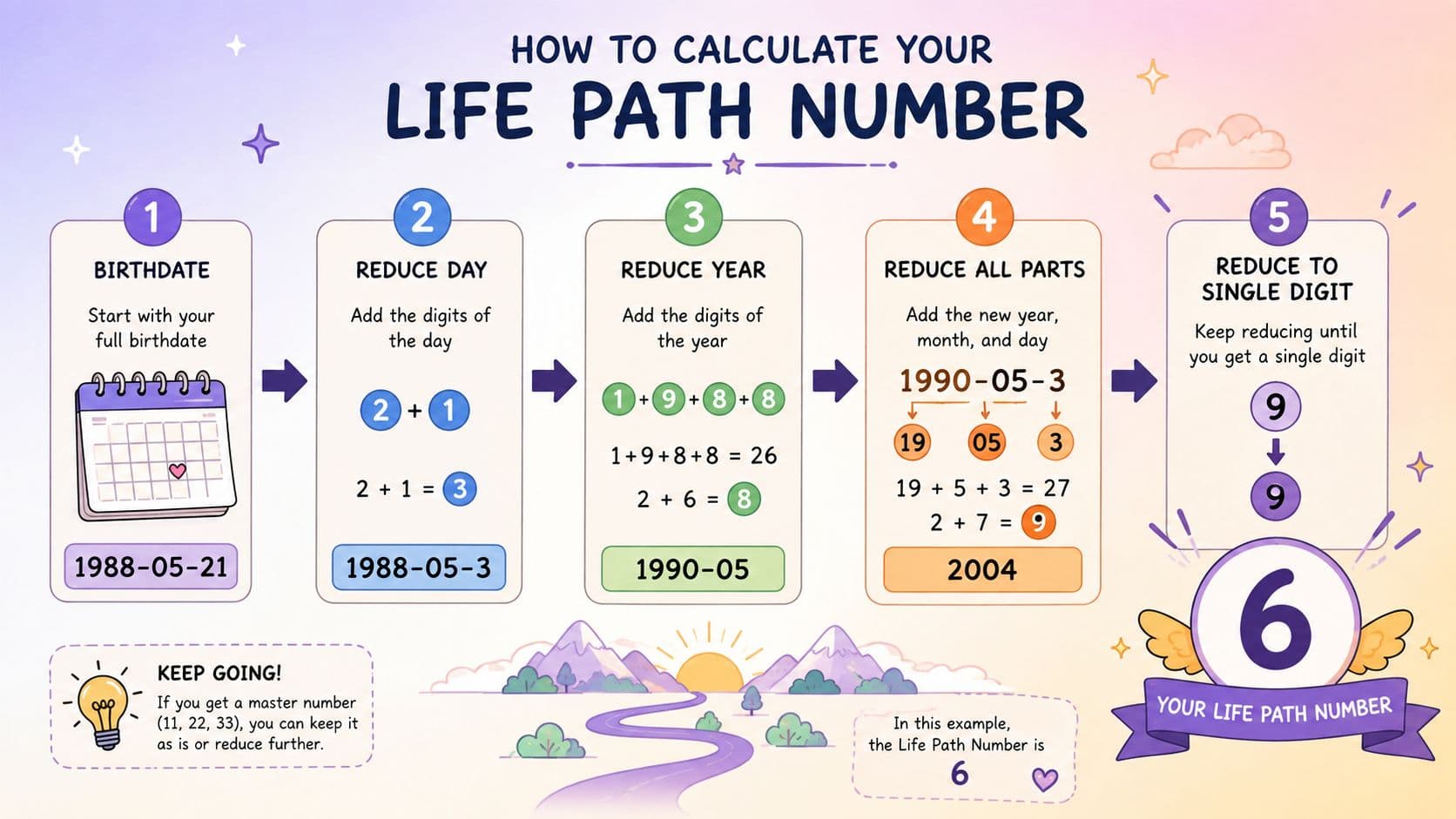
Dan Millman's The Life You Were Born to Live approaches self-understanding through life paths derived from birth dates. In that system, practitioners reduce a birth date to a core number from 1 through 9, using the number as a symbolic lens for instinctive orientations such as action, emotion, thought, and service. The Life Purpose App applies this life-path framework to self-reflection and relationship dynamics.
This symbolic approach can complement, but shouldn't replace, direct observation. A life-path pairing may give you language for discussing independence, sensitivity, creativity, responsibility, or the need for solitude. It can't determine whether a friend respects your limits, keeps promises, or repairs harm after an argument.
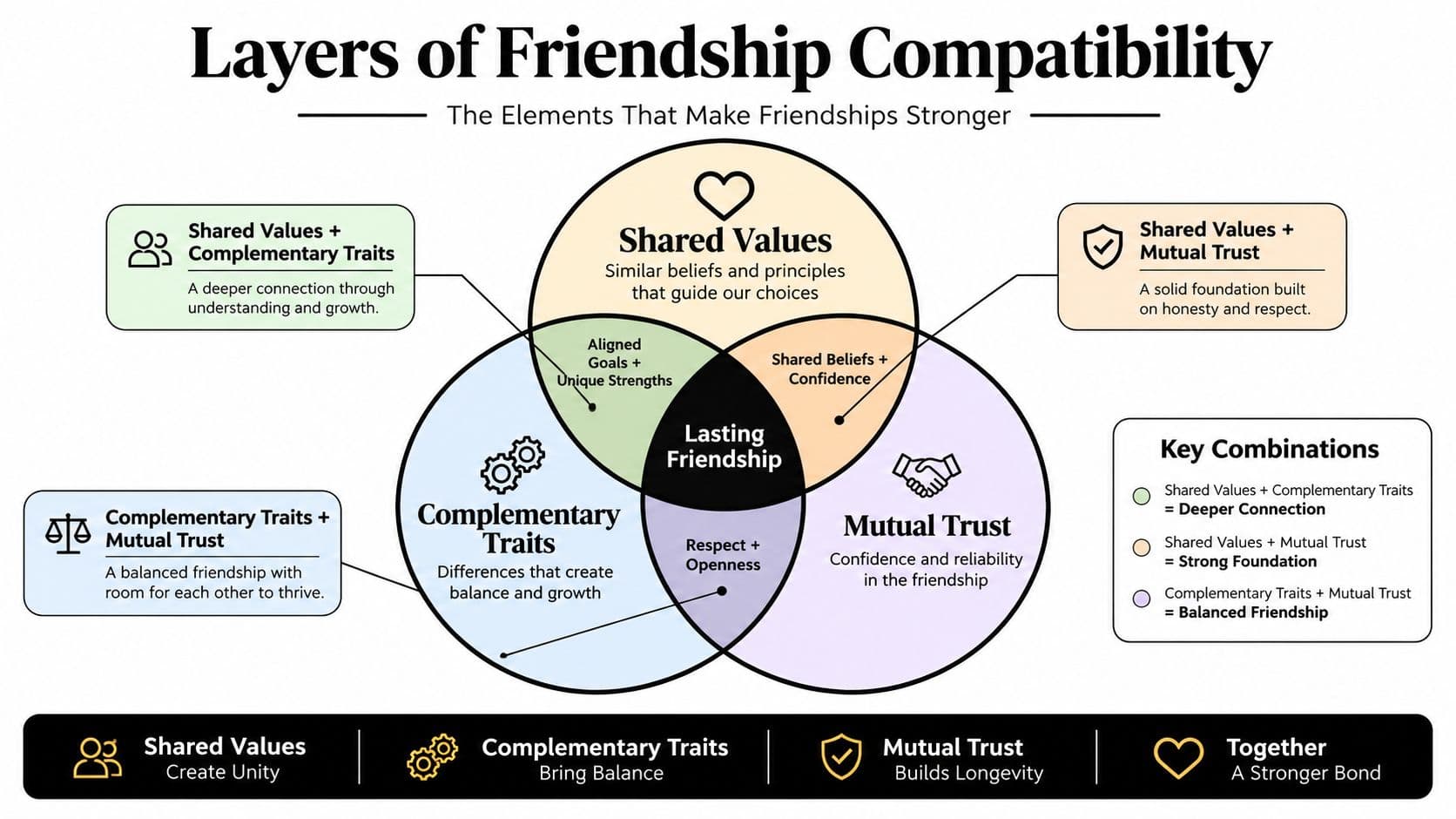
A useful definition: Compatibility is the combination of felt ease, meaningful difference, and dependable behavior.
Use that definition when assessing a friendship. Ease tells you how naturally you connect. Difference shows where you can learn from each other. Dependability reveals whether the bond can carry weight when life becomes stressful.
The Building Blocks of a Strong Friendship
A friendship may begin with shared interests, yet lasting compatibility depends on more than enjoying the same music or activities. Longitudinal research found meaningful similarity among adolescent friends across every measured attribute and time point, with gender showing the strongest similarity pattern, with a mean I greater than .72 at each wave (longitudinal research on friendship homophily). In everyday life, start by comparing steadier features, such as values, social preferences, and expectations, before judging surface preferences.
Similarity creates recognition, like two people beginning with a common map. Complementarity adds routes neither person would have taken alone. A planner and an improviser may balance each other when the planner leaves room for flexibility and the improviser respects preparation. Without that mutual respect, difference becomes friction rather than perspective.
Stability is another building block. Research involving children in the United States, China, and Indonesia found that similarity in social preferences positively predicted friendship stability across all three countries. Reported stability means were around 0.67 and 0.73 in the United States, 0.58 and 0.52 in China, and 0.53 and 0.49 in Indonesia across measured waves (research on friendship stability across countries). Stability does not require constant contact. It means both friends can anticipate care, honesty, and a reasonable effort to remain connected.
Maintenance turns potential into closeness. Research on stable friendships identified recurring strategies involving openness, approaching conflict, identifying with one another, admiration, togetherness, and a sense that the relationship will continue (research on friendship maintenance strategies). Related research connected positivity, understanding, self-disclosure, assurances, shared tasks, and support from each person's wider network with friendship closeness. These behaviors give compatibility a practical form. They show whether two people can care for the relationship when enthusiasm alone is not enough.
| Dimension | What It Looks Like | When It Helps | When It Hurts |
|---|---|---|---|
| Similarity | Shared values, interests, or worldview | Creates recognition and ease | Limits growth when neither person brings new perspectives |
| Stability | Predictable care and reliable presence | Makes vulnerability safer | Feels restrictive when contact becomes an obligation |
| Maintenance | Repair, disclosure, appreciation, and regular contact | Turns affection into lasting closeness | Becomes exhausting when one person carries the work |
| Complementarity | Different energy, planning, or emotional styles | Adds flexibility and perspective | Creates friction when differences are mocked or controlled |
Perceived similarity matters as well. Among adolescent friends, greater perceived similarity was associated with more favorable friendship-quality ratings and less conflict. Reciprocated friendships were also viewed as more similar in personality than non-reciprocated pairs (study of perceived similarity and friendship quality). You can observe these building blocks through conversation and repeated behavior, then use the Life Purpose App and its symbolic framework as prompts for interpreting patterns, not as substitutes for evidence.
Reading Compatibility Through Life Paths and the Life Purpose App
Dan Millman's The Life You Were Born to Live presents life paths as a system for reflecting on a person's central tendencies and developmental lessons. In the framework, birth-date calculations reduce to a number from 1 through 9. Practitioners commonly associate the paths with broad orientations such as initiative, cooperation, expression, discipline, freedom, care, inquiry, achievement, and service.
Treat those descriptions as prompts, not fixed identities. A person associated with expressive energy may still need quiet. Someone drawn to responsibility may also resent being expected to manage everyone else's problems. The point is to notice patterns and ask better questions.
Start with your own life path
Open the Life Purpose App and enter your birth details to identify your life path within the system described in The Life You Were Born to Live. Read the profile as a mirror for reflection. Which descriptions feel familiar? Which ones feel incomplete? Those reactions can reveal the difference between your self-image and the way friends experience you.
Add the relationship context
Use the app's relationship-mapping feature to add a friend's birth date and view the relationship dynamics between your profiles. Look for areas that appear shared, complementary, or challenging. A shared number can suggest common language. Complementary numbers can prompt you to explore how different strengths support the friendship. Friction areas can reveal topics where you'll need clearer expectations.
The app can also surface conversation starters and shared-activity prompts based on the pairing. Use those suggestions to create an actual interaction, not to label your friend. You might choose a creative project, a reflective walk, a practical task, or a more energetic outing depending on what the profiles bring into focus.
You can also compare this symbolic reflection with a more behavior-focused test. That kind of comparison keeps the process grounded in reciprocity, emotional safety, trust, and conflict resilience.
Use numerology as a conversation starter, not a friendship sentence.
Life-path analysis can help you name a dynamic you've already noticed. It can't excuse manipulation, prove loyalty, or override your experience. If a profile says two people should connect easily but you feel dismissed and unsafe, trust the behavior you're seeing.
Patterns That Work and Warning Signs to Notice
A friendship's pattern becomes clearest in ordinary moments. One person shares difficult news, makes a request, or reaches a milestone. The response shows whether the relationship offers support, pressure, or little engagement.
| Healthy pattern | Warning sign |
|---|---|
| Both people initiate contact | One person carries nearly all the effort |
| Conflict leads to repair | The same injury repeats without accountability |
| Promises receive practical follow-through | Plans and commitments remain unreliable |
| Boundaries receive respect | Limits are dismissed, mocked, or punished |
| Success creates genuine celebration | Milestones trigger comparison or undermining |
| Disclosure moves in both directions | One person shares while the other stays unavailable |
Friendship-maintenance research connects stable friendships with openness, constructive conflict, admiration, shared time, and continuity. It also points to positivity, understanding, reassurance, shared tasks, and support from each person's wider network as behaviors associated with closeness. Use these ideas as an audit. Ask whether both friends create conditions in which trust can withstand tension, rather than asking only whether you enjoy one another.
Compatibility is a pattern of interaction, not a verdict produced by similar interests or life-path numbers. A challenging pairing in Dan Millman's life-path framework may still work when both friends can explain their needs, respect differences, and repair misunderstandings. An apparently easy pairing can weaken when one person keeps score, avoids accountability, or expects unlimited access.
Use the Life Purpose App's relationship dynamics definition to find language for patterns that are difficult to describe. For a structured reflection on trust, reciprocity, and difficult dynamics, try the Friend Or Foe exercise. Treat both tools as prompts for observation, not proof that a friend belongs in or out of your life.
A warning sign does not automatically require separation. It may call for a candid conversation, a clearer boundary, or a graceful step back. Compatibility includes how two people respond to feedback, not the absence of every problem.
Strategies to Strengthen Friendships That Matter
Friendship requires deliberate upkeep because affection alone doesn't put a date on the calendar, repair a careless comment, or tell someone they matter. A 2015 study on friendship development found that friendships tend to emerge around 30 hours of shared time, with closer friendships developing around 50 hours (study on the time required to make a friend). The exact threshold isn't a promise, but it makes one point clear: repeated contact gives compatibility room to become trust.
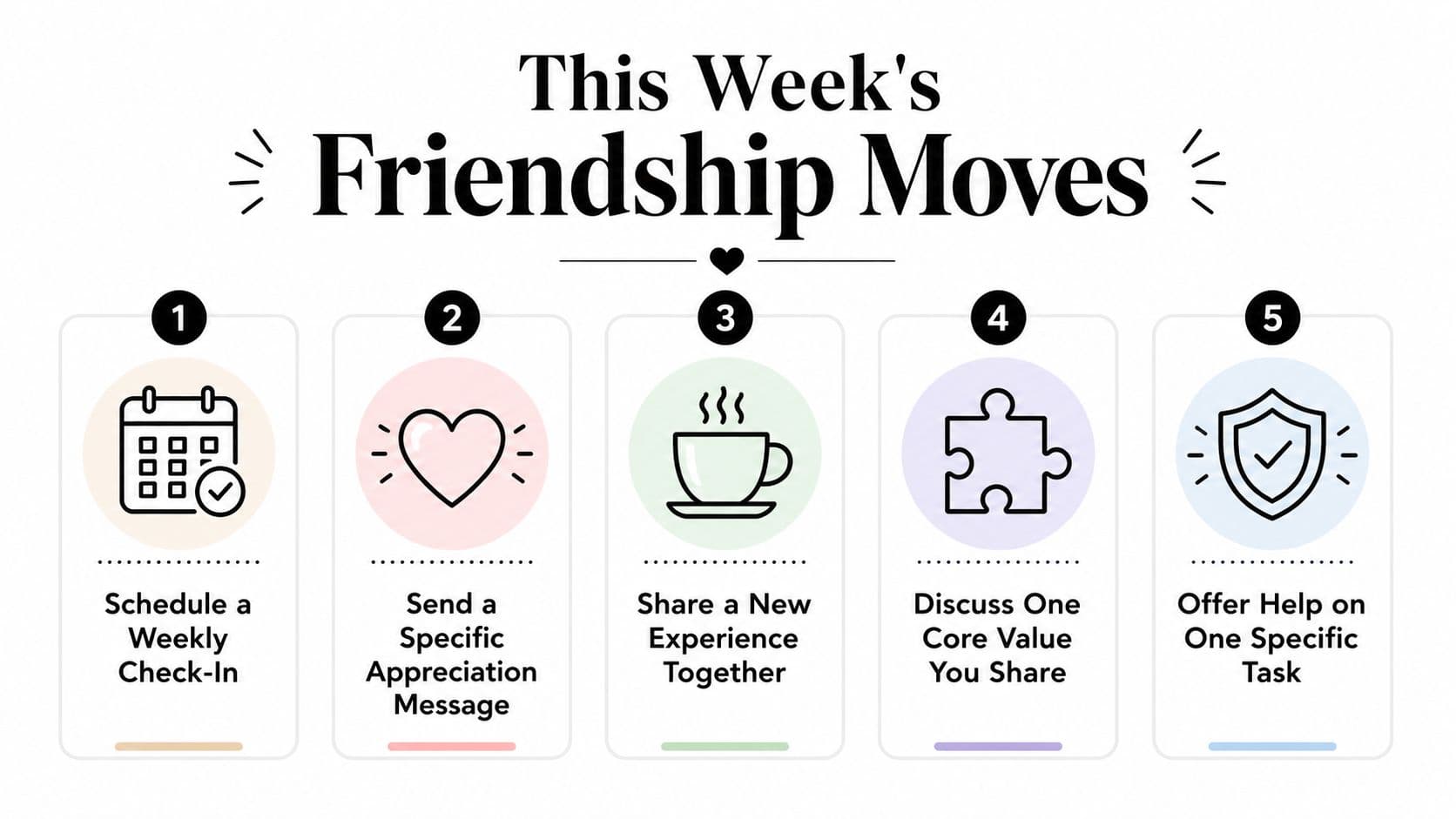
Try these moves this week:
- Schedule a recurring touchpoint. Choose a weekly call, walk, or voice-note exchange that fits both people's lives. Reliability matters more than an elaborate plan.
- Name one specific appreciation. Instead of “You're a great friend,” say, “You asked how that meeting went, and I felt remembered.” Specific gratitude shows that you notice actual care.
- Repair small ruptures quickly. Say, “I think I sounded dismissive earlier. I'm sorry. Can I try that again?” Fast repair prevents minor misunderstandings from becoming a private case against the friendship.
- Share vulnerability in calibrated doses. Self-disclosure should be reciprocal and appropriate to the trust already present. A longitudinal study found that adolescents with highly disclosing best friends later tended to show more self-disclosure in adult romantic relationships, with β = .17 and p < .05 after controlling for baseline self-disclosure (longitudinal study of self-disclosure).
- Create a ritual. A monthly walk, seasonal meal, or yearly trip gives the friendship a structure that survives busy periods. If you're coordinating something more elaborate, ideas for planning a luxury girls' escape can help turn shared intention into a concrete experience.
Life-path reflection can help you choose a fitting activity. A friend with a more expressive orientation may enjoy an art project or lively outing, while someone drawn toward reflection may prefer quiet one-on-one time. Use the Life Purpose App and The Life You Were Born to Live to frame the invitation, then ask your friend what they want.
This week's self-audit: Who do you want to know better, what shared value can you name, and what repeated action will you take?
For more guidance on listening, repair, and emotional awareness, explore emotional intelligence in relationships. The goal isn't to optimize every interaction. It's to make care visible and repeatable.
Bringing It All Together for Lasting Connections
A useful model of friendship compatibility has three layers. The first is psychological fit, including shared values, compatible social preferences, and a life stage that leaves room for connection. The second is symbolic reflection through life paths, where Dan Millman's The Life You Were Born to Live gives you language for complementary tendencies and the Life Purpose App helps you map relationship dynamics. The third is maintenance, the repeated behavior that turns potential into closeness.
Consider Maya and Jordan. Maya identifies with life path 3, and Jordan identifies with life path 6 within the system described in The Life You Were Born to Live. Maya brings expressive energy and enjoys making plans around creativity and conversation. Jordan values care, steadiness, and practical support. They may connect through warmth and shared concern for other people, while needing to discuss how much structure an outing requires.
They use the Life Purpose App to compare their profiles, then test the insight against real experience. Instead of deciding that the pairing guarantees harmony, they choose one weekly habit: a short Sunday call where Maya brings one new idea and Jordan asks what support would be useful. The exercise gives Maya room to express herself and gives Jordan a dependable way to show care.
That example illustrates the right order. Start with observable behavior. Use life-path language to identify possible strengths or tensions. Then choose a small habit that gives both people a fair chance to participate.
Friendship quality matters more than a large contact list. Reviews and longitudinal work connect higher-quality friendships with lower loneliness, while trust, emotional closeness, reliable alliance, intimacy, and conflict experiences explain more about well-being than just counting friends (review and longitudinal research on friendship quality and loneliness). The question isn't only whether someone resembles you. It's whether the relationship feels safe, reduces isolation, and remains supportive under pressure.
A 2025 study of 1,484 people in 371 friend groups found that actual similarity across most Big Five traits was small, perceived similarity was greater than actual similarity, and neither actual nor perceived similarity predicted friendship satisfaction. Warmth, dependability, openness, and emotional steadiness mattered more (discussion of recent friendship compatibility research). That finding offers an important correction to simplistic matching. You may not need a friend who mirrors you. You may need someone who supports the kind of friendship you're ready to build.
Compatibility is a starting point, not a verdict. Shared values open the door, differences add perspective, and maintenance decides whether the bond remains available through changing seasons of life. The smallest repeated actions, a message, a repair, a walk, or a promise kept, shape the friendships that last for decades.
Use the Life Purpose App to explore your life path, compare relationship dynamics with a friend, and turn reflection into a practical friendship intention. Visit Life Purpose App to begin mapping the patterns, strengths, and habits that can help your important friendships grow.
Discover Your Life Purpose Today!
Unlock your true potential and find your life’s purpose.
