Take a research-backed friendship compatibility test, interpret your results, and discover how life-path insights from the Life Purpose App can strengthen your
August 24, 2026 (28d ago)
Friendship Compatibility Test: A Practical Guide
Take a research-backed friendship compatibility test, interpret your results, and discover how life-path insights from the Life Purpose App can strengthen your
← Back to blog
Most friendship compatibility tests get the central question wrong. They ask whether two people share a name pattern, zodiac sign, favorite activity, or an appealing “vibe,” then turn a complicated relationship into a cheerful percentage. That may entertain you for a minute, but it won't tell you whether a friend can handle honesty, distance, disappointment, or change.
A useful friendship compatibility test asks a harder question: can these two people create a relationship with enough reciprocity, emotional safety, openness, and repair to remain healthy when life stops being easy? I recommend using two lenses together. Start with structured psychological dimensions that can be examined clearly, then use Dan Millman's spiritual life-path framework, as presented in The Life You Were Born to Live and the Life Purpose App, for reflection on motivation, growth, and relational patterns.
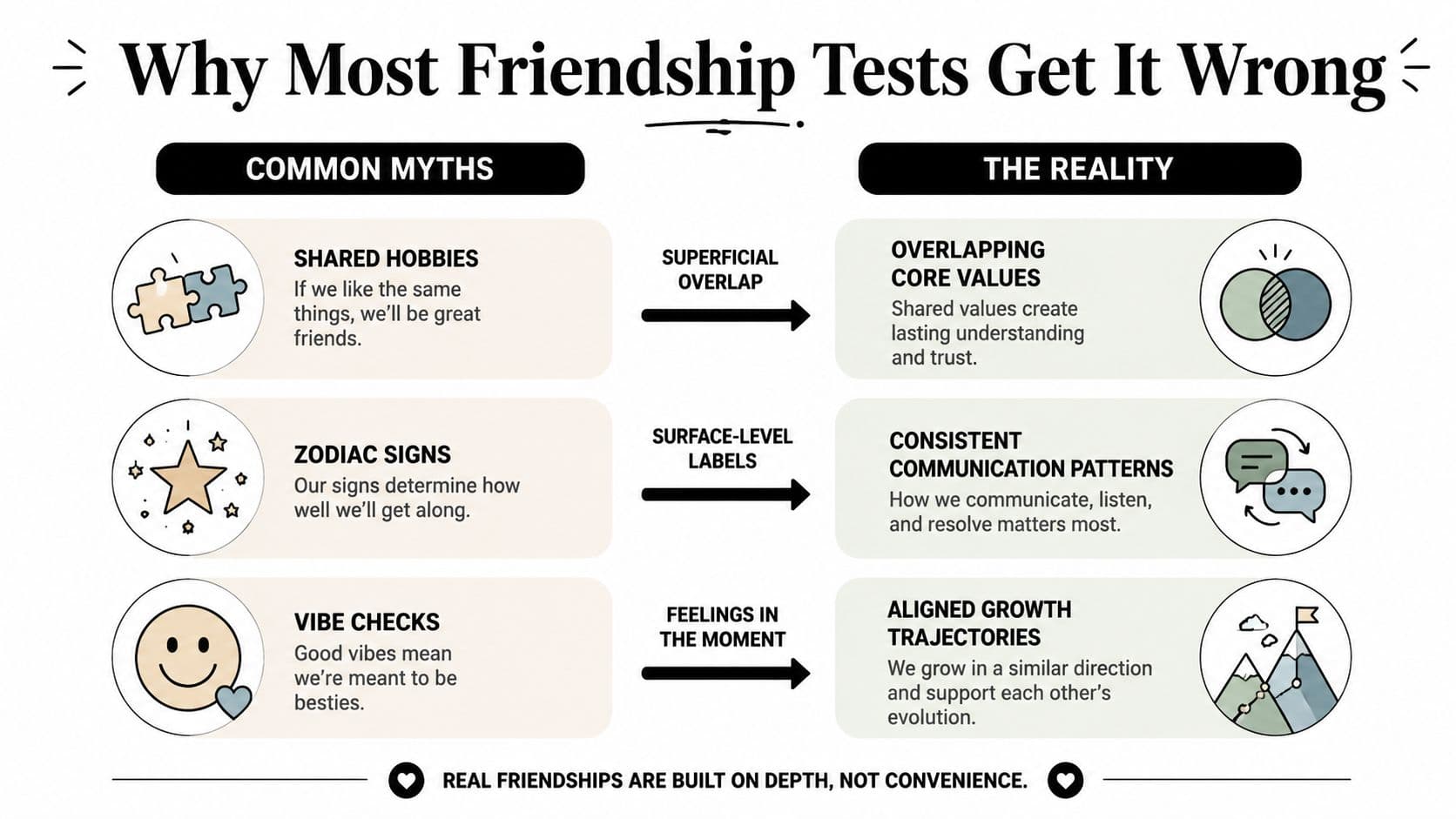
Why Most Friendship Tests Get It Wrong
A cheerful quiz can recognize a familiar “vibe” and still miss the friendship entirely. Shared music, hobbies, or zodiac signs may open the door, but they do not show whether two people handle disappointment, distance, vulnerability, or change with care. One pair can enjoy the same activities while competing, disappearing during difficult moments, or punishing honesty. Another can have little in common on paper and still build a dependable bond through clear communication and respectful repair.
Name-matching and zodiac quizzes create false confidence through broad descriptions. People notice what fits and overlook what does not. “Adventurous, loyal, and secretly sensitive” may sound personal, yet it gives no practical answer about who initiates contact, how either person responds to hurt, or whether both friends honor boundaries.
My rule: Never confuse immediate recognition with long-term compatibility.
Stronger measures examine several dimensions instead of assigning the relationship one flattering trait. The Friendship Quality on Social Network Sites questionnaire was validated using data from 1,695 friendships gathered from 1,087 adolescents aged 12–19. It identified satisfaction, companionship, help, intimacy, and self-validation, with Cronbach's alpha values ranging from .87 to .94 (peer-reviewed friendship compatibility findings). The practical lesson is clear: friendship quality can be assessed through repeated questions about behavior, not a single impression.
What durable friendships actually require
A serious friendship compatibility test should examine four realities:
- Reciprocity: Both people contribute attention, initiative, care, and practical effort.
- Emotional safety: Vulnerability does not invite mockery, dismissal, gossip, or retaliation.
- Self-disclosure: Each friend can share meaningful parts of life at a pace that feels mutual.
- Conflict repair: Disagreements produce accountability and adjustment rather than silent punishment or personal attacks.
Interdependence theory explains why the pattern between two people matters more than either personality alone. Attachment-informed psychology adds a practical focus on trust, consistency, and responses to emotional need. Similarity may help people connect, while honesty and responsibility determine whether the bond can remain healthy.
A 2024 cross-cultural study spanning 12 nations used a focused 15-item questionnaire and found that shared traits, support, and opportunities to socialize were central to friendship formation (cross-cultural friendship compatibility analysis). Use similarity as one factor, then assess support and mutual participation with equal seriousness.
Dan Millman's The Life You Were Born to Live and the Life Purpose App offer a spiritual complement through life-path reflection. Use that framework to examine values, motivation, and growth patterns. Let observable behavior make the final judgment. For a broader discussion of compatibility in relationships, compare inner alignment with the way people treat each other.
Your Research-Backed Friendship Compatibility Test
A friendship test should examine repeated behavior, not reward a memorable weekend or a clever name match. Choose one specific friend and answer from the pattern you consistently experience.
For every statement, choose a score from 1 to 5:
- 1: Almost never true
- 2: Rarely true
- 3: Sometimes true
- 4: Usually true
- 5: Almost always true
These questions turn established friendship dimensions into practical observations. They assess reciprocity, emotional safety, and conflict resilience, while also covering companionship, help, intimacy, and self-validation in friendship quality (research basis for structured friendship dimensions).
Reciprocity balance
- We both initiate contact roughly equally.
- We both make practical effort to maintain the friendship.
- Emotional support flows in both directions.
- Neither of us regularly disappears when the other needs care.
- We both make room for each other's changing schedules and responsibilities.
Emotional safety and trust
- When I share something difficult, my friend responds with empathy rather than judgment.
- I can express a different opinion without fearing ridicule or punishment.
- My friend respects my boundaries, privacy, and need for space.
- We can discuss meaningful subjects without one person dominating the conversation.
- I feel accepted without needing to perform, shrink, or hide important parts of myself.
Conflict resilience
- We can name a problem before resentment takes over.
- During disagreements, we address behavior rather than attacking character.
- Each person can acknowledge their contribution to a conflict.
- We return to difficult conversations instead of using silence as a weapon.
- After conflict, our behavior changes enough to rebuild trust.
Scoring the test
Add questions 1–5 for your reciprocity score, questions 6–10 for emotional safety and trust, and questions 11–15 for conflict resilience. Each dimension ranges from 5–25, while the complete friendship compatibility test produces a total score out of 75.
| Dimension | Sample Question | Score Range | What It Measures |
|---|---|---|---|
| Reciprocity balance | We both initiate contact roughly equally. | 5–25 | Shared effort, initiative, and emotional labor |
| Emotional safety and trust | My friend responds to difficult disclosures with empathy rather than judgment. | 5–25 | Vulnerability, acceptance, boundaries, and reliability |
| Conflict resilience | After conflict, our behavior changes enough to rebuild trust. | 5–25 | Accountability, repair, and adaptability |
The total matters, but the separate dimensions reveal the relationship more clearly. You may feel emotionally safe while carrying nearly all the effort. Another friendship may offer dependable participation yet leave little room for honest vulnerability. Score the recurring reality, not the potential you hope someone will fulfill.
Use the result alongside spiritual reflection. Dan Millman's life-path numerology framework can prompt questions about values, motivation, and growth patterns. Treat those insights as a lens for self-understanding, then let consistent conduct decide whether the friendship is durable.
For a playful group activity, you can create loyal challenge videos with AI. Use the exercise to start a conversation about loyalty, not to replace honest answers or direct discussion.
Interpreting Your Compatibility Results
Your total score gives you a starting point, not a verdict. Read it alongside the three dimension scores, the circumstances surrounding the friendship, and the behavior you see over time.
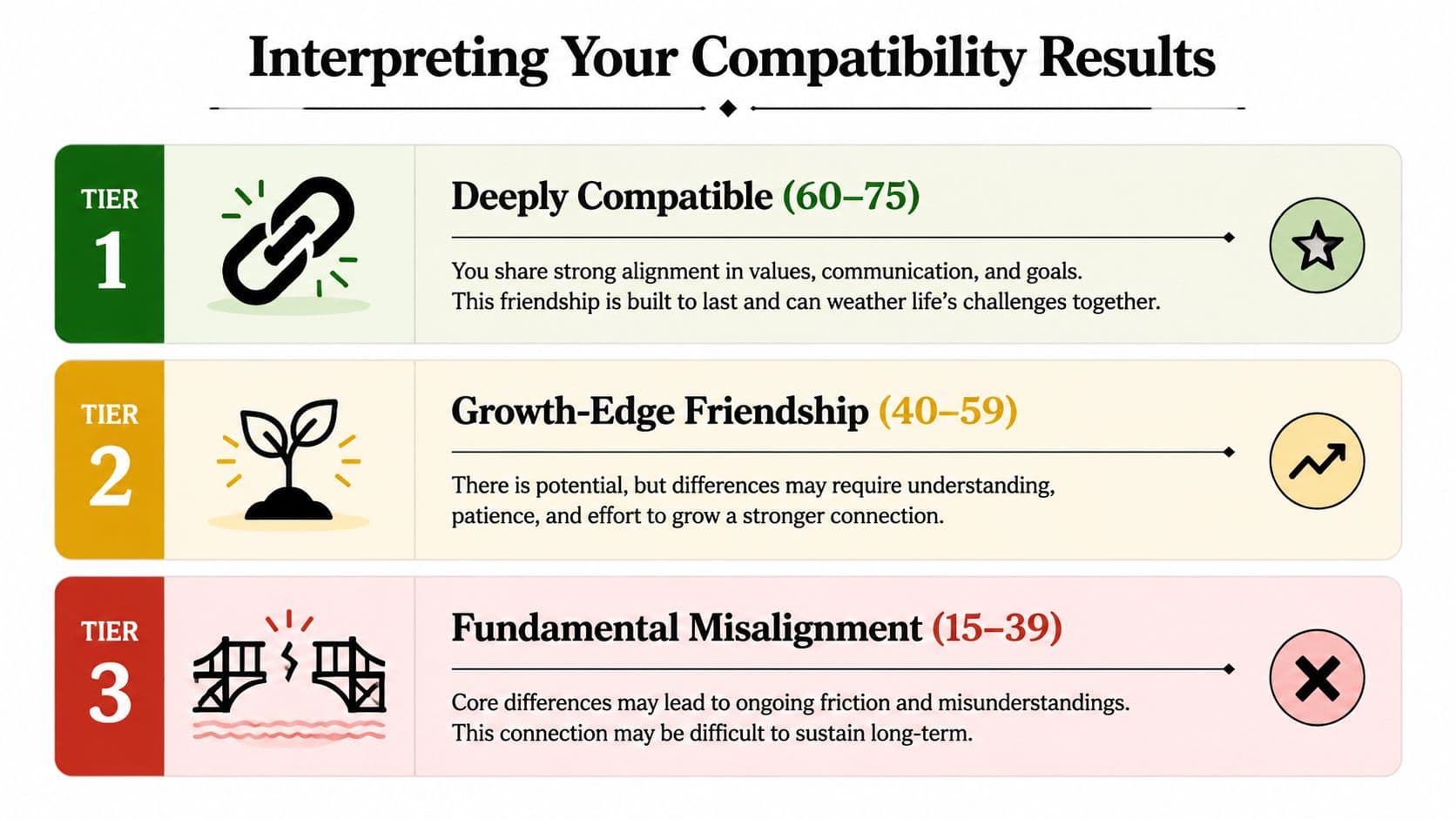
60–75 means deeply compatible
This range suggests a strong relational foundation. You likely experience meaningful reciprocity, enough safety to be candid, and a capacity to repair after tension. The friendship may still face jealousy, misunderstandings, or periods of reduced contact, but both people generally return to the relationship with care.
Don't use this score as permission to stop participating. Compatible friendships stay healthy because both friends keep practicing respect. Ask how you can preserve the bond during demanding seasons, rather than assuming closeness makes maintenance unnecessary.
40–59 means a growth-edge friendship
This range often describes a friendship with genuine affection and uneven skills. You may score well on companionship and shared enjoyment while losing points on emotional disclosure or conflict repair. The friendship isn't automatically weak. It may be asking for a clearer agreement about communication, boundaries, or support.
Look for the lowest dimension first. If reciprocity is low, stop rescuing the relationship through constant initiation and discuss the imbalance. If safety is low, test whether a small, honest disclosure receives care. If conflict resilience is low, address one recent disagreement and watch whether your friend can engage without deflecting.
15–39 means fundamental misalignment
This range signals that core parts of the relationship aren't functioning reliably. You may feel chronically unseen, carry most of the emotional labor, or avoid honesty because conflict becomes cruel or threatening. A low score doesn't make either person morally defective, but it does challenge the fantasy that affection alone can solve structural incompatibility.
Before making a major decision, check the context. Long-distance friendships can reduce contact without reducing love. A relocation, career change, caregiving demand, or other life-stage transition can temporarily distort reciprocity. Neurodivergent communication styles can also affect interpretations of frequency, tone, and emotional signaling. Those factors deserve direct conversation, not automatic judgment.
Use the score as a diagnostic map, not a courtroom sentence.
A friendship may be worth reshaping, reducing to a seasonal role, or releasing with kindness. The score reveals patterns. Your next task is to compare those patterns with real-world signs.
Signs of Compatible and Incompatible Friendships
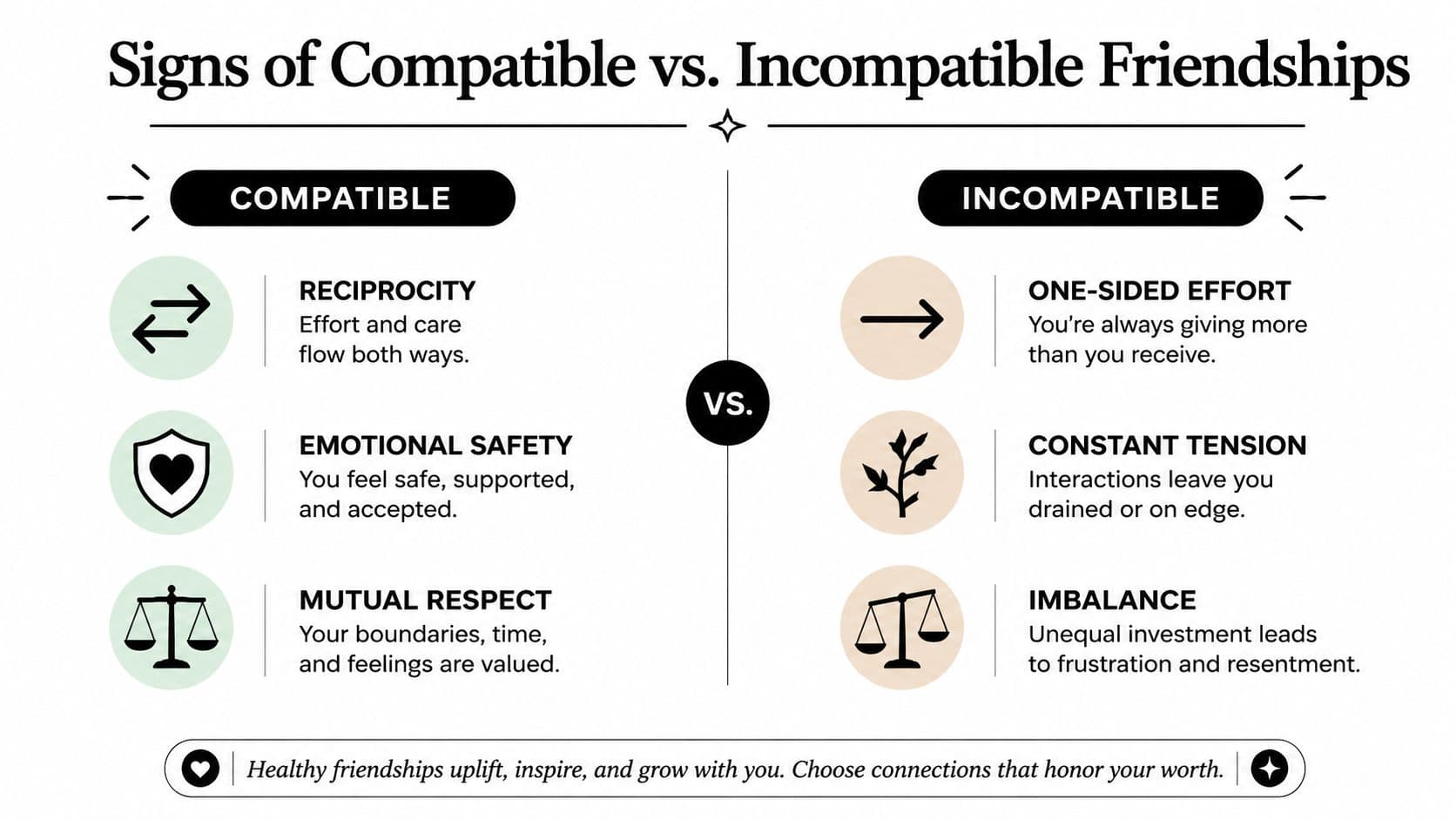
Compatible friendships feel dependable without becoming rigid. One friend can celebrate the other's success without turning it into a competition. Both people can ask for support, decline an invitation, or name a hurt without expecting the relationship to collapse.
In daily life, compatibility looks ordinary. You send a message, and your friend sometimes initiates the next one. You share disappointing news, and they listen before offering advice. You disagree about a decision, but neither person reaches for insults, public embarrassment, or old vulnerabilities as weapons.
The healthy pattern
A compatible friend doesn't need identical communication habits. One person may prefer frequent messages while the other prefers occasional, focused conversations. They can negotiate that difference because both people care about the impact of the arrangement.
Compatible friends also adapt when life changes. A relocation, new job, serious relationship, or family responsibility may alter the rhythm, but the friendship can develop a new rhythm instead of fading. They explain what has changed, make realistic promises, and keep enough contact to preserve trust.
The draining pattern
Incompatible friendships often reveal themselves through repetition rather than one dramatic event:
- One-sided effort: You always initiate, travel, apologize, accommodate, or provide emotional labor.
- Emotional caution: You edit your good news, soften your opinions, or hide pain to avoid triggering your friend.
- Subtle undermining: Compliments carry a sting, achievements receive suspicion, and your growth becomes a threat.
- Walking on eggshells: A normal boundary produces sulking, retaliation, or accusations.
- Value conflict: You define loyalty as honesty while your friend defines it as unquestioning agreement.
- Persistent depletion: You leave interactions feeling smaller, tense, guilty, or responsible for managing the other person's mood.
Some friendships belong to a season. A colleague may be a wonderful companion at work but not a person who can offer intimate support. A neighbor may share daily convenience without sharing your values. That isn't failure. Clarity lets you stop demanding lifelong depth from a connection built for a specific context.
Relationship patterns become easier to name when you understand relationship dynamics and what they reveal. Don't ask only whether the friendship is “good” or “bad.” Ask whether its current form is honest, mutual, and sustainable.
Strengthening Friendships with Life-Path Insights
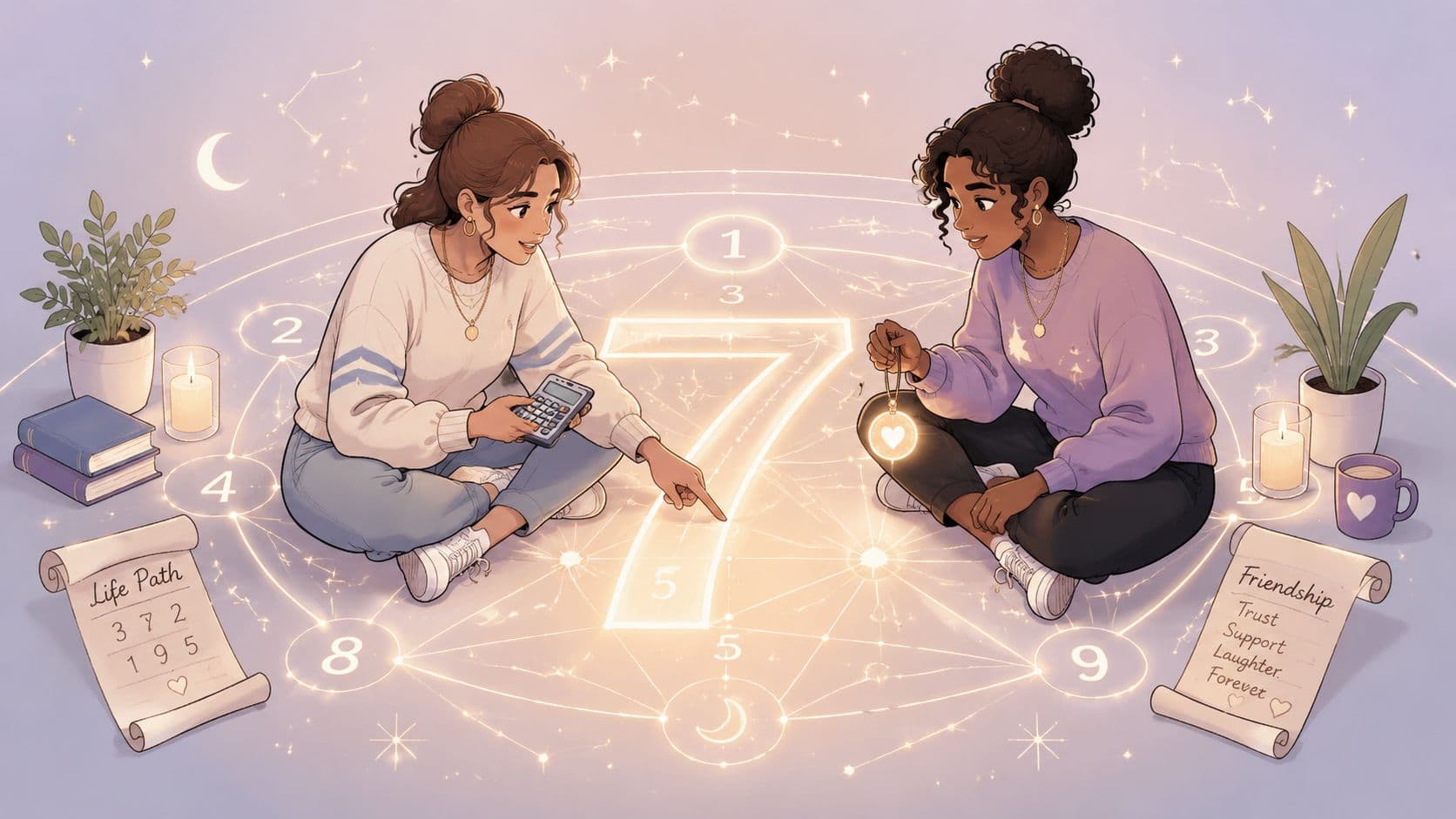
Dan Millman's The Life You Were Born to Live offers a spiritual framework for considering how people move through relationships, purpose, challenge, and growth. Life-path numerology isn't a replacement for communication or evidence-based assessment. It gives you another language for noticing why two people may want the same bond while needing different conditions to feel secure inside it.
The method begins with birth data. Numerology tools commonly calculate compatibility by comparing two people's Life Path numbers, which are derived from full birth dates and interpreted according to how the numbers interact (Life Path compatibility method). Another calculator asks for both people's birth names and birth dates before returning a compatibility result (birth-data friendship calculator).
Use the framework without surrendering your judgment
Use the Life Purpose App to generate life-path profiles for yourself and close friends, then compare the relationship dynamics with what you already know from the psychological test. The app is based on the system in Millman's book, The Life You Were Born to Live, and can help you reflect on core gifts, challenges, and patterns connected with relationships. Keep the interpretation personal and practical. A number should open a conversation, not close one.
For example, a life-path 3, associated in this framework with creative expression, paired with a life-path 4, associated with structure and stability, may experience friction between spontaneity and planning. That difference can become a strength if the 3 brings freshness and expression while the 4 creates a dependable container. It becomes a problem when one friend labels the other irresponsible or rigid.
A published compatibility chart lists Life Path 1 as highly compatible with 1, 5, and 7, Life Path 2 with 2, 4, and 8, Life Path 3 with 3, 6, and 9, and Life Path 9 with 3, 6, and 9 (Life Path pairing chart). Treat these pairings as prompts for reflection, not universal laws. The Life Purpose App offers its own life-path system and relationship-dynamics approach, so use Millman's framework consistently rather than mixing unrelated systems.
Turn insight into behavior
If one friend needs more solitude, agree on communication that doesn't interpret quiet as rejection. If another needs verbal reassurance, offer direct confirmation instead of expecting them to infer affection. If your conflict styles differ, decide whether the first step should be space, a phone call, or a written message.
Build shared rituals that honor both people. A spontaneous friend might choose the activity, while a structured friend chooses the date. One friend can lead emotional check-ins, while the other makes sure the promise happens. For further reflection on how these patterns appear in close bonds, explore this guide to relationships and personal growth.
Awareness creates choice. Numerology can suggest a growth edge, but only your actions show whether you're willing to meet it.
Building Friendships That Last Through Every Season
Durable friendship requires both psychological skill and spiritual awareness. Reciprocity keeps effort mutual. Emotional safety makes honesty possible. Conflict repair protects the bond when good intentions fail. A life-path lens can help you consider whether different motivations and growth patterns are creating friction that deserves patience rather than blame.
Revisit your friendship compatibility test when the relationship enters a new season. A move, changing work demands, altered family responsibilities, or a shift in personal values can expose strengths that were previously hidden and weaknesses that can no longer be ignored. Don't use the result to demand certainty. Use it to choose a more truthful conversation.
Friendship also needs practical adaptation. If you're maintaining old bonds while building new ones after relocation, this resource on navigating friendships in a new country offers useful context for balancing continuity with fresh connection.
Choose one friendship this week. Send the message you've been postponing, name one pattern you want to change, or express appreciation in language your friend can receive. Then compare that action with what your test and life-path reflection revealed. A compatible friendship isn't passive luck. It's a relationship two people keep choosing with honesty.
The Life Purpose App offers life-path profiles and relationship-dynamics tools based on Dan Millman's The Life You Were Born to Live, giving you a spiritual lens to pair with the practical friendship compatibility test above. Visit it with one friend in mind, explore the pattern you share, and turn that insight into one clear act of care this week.
Discover Your Life Purpose Today!
Unlock your true potential and find your life’s purpose.
