Explore friendship dynamics and discover how bonds form, evolve, and survive conflict. Practical patterns plus insight from Dan Millman's life-path framework.
September 4, 2026 (Today)
Friendship Dynamics: How Bonds Form, Bend, and Last
Explore friendship dynamics and discover how bonds form, evolve, and survive conflict. Practical patterns plus insight from Dan Millman's life-path framework.
← Back to blog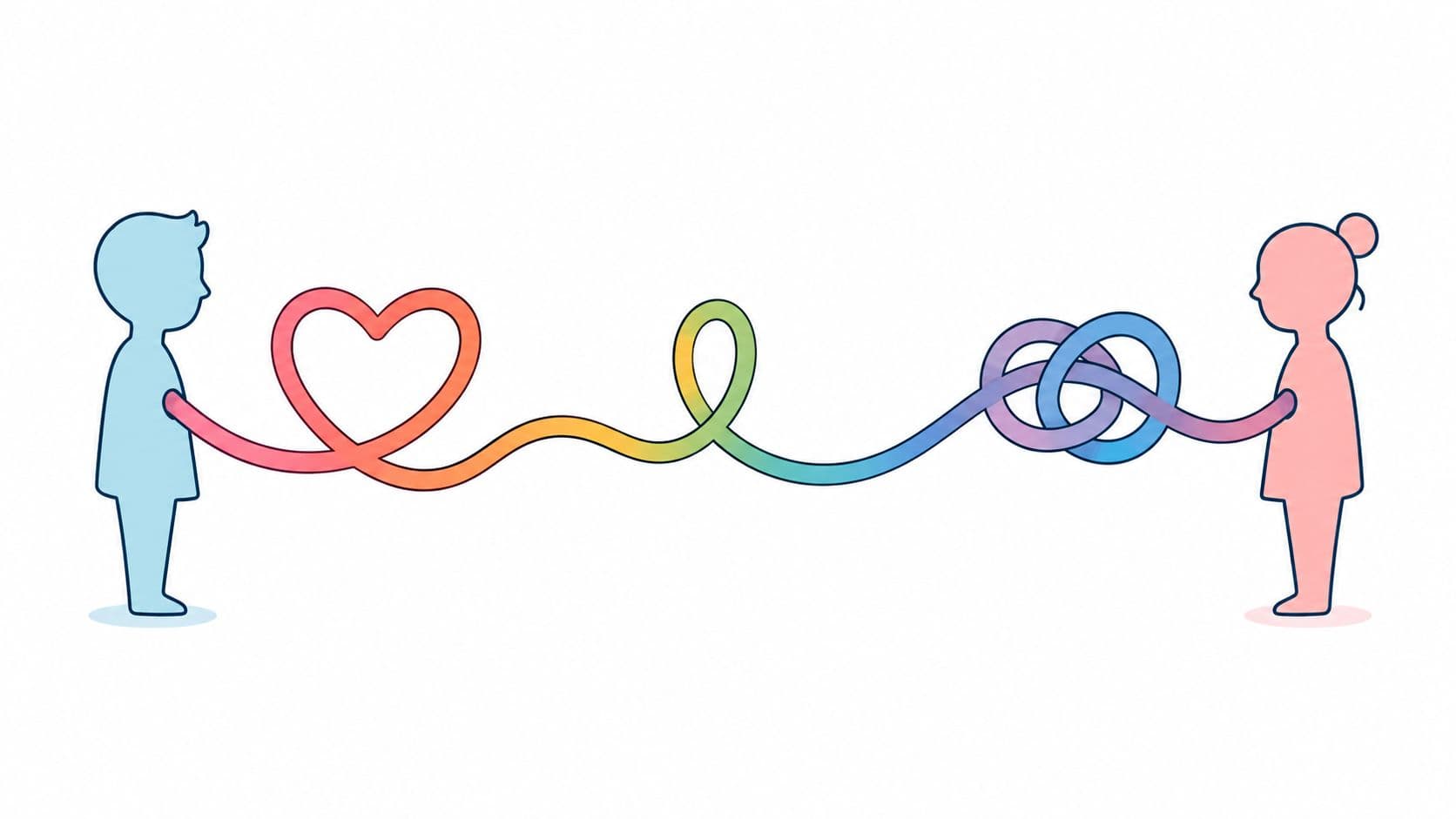
You see a friend's name light up your phone, feel a small hesitation, and place the phone face down. Nothing dramatic happened. You're not angry, and neither of you announced an ending. Yet the idea of meeting for coffee feels heavier than it used to, while another friendship seems to survive missed messages, busy seasons, and long stretches apart.
That contrast is the heart of friendship dynamics. Bonds form through repeated contact, change as people move through different life stages, and either regain their rhythm or become quieter versions of themselves. Contemporary research helps us recognize the interaction patterns involved, while Dan Millman's The Life You Were Born to Live offers a contemplative language for asking what a relationship may be teaching both people.
Why Some Friendships Drift and Others Endure
Maya reads Jordan's message while standing in line at a grocery store. It says, “Are we still doing this sometime?” The wording is harmless, but Maya feels accused. She remembers the last three times she initiated plans, the unanswered invitation, and the coffee date that ended with Jordan checking a phone. She types a reply, deletes it, and tells herself she'll respond later.
Friendships rarely end because of one imperfect text. More often, they lose their rhythm. Proximity changes, daily pace separates, or the purpose that once brought two people together disappears. A colleague becomes a former colleague. A classmate moves away. Two new parents discover that their available hours no longer overlap. The relationship may still matter, but the setting that sustained it has gone.
That doesn't mean every fading friendship is waiting for rescue. Some ties drift because both people are overloaded and need a simpler way to stay connected. Others have completed an important chapter. The difficult question isn't only, “Why aren't we as close?” It's also, “Is there enough mutual energy for a new form of closeness?”
A useful starting point is to compare your experience with the broader picture. The American Friendship Project analysis found that more than 92.1% of respondents across samples had at least one friend, while the estimated share with no friends was about 2% to 3%. Across more than 40 years of surveys, fewer than 5% of Americans reported having no friends. Yet friendship quality can still feel uncertain, since over 75% were satisfied with the number of friends they had, while more than 40% said they weren't as close to their friends as they wanted to be.
A friendship can be socially present and emotionally undernourished at the same time.
To understand what's happening, look through three lenses. First, notice the stages a bond passes through. Second, watch the repeated behaviors that create ease or tension. Third, use Dan Millman's life-path framework from The Life You Were Born to Live as a reflective prompt, not a verdict. You can also explore how different needs and rhythms meet.
You don't need to diagnose your friend. Begin by observing the relationship you both create, especially when neither of you is making a special effort.
How Friendships Form and Change Over Time
Friendship usually begins less dramatically than people expect. Two people share a room, routine, interest, or problem. They exchange small remarks, discover a little common ground, and meet again. Repeated low-stakes contact gives each person a chance to learn whether the other is welcoming, reliable, and interested.
The early building blocks
Three ingredients tend to matter:
- Repeated contact: Familiarity grows when people encounter each other often enough for conversation to become easy.
- Mutual disclosure: Each person shares something personal, then watches whether the other responds with care rather than dismissal.
- Small reliability: A friend remembers a detail, follows through on a plan, or checks in after a difficult day.
Trust doesn't require grand gestures. It grows when ordinary interactions send the same message repeatedly: “You can be yourself here, and I'll handle that with respect.”
The recognizable stages
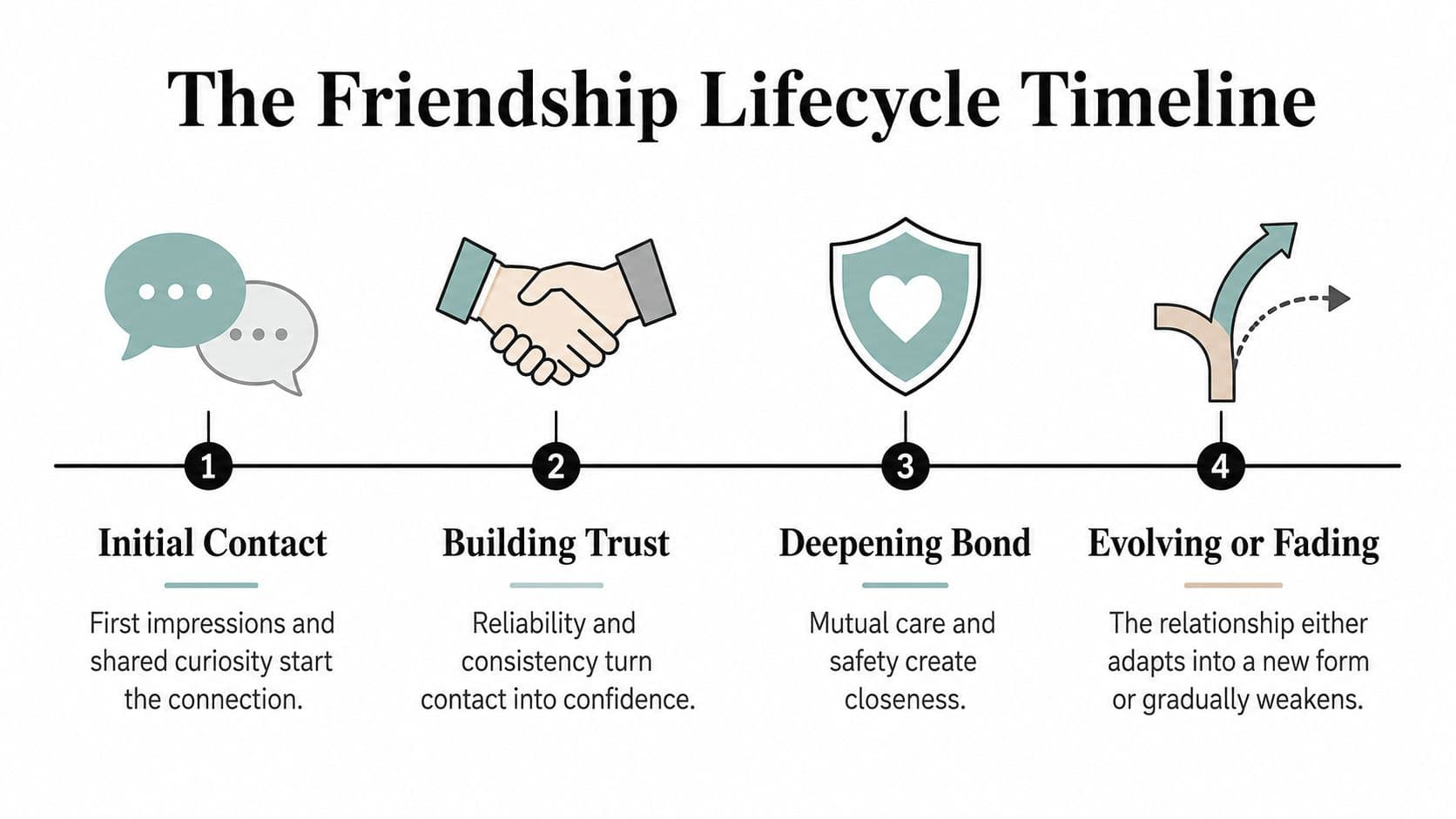
A new friendship often deepens as shared experiences accumulate. Conversations become less guarded, plans require less explanation, and each person starts to include the other in decisions and routines. Eventually, the bond may stabilize into a dependable pattern, even if the contact becomes less frequent.
Then context can change. A workplace ends, a school term finishes, a family responsibility expands, or a life phase shifts. Many people misread distance as rejection at this point. The friendship may not have suffered a conflict. It may have lost the structure that made contact effortless.
From there, a relationship can re-engage, remain occasional, or fade. Re-engagement usually needs a concrete invitation rather than a vague promise to catch up. “Would you like to walk on Saturday?” creates an opening. “We should meet sometime” leaves the burden on an already weakened connection.
Friendships of circumstance depend heavily on a shared environment. Friendships of choice survive because both people deliberately recreate contact after that environment disappears. Neither type is inferior. A former teammate may remain a warm, occasional presence, while a friend from a brief project may become central to your life.
If social fear makes the first move feel overwhelming, practical social anxiety self-help strategies can help you reduce the size of the task. You don't need to perform confidence. You only need to make one manageable, honest bid for connection.
The Patterns That Shape Everyday Friendships
A friendship's quality depends less on constant contact than on what contact communicates. A short message can feel caring when it shows attention. A long conversation can feel draining when one person has to manage every emotional detail. Research on digital maintenance supports this distinction: in a Facebook-based actor-partner model, caring produced significant positive effects on satisfaction and liking for both the person using it and their friend, while surveillance had positive effects on closeness. Sharing, by contrast, showed significant negative effects on satisfaction and liking, including interaction effects. The study of digital relationship maintenance suggests that more visible activity isn't automatically better friendship.
What steadies a bond
The stabilizing patterns are often modest:
- Initiation: Both people sometimes begin the conversation or suggest an activity.
- Responsiveness: A delayed reply doesn't become a disappearance, and important disclosures receive attention.
- Repair attempts: Someone can say, “That came out wrong,” and the other person can stay open long enough to reset.
- Balanced vulnerability: One person isn't always the listener, rescuer, planner, or person in crisis.
- Low-pressure enjoyment: Shared pleasure gives the friendship room to exist outside problem-solving.
The opposite patterns can be equally ordinary. Scorekeeping turns every invitation into evidence. One-sided caretaking makes generosity feel compulsory. Chronic lateness teaches one person that the other's time carries less weight. Competitive listening redirects every disclosure into a story about who has suffered more.
| Pattern | Effect | Example |
|---|---|---|
| Initiation | Keeps contact mutual | Each friend suggests plans at different times |
| Responsiveness | Builds emotional safety | A difficult message receives a thoughtful reply |
| Repair attempts | Prevents one moment from becoming a permanent story | One friend acknowledges the missed commitment |
| Balanced vulnerability | Supports reciprocity | Both people can ask for help and offer it |
| Scorekeeping | Creates hidden debt | “I invited you three times, so you owe me” |
| One-sided caretaking | Produces fatigue and resentment | One friend always handles the emotional labor |
| Competitive listening | Makes disclosure feel unsafe | Every concern becomes a comparison |
| Chronic lateness | Signals unreliable regard | One person repeatedly waits without explanation |
A single missed invitation usually isn't the problem. The trouble begins when the same pattern becomes the relationship's default setting, the tone you return to when no special effort is being made. A friendship with a warm default can survive awkward moments. A friendship with a defensive default may turn a minor delay into a chain of assumptions.
For a plain-language explanation of how these repeating patterns affect connection, see this guide to relationship dynamics. And when a friendship needs a fresh shared experience rather than another serious conversation, a low-pressure outing, such as the Food Escapes Manchester events, can give both people something enjoyable to respond to together.
Two Friendships, Two Patterns
Maya and Jordan care about each other, but their friendship keeps producing friction. Maya initiates plans, then waits for Jordan to confirm. Jordan assumes Maya will speak up if she wants something different. When Maya finally sounds disappointed, Jordan hears criticism and becomes brief. Maya reads that brevity as proof that Jordan doesn't care, so she withdraws. Jordan notices the withdrawal and decides Maya is punishing them.
The tension doesn't come from one villain. It comes from proximity without rhythm, a relationship that still exists but no longer has a dependable way to move. Their reaction chain is predictable: invitation, delay, interpretation, defensiveness, retreat. An assumption gap sits underneath it all. Maya expects effort to be noticed without naming it. Jordan expects direct requests and doesn't realize that silence has become part of the conflict.
Priya and Lena have also moved through major changes. Their schedules no longer line up naturally, and one has taken on family responsibilities while the other has changed jobs. They stay connected through a simple reconnection ritual. Every so often, one sends a voice note and suggests a specific walk or meal. If neither has capacity, they say so without treating the delay as a personal injury.
Their friendship contains reliable micro-initiations. A photograph from a familiar place, a short “thinking of you,” or an invitation that can be declined keeps the door open. They also make mutual bids for attention. When Lena says she's struggling, Priya doesn't immediately solve the problem. When Priya shares good news, Lena celebrates it rather than redirecting the conversation.
Ease doesn't mean the friendship never strains. It means both people know how to return.
The same person can feel depleted in one friendship on Monday and restored by another on Friday. That difference doesn't prove that one friend is bad or that you're always the problem. It shows how strongly a relationship's repeated pattern shapes your experience. Ask what happens after a missed message, a changed plan, or an honest admission. The answer tells you more than the friendship's history alone.
Reading Compatibility Through Dan Millman's Life-Path Framework
Dan Millman's life-path framework in The Life You Were Born to Live works best here as a contemplative lens, not a fortune-telling device. It gives you language for recurring lessons and tendencies, but it shouldn't replace direct conversation, observation, or respect for a friend's individuality.
The framework associates life paths with different core themes, including service, expression, investigation, and leadership, among others. Two friends may complement each other when their rhythms support growth. A person drawn toward duty may offer steadiness to someone who values freedom, while the freedom-oriented friend may help the dutiful one experiment, rest, or loosen rigid expectations. The same pairing can become difficult if duty turns into control or freedom feels like unreliability.
Notice the lesson beneath the behavior
You can explore a friend's dominant pattern without assigning a fixed label. Watch three ordinary areas:
- Decision-making: Do they act quickly, gather information, seek consensus, or wait until circumstances force a choice?
- Complaints: What repeatedly frustrates them? Disorder, restriction, invisibility, dependence, conflict, or lack of recognition may point toward a lesson they're working through.
- Energy: Where do they give effort freely? Someone may pour energy into helping others, creating, organizing, questioning, teaching, or protecting.
Your observations should remain tentative. A friend who seems controlling may be frightened. A quiet person may be investigating rather than disengaging. A generous person may also be avoiding their own needs. Context changes behavior, and people grow beyond familiar patterns.
Ask how the two of you activate each other. Does one friend's need for structure make the other feel trapped? Does one person's spontaneity help the other feel alive, or does it repeatedly create broken agreements? Does one person's focus on service become caretaking, while the other accepts help without practicing reciprocity?
The framework becomes useful when it leads to better questions. It becomes harmful when it turns a birth date into an excuse for poor behavior.
Use a life path to open curiosity, never to close judgment.
For readers who want to consider these themes in a wider relational context, the discussion of relationships can offer another reflective starting point. The practical question is simple: What lesson is this friendship asking both of us to learn? Perhaps you're learning to state needs before resentment. Perhaps your friend is learning consistency. Perhaps the relationship is teaching both of you how to care without abandoning yourselves.
A Practical Playbook for Repairing What Broke
Repair works better when you resist the urge to solve everything in the first message. A ruptured friendship needs enough calm for both people to distinguish what happened from the story each person built around it.
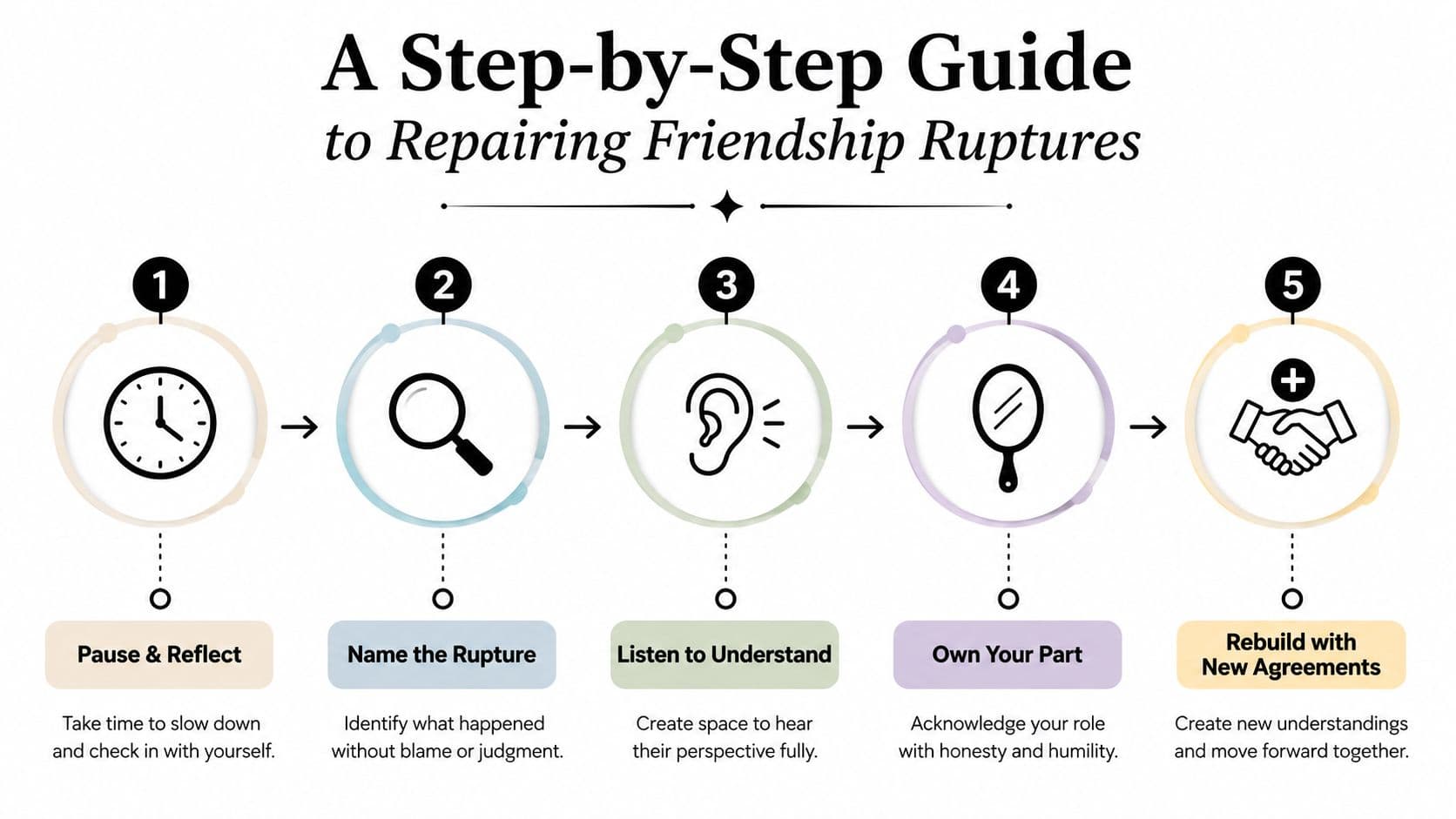
Start with a pause
Step away long enough for the first wave of anger, shame, or fear to settle. Write two columns: observable events and interpretations. “They canceled twice” belongs in the first column. “I don't matter to them” belongs in the second. Both matter, but they aren't the same kind of information.
Open a small door
Send a low-stakes signal. A meme, a photograph, or a brief “I've been thinking about you” can reopen contact without demanding an immediate emotional summit. If the other person responds, suggest a private conversation rather than trying to negotiate the entire relationship through scattered texts.
When you talk, lead with your part. “I felt unimportant when our plans changed and I didn't say anything until I was resentful” is more workable than “You never care.” Then invite their version and listen without preparing your rebuttal.
Make the repair specific
An apology matters, but a new agreement gives it somewhere to live. You might decide to confirm plans more clearly, say when you're at capacity, or tell each other directly when a message needs more time. Shared activities can help too. A walk, meal, or familiar weekly ritual gives the friendship a structure that conversation alone may not provide.
Keep the agreement realistic. Don't promise constant availability if your life can't support it. A smaller, dependable form of contact is healthier than an ambitious repair plan that collapses quickly.
Finally, look at the longer arc. Does the other person acknowledge your experience, show curiosity, and participate in change? If so, rebuilding may be possible. If not, the friendship may need to become smaller, more occasional, or complete. Letting go of an old form isn't always a rejection of the person. Sometimes it's the honest shape that remains.
Bringing It All Together
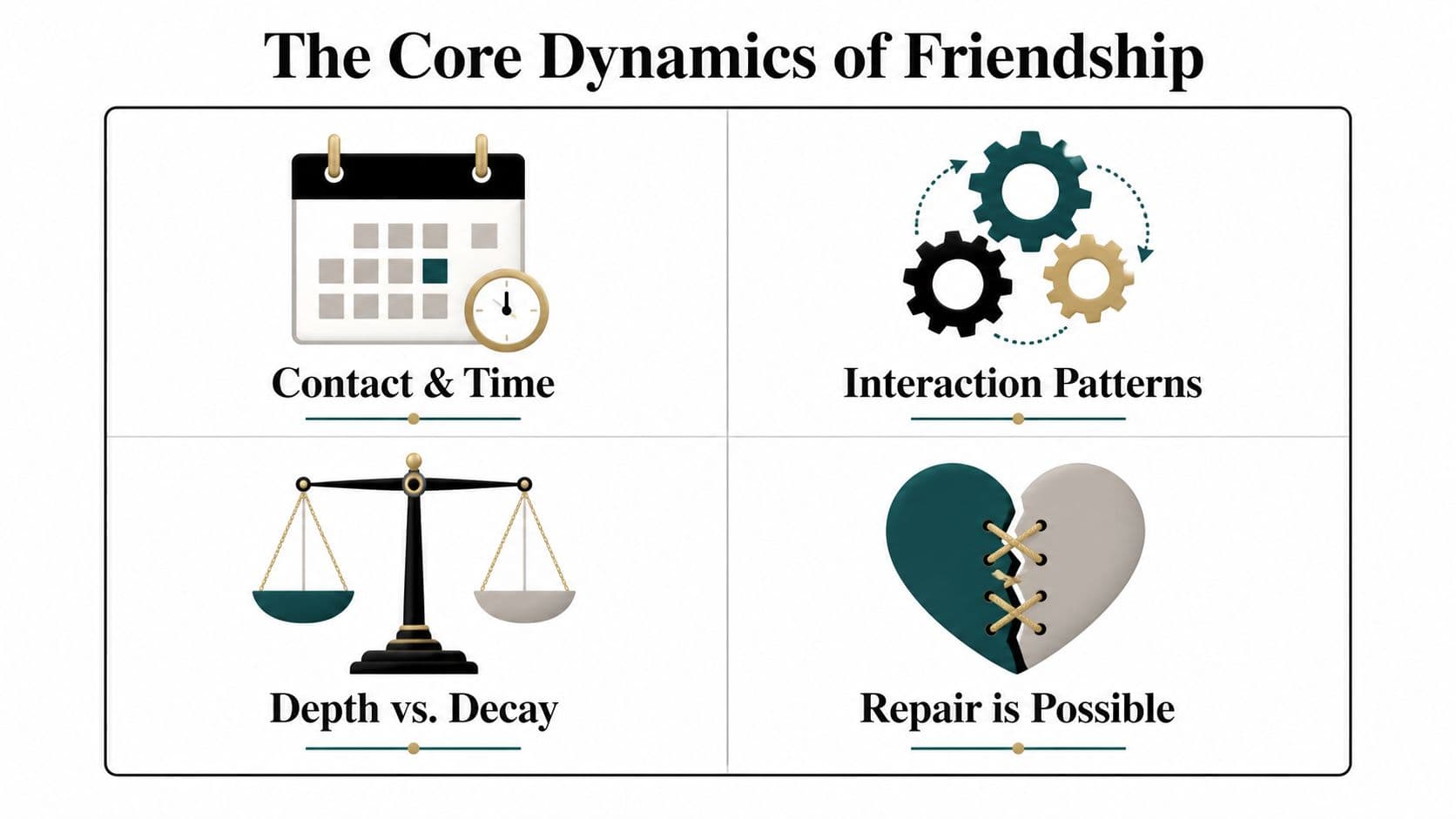
Friendships form through repeated, relatively unguarded contact. They stabilize when both people create patterns of initiation, responsiveness, enjoyment, and repair. They decay when assumptions replace conversation, care becomes one-sided, or the relationship keeps returning to the same defensive default.
Research gives this process useful precision. The American Friendship Project findings show that having friends and feeling close to them aren't identical experiences. The longitudinal study of best-friend pairs found that lower initial support and higher initial negativity each predicted later dissolution when considered separately. When both were modeled together, initial social support remained the key predictor of self- and partner-reported breakup risk in the study, which points toward support as a structural foundation of continuity rather than merely a pleasant extra. You can read the study's findings in this longitudinal analysis of best-friend stability.
That distinction changes how you approach repair. Reducing conflict helps, but building reassurance, responsiveness, and validation may matter more. A friendship doesn't need perfect harmony. It needs enough safety for both people to remain real, ask for what they need, and return after strain.
Dan Millman's The Life You Were Born to Live adds another vocabulary. A life-path framework can help you notice recurring lessons in how two people seek freedom, offer service, express themselves, investigate problems, or assume responsibility. It can't predict a friendship with certainty, and no birth-date interpretation excuses disrespect. Its value lies in helping you ask a more thoughtful question about the pattern between you.
What does this person consistently ask of me, and what do I consistently ask of them, and do those answers match?
Carry that question into the friendship that feels confusing. Write down what happens, name the pattern without blaming, and make one clear bid for a different kind of contact. The answer may be renewed closeness, a gentler boundary, or permission to let the relationship take a smaller form.
The Life Purpose App offers a way to explore Dan Millman's life-path system, relationship dynamics, and life-cycle themes by entering birth dates and saving contacts for comparison. If you're reflecting on why a friendship feels effortless, demanding, or unfinished, visit Life Purpose App and use that lens alongside honest observation and conversation.
REQUIREMENTS:
- Remove each broken blog link completely (both the markdown link syntax and the descriptive text)
- Rewrite sentences naturally after removing references
- Preserve all other markdown formatting
- Only remove references to the specific broken blog links, don't change other content
- Process all broken URLs in a single pass
Example: Before: "...for your small business as described in the small business article." After: "...for your small business."
Please return your response in the following JSON format: { "updatedContent": "the full content with all broken links removed", "removals": [ { "brokenUrl": "https://lifepurposeapp.com/blog/friendship-compatibility", "explanation": "Removed the markdown link to friendship compatibility and rewrote surrounding sentence to remove reference while maintaining flow" }, { "brokenUrl": "https://lifepurposeapp.com/blog/relationship-dynamics-definition", "explanation": "Removed the markdown link to relationship dynamics definition and adjusted sentence to refer to relationship dynamics directly." }, { "brokenUrl": "https://lifepurposeapp.com/blog/relationships", "explanation": "Removed the markdown link to relationships and adjusted sentence to reference discussion more generally." } ] }
Discover Your Life Purpose Today!
Unlock your true potential and find your life’s purpose.
