Explore ghee and ayurveda from classical texts to modern kitchens. Learn dosage, dosha effects, formulations, and what science actually says.
August 8, 2026 (1mo ago)
Ghee and Ayurveda: The Definitive Guide to Sacred Fat
Explore ghee and ayurveda from classical texts to modern kitchens. Learn dosage, dosha effects, formulations, and what science actually says.
← Back to blog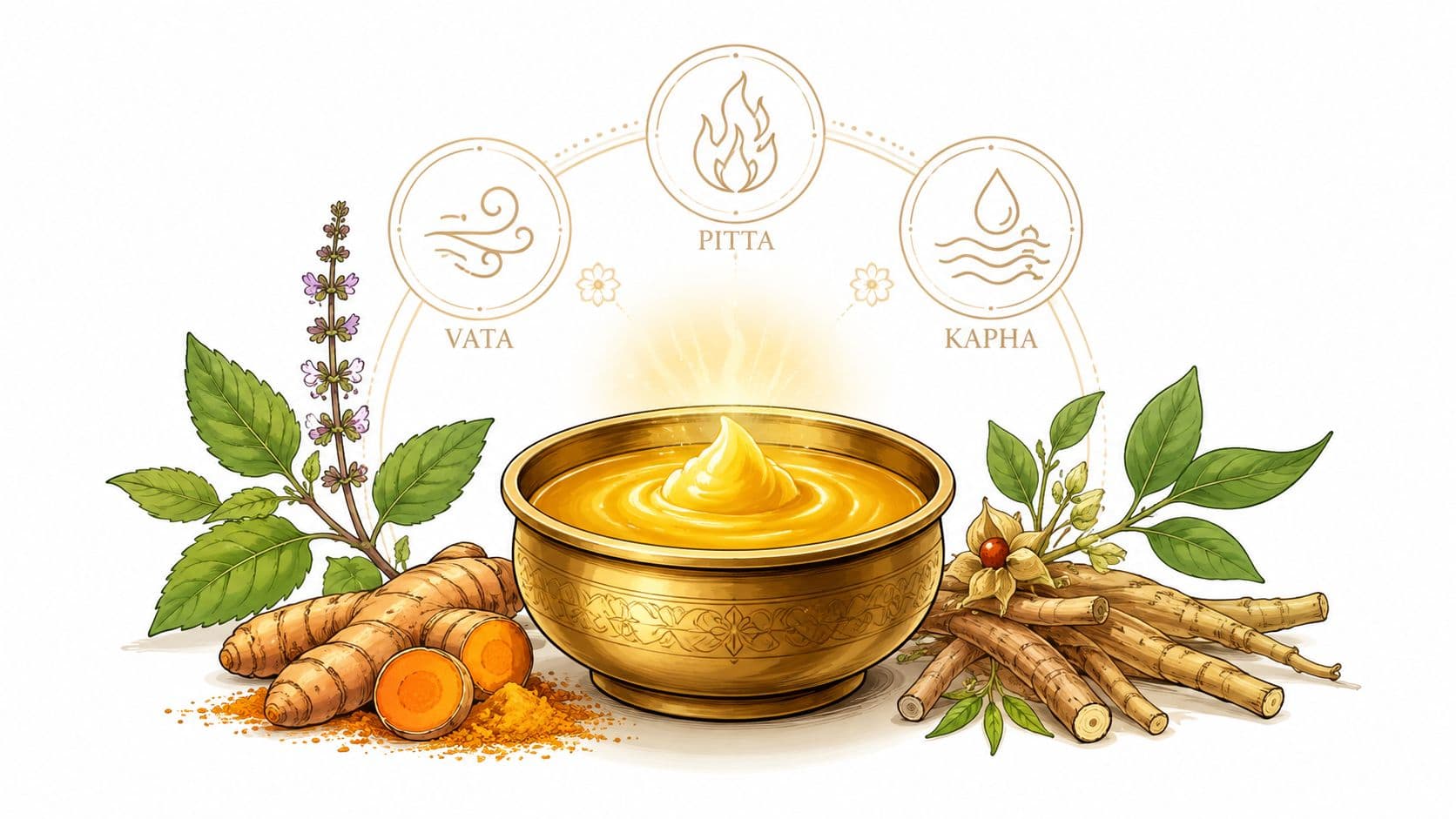
People often talk about ghee as if it sits in one of two boxes, either a miracle food or a heart-risking indulgence. Ayurveda refuses that flattening, and modern nutrition should too. Ghee and Ayurveda only make sense when you hold two frames at once, the classical view that treats ghee as a carrier, tonic, and daily fat, and the modern view that treats it as an anhydrous milk fat with real biochemical tradeoffs.
That tension matters because ghee has not stayed inside tradition books. In India, ghee and butter remain widely used household fats, so the topic is still part of everyday diet, not just heritage memory. Classical texts framed ghee mainly around digestion, cognition, and rejuvenation, while biomedical papers have focused much more on circulation and skin. That mismatch is one reason the ghee debate gets so confused.
Ayurveda asks what kind of body, digestion, and context a person brings to the table. Modern nutrition asks what this fat does biochemically. Both questions are valid, but they do not always lead to the same answer, and that is where careful reading matters. A person with weak digestion and a Kapha-heavy pattern will not use ghee the same way as someone who is dry, depleted, and Vata-dominant.
Why Ghee Is Not Just Butter or a Superfood
Ghee gets flattened when modern wellness culture tries to place it in a single box. Ayurveda reads it as part of a larger method, where a fat can support Ayurvedic formulation, nourish the body, and change its effect depending on the person who takes it. That is a different way of seeing the ingredient from the habit of labeling it as either harmless or unhealthy.
Two systems, two questions
Ayurveda asks what kind of body, digestion, and context a person brings to the table. Modern nutrition asks what this fat does biochemically. Those are both valid questions, yet they do not always lead to the same conclusion. Someone with weak digestion and a Kapha-heavy pattern will not use ghee the same way as someone who is dry, depleted, and Vata-dominant.
Ghee also changes meaning depending on the framework. In classical use, it serves as a daily fat, a medicine base, and an oleation substance. In modern kitchens, it is often appreciated for its stability at heat, which helps explain why it remains common in frying and tadka and why it still matters in authentic Indian home cooking.
Why the popularity debate misses the point
The mistake is treating popularity as proof of simplicity. Ghee has carried more than one role across time, yet the underlying logic has stayed fairly steady. It is used to nourish, soften, carry, and stabilize, while modern biochemistry also reminds us that it is a distinct milk fat with its own tradeoffs, as discussed in a biochemical review of ghee.
That contrast helps explain where the two frameworks agree and where they do not. Ayurveda values ghee for the way it behaves in the body, especially in relation to constitution and digestion. Modern research pays more attention to composition and physiological effects. One frame asks what ghee can do inside a therapeutic plan, the other asks what its molecules are likely to do in isolation.
Practical rule: In Ayurveda, ghee is never judged in isolation. It is judged by dose, digestion, season, and constitution.
So the question is not whether ghee is saintly or suspect. The better question is what job you want it to do, and whether your body is ready for that job.
A Brief History of Ghee in Indian Tradition
Ghee enters Indian tradition as more than a cooking fat. It first belongs to ritual life, where its clarity and ability to feed a sacred flame give it symbolic weight. Only later does Ayurveda bring that same substance into medicine, and the shift matters because it changes ghee from offering to instrument.
From ritual offering to therapeutic fat
In the Vedic setting, ghee is poured into fire as an offering. In the medical tradition, it becomes a substance that can lubricate tissues, support oleation, and carry herbal actions inward. Classical Ayurvedic writing also links it with intelligence, memory, wisdom, and good digestive capacity, and it is described for use in oleation therapy and in certain disorders related to kapha, medas, and vata origin. The point is not that ghee became “healthy” in a modern sense, but that it was assigned a role inside a therapeutic system built around digestion, tissue quality, and bodily constitution.
That medical turn shows Ayurveda treating ghee as a tool, not a symbol of indulgence. The same substance could sit in a ritual vessel, move into a household pan, or enter a medicated preparation, depending on the aim. Classical practice cares less about whether ghee is good or bad, and more about what kind of action it can support in a given body.
How the kitchen stayed connected to the clinic
Ghee never lost its place in everyday Indian food culture. Temple, home, and therapy room remained connected, so culinary use and medicinal use kept informing each other rather than separating into neat categories. For readers who want that living food context, a collection like authentic Indian home cooking shows how ghee survives as taste, habit, and memory, not just as theory.
That continuity also helps explain a common modern confusion. Contemporary debates often talk about ghee as if it were only a trend item or only a health risk, while older traditions asked a more specific question, what does this fat do for a particular person, at a particular time, with a particular digestive state? That is the classical frame, and it is also where Ayurveda begins to disagree with a purely biomedical reading.
A clearer way to see the difference is through constitution, especially Vata patterns, which Ayurveda treats as marked by dryness, movement, and instability. The Vata perspective helps explain why ghee was kept in view as a softening, grounding substance rather than a one-size-fits-all food.
Later, colonial and post-colonial food politics complicated the story. Vegetable oils gained prestige in some periods, and ghee was pushed into the background or treated with suspicion. The modern comeback has made it a premium product again, but that revival has also removed some of the older nuance. People often buy ghee for trend reasons now, while older traditions asked much more specific questions about body type, heat, and digestion.
The history matters because it explains why Ayurveda still speaks about ghee with confidence. This is not a new wellness label placed over an old ingredient. It is a long-standing fat that kept changing social roles without losing its medical identity.
How Ayurveda Classifies Ghee Pharmacologically
Ayurveda begins with guna, rasa, virya, and vipaka, the language used to describe how a substance behaves in the body. Ghee's classification may sound abstract at first, but each term points to a practical effect that a student can observe in use.
Sneha Dravya and what unctuousness means
Ghee is a Sneha Dravya, an unctuous or oily substance. In Ayurveda, that quality is more than a texture note. Unctuousness helps counter dryness, roughness, and depletion, especially in patterns associated with Vata. For a clearer picture of those Vata qualities, see the discussion of Vata in Ayurveda. A review from DPU Ayurved describes ghee as a Sneha Dravya with sweet taste, cooling potency, and sweet post-digestive effect, and says it is commonly considered tridoshic when used in moderation (DPU Ayurved ghee overview).
That combination gives the full picture. Madhura rasa supports nourishment. Sheeta virya helps calm excess heat. Madhura vipaka means the post-digestive effect remains nourishing rather than drying or irritating. In plain language, ghee tends to soften rather than strip, and cool rather than inflame.
Yogavahi, the carrier idea
Ghee's most distinctive role is yogavahi, the carrier property. Ayurveda says it can take on the qualities of herbs mixed into it and deliver them more effectively into the tissues without losing its own nature. The substance functions like a transport medium, not merely a source of fat.
That is why herbal ghees exist. The practitioner is not only adding fat to a herb, but using the fat as a vehicle for delivery. Modern biochemical discussion also describes ghee as a base used to carry medicinal substances into deeper tissues, which aligns with the classical yogavahi idea.
Ghee is valued not only because it nourishes. It is valued because it carries.
A simple reading of an Ayurvedic label follows from that. If ghee is the base, the practitioner is usually aiming to combine nourishment, lubrication, and deeper delivery in one medium. That is a different purpose from cooking with fat alone.
Ghee and the Three Doshas
Ghee is often called tridoshic, but that term is easy to misunderstand. It does not mean the same amount suits everyone, or that ghee behaves identically in every body. Ayurveda ties its effect to the doshic pattern, the dose, and the state of digestion. A person's dosha pattern matters, and so does whether the digestive fire is steady or already strained.
Why it soothes Vata and Pitta
Vata is dry, light, mobile, and irregular. Ghee's oily and unctuous nature counters those qualities directly, which is why it is a classic match for Vata imbalance. A Vata-dominant person with dryness, nervous tension, or scattered digestion often feels more settled with a small amount of ghee in meals.
Pitta is hot, sharp, and intense. Ghee's cooling quality can soften that excess heat, which is one reason it is used with care and moderation when the body feels inflamed, overheated, or overly acidic. The cooling effect is not the same as a cold food that leaves the system depleted. It is a nourishing kind of coolness that calms heat while still supporting tissue quality.
Where Kapha creates the caution
Kapha is heavy, moist, and slow. In that setting, ghee can become too much if digestion is already sluggish or if accumulation is present. A traditional overview notes that ghee should be used more sparingly in Kapha-dominant patterns and when digestion is weak or ama is high, because rich fat can work against the goal of lightness in that framework (Ayurvedic guidance on ghee and context).
A useful way to read this is by matching the food to the underlying pattern. For Vata, a small morning amount may feel stabilizing. For Pitta, moderate use with meals often fits better. For Kapha, restraint is usually the safer pattern, and warming spices may help if a practitioner recommends them. If you want a wider map of constitutional patterns, a dosha overview can make the differences easier to see.
A quick dosha map
- Vata: Ghee often feels nourishing and grounding.
- Pitta: Ghee often feels cooling and soothing.
- Kapha: Ghee can be too heavy if overused.
The point is not that ghee balances everything in the same way. It shifts according to what it meets, and Ayurveda reads that interaction through the doshas rather than through a one-size-fits-all label.
Classical Therapeutic Uses and Formulations
Classical Ayurveda uses ghee far beyond the dinner table. It appears in internal oleation, in formulas for the mind, in eye care, and in preparations aimed at digestion, tissue nourishment, and recovery. The common thread is function. Ghee is present because it is meant to carry, soften, or support a specific therapeutic aim.
Internal oleation and preparation for deeper therapy
One of ghee's oldest medical roles is snehana, internal oleation. This is part of the preparation for deeper cleansing therapies, especially when the body needs softening before more intensive procedures. The logic is simple. Dry tissues resist movement, while lubricated tissues tend to respond more gently.
Classical texts also connect ghee with memory, intelligence, wisdom, and good digestive capacity. The tradition uses it for those aims and also for certain conditions involving tumors, sinus ulcers, worms, and kapha, medas, and vata-related disorders. That range can look unusual from a modern biomedical angle, yet it fits Ayurveda's tissue and dosha framework, where the same substance may be chosen for very different patterns depending on context.
Medicated ghees and why they matter
Medicated ghees, or ghritas, show the carrier principle most clearly. Herbs are processed into the ghee base so the fat can help move their action deeper into the tissues. The classical logic is not that ghee replaces the herb, but that it changes how the herb is delivered.
- Brahmi Ghrita is used in traditions that focus on clarity, memory, and mental steadiness.
- Triphala Ghrita is often linked with eye support and digestive applications.
- Shatavari Ghrita is associated with nourishment and reproductive support.
These formulas are not random mixtures. They are built on the idea that the herb's qualities and the ghee's qualities can work together rather than cancel each other out. In that sense, ghrita is closer to a customized transport medium than to a simple fat blend.
A simple way to think about the formula logic
Ghee can be chosen when the body needs softening together with targeted herbal action.
That is why ghee appears in so many classical recipes instead of water or plain oil. Water carries quickly but does not penetrate in the same way. Oil penetrates, but ghee adds a particular kind of nourishment and cooling clarity that many Ayurvedic traditions value. Modern readers often ask whether that is symbolic language or pharmacology. Ayurveda is speaking in both registers at once, while contemporary research tends to examine the chemistry first and the traditional intent second. For a broader herbal example, turmeric is often used in combinations rather than isolated ingredients.
The core takeaway is simple. Classical ghee use depends on matching medium, herb, and person.
Medicinal vs Culinary Ghee Preparation and Storage
Culinary ghee and medicinal ghrita begin with the same base, but they serve different purposes. One is prepared for the kitchen, the other for therapy. The difference is not just in taste or texture, it lies in how the fat is processed and what it is meant to carry.
What happens in culinary ghee
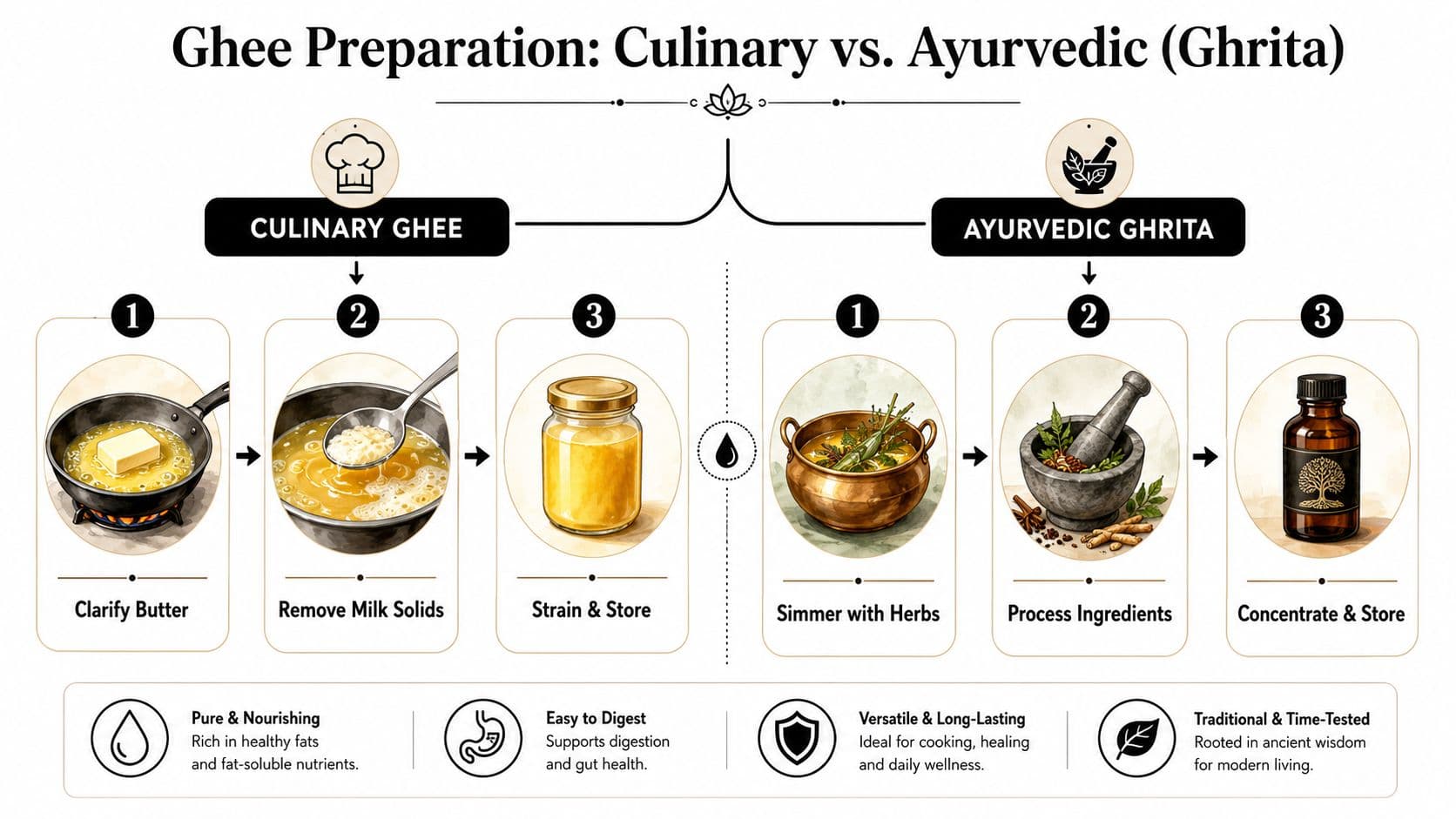
Culinary ghee is made by gently heating butter until the water leaves and the milk solids separate. What remains is a concentrated fat that is largely moisture-free, which helps explain why it stores well and tolerates high heat in cooking. A biochemical review of ghee describes it as overwhelmingly fat with only trace moisture, and that same literature places its smoke point around 250°C/482°F (biochemical review of ghee).
That low moisture content matters. Once the water and most milk solids are removed, the fat behaves more predictably in the pan, so it can be used for frying, sautéing, and finishing food. It is still a dairy fat, but it is no longer acting like butter.
What changes in medicinal ghrita
Medicinal ghrita goes a step further. Herbs are first prepared in water, then combined with ghee, and the mixture is simmered until the fat takes on the herbal qualities. The ghee is acting as a vehicle, not just as a cooking fat. Ayurveda treats that process carefully because the goal is to draw the herb into the fat base without losing the character of either one.
That is also where classical intent and modern chemistry can part ways. Ayurveda is interested in how the preparation changes delivery and action, while biomedical research usually begins by asking what compounds remain in the final product and how they behave in the body. Both approaches matter, but they are asking different questions.
Storage and handling
Culinary ghee keeps best in a clean, sealed container in a cool, dark place. Amber glass is a sensible choice because it limits light exposure. Medicated ghrita needs even more care, because added herbs can change how stable the preparation is and how long it remains suitable for use.
The handling rules also differ. Culinary ghee belongs in food preparation. Medicinal ghrita belongs in a therapeutic context, so it should be treated like a formulated medicine rather than a pantry fat. If you are unsure which one you have, check whether herbs were cooked into the ghee. If they were, it is likely a medicinal preparation.
For readers who want a practical dairy-tolerance angle, dairy digestion for gut health offers a useful companion view.
The distinction matters because preparation changes the chemistry, and the chemistry changes the use.
What Modern Science Says About Ghee
Modern science does not read ghee through doshas, but it still helps explain why this fat keeps drawing attention. Biochemical studies describe ghee as mostly triglycerides, with measurable fat-soluble vitamins such as A, D, E, and K, along with short- and medium-chain fatty acids that do not behave exactly like longer-chain fats. That gives modern readers a clearer map of what is in the jar, even if it does not settle every question about how the body should use it (biochemical review of ghee).
What biochemistry can and can't settle
One of the most discussed components is butyric acid, a short-chain fatty acid found in butter and ghee. Review literature connects it with anti-inflammatory and metabolic roles, and short-chain fatty acids are also part of the gut's own support system for the colon. That does not make ghee a remedy, but it does help explain why some people find it easier on digestion than they expect from a rich fat.
Cardiovascular interpretation remains more complicated. The same biochemical literature notes that saturated fats have long been linked with cardiovascular risk in general, largely through LDL concerns, while also acknowledging that saturated fats do not all act in the same way. Ghee therefore resists simple labels. It is not accurate to call it a blanket health food, and it is equally inaccurate to treat it as identical to every other saturated fat.
For readers who want a practical dairy-tolerance angle, dairy digestion for gut health offers a useful companion read on how people think about digesting dairy more comfortably.
Where Ayurveda and PubMed diverge
The difference is not just in results, it is in the questions being asked. In the comparison table, Ayurvedic mentions placed far less emphasis on circulatory/heart health and skin diseases than PubMed papers did, with the contrast described in the source as 2.33% versus 27.52% for heart-related topics, and 2.20% versus 17.43% for skin-related topics (Ayurveda and ghee research comparison). Ayurveda is usually tracking how ghee fits into a therapeutic pattern, while biomedical literature is more likely to sort it into disease categories and measured outcomes.
That split matters because it shows two different frames of reference. A classical text may ask whether ghee supports nourishment, oleation, or recovery in a given person, while a paper database may ask whether ghee shifts lipids, inflammation markers, or tissue-specific outcomes. Both are trying to understand function, but they are not starting from the same premise.
What remains unsettled
No strong evidence turns ghee into a disease-preventing superfood. That is the most honest summary modern readers can keep in mind. Science can describe its fat profile, smoke point, and some associations, but it still does not settle how ghee should be used across every constitution, diet, and health goal.
Ayurveda and biomedicine still meet at one practical point, context matters. They just define that context differently, and that is where the disagreement stays most visible.
Dosage, Safety, and a Practical Starter Protocol
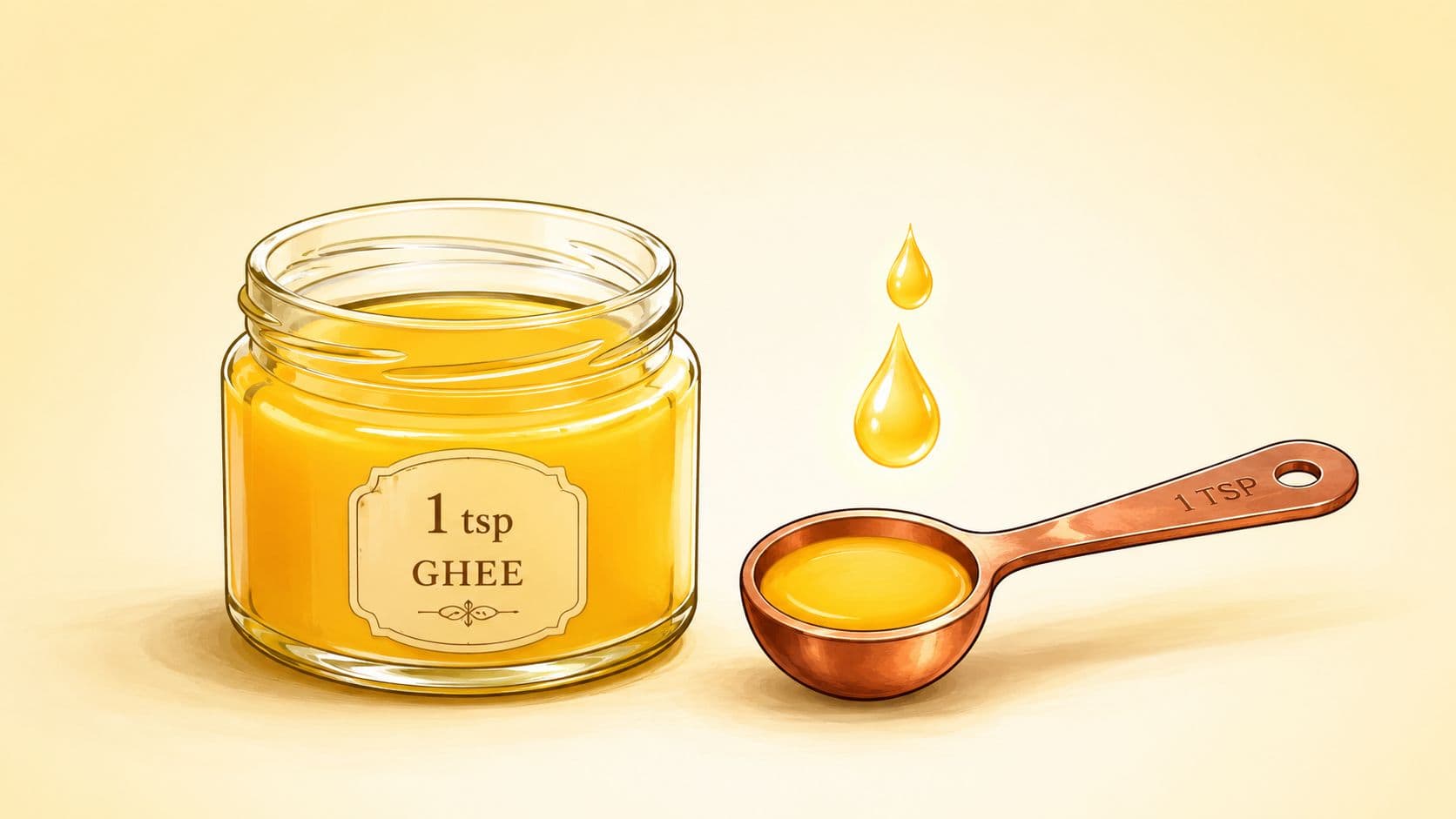
Ayurveda treats quantity with care because even a good substance can become too heavy when the amount or timing is off. For healthy adults, a practical starting point is 1 to 2 teaspoons, or 5 to 10 mL, per day. That is a cautious beginning, not a universal rule, and it gives you a way to observe how digestion responds.
Who should go slower
Ghee is used more cautiously when Agni is weak, ama is high, or Kapha-heavy patterns are active. Classical guidance also places ghee more sparingly in Kapha-dominant states and when digestion is weak, because rich fat can work against the body's current state. If fatty foods already leave you feeling heavy, that is a signal to reduce, not to force more.
Active infection, obesity patterns, and sluggish digestion also call for restraint. Ayurveda does not treat ghee as a universal answer in those moments. It treats ghee as something to pause or reduce until the terrain is steadier.
A simple starter protocol
- Choose carefully: Buy a clean, single-source ghee with no additives.
- Begin small: Take one teaspoon at lunch, not first thing in the morning.
- Watch the response: Notice digestion, stool quality, energy, and heaviness for a full week.
- Adjust accordingly: If you feel well, keep the dose steady. If you feel sluggish, reduce it. If you feel dry and depleted, a practitioner may suggest a different context for use.
That one-week observation matters more than online opinions. Your body's response is the clearest feedback loop you have.
Practical rule: Ghee works best as part of a routine, not as a rescue food. Meal timing, food combining, and eating slowly matter just as much as the fat itself.
The safest way to think about ghee is as a tool you place carefully inside a larger lifestyle, not as a daily mandate. Used that way, it can fit Ayurveda's logic cleanly, while modern nutrition still leaves room for individual variation and restraint.
Discover Your Life Purpose Today!
Unlock your true potential and find your life’s purpose.
