Explore goddesses names and meanings across Greek, Hindu, Yoruba, Norse, Celtic, Chinese, and other traditions, with uses for reflection and devotion.
August 17, 2026 (1mo ago)
10 Goddesses Names and Meanings from Around the World
Explore goddesses names and meanings across Greek, Hindu, Yoruba, Norse, Celtic, Chinese, and other traditions, with uses for reflection and devotion.
← Back to blog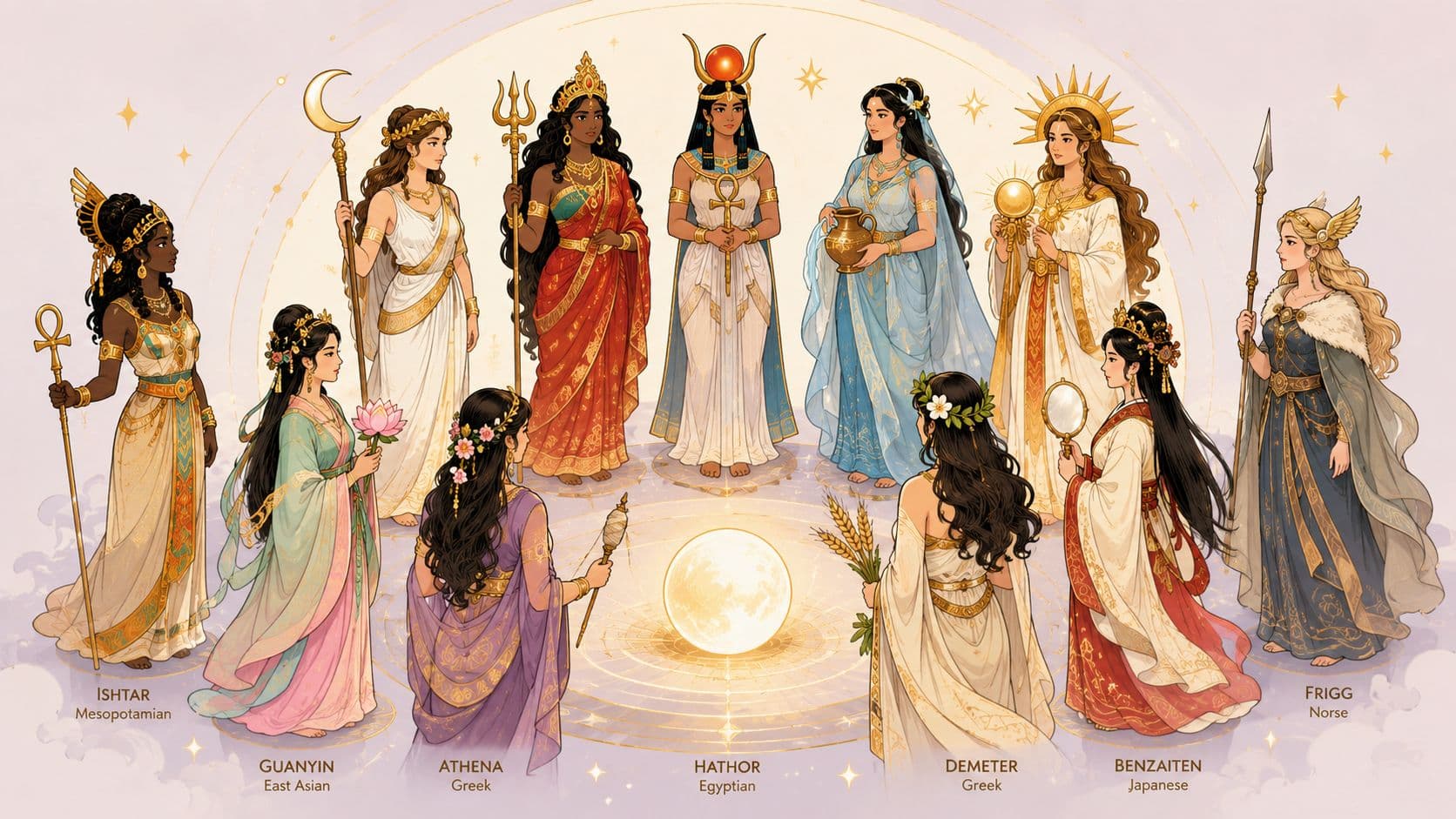
What makes a goddess name meaningful, the dictionary definition, the culture that shaped it, or the personal season in which you encounter it? Goddess names can carry several layers at once: linguistic roots, mythological roles, sacred practices, regional traditions, and modern symbolism. A single gloss such as “wisdom” or “love” can be useful, but it can also flatten a complex figure into a personality label.
This guide treats goddesses names and meanings as a starting point for learning and reflection, not as a substitute for the living practices of the traditions represented. Each entry includes a name meaning or interpretive association, cultural origin, domains, mythological context, pronunciation guidance, a caution against oversimplification, and a grounded journaling or devotional prompt. If you're considering a goddess-inspired tattoo, begin with cultural context before choosing an image. This goddess tattoo guide for first-timers can help you think through symbolism and permanence.
Symbolic reflection isn't the same as numerology. If you connect a goddess archetype with a life path, use only Dan Millman's The Life You Were Born to Live and the Life Purpose App as your reference points. The aim isn't to force a sacred figure into a personal formula. It's to ask better questions about the qualities, responsibilities, and stories you want to explore.
1. Athena Greek Goddess of Wisdom and Strategic Warfare
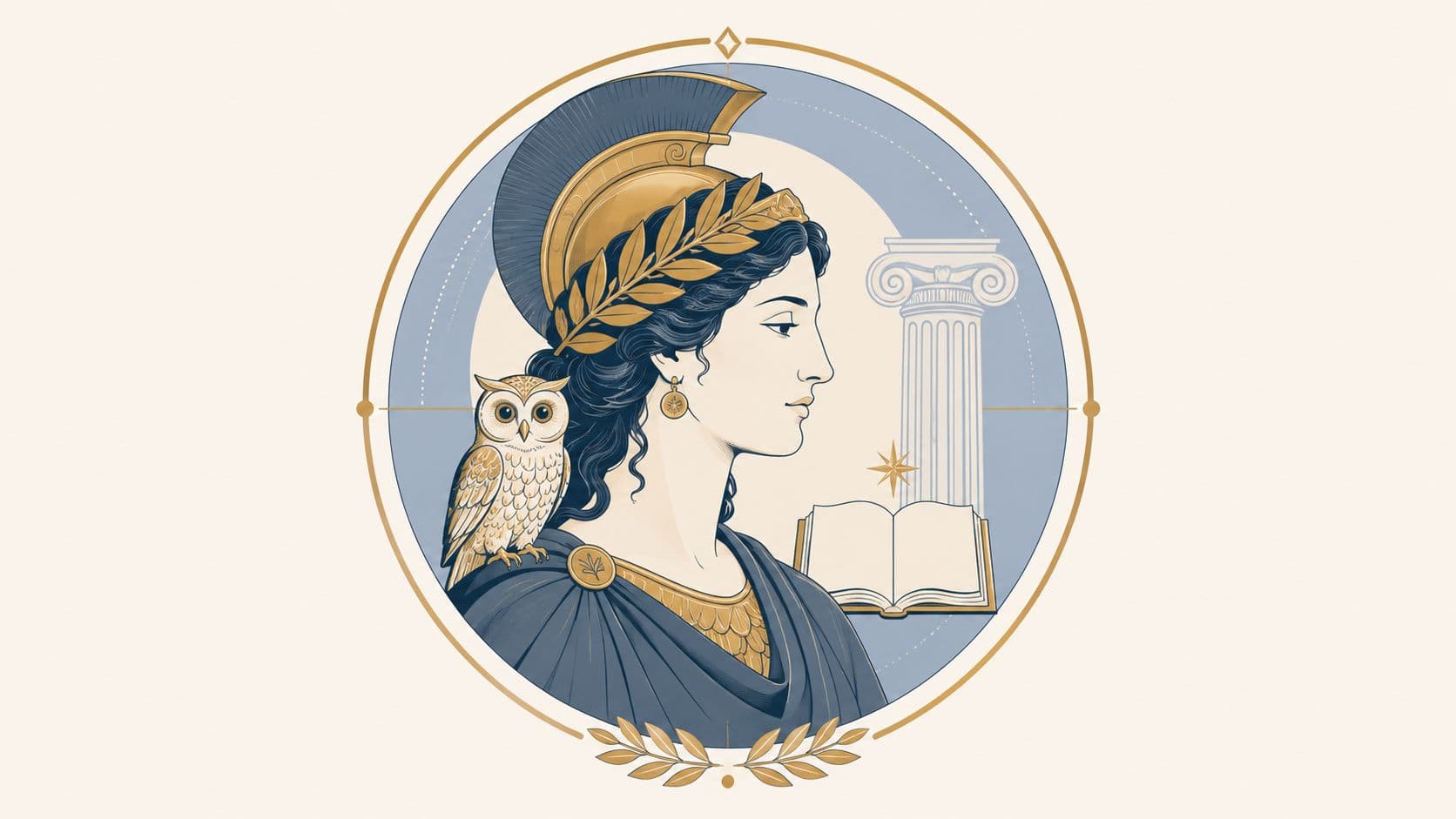
Athena is associated with wisdom, crafts, practical reason, and strategic warfare. Britannica describes her form of battle as one based on strategy and skill rather than uncontrolled violence, which makes “warrior goddess” an incomplete description. Her name has also been interpreted through ideas such as mind and divine intelligence, though the etymology remains more complicated than a single modern translation.
In Greek mythology, Athena's emergence fully formed from Zeus's head presents her as a figure of intellect, clarity, and deliberate action. She's often linked with the owl, armor, and the city of Athens. These symbols don't reduce her to “being smart.” They point toward judgment, civic responsibility, skilled work, and the difficult task of choosing a sound course under pressure.
Pronunciation and reflection
Athena is commonly pronounced uh-THEE-nuh in English. A useful reflection question is: Where am I confusing information with judgment, and what decision would become clearer if I slowed down? An educator mentoring a student, an architect solving a design problem, or an activist planning a campaign might all recognize Athena's emphasis on strategy, but none of those modern roles is identical to her ancient worship.
Read the difference between intelligence and knowledge before turning Athena into a productivity symbol. If you use the Life Purpose App alongside The Life You Were Born to Live, let the exercise remain exploratory. Journal about how your gifts serve other people, rather than assuming a life-path framework defines Athena's meaning.
Practical rule: Treat Athena as a figure of disciplined judgment, not as a shortcut for intelligence.
2. Oshun Yoruba Goddess of Love Fertility and Prosperity
Oshun belongs to the Yoruba religious tradition and is associated with fresh water, love, fertility, beauty, sensuality, creativity, and prosperity. Her name and worship are inseparable from a living spiritual context that includes devotion, ritual, music, community, and sacred relationships. She shouldn't be presented as a generic “abundance goddess” detached from Yoruba history and practice.
Rivers are central to Oshun's symbolism. Flowing water can suggest emotional depth and nourishment, while mirrors, honey, and adornment are often used in modern representations to express beauty and self-regard. Those symbols don't mean that prosperity is something a person attracts by wanting it. A more careful reading connects care, relational intelligence, creativity, and the ability to sustain life.
For someone building a values-led business, Oshun might prompt questions about whether financial goals support genuine service. For a creative person, she might open reflection on whether beauty and pleasure have a legitimate place in their work. The associated cowrie shells as talismans also deserve cultural context rather than being treated as interchangeable decorative objects.
Pronunciation and reflection
Oshun is often rendered in English as oh-SHOON, though pronunciation can vary by language and community. Ask: What gifts do I dismiss because they come naturally to me, and how could I develop them with integrity? A practical action might be to review one creative or commercial commitment and check whether it reflects your values.
For further reflection, explore love and compassion as a personal practice. If you bring in The Life You Were Born to Live or the Life Purpose App, use them to consider how service and personal gifts relate to abundance. Don't claim Oshun as a private branding device without learning from Yoruba sources and respecting the tradition's living practitioners.
3. Parvati Hindu Goddess of Love Fertility and Divine Shakti
Parvati represents love, fertility, devotion, creativity, and Shakti, the dynamic power associated with divine feminine energy in Hindu traditions. She's not only a gentle mother figure. Across Hindu stories and theological interpretations, Parvati can appear as a devoted partner, compassionate mother, ascetic, and powerful manifestation of divine energy.
Her association with Shiva is often read through the relationship between stillness and active creative power. Stories of her austerity and focused devotion emphasize persistence, spiritual discipline, and transformation. Yet modern summaries can turn that complexity into a simple lesson about patience or romantic dedication. Parvati's significance belongs within Hindu cosmology, ritual, philosophy, and regional traditions, not only within contemporary self-development language.
A person drawn to Parvati might reflect on how inner practice supports outer responsibility. A parent could ask how care and self-development coexist. An artist might explore how sustained attention changes raw emotion into meaningful work. A healer could consider whether compassion is supported by boundaries and disciplined training.
Pronunciation and reflection
Parvati is commonly pronounced par-vuh-TEE in English. Write about this question: What am I willing to practice consistently, even when the result isn't visible yet? Choose one small action, such as returning to meditation, completing a creative study, or repairing a neglected relationship.
The concept of Shakti requires care, so begin with a clear explanation of what Shakti means rather than treating it as a decorative synonym for feminine power. If numerology or life paths are part of your reflection, consult Dan Millman's The Life You Were Born to Live and the Life Purpose App only as personal-development frameworks. They can support questions about devotion and direction, but they don't replace Hindu learning or practice.
4. Freya Norse Goddess of Love War and Sovereignty
Freya brings together qualities that modern readers often separate: love, desire, magic, war, wealth, and sovereignty. In Norse mythology, she's a powerful Vanir goddess, associated with beauty and fertility but also with battle and the magical practice called seiðr. Her story resists the idea that tenderness and strength belong to different categories.
The spelling Freyja reflects Old Norse usage, while Freya is the familiar English form. It's commonly pronounced FRAY-uh. That pronunciation is useful for everyday naming, but the cultural background matters more than getting a single phonetic version perfect. Norse myths survive through sources shaped by time, transmission, and later recording, so modern depictions shouldn't be mistaken for a complete portrait of ancient belief.
Freya can serve as a prompt for personal sovereignty, especially for someone deciding what they value outside conventional expectations. An independent business owner might ask whether their work reflects their own authority. An artist might consider where compromise has become self-erasure. A counselor or healer might examine whether care for others has displaced care for the self.
“A boundary can protect devotion rather than oppose it.”
Journal on this question: What would I choose if I believed my needs and my responsibilities could coexist? Then identify one boundary you can state clearly this week. If you use The Life You Were Born to Live and the Life Purpose App, consider how your life-path reflections relate to collaboration, independence, and service. Don't use Freya to justify selfishness, and don't reduce her to a modern slogan.
5. Kali Hindu Goddess of Destruction Time and Transformation
Kali is associated with time, death, destruction, liberation, and transformation. Her fierce imagery can feel unsettling, but presenting her as merely violent misses the theological and devotional dimensions of the figure. Kali's destruction can be understood as the breaking apart of ignorance, attachment, and forms that prevent liberation, though interpretations vary across Hindu traditions and communities.
The name Kali is related to ideas of blackness and time, and popular explanations often connect it with the force that consumes all forms. That doesn't make Kali a simple symbol for “starting over.” Transformation can involve grief, accountability, spiritual discipline, and the loss of identities a person has relied upon. Her imagery should be approached with respect, not borrowed casually for an aesthetic of danger.
A person leaving an exploitative workplace might reflect on what must end before a healthier life can begin. A therapist might use the image carefully when discussing patterns that no longer serve a client, while avoiding the suggestion that suffering is automatically sacred. An activist could ask whether dismantling an unjust structure is paired with a credible vision for what follows.
Pronunciation and reflection
Kali is commonly pronounced KAH-lee in English. Write: What am I protecting because it is familiar, even though it no longer reflects my values? Follow the question with one grounded action, such as ending an unhelpful commitment, clearing a physical space, or seeking qualified support for a difficult transition.
For a life-path reflection, use Dan Millman's The Life You Were Born to Live and the Life Purpose App. The app also includes material focused on Kali as a goddess of time and change, but neither source should be used to claim that a particular life cycle predicts a crisis. Let the framework prompt observation, not certainty.
6. Artemis Greek Goddess of the Wilderness Independence and Protection
Artemis is associated with wilderness, hunting, animals, childbirth, independence, and protection. Her identity isn't limited to the modern image of a solitary huntress. Greek stories present a complex goddess whose domains include both the wild and vulnerable human life, especially women and children.
Her name is commonly pronounced AR-tuh-miss in English. The figure's independence is often emphasized because Artemis remains outside expected marital structures in many modern retellings. That reading can be meaningful, but it shouldn't erase the ritual, social, and mythological contexts in which ancient Greeks understood her. “Independent” doesn't automatically mean isolated, and protection doesn't mean control.
A wildlife advocate might connect with Artemis through practical conservation work. A single parent might recognize the demanding combination of autonomy and protection. Someone pursuing a nontraditional career could use her as a prompt to examine whether the chosen path is truly theirs or just a reaction against convention.
A focused practice
Begin with a short walk without your phone, if your circumstances allow it. Notice the difference between solitude that restores you and isolation that leaves you unsupported. Then answer: What deserves my focused attention, and what support would help me protect it?
An environmental advocate could turn that answer into a specific action, such as volunteering with a local conservation group. Someone using The Life You Were Born to Live and the Life Purpose App might reflect on independence, relationships, and service together. The goal isn't to prove that Artemis governs your life path. It's to translate admiration into responsible behavior.
7. Quan Yin Chinese Goddess of Compassion and Mercy
Quan Yin, also written Guanyin, is a Chinese manifestation of the bodhisattva Avalokiteshvara and is widely associated with compassion, mercy, listening, and the alleviation of suffering. Calling Quan Yin a “goddess” can be understandable in popular English usage, but Buddhist context matters. She's revered through devotional practices that differ across cultures, temples, and communities.
The name Guanyin is commonly understood through the idea of observing or hearing the cries of the world. That association makes listening central to her symbolism. Her compassion isn't passive kindness. It implies attention, responsiveness, and a willingness to help while recognizing the complexity of suffering.
Healthcare workers, therapists, social workers, and teachers may feel drawn to this image of service. Yet compassion without limits can become exhaustion or rescuing. A respectful reflection asks not only how to help, but also how to avoid treating another person as a project.
Pronunciation and reflection
Quan Yin is often pronounced kwahn yin in English, while Guanyin has pronunciations that vary by Chinese language and romanization. Ask: What would careful listening look like before I offer advice? Practice by giving someone your full attention without interrupting, fixing, or shifting the conversation toward yourself.
If you use Dan Millman's The Life You Were Born to Live or the Life Purpose App, reflect on service alongside rest and personal boundaries. Quan Yin's compassion doesn't require self-neglect. It calls for a form of care that remains attentive to the dignity and agency of everyone involved.
8. Hecate Greek Goddess of Magic Crossroads and Initiation
Hecate is linked with magic, crossroads, thresholds, night, protection, and initiation. In modern spiritual writing, she's frequently labeled a witchcraft goddess, but that description can compress a varied ancient figure into a contemporary category. Her associations changed across time and place, and ancient sources don't provide one perfectly fixed profile.
The name Hecate is commonly pronounced HEK-uh-tee in English. Her connection with crossroads makes her especially useful for reflection during uncertain transitions. A crossroads isn't necessarily a dramatic supernatural event. It can be the ordinary moment when a person recognizes that an old identity, career, relationship, or belief can't contain the next stage of life.
Her triple form is often interpreted through maiden, mother, and crone imagery. That interpretation has become influential in modern pagan contexts, but it shouldn't be presented as the only ancient meaning. The broader lesson is cyclical change, multiple perspectives, and the ability to stand at a threshold without rushing into a false certainty.
A threshold journal
Draw three paths on a page. Label them continue, change, and pause. Under each, write what the choice protects, what it costs, and what information you still need. This practice keeps Hecate's symbolism connected to discernment rather than vague mystery.
A therapist supporting a client through bereavement, a researcher exploring unconventional knowledge, or a person balancing multiple careers might all find the crossroads image relevant. Use The Life You Were Born to Live and the Life Purpose App if life paths or numerology help you frame a transition, but don't treat a cycle reading as a command. Reflection should widen your awareness, not remove your responsibility to choose.
9. Durga Hindu Goddess of Divine Protection and Victory
Durga represents protection, courage, justice, and victory over destructive forces. Her name is often explained through the idea of the invincible or the difficult-to-overcome, but a translation alone can't express her place in Hindu worship and theology. She's frequently portrayed riding a lion or tiger and carrying weapons associated with different divine powers, symbolizing coordinated strength directed toward protection.
That imagery supports a careful distinction between aggression and defense. Durga's power isn't about winning every argument or dominating every person. It's about confronting threats to moral order and protecting life. Modern readers can draw inspiration from that principle, but they should avoid turning sacred imagery into a costume for personal conflict.
An advocate challenging systemic injustice might connect with Durga's courage. A parent could reflect on protective responsibility, while a professional serving vulnerable people might examine whether workplace policies match stated values. Protection also includes boundaries, documentation, allyship, and sustained effort. Anger alone isn't a strategy.
Protective strength needs discernment. Ask what you're defending, who benefits, and what your action makes possible.
Durga is commonly pronounced DUR-gah. Write: Where do I need to become more decisive in defense of a value I already claim to hold? Choose one action that doesn't put another person at unnecessary risk. If you consult The Life You Were Born to Live or the Life Purpose App, use the exercise to explore service and advocacy, not to label yourself a destined warrior.
10. Brigid Celtic Goddess of Fire Poetry Healing and Smithcraft
Brigid is associated with fire, poetry, healing, fertility, smithcraft, wells, and seasonal renewal. Her traditions are connected with Ireland and the wider Gaelic cultural world, where she has been remembered through overlapping pagan, folkloric, and Christian contexts. That layered history makes her difficult to reduce to “creativity goddess,” even though creative fire is a useful modern entry point.
Brigid's domains bring together work that changes materials and work that changes meaning. A smith shapes metal through heat. A poet shapes language. A healer supports restoration. Water from a well suggests nourishment and depth, while fire suggests inspiration, craft, and transformation. These aren't interchangeable symbols, but together they invite reflection on how a person's different gifts might support one another.
An artist may use Brigid as a prompt to treat practice as a craft rather than waiting for inspiration. A teacher could ask how creativity makes difficult ideas accessible. A healer integrating several modalities might reflect on whether the work is grounded in appropriate training and care.
Pronunciation and reflection
Brigid is commonly pronounced BRIJ-id in English. The Irish form Bríd has a different pronunciation, often approximated as breed. If you're using the name in a spiritual or creative practice, learn which form and tradition you're engaging with. A Gaeilgeoir AI guide to Brigid's symbols offers a starting point for exploring those associations.
Journal on this question: Which two abilities in my life seem unrelated, and what useful work could they create together? Then spend one focused session making, writing, repairing, teaching, or caring. If you use The Life You Were Born to Live and the Life Purpose App, treat life-path reflection as a way to notice creative patterns, not as proof that one vocation is predetermined.
Top 10 Goddesses, Names & Meanings
| Goddess | Implementation Complexity (🔄) | Resource Requirements (⚡) | Expected Outcomes (📊) | Ideal Use Cases (💡) | Key Advantages (⭐) |
|---|---|---|---|---|---|
| Athena | 🔄 Medium, structured strategic work | ⚡ Moderate, education, mentorship, planning tools | 📊 Strategic clarity, mastery, long-term impact, ⭐⭐⭐⭐ | Leadership, coaching, engineering, education | ⭐ Strategic thinking, clear decision-making |
| Oshun | 🔄 Low–Medium, flow-based, less formal process | ⚡ Moderate, creative resources, relational energy | 📊 Increased abundance, charisma, creative success, ⭐⭐⭐⭐ | Entrepreneurs, artists, relationship/manifestation work | ⭐ Attracts prosperity; fosters authentic expression |
| Parvati | 🔄 Medium, combines devotion + practice | ⚡ Moderate–High, time for practice, relational investment | 📊 Balanced inner growth and loving relationships, ⭐⭐⭐⭐ | Spiritual practice, parenting, creative transformation | ⭐ Integrates devotion with worldly action |
| Freya | 🔄 Medium, sovereignty + intuition integration | ⚡ Moderate, autonomy, intuitive practice | 📊 Strong personal sovereignty and intuitive agency, ⭐⭐⭐⭐ | Independent entrepreneurship, activism, creative authority | ⭐ Encourages self-advocacy and boundary-setting |
| Kali | 🔄 High, intense transformational process | ⚡ High, emotional resilience, support systems | 📊 Radical clearing and rebirth; high impact, destabilizing if unmanaged, ⭐⭐⭐ | Major life transitions, shadow work, systemic dismantling | ⭐ Powerful catalyst for release and transformation |
| Artemis | 🔄 Low–Medium, focused, goal-driven practice | ⚡ Moderate, skills, solitary discipline | 📊 Focused goal achievement, protection of boundaries, ⭐⭐⭐⭐ | Solo ventures, environmental protection, focused advocacy | ⭐ Promotes independence, clarity of aim |
| Quan Yin | 🔄 Low, practice of compassion and listening | ⚡ Moderate, empathic capacity, self-care systems | 📊 Deep healing, service-oriented impact, ⭐⭐⭐⭐ | Healthcare, therapy, social work, mentoring | ⭐ Embodies unconditional compassion and listening |
| Hecate | 🔄 High, navigates liminality and initiation | ⚡ High, tolerance for ambiguity, ritual/guidance tools | 📊 Deep initiation, integration of shadow and multiple paths, ⭐⭐⭐⭐ | Life transitions, spiritual initiation, research into hidden domains | ⭐ Guides threshold work and integrative wisdom |
| Durga | 🔄 Medium–High, decisive protective action | ⚡ High, moral clarity, leadership, resources for advocacy | 📊 Protection, justice-oriented victories, ⭐⭐⭐⭐ | Advocacy, defense of vulnerable groups, boundary enforcement | ⭐ Fierce protector; integrates strength with justice |
| Brigid | 🔄 Medium, creative integration and craft mastery | ⚡ Moderate, tools, practice time, cross-disciplinary skills | 📊 Creative mastery, healing through craft and poetry, ⭐⭐⭐⭐ | Artists, healers, craftspersons, teachers | ⭐ Fosters integration of creativity and healing |
Choose a Name Then Build a Meaningful Practice
The best goddess name isn't automatically the most famous, the most powerful-sounding, or the easiest to place on a social media profile. Choose according to the quality you want to study and the responsibilities that come with it. Athena may support reflection on strategic wisdom. Oshun can open questions about beauty, relationship, creativity, and prosperity within Yoruba context. Parvati offers a lens on devotion and Shakti. Freya brings sovereignty and the integration of love with strength.
Other choices carry different invitations. Kali asks what must be released, while Artemis points toward independence, wilderness, and protection. Quan Yin emphasizes compassion and listening. Hecate belongs to thresholds, crossroads, and initiation. Durga centers protective courage, and Brigid connects fire, poetry, healing, and skilled making.
Meanings also change as names travel. Ancient goddess names often carried direct semantic or functional associations. Aphrodite, for example, is commonly glossed as “born from sea foam,” Athena has been interpreted through “mind” or “divine intelligence,” Hera through “lady” or “protector,” Gaia through “Earth,” and Isis through “throne.” These interpretations show why names can encode sovereignty, wisdom, fertility, and protection, but they don't eliminate debates about linguistic origin or later storytelling. Britannica's overview of Greek gods and goddesses identifies Aphrodite as the Greek goddess of sexual love and beauty and Venus as her Roman counterpart, a useful reminder that cross-cultural comparisons need specific evidence.
The English word goddess has its own history. It developed as a compound of Germanic “god” and the feminine suffix “-ess,” with Middle English attestations such as “goddesse.” That generic word can refer to female deities, while each divine name carries its own language, tradition, and history. A name list that treats every figure as a universal self-help archetype loses that distinction. Etymological background on the word goddess can help you keep the generic term separate from the specific traditions.
Use this three-step practice:
- Learn the context: Find reliable information about the culture, religious tradition, regional forms, and living communities connected with the name. Don't assume a modern gloss captures the whole figure.
- Write a precise question: Base it on the goddess's domains. Ask Athena about judgment, Hecate about transition, Brigid about craft, or Quan Yin about listening. Avoid questions so broad that any answer could fit.
- Choose one grounded action: Make the practice observable. Set a boundary, complete a creative task, volunteer, study a tradition, repair a relationship, or spend time in nature.
Record the name, pronunciation, emotional response, and recurring themes in a journal. Note where your interpretation feels inspired and where it may be borrowing without enough understanding. If you connect the exercise to numerology or life paths, use Dan Millman's The Life You Were Born to Live and the Life Purpose App as the only frameworks named here. Enter the reflection with curiosity, not certainty, and keep sacred traditions larger than the personal meaning you draw from them.
The Life Purpose App offers life-path insight based on Dan Millman's The Life You Were Born to Live, including personal themes, spiritual laws, life cycles, and relationship dynamics. Use the Life Purpose App to add a structured self-reflection layer to your goddess-name journaling, then choose one practical action that brings the quality you're exploring into everyday life.
Discover Your Life Purpose Today!
Unlock your true potential and find your life’s purpose.
