Navigating grief over breakup is a painful journey. This guide explains the stages and timeline, and offers practical strategies for healing and self-discovery.
June 17, 2026 (1mo ago)
Grief Over Breakup: A Compassionate Guide to Healing
Navigating grief over breakup is a painful journey. This guide explains the stages and timeline, and offers practical strategies for healing and self-discovery.
← Back to blog
You wake up and reach for your phone before you're even fully conscious. For half a second, your body expects the usual message. Then you remember. Your stomach drops, your chest tightens, and the room feels unfamiliar in a way that doesn't make logical sense.
That moment is part of grief over a breakup. Not drama. Not weakness. Not proof that you're “too attached.”
It's grief.
And grief after a relationship ends can be confusing because the person you lost is still alive. People around you may expect you to bounce back quickly, especially if the breakup was necessary or if the relationship had serious problems. But your nervous system doesn't care that the relationship was complicated. It notices loss. It notices interruption. It notices that a whole emotional world has been torn open.
If you're hurting more than you thought you would, or longer than you think you “should,” you're not failing at healing. You're having a profound human response to the end of something that mattered.
Why Grief Over a Breakup Feels So Overwhelming
A breakup often looks simple from the outside. Two people separate. Life goes on. But inside, it can feel like a house lost one of its load-bearing walls overnight. The structure is still standing, yet everything inside feels unstable.
That's because grief over a breakup usually isn't only about losing the person. A lot of the pain comes from losing the life that formed around the relationship. Cleveland Clinic's guidance on breakup grief explains that much of the distress comes from losing a shared future, routines, and identity. It also notes that grief can show up physically, with things like sleep trouble and a racing heart.
You're grieving more than one loss
When people say, “I miss them,” they often mean several things at once.
- The future you pictured: trips you thought you'd take, plans you built, even ordinary assumptions about next month.
- The version of you inside the relationship: partner, teammate, confidant, the person who belonged somewhere.
- The small rituals: good morning texts, grocery runs, the one person who knew your schedule without asking.
- Your emotional home base: the place your mind went for comfort, reassurance, or contact.
That helps explain why even a breakup you chose can still hurt badly. Your heart can know it was the right decision while your body still reacts like something essential has been removed.
Grief after a breakup often hurts because your life has to reorganize itself, not because you made the wrong choice.
Why the pain can feel physical
People get scared by this part. They say, “Why am I shaking?” or “Why can't I sleep?” or “Why does my chest feel tight if this is emotional?”
Because emotional pain doesn't stay neatly in your thoughts. It moves through your body. You may feel restless at night, lose your appetite, replay conversations, or feel sudden waves of panic when a memory surfaces. None of that automatically means something is wrong with you. It means loss has landed in your system.
A simple example. If you always cooked dinner together, 7 p.m. may suddenly become the hardest part of the day. Not because dinner itself matters so much, but because your body expects connection there and finds absence instead.
The identity shock no one talks about enough
One hidden layer of breakup grief is identity disruption. You don't only ask, “Why did this end?” You also ask, “Who am I now?”
That question can feel especially sharp after a long relationship, an on-and-off bond, or a relationship that consumed a lot of your energy. The breakup doesn't just create sadness. It can create disorientation.
If you're feeling lost, try naming the exact kind of loss.
| What hurts | What it might really mean |
|---|---|
| “I miss texting them” | I miss daily connection and predictability |
| “I can't stop thinking about our plans” | I'm grieving a future that won't happen |
| “I don't know who I am now” | My identity was intertwined with the relationship |
| “My body feels off” | My nervous system is reacting to abrupt change |
Putting language to the pain won't erase it. But it can make the experience less frightening.
The Unpredictable Timeline of Emotional Healing
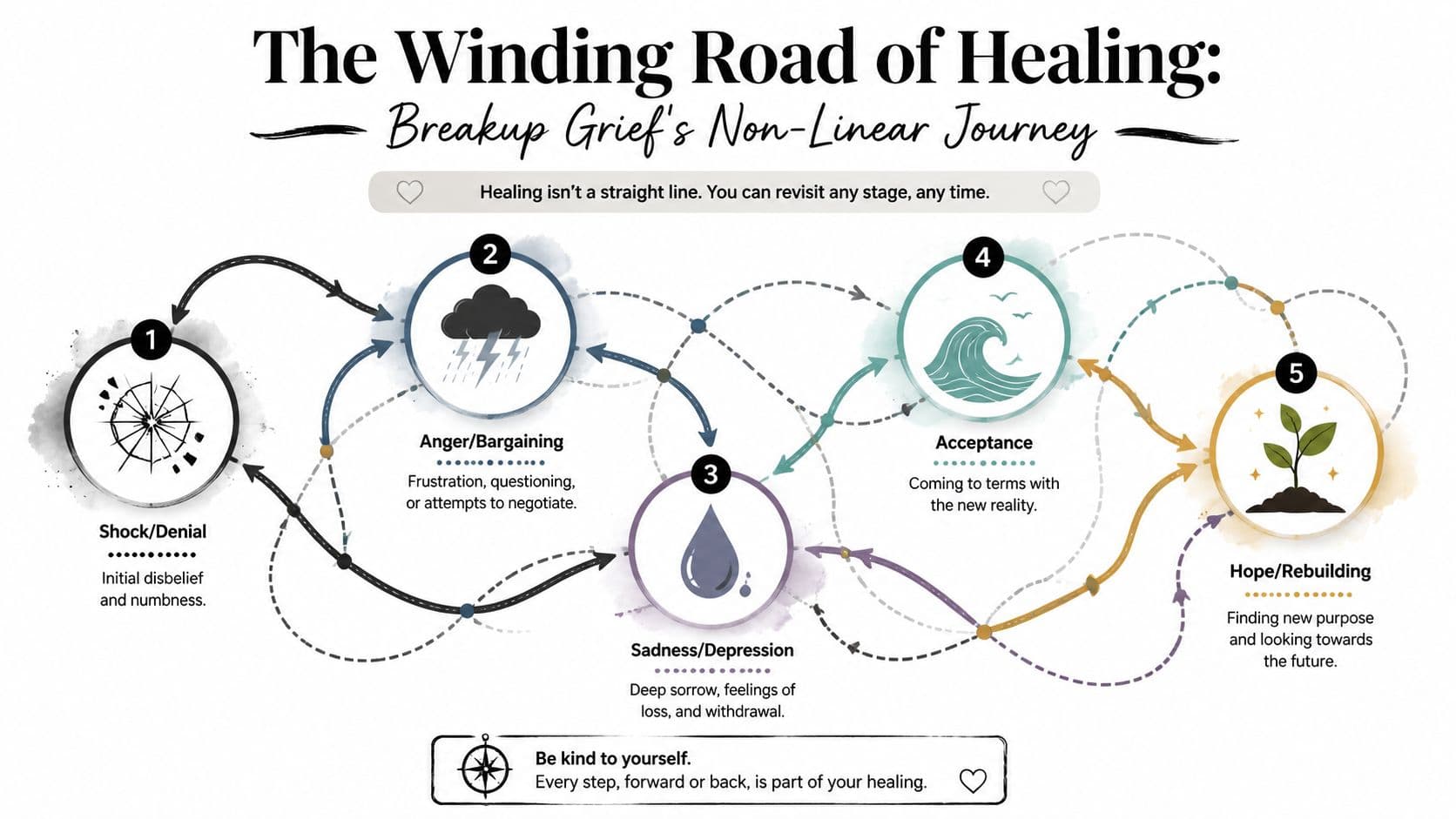
One of the hardest parts of breakup grief is that it rarely moves in a straight line. You can feel calm on Tuesday, devastated on Wednesday, annoyed on Thursday, and oddly hopeful by the weekend. Then a song plays in a coffee shop and you're right back in the ache.
That doesn't mean you're stuck. It means grief is cyclical.
A cross-national breakup study summarized here surveyed 5,705 participants in 96 countries and found that women reported slightly higher average emotional anguish than men, 6.84 versus 6.58 on a 10-point scale. The larger takeaway is that breakup pain shows up across cultures in a measurable way. You're not having some strange private collapse. You're in a human process that many people recognize.
Healing loops more than it climbs
People often think healing should look like steady progress. In real life, it tends to look more like this:
- Shock first, feelings later: at the beginning you may feel numb, practical, or oddly fine.
- Anger after longing: once the initial ache softens, frustration can rise.
- Relief mixed with grief: you can miss someone and still know the relationship wasn't healthy.
- Good days followed by crashes: a better day doesn't mean you're done grieving.
This is why rigid stage models can make people feel worse. If you expect a neat sequence, you'll mistake normal emotional swings for failure.
Reality check: You don't graduate from grief in a tidy order. Feelings revisit you until your mind and body catch up to the new reality.
How long does it take
A university thesis discussing breakup grief summarizes research suggesting a typical grieving period after romantic relationship dissolution of about 6–11 months, while also noting that many people begin to feel gradual improvement within weeks to months. Long-term relationships can take many months to process.
That range matters because it gives people permission to stop asking, “Why am I not over this yet?” If you're still hurting after a few months, that isn't automatically a sign you're doing something wrong. It may mean you lost something meaningful.
Common signs that can come and go
You might notice:
- Emotional swings: sadness, anger, confusion, relief, longing
- Mental loops: replaying conversations, second-guessing yourself, bargaining fantasies
- Body changes: fatigue, sleep disruption, appetite shifts
- Social changes: pulling back, feeling raw around couples, wanting reassurance
Healing usually becomes visible before it feels complete. You may start functioning better while still carrying a lot of tenderness. That's normal too.
How to Survive the First Days and Weeks
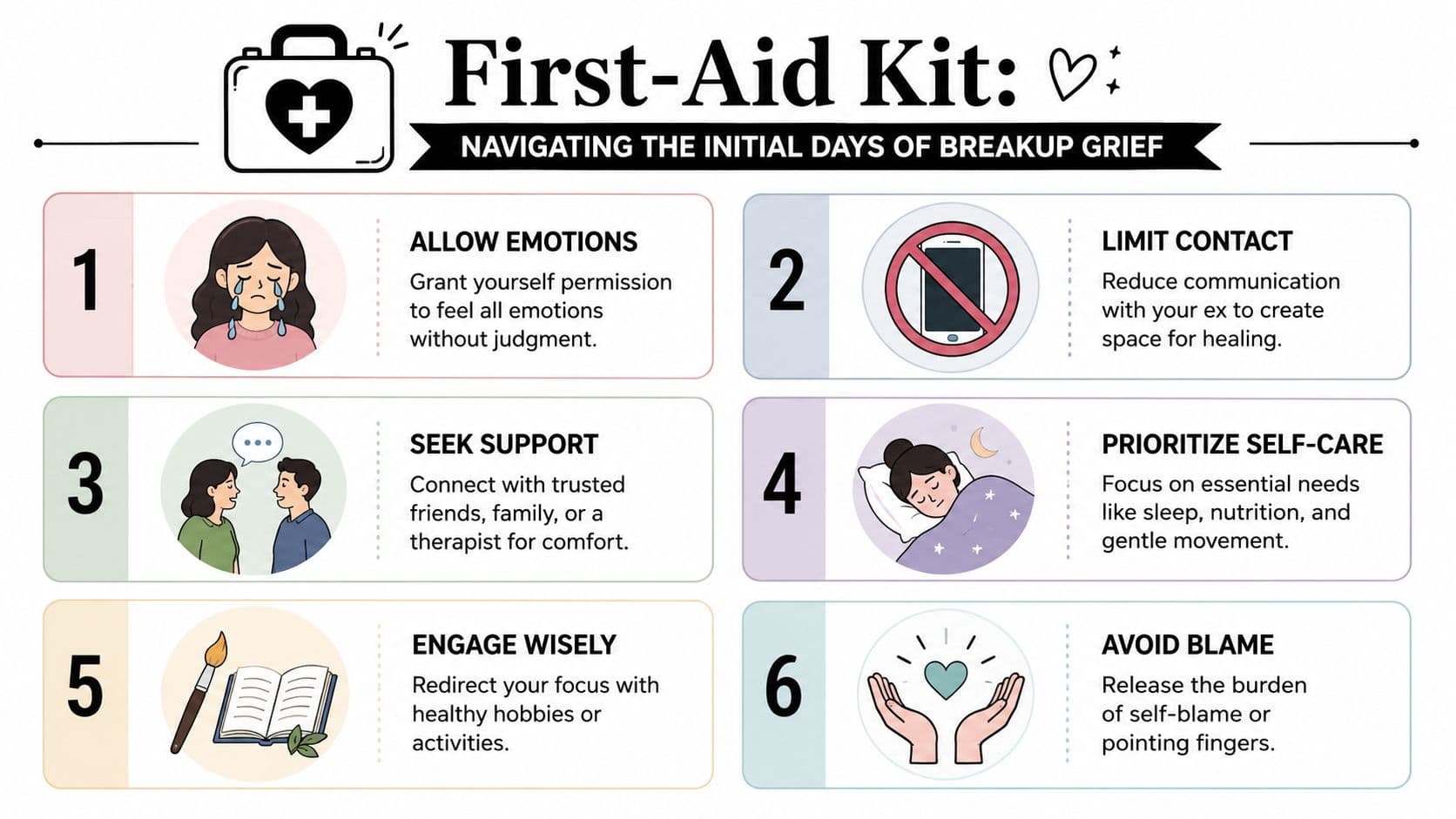
The first stretch after a breakup is not the time for perfect insight. It's the time for stabilization. Think emotional first aid, not life mastery.
Clinical guidance often treats the first 72 hours as a high-intensity period when emotional arousal can impair judgment, and one source specifically recommends waiting three days before major decisions or contacting an ex, as noted in this therapist guidance on breakup grief.
Use the three-day rule
If you can, avoid these in the immediate aftermath:
- Big declarations: “I'll never date again” or “I'm moving across the country.”
- Impulse contact: long texts, midnight calls, attempts to get closure while you're flooded.
- Digital self-injury: checking their social media, rereading old threads, tracking their status.
- Major decisions: quitting jobs, throwing out everything, jumping into a new relationship.
You don't need to solve the whole breakup in one weekend. You need to lower the emotional temperature.
Make your world smaller for a little while
When grief is acute, reduce your goals to basics.
- Sleep protection. Put your phone away earlier than usual. Even if you don't get quality sleep, give your body a chance to rest.
- Simple food. Eat whatever is realistic and gentle. Toast, soup, eggs, rice, fruit. This isn't the week for nutritional perfection.
- Body movement. A slow walk counts. Stretching counts. Standing in sunlight counts.
- One safe person. Pick one or two people who can handle your honesty without escalating the situation.
A practical support list helps. Write down:
- Who can listen
- Who can distract you
- Who can help with logistics
- Who you should not contact when you're spiraling
If your mind is racing, ask one small question: “What does my body need in the next hour?”
What to do when the urge hits
The urge to reach out can feel unbearable. When that happens, try a pause routine.
| Urge | Pause action |
|---|---|
| Text your ex | Write the message in Notes and wait |
| Check their profile | Hand your phone to a friend or leave the room |
| Blame yourself | Say out loud what you actually know, not what fear is guessing |
| Panic at night | Sit upright, breathe slowly, sip water, turn on one soft light |
The first days are often about preventing extra injury. That matters. A lot.
Rebuilding Your Life One Day at a Time
Once the initial shock settles, a quieter challenge begins. You have to build a life that no longer revolves around waiting, checking, hoping, or bracing. This stage is less dramatic, but it's where real healing often takes root.
One useful idea from post-breakup research is that coping style matters. A longitudinal study on post-breakup mental health found that attachment-related anxiety and avoidance predict more severe post-breakup depressive and anxiety symptoms through two pathways: higher self-punishment coping and lower accommodation coping. In plain language, people tend to suffer more when they respond with harsh self-blame and adapt less to the new reality.
Self-punishment versus adaptation
Self-punishment coping sounds like this:
- “I ruin everything.”
- “If I had been better, they would've stayed.”
- “This proves there's something wrong with me.”
Accommodation coping sounds more like this:
- “This hurts, and it's real.”
- “I can learn from this without attacking myself.”
- “My life has changed, and I can slowly adjust to that change.”
That distinction matters because self-blame often disguises itself as accountability. But beating yourself up doesn't deepen insight. It usually keeps you stuck.
A gentler standard: Take responsibility for your part without turning yourself into the villain of the story.
Rebuild through structure, not inspiration
You don't need a grand reinvention. You need repeatable anchors.
Try restoring rhythm in a few categories:
- Morning anchor: tea, shower, journaling, prayer, a walk around the block
- Body anchor: regular meals, sleep routines, movement that doesn't feel punishing
- Relational anchor: one planned call, one coffee, one honest conversation each week
- Meaning anchor: reading, therapy, creative work, time in nature, spiritual reflection
This works because routine tells your nervous system that life still has shape.
Journaling that actually helps
A blank page can feel overwhelming, so use prompts with edges.
Try these:
- What exactly am I grieving today? The person, the future, my identity, my safety, my routine?
- What story am I telling myself about this breakup? Is that story kind, fair, and fully true?
- What do I miss that I can begin giving myself in new ways?
- What did this relationship reveal about my needs, limits, and patterns?
- What would healing look like this week, not forever?
Some people also benefit from two columns. In one, write the self-punishing thought. In the other, write the most honest compassionate response you can manage.
Let identity return in pieces
You might not know who you are yet outside this relationship. That's okay. Identity rarely returns all at once.
It often comes back through ordinary moments. You remember what music you like when no one else is choosing. You notice how you spend a free Saturday. You rediscover parts of yourself that got quieter while the relationship took center stage.
That isn't just recovery. It's information.
Discovering Purpose and Meaning in the Pain
At some point after a breakup, a quiet question often shows up in the middle of an ordinary moment. You are washing a mug, sitting in traffic, folding laundry, and suddenly your mind asks, Who am I now? Not just without this relationship, but underneath it.
That question can feel unsettling because grief does more than hurt. It removes structure. It breaks the story you were living inside. The future you pictured is gone, and your mind starts searching for a new map.
That search is part of healing.

Pain can reveal what was hidden
A breakup often exposes patterns that were easy to miss while you were busy trying to keep the relationship going. Grief strips away distraction. What remains is often very honest.
You may start to see that you kept overriding your own needs to preserve connection. You may notice that intense chemistry pulled your attention away from compatibility. You may realize you were asking the relationship to prove that you were lovable, safe, or enough.
None of that means the relationship was pointless. It means the loss may be showing you where your inner life needs care.
Pain works like a flashlight in a dark room. It does not create everything you see. It reveals what was already there.
A spiritual lens can add meaning without denying reality
Some people do not want only coping tools. They also want a way to understand what this heartbreak is asking of them as a person. That is where a spiritual framework can be helpful, if it is used gently and without blame.
Dan Millman's life path framework, described in The Life You Were Born to Live, gives some people language for recurring lessons, strengths, and challenges. After a breakup, that lens can shift the question. Instead of staying only with, Why did this happen, you can also ask, What qualities is this experience trying to develop in me?
That question matters because grief is not only about losing someone. It is also about meeting yourself more truthfully.
For example, a person whose path centers on trust may discover how often fear chose their partners. Someone whose lesson involves boundaries may finally see how often they confused self-sacrifice with love. A person learning courage may notice how much of their life was organized around avoiding rejection.
The point is not to force a grand meaning onto fresh pain. The point is to let the pain become information.
How to use this without turning it into self-blame
Spiritual reflection can help. It can also go wrong if you use it to shame yourself.
A healthier approach sounds like this:
- Name the pattern, not your character. “I ignored my limits” is more useful than “I ruin relationships.”
- Look for the lesson, not a cosmic punishment. Growth is different from blame.
- Ask what wants to strengthen now. Boundaries, self-trust, honesty, discernment, patience, or self-respect.
- Let grief and meaning exist together. You can cry for what you lost and still believe this experience is shaping you.
That balance matters. If you rush to meaning too early, you can bypass grief. If you stay only in devastation, you can miss what your own life is trying to teach you.
Questions that turn pain into self-discovery
If this perspective speaks to you, spend time with a few questions instead of trying to answer everything at once:
- What did this relationship ask me to learn about love, limits, or truth?
- What old wound became activated here?
- Where did I abandon myself to avoid losing someone else?
- What quality is life asking me to build now?
- Who am I becoming through this loss, even before I fully understand it?
Write your answers slowly. Keep them simple. A sentence or two is enough.
Healing also includes remembering that your heartbreak is not only an ending. It may be an initiation into a more honest version of your life.
Meaning usually arrives in pieces. First comes survival. Then a little clarity. Then a moment when you notice you are no longer asking only how to get the person back, but how to come back to yourself.
That is purpose beginning to take shape.
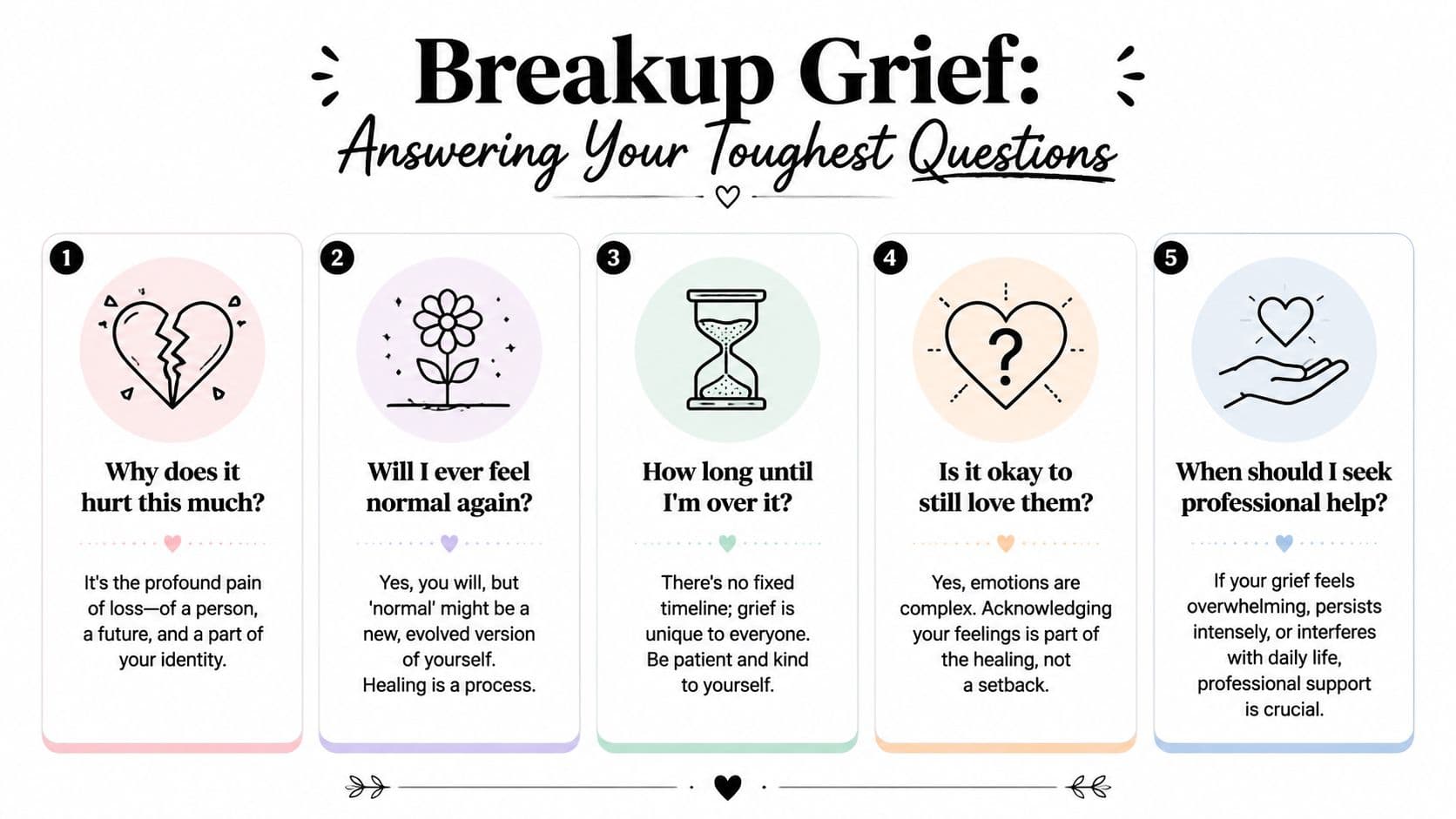
Answering Your Toughest Questions About Breakup Grief
Some questions linger because generic breakup advice doesn't touch them. The pain gets more manageable when you answer the core question, not the polite one.
Is it normal to grieve a short or toxic relationship
Yes.
Length is only one factor. A short relationship can carry intense hope, longing, chemistry, or projected future. A toxic relationship can create trauma bonds, confusion, and deep emotional entanglement. Sometimes people grieve those relationships even harder because they aren't only mourning love. They're mourning what they hoped the relationship would finally become.
Is it okay that part of me still loves them
Yes, that's also normal.
Love doesn't switch off neatly because a relationship ends. You can still love someone and know you can't be with them. You can miss them and not want them back. You can feel relief and heartbreak in the same week.
Conflicting feelings usually mean you're human, not confused beyond repair.
What if I have to stay in contact
Keep contact purposeful and contained.
A useful guideline is to make communication:
- Brief
- Specific
- Relevant to the shared responsibility
- Free of emotional processing if possible
If you share children, work together, or have practical obligations, you may need emotional boundaries more than physical distance. That can mean scheduled communication, written communication, or pausing nonessential conversations.
How do I know if this is more than normal grief
This is the question many people ask too late.
According to HelpGuide's mental health guidance on breakups and divorce, persistent impairment, severe hopelessness, or an inability to function are critical signs that professional help is needed. Those reactions go beyond ordinary heartbreak.
A simple way to put it:
| More typical grief | Signs to seek support |
|---|---|
| Painful but fluctuating feelings | Ongoing inability to function in daily life |
| Sadness with some moments of relief or connection | Severe hopelessness that doesn't let up |
| Distress that slowly shifts over time | Persistent impairment that keeps disrupting work, care, or safety |
Please don't use this table to diagnose yourself. Use it as permission to take your pain seriously.
What if I thought I'd be better by now
Then you're probably being harder on yourself than the situation warrants.
Healing often takes longer than people expect, especially if the relationship shaped your identity, repeated old wounds, or ended with betrayal and confusion. If you're still grieving, it doesn't automatically mean you're stuck on the person. You may still be healing the meaning of what happened.
If your suffering feels too heavy to carry alone, reaching out for therapy or mental health support is a wise step, not a dramatic one.
If this breakup has opened bigger questions about your patterns, purpose, and the lessons beneath your relationships, the Life Purpose App can be a thoughtful next step. As a digital companion to Dan Millman's The Life You Were Born to Live, it helps you explore your life path, core themes, and relationship dynamics in a deeper way. For some people, that kind of reflection brings welcome clarity during heartbreak, especially when they're ready to turn pain into self-knowledge.
Discover Your Life Purpose Today!
Unlock your true potential and find your life’s purpose.
