Discover what "hands in light" really means — from energy healing traditions and spiritual symbolism to the surprising science of light emitted by human hands.

October 5, 2026 (1mo ago)
Hands in Light: Meaning, Symbolism, and Science Explained
Discover what "hands in light" really means — from energy healing traditions and spiritual symbolism to the surprising science of light emitted by human hands.
← Back to blog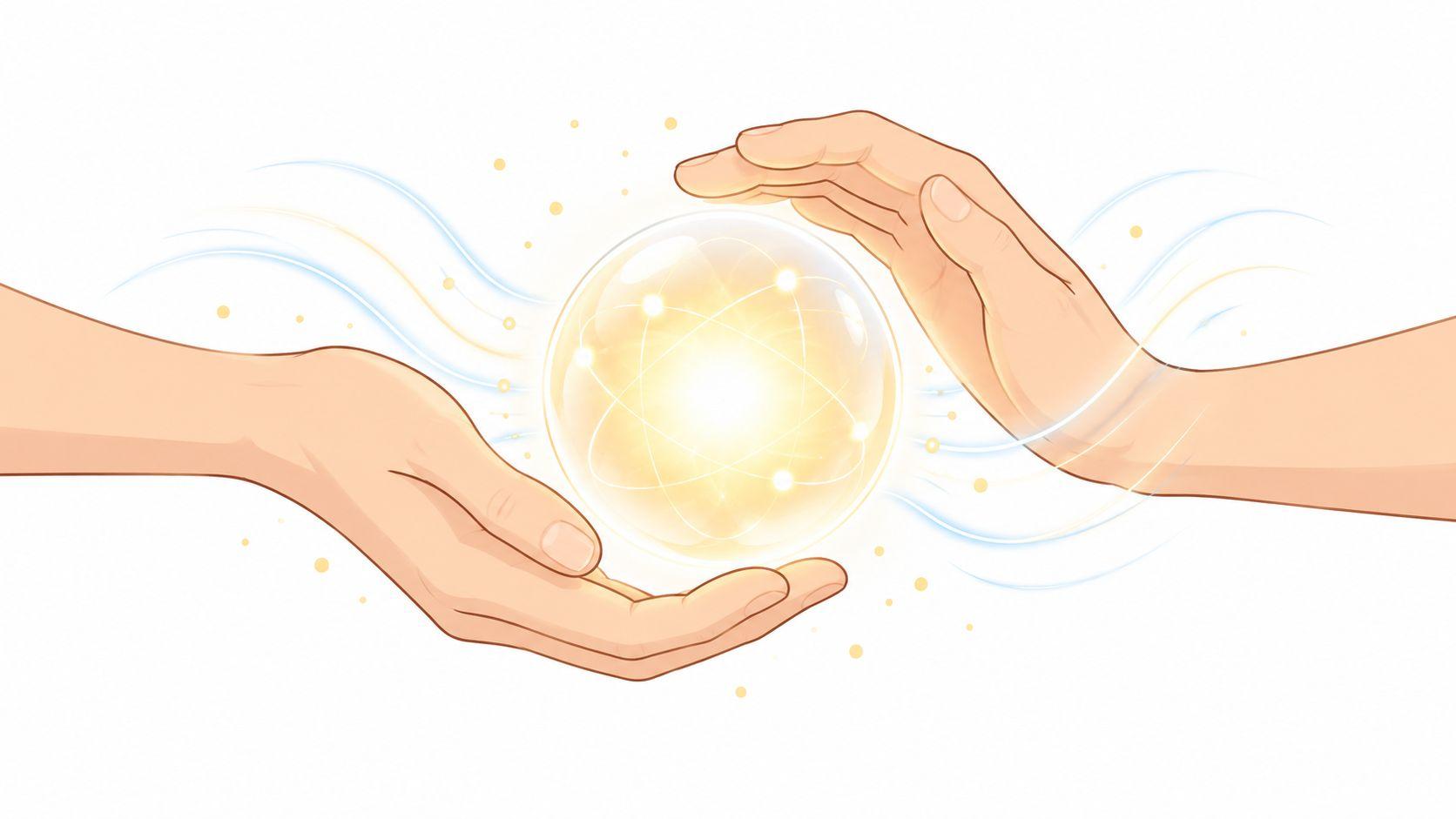
Discover what "hands in light" really means — from energy healing traditions and spiritual symbolism to the surprising science of light emitted by human hands.
Hands in light has at least three distinct meanings, while human hands can emit around 60 photons from the fingernails, 40 from the fingers, and 20 from the palms. The phrase can refer to an energy-healing practice, spiritual or artistic symbolism, or the literal interaction between human hands and measurable light.
Why can one short phrase point to a healing system, a stock photograph, and a physics experiment at the same time?
Search results rarely answer that question. They mostly show hands reaching toward brightness, cupping a glowing object, or being illuminated from below. The image is familiar, but the meaning behind it changes completely depending on who is using it.
This guide separates the three interpretations without dismissing any of them. It treats Barbara Brennan's Hands of Light as a spiritual healing tradition, examines hands reaching toward light as visual symbolism, and then looks at what researchers have measured from human hands.
What Does Hands in Light Actually Mean
Someone searching for hands in light might be looking for a meditation image, a Reiki-related idea, a book about the human energy field, or a scientific explanation of faint light emitted by skin. Those searches share words, but they don't share an underlying subject.
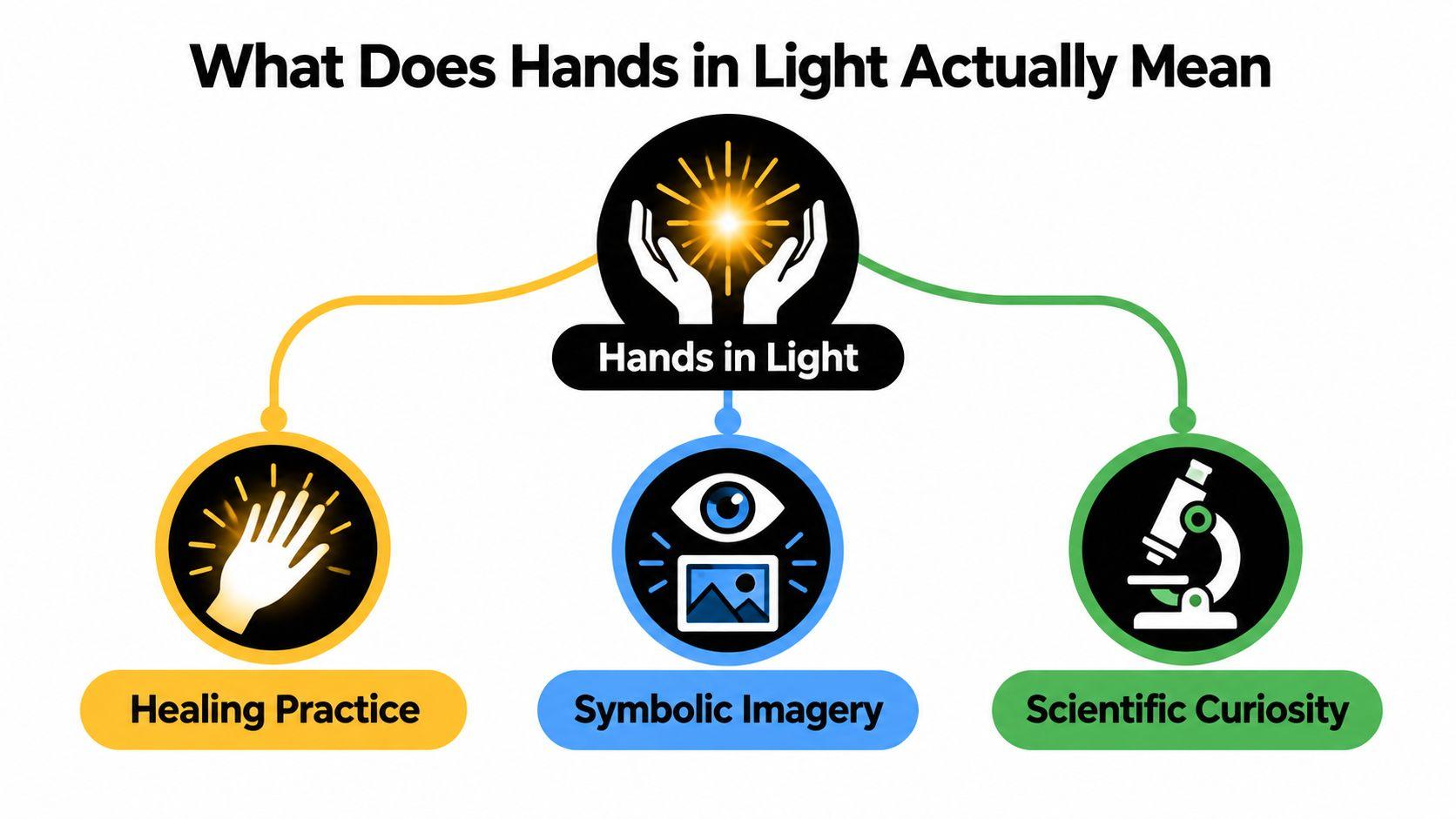
The phrase becomes easier to understand when you place it into one of three lanes.
The healing practice
In the first lane, hands in light refers to the language of energy healing. Practitioners may describe the hands as sensing, directing, balancing, or supporting a subtle human energy field. The phrase can also evoke hands-on healing, hands held above the body, or the visual vocabulary associated with Reiki and related wellness practices.
This is a belief-based and experiential framework. Its terms belong to the tradition itself, so they shouldn't be confused with the technical language of biology or physics.
Readers drawn to this lane may also encounter ideas such as chi, a concept explained in greater detail in this guide to what chi means. That vocabulary can help explain how some traditions describe vitality and connection, but it doesn't turn a spiritual interpretation into a laboratory finding.
The visual symbol
In the second lane, hands in light is an image rather than a treatment. Open hands reaching toward a bright area can suggest hope, prayer, surrender, discovery, protection, connection, or mystery. A designer may use the same composition for a meditation app, a film poster, a charity campaign, or a wellness website.
Most search results for the phrase are stock-image or visual-design pages instead of explanatory articles. As the available hands-in-light footage and imagery shows, commercial pages tend to describe what the picture looks like, not what the phrase means in practice or how its meaning changes across spiritual, artistic, and commercial settings.
The measurable phenomenon
The third lane is literal. Human hands emit faint light, including visible-range ultraweak photon emission, and they can also act as passive infrared sources. These findings concern chemical and thermal processes in the body and the way infrared radiation can be detected or used.
That doesn't automatically validate energy healing. It does show that the phrase has a surprising scientific foothold, even if that foothold is different from the one described by spiritual traditions.
A single phrase can carry unrelated meanings across different communities. Identify the lane first, then decide what kind of answer you need.
The Healing Tradition Behind Hands of Light
The strongest literary association with hands and light comes from a book Hands of Light: A Guide to Healing Through the Human Energy Field. The title helped give a clear, memorable form to an idea that had previously circulated through various subtle-energy and spiritual communities.
The book was first published in 1987 by Pleiades Books. It was then issued in a simultaneous hardcover and trade paperback edition by Bantam in June 1988, according to the archived text of Hands of Light.
Brennan presented her system as grounded in professional observation and practice. The book describes fifteen years of professional experience and observations of 5,000 clients and students as the basis for its approach to energy-field healing. Those details matter historically because they show how the work positioned itself, not because they independently prove the existence of the field it describes.
How the vocabulary took hold
A person might encounter the phrase through a practitioner who speaks about sensing energy around the body, through a training course that uses the hands as instruments of attention, or through a book that presents the body as more than its visible anatomy. In each case, light carries a layered meaning. It can suggest perception, healing, consciousness, warmth, or an unseen dimension of human experience.
A later summary of Brennan's Hands of Light describes the book as drawing on more than 20 years of experience with 5,000 clients and students and identifies it as a landmark 1987 publication that helped popularize energy healing and the human energy field in the wider wellness market. The difference between the book's own description of fifteen years and this later summary's description of more than 20 years is a reminder to distinguish historical accounts from the system's spiritual claims.
The book's influence also explains why hands in light appears in wellness branding. Hands are practical, intimate, and human. Light is difficult to define, so it can stand for transformation without committing the reader to one specific doctrine.
People interested in the emotional or intuitive language surrounding this tradition may also encounter discussions of empaths and healers. Such language belongs to the broader spiritual ecosystem around the book, rather than to clinical diagnosis.
What the book does and doesn't establish
Hands of Light is important as a cultural and spiritual reference point. It documents a particular system and helped bring its vocabulary to a broad readership. It doesn't, by itself, establish that a human energy field has been measured in the scientific sense or that every healing claim associated with the tradition is clinically confirmed.
That distinction lets readers approach the work seriously without asking it to be something it wasn't written to be. It is a guide to a spiritual model of healing, not a substitute for medical care or controlled scientific evidence.
What Energy Healing With the Hands Claims to Do
In Brennan's framework, the body is surrounded by a human energy field that can be perceived and influenced through trained attention. The practitioner's hands become tools for sensing differences, locating areas that seem disturbed, and supporting a process the tradition describes as healing or balancing.
The practitioner might touch the body lightly, keep the hands just above it, or move them through particular areas without physical contact. The exact ritual varies by school and practitioner, but the central idea remains similar. The hands are treated as instruments of perception and interaction, not merely as a way to deliver pressure or massage.
A useful analogy is a musician tuning an instrument that can't be seen. The practitioner listens through sensation, intuition, or visualisation, then makes small adjustments according to the system being taught. The analogy explains the practitioner's role without claiming that an invisible field has been demonstrated by the same methods used to measure temperature or radiation.
What people seek from a session
People may approach energy healing because they want relaxation, emotional processing, a sense of connection, or a reflective ritual. Those are reasonable descriptions of what a person might seek or report. They shouldn't be rewritten as clinically established outcomes.
Brennan's work helped make this vocabulary familiar, while later wellness businesses adapted it to different settings. A calm room, gentle touch, quiet music, and scent can all shape the experience. For practitioners who use incense as part of the atmosphere, a resource like quality incense blends for retail can be useful for understanding how scent is selected and presented in wellness environments.
The phrase healing also needs careful handling. A session may support a person's sense of calm or meaning, but it shouldn't replace medical assessment, psychological care, or prescribed treatment. A responsible practitioner will explain the limits of the service rather than promising to cure disease.
Choosing a practitioner
If you want to explore the tradition, ask practical questions before booking:
- Training: What system did the practitioner study, and what does the training cover?
- Boundaries: Will the practitioner avoid diagnosing illness or telling you to stop medical treatment?
- Consent: Can you choose hands-on, hands-above-body, or no-touch work?
- Expectations: Does the practitioner describe possible experiences rather than guarantee a result?
- Professional conduct: Are fees, session length, privacy, and cancellation terms clear?
A reflective practice can be meaningful without requiring exaggerated promises. Readers who want language for intention and emotional support may also explore sending healing vibes, while keeping the distinction between a personal ritual and a medical intervention clear.
The Surprising Science of Light From Human Hands
The scientific question is narrower than the spiritual one: do human hands emit measurable light? The answer is yes, but the mechanism described by research is not the same as the energy field proposed in Brennan's system.
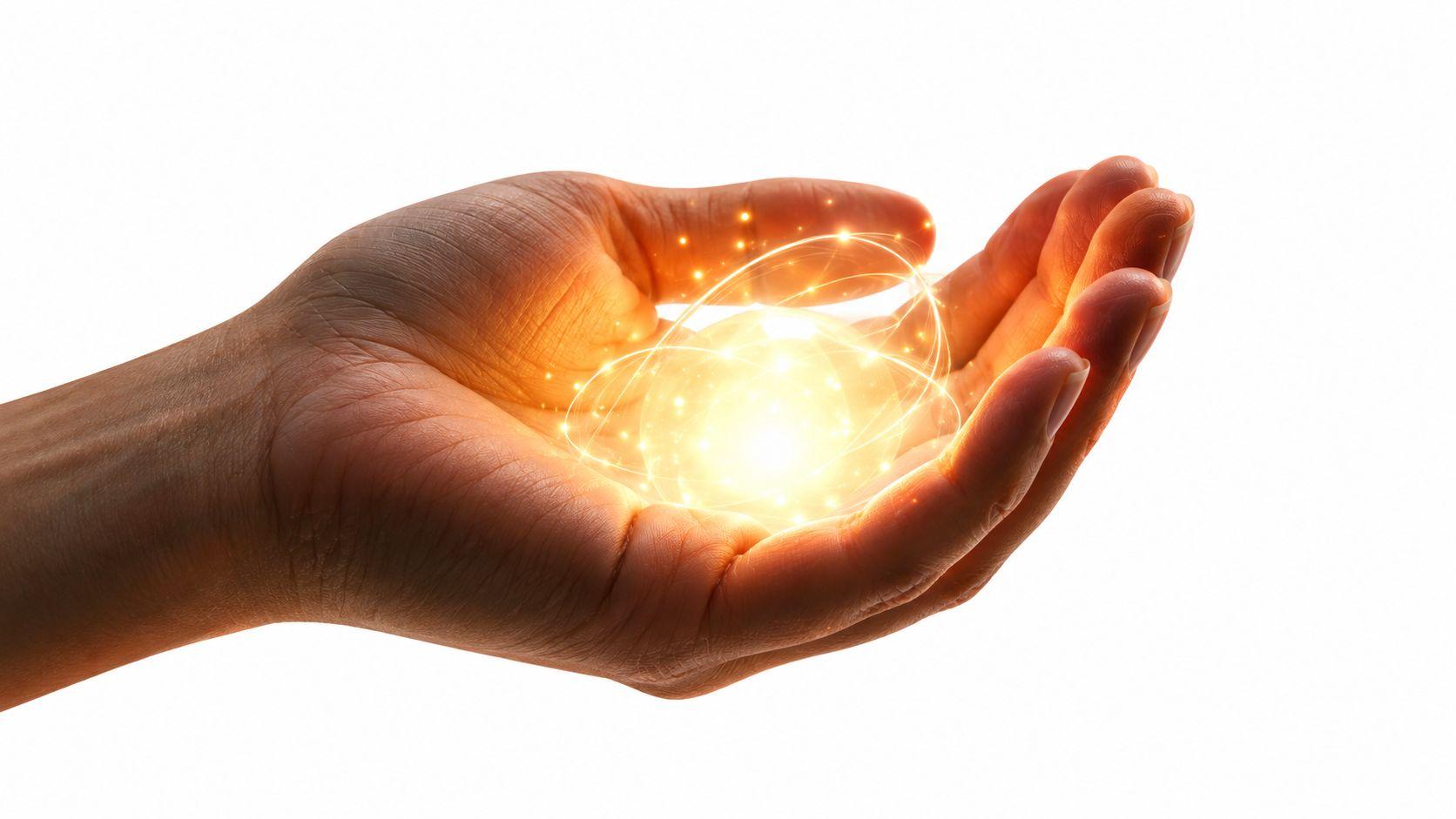
One study reported different visible-range photon counts from different regions of the hand. It found around 60 photons from fingernails, 40 from fingers, and 20 from palms, with emission increasing under warmer temperatures and added oxygen, as described in this report on ultraweak light from human hands.
The researchers interpreted the signal as chemiluminescence. Some of the light was associated with reactions at the skin's surface involving oxygen, while some was linked to internal biochemical processes. This is a faint physical emission, not the bright glow shown in a fantasy illustration.
Why the measurements matter
The result challenges a simple assumption that hands are completely dark unless an external lamp shines on them. Human tissue produces chemical activity, heat, and radiation. Sensitive instruments can detect signals that ordinary vision can't.
Temperature and oxygen matter because chemical reactions can change as conditions change. That gives the phenomenon a testable physical explanation. Researchers can vary conditions, measure emissions, and compare regions of the hand.
The hand also interacts with infrared light in a different way. A peer-reviewed PNAS study on passive infrared emission showed that each finger can act as an independent IR emitter. By changing hand gestures, a person can control the number and spatial arrangement of those emitters, allowing the hand to function as a multiplexed light source without external power.
What the science supports
The research supports three modest conclusions:
- Human hands emit faint visible light: The signal can be measured and varies by hand region and environmental conditions.
- Human hands emit infrared radiation: Fingers can operate as separate passive IR emitters in a controlled arrangement.
- Gesture can affect infrared structure: Changing the position of the fingers changes the spatial pattern available to a detector.
The research doesn't establish that a healer can direct a spiritual energy field into another person, that photon emission explains emotional improvement, or that infrared emission validates every claim made in energy-healing traditions.
That boundary is important. Spiritual practice and physics can both be discussed respectfully, but they answer different questions. One asks how people interpret experience and healing. The other asks what instruments can detect, under defined conditions.
Hands Reaching for Light as a Symbol
Hands reaching toward brightness work because they communicate before the viewer has time to analyze them. An open palm can imply receptivity. A hand rising into a beam can suggest escape, hope, prayer, ambition, or a search for knowledge. Designers can adapt the gesture to many messages without changing the basic composition.
Commercial imagery keeps reusing the motif because it remains flexible. Recent stock-footage listings from 2026 still frame hands reaching for light as useful for hope, spirituality, connection, or mystery, while related decorative concepts include hand-shadow lighting associated with interactive and multifunctional decor.
The same picture can therefore signal different things to different audiences.
| Context | What the Image Signals | Typical Audience Expectation |
|---|---|---|
| Meditation app | Calm, openness, inner reflection | A guided exercise, breathing practice, or quiet pause |
| Film poster | Mystery, danger, revelation, or longing | A story involving transformation or an unknown force |
| Therapy practice homepage | Support, trust, human connection | A safe conversation and a compassionate professional |
Symbolism is not evidence
A glowing hand in a poster doesn't claim to document photon emission. It uses light as a metaphor. Confusing the metaphor with the physical phenomenon creates unnecessary arguments, because the image was never meant to be a laboratory diagram.
The motif can also be personal. An artist might use reaching hands to represent grief, faith, migration, recovery, or a desire for contact. Someone developing a tattoo concept may explore reaching ideas for tattoos as a way to turn that broad symbolism into a more specific visual statement.
The meaning depends on surrounding details. A dark background can add uncertainty. Warm light can suggest comfort. A hand cupping a small glow can imply protection, while several hands around one source can suggest community.
Why the motif persists
The phrase remains commercially active, but that doesn't prove that public understanding is deepening. Search results are crowded with licensing pages that sell the visual while offering little explanation of its cultural, spiritual, or scientific meanings.
That creates a useful contrarian reading. The popularity of hands in light may reflect aesthetic reuse more than sustained informational demand. People may repeatedly choose the image because it is emotionally legible, not because they agree on what it means.
Reading the motif consciously gives the viewer more control. Instead of accepting light equals hope automatically, ask who created the image, who is meant to see it, and what action the image is supposed to encourage.
How People Explore Hands and Light Today
Interest in hands and light often points to a larger question about self-knowledge. A person may begin with an image, then look for a healing practice, a meditation ritual, or a structured way to reflect on identity and direction.
One path follows the lineage associated with Brennan's Hands of Light. That can involve reading the book, attending a session, or studying with a school that teaches energy-field practices. In each case, the important step is to understand what the practitioner or school claims, what evidence it offers, and what boundaries it maintains around medical and psychological care.
Another path uses a symbolic system for personal reflection. Dan Millman's book, The Life You Were Born to Live, presents a life-path framework based on a birth date. The revised edition expanded the system from 37 life paths to 45, as described in this account of Dan Millman's revised framework. The Life Purpose App presents the same book-based system in digital form.
How the birth-date method works
The calculation has a detail that readers often miss. In Dan Millman's The Life You Were Born to Live and the Life Purpose App, the digits of the birth date are added together, but the final total is kept rather than reduced to a single digit. A total such as 37 identifies a specific life path in the method, instead of being reduced again.
That makes this approach different from many mainstream numerology references, which commonly describe life paths through single digits and may also use additional special values. If you're exploring life paths or life numbers, use the terminology and calculation method from Dan Millman's The Life You Were Born to Live and the Life Purpose App rather than combining rules from unrelated systems.
The appeal is partly practical. A fixed calculation gives the reader a starting point for journaling about strengths, recurring challenges, work, relationships, and personal direction. It doesn't provide a scientific measurement of personality or destiny, so it works best as a reflective framework rather than a prediction engine.
A simple way to choose
- Choose the healing route if you want an embodied ritual involving attention, touch, or hands held above the body.
- Choose the symbolic route if you're interested in art, branding, meditation imagery, or the emotional meaning of light.
- Choose the life-path route if you want a structured self-reflection exercise based on Dan Millman's The Life You Were Born to Live and the Life Purpose App.
These routes can sit alongside one another, but they shouldn't be treated as interchangeable proof systems. A life-path calculation doesn't verify an energy field, and a calming healing session doesn't validate a numerological conclusion.
Finding Your Own Answer Plus Common Questions
The most useful interpretation depends on what brought you to the phrase.
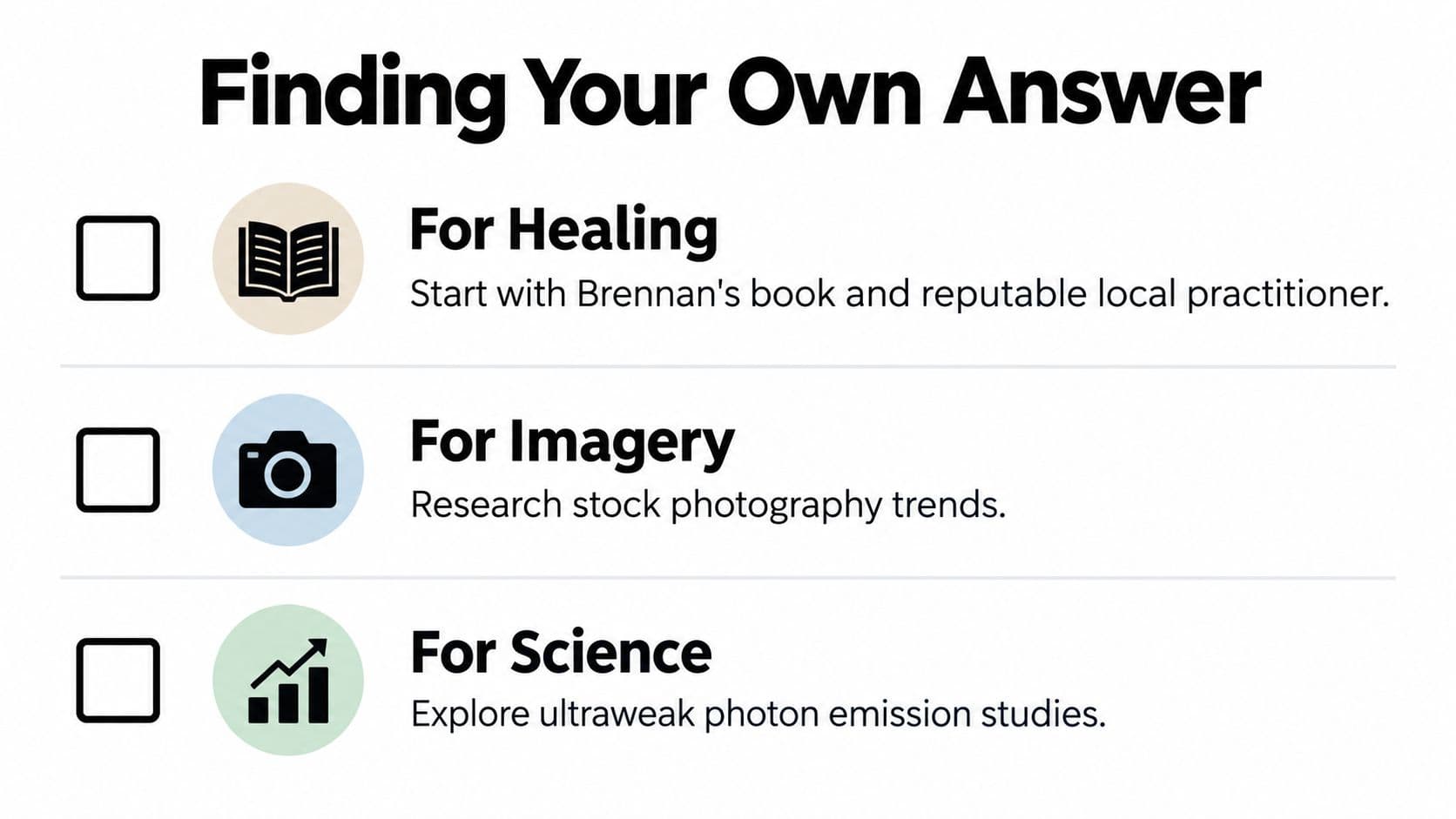
If you came for healing, begin with Brennan's book and evaluate a reputable local practitioner carefully. If you came for imagery, ask what the composition is trying to make you feel and what audience the creator wants to reach. If you came for science, follow the research on ultraweak photon emission and passive infrared light rather than relying on a glowing illustration.
Does hands-on healing require training
A practitioner should have training in the specific system they offer, clear consent procedures, and an honest explanation of what a session can and can't do. Training may teach touch, hand positions, attention, ethics, or the tradition's interpretation of the human energy field. It doesn't qualify someone to diagnose illness unless they also hold appropriate healthcare credentials.
Does the hands-in-light image have religious origins
The image can resemble prayer, blessing, supplication, or divine illumination, but it doesn't have one universal religious origin. Artists, advertisers, wellness businesses, filmmakers, and designers use the same visual language for different purposes. Context determines whether the image reads as sacred, therapeutic, inspirational, or dramatic.
Can life-path systems and energy healing be combined
They can be combined as personal practices if the person understands that they serve different purposes. Dan Millman's The Life You Were Born to Live and the Life Purpose App provide a structured reflection system, while energy healing offers a ritual or experiential framework. Neither should be presented as scientific confirmation of the other, and neither should replace appropriate medical or mental-health support.
Curiosity connects all three meanings. Whether you're studying a book, decoding an image, or examining faint emissions from the skin, the phrase becomes clearer once you stop forcing unrelated ideas into one definition.
If you want a structured way to reflect on direction, strengths, and recurring life themes, explore the Life Purpose App, a digital companion to Dan Millman's The Life You Were Born to Live. Enter your birth date to explore the book's life-path framework, then use the result as a starting point for thoughtful self-reflection rather than a fixed prediction.
Discover your life path today
Enter your date of birth and see your life path, free.
Find your life path