Hands of Light by Barbara Brennan explained: its energy-field concepts, what research shows, who the book suits and how to read it safely.

November 5, 2026 (13d ago)
Hands of Light Explained: A Guide to Brennan's Book
Hands of Light by Barbara Brennan explained: its energy-field concepts, what research shows, who the book suits and how to read it safely.
← Back to blog
Hands of Light by Barbara Brennan explained: its energy-field concepts, what research shows, who the book suits and how to read it safely.
The Barbara Brennan School of Healing says Barbara Brennan had observed 5,000 clients and thousands of students by the time it described Hands of Light. That number reframes the book. It isn't a short speculation. It's the written form of a practice built across a very large caseload, then taught to other people.
You can use that practice as a mirror for attention, mood, and sensation. You can't treat it as a lab report or a diagnosis. This guide keeps those jobs apart. It explains the model on the book's own terms, then sorts each claim into reflective use, unproven, or needs a clinician.
What Hands of Light Is and Where It Came From
Hands of Light is a 1987 book by Barbara Brennan that sets out her model of the human energy field and the healing practice behind it. A client who waits months for a session isn't meeting a theory drafted the night before. They're stepping into a sequence the practitioner has already repeated and started to teach.
The Encyclopedia.com account of the Barbara Brennan School of Healing records that she founded the school in 1982 to train professional healers, left private practice in New York City to expand it, and by 1986 had private clients scheduled as much as one year in advance. That same account places the first publication in 1987 as a hardcover associated with Pleiades Books, calls the title a New Age bestseller in 1989, and notes a graduate program in the 1999–2000 academic year for former graduates.

The curriculum was organized around four areas: healing science, personal awakening and self-exploration, creativity, and professionalism. That mix explains the book's voice. You're not only reading a picture of an aura. You're also being asked to examine yourself, practice a skill, and behave like someone who might work with other people.
The book reads best as the written manual of a working practice, which is why the tone is exercise-heavy and hands-on.
Keep that training focus in mind. The pages assume repetition, supervision, and time, not a single evening of reading.
The Core Ideas Behind Aura, Chakras and the Energy Field
Brennan describes a human energy field around the body that practitioners learn to sense through trained awareness, meditation, and visualization. The map comes before the proof. Each part below is what the book asks you to notice, not a measurement a clinic can order.
| Concept | What Brennan describes | Practical reflective use |
|---|---|---|
| Human energy field (aura) | Layered field surrounding the body, perceived through trained sensing | Notice mood and body sensations before and after a practice |
| Chakras | Energy centers along the body's central axis | Use each center as a prompt for one theme such as body, emotion, or purpose |
| Hara line | Central line running through the core of the body | Use slow breathing to notice where your attention settles |
| Core star | Central point described as the source of an individual's energy pattern | Write down the qualities you associate with your center each week |
| Energetic blockages | Areas where energy flow is described as restricted | Track recurring tension and the situations that trigger it |
| High Sense Perception | Trained ability to perceive the energy field | Compare descriptions with a trusted partner to see whether they match |
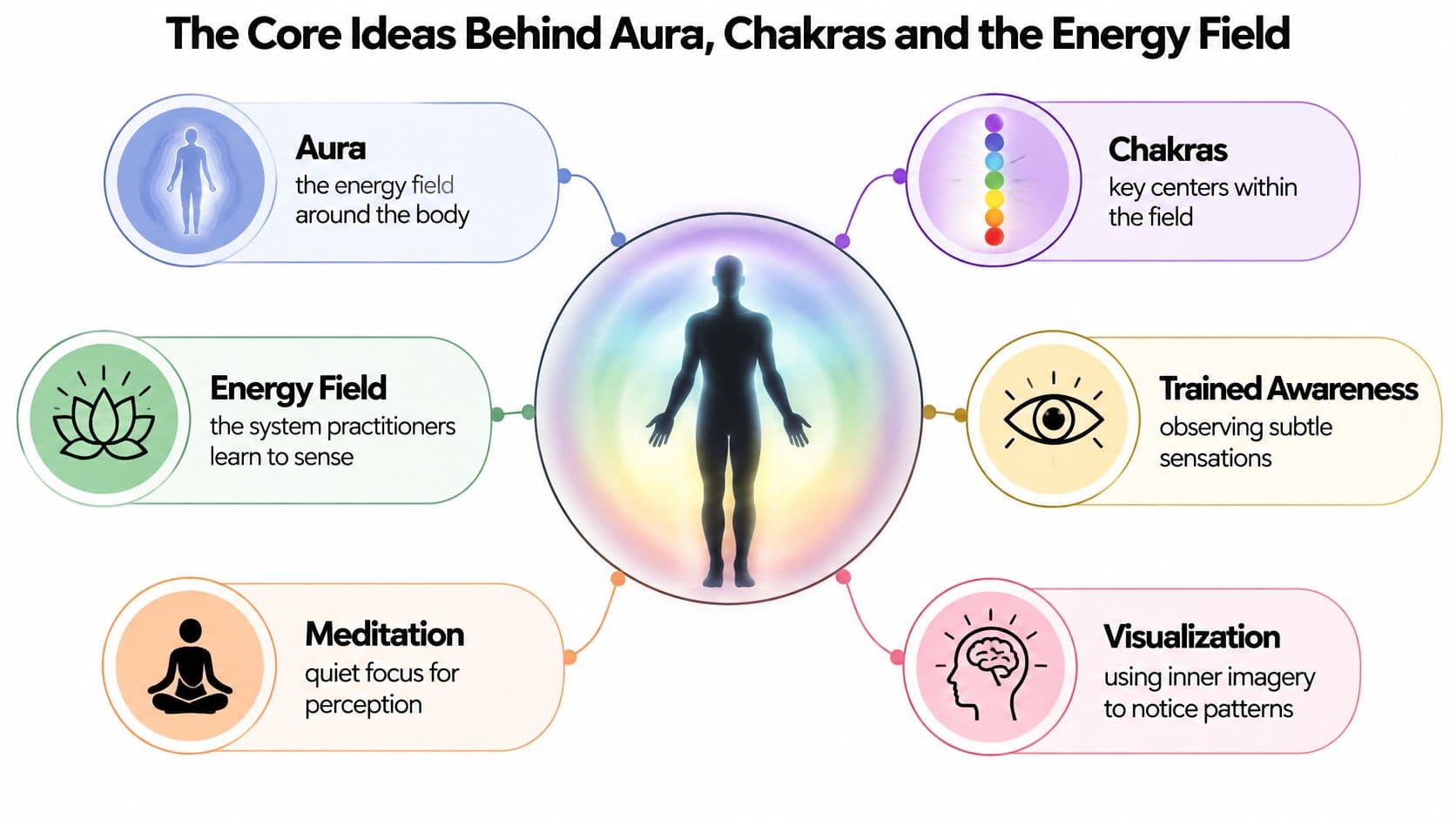
A map drawn by feel
The model's like a map drawn by someone who explored the terrain by feel. The map helps you notice patterns. It isn't the terrain, and it doesn't become a diagnosis because the drawing is detailed.
The aura, in this telling, is the field's outer layers. A reflective use is simple. Before a sit, note your mood in one line. Afterward, note warmth, pressure, or a shift in mood. You're logging experience, not confirming a layer of light.
Chakras are energy centers along the body's central axis. Give each center one theme, such as body, emotion, or purpose, and stop there. A chakra color chart can keep those themes from blurring together. If you want a sensory cue while you journal, the chakra scent recommendations from Aroma Warehouse pair familiar scents with each center. Scent is a prompt for attention, not evidence that a center is medically real.
Line, center, blockage, and perception
The Hara line is described as a central line through the core. Slow breathing is enough. Notice where attention settles, high in the chest or low in the belly, and write that down without a story attached.
The core star is a central point described as the source of a person's energy pattern. Once a week, list qualities you associate with your center, such as steadiness or scatter. If that list starts to sound like a life path, Dan Millman's book, "The Life You Were Born to Live," and the Life Purpose App are a separate self-knowledge system. They aren't a test of this star.
Energetic blockages are places where flow is described as restricted. Practitioners talk about clearing them through attention and hands-on work. Your safer version is a tension log. Note the body area, the situation, and whether the feeling eased after rest. Don't decide the log found a blocked current.
High Sense Perception is the trained ability to perceive the field. Compare a short description with a trusted partner who did the same exercise. Matching words are interesting. They still aren't a blinded test.
You should now be able to name each concept, say what it's meant to describe, and separate a reflective prompt from a claim that still needs evidence.
What Research Says About the Book's Energy Claims
Read the bottom line before the detail. Related research can track symptoms. It doesn't confirm Brennan's specific chakras or aura.
| Evidence area | What the studies found | What it means for readers |
|---|---|---|
| Aura and chakra model | No validated physiological measure; systematic review of 22 eligible studies from 67 records found inconsistent EEG findings | Treat as a reflective framework, not a diagnostic tool |
| Noncontact and biofield trials | Review of 90 randomized trials; only 28 trials (1,775 participants) used nonphysical-contact treatment; 12 of 18 eligible trials reported at least one significant benefit | Symptom-level benefit is possible; mechanisms remain unproven; studies are small |
| 2025 scoping review of biofield therapies | 353 studies, including 255 randomized trials; 172 positive, 95 mixed, 71 nonsignificant | Large literature with inconsistent results; no firm conclusion for specific conditions |
| Strongest outcome signal | Reductions in self-reported pain, with sparse evidence and design limits | Track pain and stress with validated scales if you test a practice yourself |
What those rows actually limit
A systematic review of physiological studies identified 22 eligible investigations from 67 records. Most were moderate-to-poor quality, EEG findings were inconsistent and nonspecific, and no physiological signature uniquely defining a healer's state emerged. Pain scores, anxiety, EEG, and heart-rate variability are common outcome measures in this area. They don't validate Brennan's chakras or aura model. Concepts in Hands of Light fit reflective self-observation. They aren't diagnostic instruments, and they don't show that you can detect disease or replace clinical care.
A review of noncontact healing trials looked at 90 randomized controlled trials and found only 28 trials, totaling 1,775 participants, that clearly used nonphysical-contact treatment. Protocols varied in condition, duration, controls, and outcomes. Twelve of the 18 trials not excluded for design reasons reported at least one statistically significant beneficial primary outcome, yet the authors judged these small, pilot-scale studies unable to support sound conclusions. The same review literature puts the strongest signal on reductions in self-reported pain, with sparse evidence and serious design limits.
A 2025 scoping review of biofield therapies identified 353 studies, including 255 randomized controlled trials, with 172 positive findings, 95 mixed results, and 71 nonsignificant results. Inconsistent reporting blocks any firm conclusion for a specific condition. Hundreds of papers are a reason to ask better questions, not a reason to treat the mechanism as settled. People comparing body-based traditions can read about understanding acupuncture's effects within the body as a different kind of claim, one that talks about biochemical pathways rather than an unmeasured field. That contrast is useful. It doesn't transfer proof to Brennan's map. If you like the language of subtle sensation, a piece on energy, frequency, and vibration can keep the metaphor separate from a clinical test.
Symptom-level benefit is possible. The mechanisms proposed in the book aren't established.
The table doesn't prove your personal experience wrong. It shows which claims are testable and which remain unproven. If you try a practice, measure perceived stress, pain, mood, or purpose with a validated scale, and don't call a calmer evening an energy-field correction.
How to Practice the Book's Self-Observation Exercises
This routine is for reflection. It doesn't clear a medical problem, and it works only if you record sensation before you explain it.
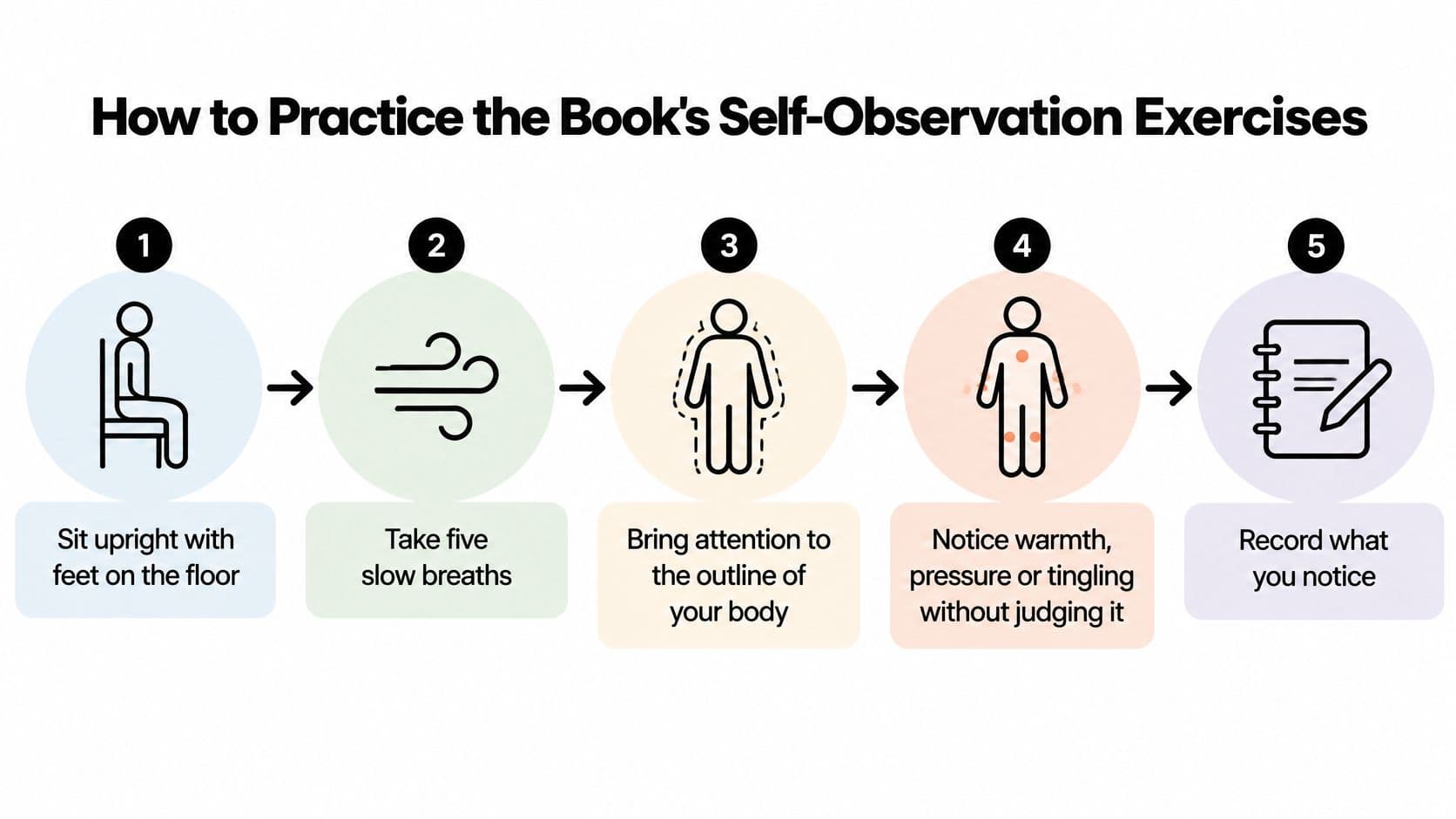
The six-step sit
- Sit upright with your feet on the floor and take five slow breaths. The upright seat keeps you awake, and the counted breaths give the sit a start so you don't drift into planning the rest of the day.
- Bring attention to the outline of your body. Notice warmth, pressure, or tingling without judging it. You're collecting raw sensation, the same kind of body signal discussed in recognizing your body's signals.
- Imagine a layer of light just beyond the skin and record its texture, color, or density as an impression. Label it as an image. The moment you call it an aura fact, you've left observation.
- Move attention through one chakra at a time, about a minute each, and note sensation plus any emotion. A minute is long enough to notice and short enough to stop you from building a theory mid-sit.
- Write the impressions in a journal, with what you felt in one column and what you interpreted in another. Pairing the sit with meditation and journaling keeps the page honest.
- Repeat for two weeks and compare entries. A single evening is a mood. Two weeks can show a pattern, such as chest tightness only after hard conversations.
The most common slip is rushing the chakra check, or deciding in advance what you should feel. Expectation then masquerades as perception. If you already "know" the throat center will feel blocked, you aren't observing. You're confirming a script.
What a useful log looks like
A useful log is short, dated, and boring in the best way. Sensation comes first. Meaning comes second, and only if you still want it.
Tuesday. Heavy feeling in the chest during the throat check. Neck stiff after a difficult call. Interpretation, saved for later: I want to say I swallowed my words. Sensation, kept as fact: heavy chest, stiff neck.
Don't add a diagnosis to that note. Don't add a cleared blockage either. After fourteen entries, look for repeats. Same time of day, same trigger, same body area. If a symptom is new, severe, or persistent, the log is a reason to call a clinician, not a substitute for one.
Who Hands of Light Suits and Who Should Look Elsewhere
Popularity and fit answer different questions. Barbara Brennan's biography on Wikipedia reports, from her official biography, more than 1 million copies in print and publication in 26 languages, figures that are publisher- or author-reported rather than independently audited sales. That reach shows the exercises found a wide readership over decades. It tells you nothing about whether the book is the right tool for your situation.
A fit check before you start
The book suits spiritual seekers exploring body-based imagery, students of energy healing, and counselors or wellness practitioners who want a reflective framework. It also suits readers who enjoy journaling and visualization and can hold an image loosely, without needing it confirmed. Those readers get a structured way to pay attention to their own reactions.
The fit fails somewhere else. It doesn't suit you if a symptom still needs a diagnosis, if you're weighing energy sessions against medical treatment, or if you want a guarantee about cancer, a congenital condition, trauma, or another serious illness. No strong evidence shows that Brennan's specific aura perceptions independently diagnose or cure disease, so the book's claims can't carry that weight.
Three questions settle most of the decision before you practice or book anyone:
- Reflection or treatment? If you want meaning, relaxation, or a journal habit, the exercises fit. If you want a disease named or removed, they don't.
- Has a clinician seen this symptom? If the answer is no, make that appointment before you interpret tightness as a blockage.
- Will the practitioner disclose training, consent, confidentiality, and boundaries? If they won't, don't book.
| Situation | What to do |
|---|---|
| Curious about reflection, relaxation, or meaning-making | Use the exercises as self-observation and keep a dated log |
| Symptom that hasn't been diagnosed | See a qualified clinician first and use energy practice only as reflection |
| Considering a paid practitioner | Ask about training, consent, confidentiality, and boundaries before booking |
| Cancer, congenital condition, trauma, or other serious illness | Don't rely on energy practice; seek qualified medical care |
The table sorts situations the same way the questions do: reflective use, unproven territory, or a case for a clinician. Hands of Light rewards a reader willing to repeat a simple log over time. It fails a reader looking for a promise.
Common Misreadings of Hands of Light and How to Test Them
Four misreadings show up constantly. Each one confuses a training manual with a result you don't have to question.
"This is a medical manual." It isn't. It's a practice manual for reflection and training. Nothing in the exercise list authorizes you to skip a clinician or to accept a guarantee about a serious illness.
"If I can't see an aura, I'm doing it wrong." Perception varies, and the book frames seeing the field as a skill built over time. A blank session is data about that sitting. It isn't a moral failure.
"The feeling was vivid, so the energy must be real." Vivid experience isn't objective measurement. A summary of the book's claims lines up with the harder point. Reports of auric interaction, chakras, channeling, and energetic configurations lack accepted empirical validation, and improvement can also reflect placebo effects, relaxation, and the simple fact that someone paid attention to you.
"I felt better, so the method works." Change can be real and still have another cause. A calmer pain score after rest doesn't identify a cleared blockage. The research table already shows how small and mixed the trial record is. Your single week doesn't overturn that.
Questions that decide the claim
Use these tests on any strong claim, including one a practitioner makes about you:
- Independent match: Can two trained practitioners identify the same field without comparing notes first?
- Timing: Were observations recorded before outcomes were known?
- Blinding: Is there a blinded comparison, or does everyone know who was "treated"?
- Measures: Are changes tracked with validated clinical or psychological scales?
- Failures: Are adverse effects and failed outcomes reported, or only the good sessions?
Respect the spiritual experience. Separate what a person perceives from a claim about external energy or a medical cause. The test questions decide what you should believe, not the book's authority and not the intensity of a session.
Further Reading and Next Steps
You have three choices today: read further, practice, or seek care. They are not interchangeable.
Start with the opening chapters of Hands of Light, first edition or later, and resist skipping ahead to the strongest healing claims. For research context, read the physiological systematic review and the 2025 scoping review named above, then write their conclusions in your own notes. School materials explain how the training was meant to work, so treat them as the practitioner's account rather than independent evidence.
One question should govern everything you do next: can you explore this material without delaying diagnosis or replacing medical treatment? This table keeps the answer practical.
| What you notice | Where it belongs |
|---|---|
| Persistent pain, fatigue, or any unexplained symptom | A qualified clinician, before any further energy work |
| Stress, restlessness, or a search for meaning | The journal and the self-observation exercises |
| A promise to cure cancer, congenital conditions, or trauma | A firm refusal, then qualified medical care |
For ongoing study, pair the book with a journal and one validated pain or stress scale, and choose a practitioner who will answer direct questions about training and boundaries. Use the exercises for reflection, relaxation, or meaning-making. Anything that looks like illness goes to medicine.
This week, read the first chapters with the journal open, run the two-week log, and decide whether the practice still earns its place in your reflection. If a symptom persists, the clinician comes first. Life Purpose App is the digital companion to Dan Millman's book, "The Life You Were Born to Live," and it offers a birth-date reading of life paths, spiritual laws, and the gifts and challenges tied to health, money, work, and relationships. If Hands of Light has you watching sensation and purpose, that reading can sit beside your journal as a separate self-knowledge tool rather than proof of an energy field. Visit Life Purpose App and start with the free life-path summary before deciding whether a fuller reading belongs in your practice.
REQUIREMENTS:
- Remove each broken blog link completely (both the markdown link syntax and the descriptive text)
- Rewrite sentences naturally after removing references
- Preserve all other markdown formatting
- Only remove references to the specific broken blog links, don't change other content
- Process all broken URLs in a single pass
Example: After: "...for your small business."
Please return your response in the following JSON format: { "updatedContent": "the full content with all broken links removed", "removals": [ { "brokenUrl": "the broken blog URL", "explanation": "brief explanation of what was removed and how the text was adjusted" } ] }
Discover your life path today
Enter your date of birth and see your life path, free.
Find your life path