Feeling disconnected or emotionally stuck? Learn the signs of a heart chakra blockage and discover gentle, effective practices to heal and open your heart.
June 8, 2026 (1mo ago) — last updated June 22, 2026 (1mo ago)
Heart Chakra Blockage: A Guide to Opening Your Heart
Feeling disconnected or emotionally stuck? Learn the signs of a heart chakra blockage and discover gentle, effective practices to heal and open your heart.
← Back to blog
Some days, the strangest part isn't that anything dramatic happened. It's that nothing obvious happened, and yet your chest feels tight anyway. A text comes in from someone you care about, and instead of warmth, you feel guarded. You sit with friends and still feel alone. You want closeness, but the second it gets real, part of you pulls back.
A lot of people describe that state as being closed off. In chakra language, many would call it heart chakra blockage. That phrase can sound abstract at first, but the experience usually isn't abstract at all. It can feel like shallow breathing, a heavy chest, old grief that never fully moved through, or a pattern of loving from behind a wall.
This doesn't mean something is wrong with you. Often, it means your system learned how to protect you.
If you've been carrying emotional tension in your chest, or you've noticed that stress shows up in your body before your mind can name it, resources on The Axelrad Clinic on finding fertility calm can also feel useful because they connect anxiety, body awareness, and gentle regulation in a grounded way. That same body-first lens matters here.
That Familiar Ache in Your Chest
You might know this feeling well. Someone offers affection, help, or understanding, and instead of relaxing, you tense. Your shoulders lift. Your chest hardens. You say “I'm fine” because you don't know how to explain that you want connection and fear it at the same time.
For some people, this shows up after heartbreak. For others, it comes after years of being the strong one, the caretaker, the one who kept going. The body gets used to bracing. After a while, that bracing can start to feel like your personality when it's really a protective habit.
Sometimes the heart doesn't close because it's unwilling. It closes because it learned that openness once came with pain.
In spiritual traditions, the heart center is associated with love, compassion, empathy, and the ability to give and receive care. In real life, that can translate into very ordinary moments. Can you let someone comfort you? Can you soften during conflict instead of armoring up? Can you feel your own hurt without shutting down?
A heart chakra blockage doesn't have to be treated like a mystical flaw. It can be understood as a human response to stress, grief, betrayal, loneliness, or exhaustion. That matters, because when we frame it this way, healing becomes more approachable. It's less about forcing yourself to “open” and more about creating enough safety that opening becomes possible again.
What Is the Heart Chakra Understanding Anahata
Anahata is the Sanskrit name often used for the heart chakra. In yoga traditions, it's placed in the middle of the chest near the heart center and is associated with the qualities people most often connect with the heart. Love, compassion, empathy, forgiveness, and connection all live here in chakra-based practice.

Think of it as a bridge
The heart chakra is often described as a bridge between two parts of your experience.
On one side are your more practical, survival-based concerns. Safety, stability, physical needs, self-protection. On the other side are the higher, more spacious qualities of consciousness. Meaning, intuition, expression, perspective, and spiritual connection.
When the heart center feels balanced, those worlds can work together. You can stay grounded and still be tender. You can protect yourself without becoming unreachable. You can care wholeheartedly without abandoning yourself.
That bridge image helps because many people misunderstand heart opening. They think it means being endlessly available, endlessly forgiving, or emotionally soft all the time. It doesn't. A balanced heart chakra isn't the absence of boundaries. It's the ability to stay connected to love while also staying connected to truth.
Why the element of air matters
In chakra traditions, the heart chakra is linked with air. That association makes sense even for people who don't usually think in symbolic language. Breath changes when we feel safe, and it also changes when we feel threatened. The chest expands when we're at ease. It tightens when we brace.
That's one reason breath-based practices are so closely tied to heart-centered work. The symbolism of air becomes practical through the body.
If you want a simple visual reference for how chakras are commonly mapped by color and region, it offers a clear overview.
Practical rule: Don't measure your heart by how open you feel in your best moments. Notice how available you are to love, honesty, and self-respect in ordinary moments.
Signs of a Blocked Heart Chakra
A blocked heart chakra is commonly described through a mix of physical, emotional, and relational signs. In wellness guidance, the physical side may include chest-area symptoms such as high blood pressure, lowered immunity and more frequent infections, heart palpitations, and poor circulation, with the chakra traditionally located in the middle of the chest near the heart center, as described in ISSA's overview of Anahata.
That doesn't mean every one of these signs points to energy imbalance. It means this is the symptom language many readers encounter when they first learn about heart chakra blockage.
Common signs of heart chakra imbalance
| Physical Signs | Emotional Signs | Relational Signs |
|---|---|---|
| Chest tightness or a sense of heaviness | Fear of intimacy | Difficulty giving or receiving love |
| Heart palpitations | Jealousy | Social anxiety |
| Respiratory discomfort | Holding grudges | Pulling away when closeness grows |
| Poor circulation | Emotional numbness | Isolation even when support is available |
| Upper back or shoulder pain | Lingering sadness | Co-dependency |
| A guarded chest and tense shoulders | Distrust | Overgiving or under-receiving |
How these signs often cluster
Many people don't experience just one sign. They notice a pattern.
A person might feel chest tightness during vulnerable conversations, upper back tension after conflict, and a habit of replaying old hurt long after the moment has passed. Another person might look loving on the outside but feel strangely unreachable inside. They care, yet they can't let care in.
The body can offer clues here. Some wellness guidance describes a front-body and back-body imbalance, where the chest stays subtly guarded while the upper back and shoulders remain tense. That creates a very familiar shape in the body. Protected in front, burdened in back.
If your stress tends to show up as anxiety, sleep disruption, muscle tension, or emotional overwhelm, practical resources on finding calm with naturopathic management can also support the broader regulation work that often sits underneath this pattern.
A gentle distinction
These signs are best used for reflection, not self-diagnosis. The question isn't “Do I officially have a blocked heart chakra?” The more useful question is, “Do these patterns sound familiar enough that I want to care for this part of myself differently?”
Common Root Causes of Heart Chakra Imbalance
Individuals don't typically wake up one day and decide to close their hearts. They adapt.
According to chakra-based wellness guidance, grief, betrayal, rejection, and abuse are repeatedly identified as major upstream drivers of heart chakra blockage, especially when they lead to difficulty giving or receiving love and fear of intimacy, as described in Healing Sounds' discussion of blocked heart chakra symptoms. In plain language, the heart learns caution after pain.

The protective logic of a closed heart
If you were hurt when you trusted, vulnerability may start to feel unsafe.
If you were rejected when you showed your real feelings, emotional restraint may start to feel intelligent.
If you spent years caring for everyone else, self-protection may feel selfish even when it's necessary.
None of those responses make you broken. They make sense. The problem begins when a survival response outlives the situation that created it. What once protected you can later isolate you.
A blocked heart often has a good reason for being blocked. Compassion starts there.
Experiences that often sit underneath the blockage
Some root causes are easy to name. Others are quieter.
- Unresolved grief can leave tenderness trapped beneath numbness.
- Betrayal or heartbreak can turn discernment into chronic mistrust.
- Rejection can teach the body to expect abandonment before closeness has a chance to grow.
- Emotional abuse can make self-expression feel risky and receiving love feel confusing.
- Long-term stress can keep the nervous system too activated for openness to feel safe.
- Lack of self-compassion can create an inner climate where the heart never gets to rest.
For many people, the deepest pattern isn't just one event. It's repetition. The same kind of relationship. The same fear of being “too much” or “not enough.” The same urge to overgive, disappear, or shut down.
That's why heart-centered healing often goes beyond symptom relief. It asks what story your heart has been living inside.
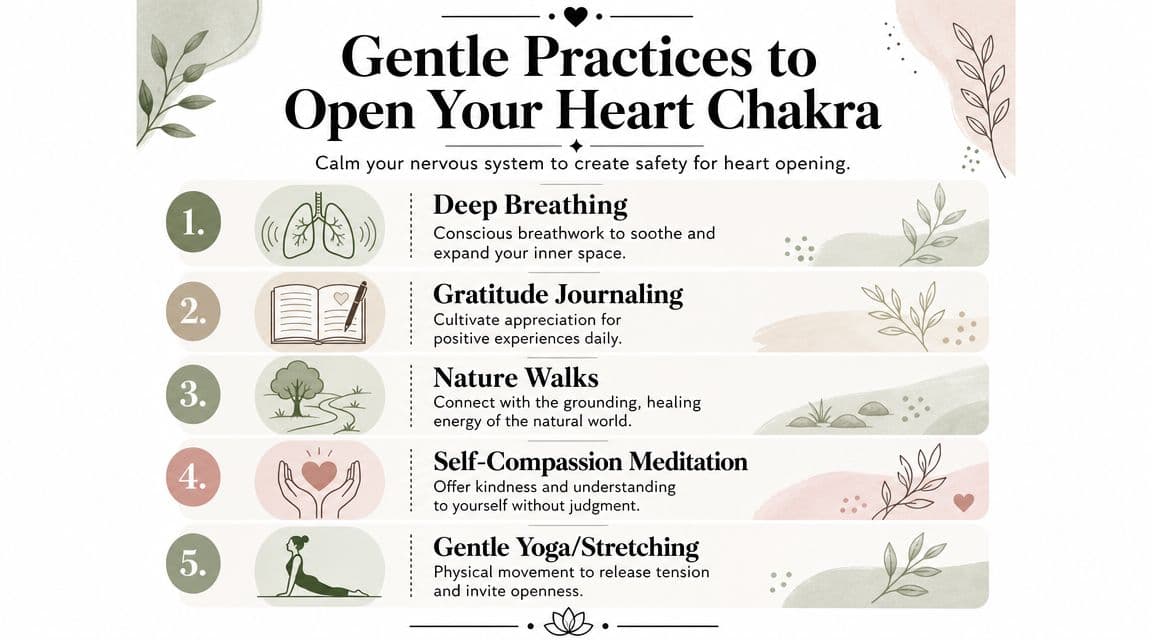
Practices to Gently Open Your Heart Chakra
Trying to force the heart open usually backfires. If your body is braced, more pressure won't create softness. Safety will.
Recent wellness guidance has shifted toward breath, singing, yawning, shaking, and other body-based practices rather than relying only on affirmations or crystals, suggesting that nervous-system regulation may be the most useful frame for heart healing, as discussed in Mindvalley's heart chakra guide.
Start with the body, not the story
When people feel blocked, they often try to think their way into openness. That can help a little, but the body usually needs to feel safer before the emotions can move.
A few gentle options:
-
Heart breathing
Place a hand on your chest. Breathe slowly enough that your exhale feels longer and softer than your inhale. Don't aim for a big emotional release. Aim for a slight sense of space. -
Self-holding
Cross your arms and hold your upper arms or shoulders. This can feel surprisingly grounding when the chest feels exposed or overstimulated. -
Yawning, humming, or singing
These simple practices can help shift tension and bring warmth back into the chest and throat area. -
Gentle shaking
Stand with soft knees and lightly shake out your hands, arms, and shoulders. This can help interrupt a frozen, guarded state.
Use movement that invites, not movement that strains
Some people associate heart chakra healing with dramatic backbends. Those practices aren't necessary.
Better starting points are often small and sustainable:
- Doorway chest stretch for a few easy breaths
- Shoulder rolls done slowly, especially after emotional conversations
- Supported fish pose or resting over a pillow if that feels comfortable
- A walk outdoors while noticing your breath and the feeling of air around your chest
The goal isn't performance. It's less guarding.
If you want more meditation-based support, a guide to chakra balance can complement body-based practice well.
Try asking, “What would help my chest feel 5 percent safer right now?” Small shifts are often more honest than dramatic rituals.
Add emotional practices that don't overwhelm you
Once the body has a little more room, emotional work becomes easier.
Here are a few strong options:
-
Gratitude journaling
Not forced positivity. Just one real thing that softened you today. -
Loving-kindness meditation
Start with yourself if offering love outward feels easier than receiving it inward. -
Forgiveness journaling
This doesn't mean excusing harm. It means noticing what you're still carrying. -
Naming the unmet need
Sometimes “heart healing” begins with a sentence like, “I wanted comfort and didn't get it.”
Practice safe connection
Heart chakra blockage often shows up in relationship, so healing usually has a relational piece too.
That might mean telling a trusted person, “I'm trying to be more honest when I feel myself shutting down.” It might mean receiving help without minimizing your need. It might mean learning boundaries so your heart doesn't confuse openness with self-abandonment.
For some people, the deepest heart-opening practice is not saying yes more often. It's saying no without guilt.
Creating a Daily Heart-Centering Routine
Healing tends to deepen through repetition, not intensity. A brief daily routine can do more for heart chakra blockage than occasional emotional breakthroughs that leave you flooded and tired.

A simple routine you can actually keep
You don't need a long ritual. Try a 5 to 10 minute routine in the morning or evening.
-
Set an intention
Place a hand on your chest and choose one phrase for the day. “May I stay open without abandoning myself” works well. -
Breathe into the heart space
Spend a couple of minutes letting the breath slow down. Keep it comfortable. -
Write one line of gratitude
Not a list unless you want one. One sincere line is enough. -
Repeat a loving phrase
Something simple like, “It's safe to soften a little.” -
Do one chest-opening movement
A shoulder roll, a doorway stretch, or a self-hug all count.
Make it easier to return tomorrow
The best routine is the one you'll repeat when you're tired, distracted, or having a hard day.
A few ways to keep it realistic:
- Attach it to something you already do like morning tea or brushing your teeth.
- Keep tools visible by leaving your journal or cushion where you can see them.
- Allow low-energy versions so you don't quit when life gets messy.
If you want more support building a sustainable practice, this piece on how to integrate meditation into self-care offers helpful ideas for making it part of daily life.
Daily heart care works best when it feels kind, not strict.
Cautions and When to Seek Professional Help
Spiritual language can be meaningful, but it shouldn't replace common sense or proper care. A key concern with heart chakra blockage is that chest or heart-area sensations can have non-spiritual causes and should not be assumed to be energetic without ruling out other factors, as noted in Insight Timer's heart chakra guide.
Treat these as red flags
Please seek medical care promptly if you have:
- Persistent chest pain
- New or worsening heart palpitations
- Shortness of breath
- Fainting, dizziness, or unusual weakness
- Symptoms that feel severe, sudden, or frightening
Please seek mental health support if you notice:
- Severe depression
- Panic that feels unmanageable
- Trauma symptoms
- Persistent emotional numbness
- Relationship patterns rooted in fear, abuse, or dissociation
Trauma-informed support can be especially important if heart-centered practices bring up more activation than relief. Approaches like trauma-informed yoga can offer a gentler path when standard “open your heart” advice feels too intense.
A grounded way to hold both truths
You can believe in chakras and still see a doctor. You can practice meditation, breathwork, or prayer and still work with a therapist. In many cases, that combination is the wisest approach.
Heart healing is not about choosing between spiritual care and professional help. It's about caring for the whole person.
If you're drawn to deeper self-understanding, Life Purpose App offers a digital companion to Dan Millman's The Life You Were Born to Live. It can help you explore recurring relationship patterns, core challenges, and life themes in a way that supports reflection without losing sight of practical healing.
Discover Your Life Purpose Today!
Unlock your true potential and find your life’s purpose.
