Uncover how accurate is numerology in our 2026 guide. We delve into Dan Millman's methods, science, & psychology to provide a clear, balanced answer.
July 2, 2026 (24d ago) — last updated July 2, 2026 (23d ago)
How Accurate Is Numerology: Unbiased Analysis for 2026
Uncover how accurate is numerology in our 2026 guide. We delve into Dan Millman's methods, science, & psychology to provide a clear, balanced answer.
← Back to blog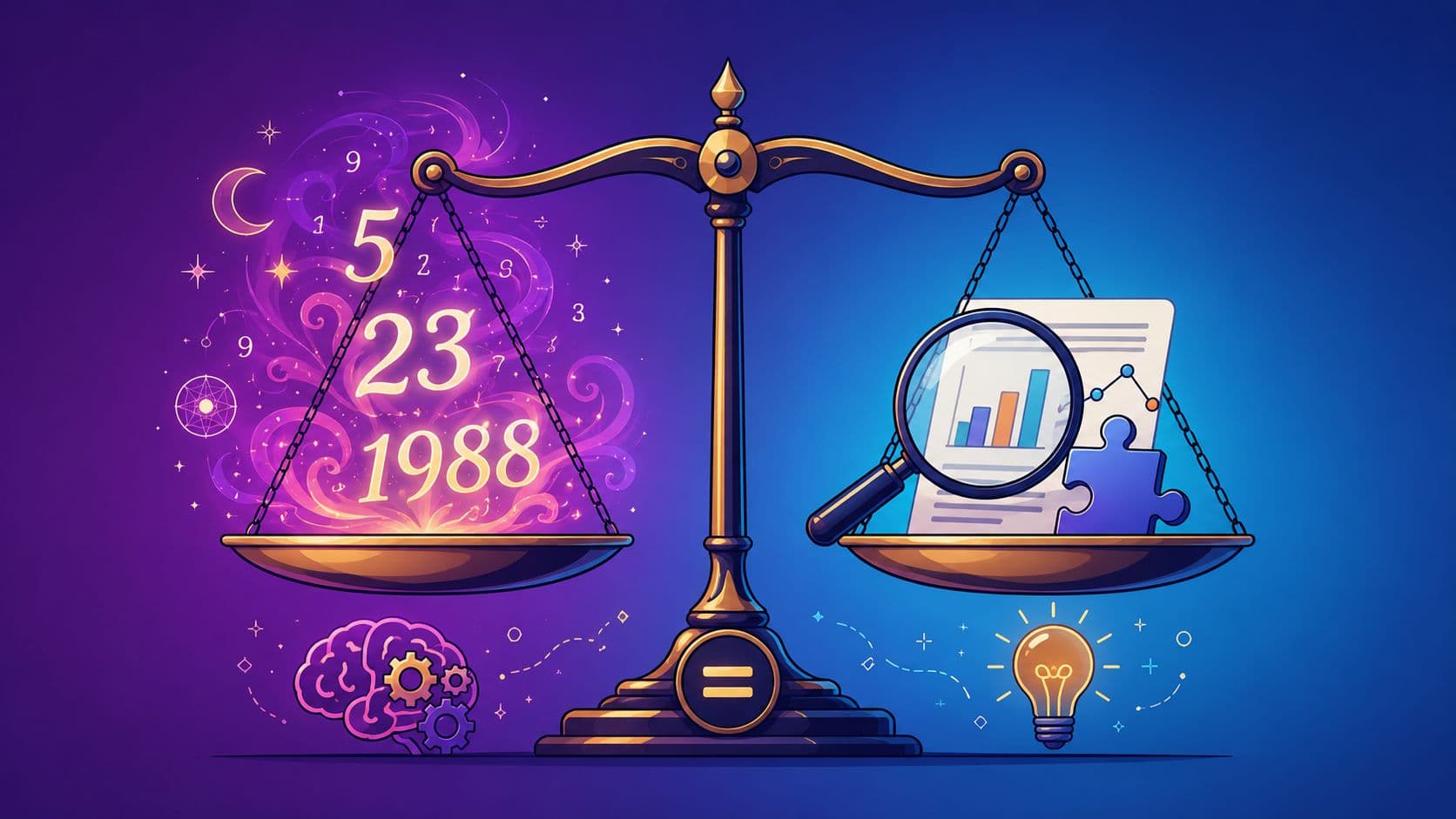
Have you ever entered your birth date into a numerology tool, or looked up your life path in Dan Millman's The Life You Were Born to Live, and felt a jolt of recognition? Not mild interest. Real surprise. The description seems to know something about you.
That reaction leaves many people with the same question. How accurate is numerology? The honest answer isn't a simple yes or no. Numerology can feel strikingly accurate for reasons that are understandable and meaningful, but that feeling is different from scientific proof.
A balanced view has room for both facts. People often find real personal insight in systems built around life paths, symbols, and recurring themes. At the same time, the scientific consensus is that numerology has not been empirically validated. If you keep both ideas in view, the topic becomes much clearer.
The Allure of Uncanny Accuracy
A numerology reading often works like a mirror. You read a few lines and think, “That's me.” You see strengths you recognize, struggles you've hidden, and patterns that seem to fit your life story. In systems built around life paths, including Dan Millman's The Life You Were Born to Live and tools connected to that framework, this feeling of recognition is central.
That's part of why people return to numerology. It doesn't just offer labels. It offers a story about purpose, challenge, timing, and growth. When a life number description names tensions you already feel, it can seem less like interpretation and more like discovery.
Why the experience feels so personal
Numerology speaks in themes of broad appeal:
- Identity: Who am I when I'm at my best, and what keeps tripping me up?
- Relationships: Why do I repeat certain patterns with family, partners, or friends?
- Direction: What kind of work or contribution feels meaningful?
- Timing: Why do some periods of life feel expansive while others feel difficult?
Those aren't shallow questions. They sit close to the center of how people make sense of their lives. A system that organizes those questions neatly can feel unusually insightful, even before we ask whether its claims are objectively true.
Numerology often feels accurate because it gives emotional texture to experiences people already recognize but haven't fully named.
The gap most people miss
The usual debate gets stuck too quickly. Believers may say, “It works because it knew me.” Skeptics may say, “It can't work because there's no scientific basis.” Both reactions skip something important.
The useful question isn't only whether numerology predicts reality. It's also why the system feels so compelling in the first place.
Once you ask that, the topic opens up. You can look at how life paths are calculated in Dan Millman's The Life You Were Born to Live, why those descriptions resonate so strongly, what psychology says about pattern recognition, and why science still classifies numerology as pseudoscience. That combination gives a clearer answer than either blind faith or instant dismissal.
How Numerology Systems Create Meaning
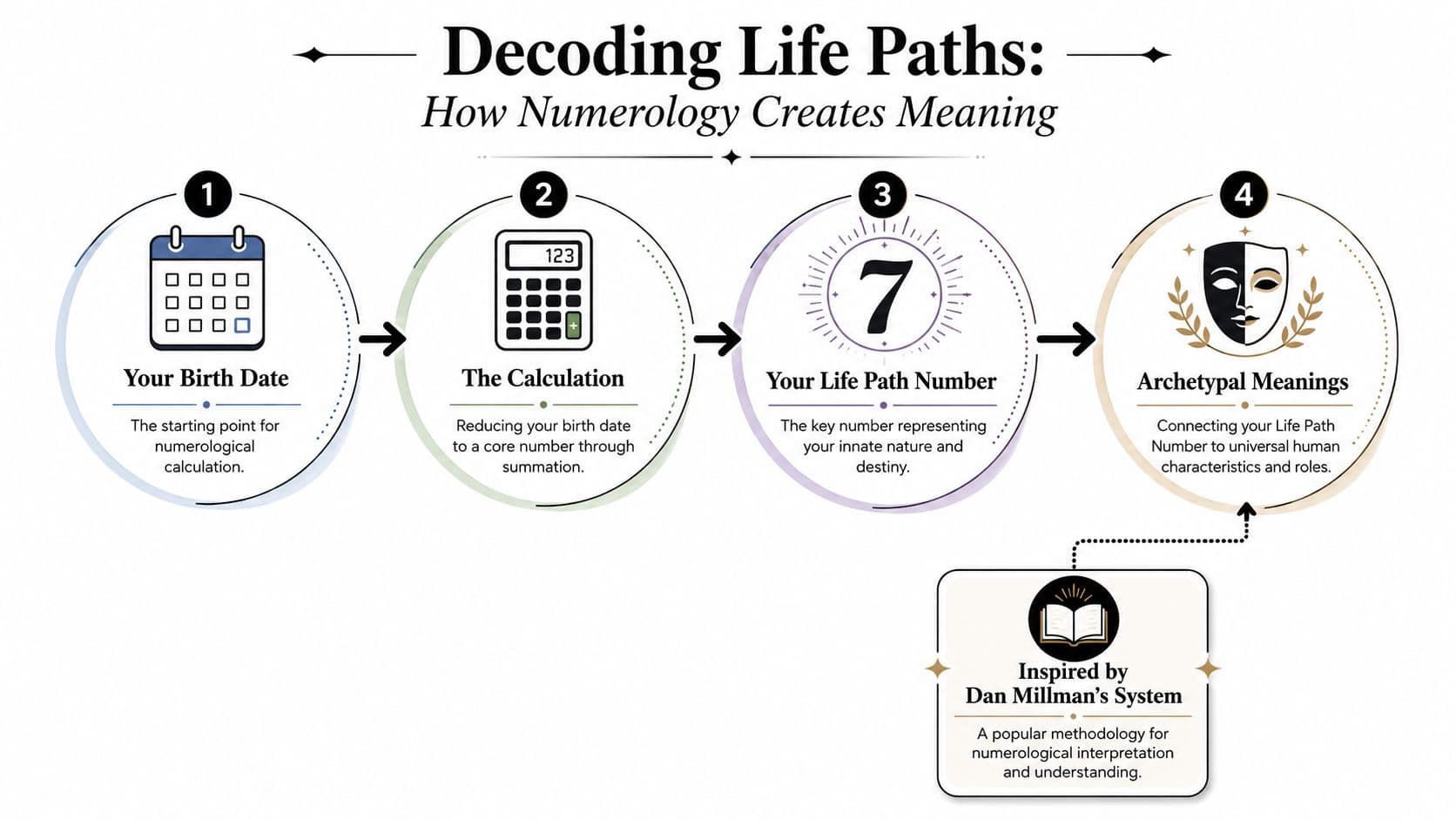
Numerology begins with a rule-based process. In the framework popularized by Dan Millman in The Life You Were Born to Live, a person's life path comes from the birth date. The system doesn't improvise the math. It follows a repeatable calculation and then matches the result to one of the book's life path interpretations.
Take a hypothetical birth date of May 23, 1988. In this approach, you would add the digits as 5 + 2 + 3 + 1 + 9 + 8 + 8 = 36. In Dan Millman's system, that result corresponds to one of the 45 life paths described in The Life You Were Born to Live.
The mechanics are simple
Here's the basic flow in plain language:
-
Start with your birth date
Write the month, day, and year as numbers. -
Add the digits together
You're not interpreting yet. You're only calculating. -
Find the resulting life path
In Dan Millman's The Life You Were Born to Live, the result maps to a specific life path. -
Read the archetypal meaning
The number is treated as a symbolic key to gifts, lessons, and recurring challenges.
If you're new to this style of calculation, a beginner-friendly explanation of the process appears in this guide.
Meaning enters after the math
The important part is that the number itself doesn't carry obvious meaning until the system assigns one. A date like 36 is just arithmetic. It becomes significant because Dan Millman's The Life You Were Born to Live connects that result to a detailed human pattern.
That distinction matters. People sometimes assume numerology is random fortune-telling, but most systems don't present themselves that way. They present themselves as structured symbolic frameworks. The consistency of the method helps build trust. If the same birth date always produces the same life path, the output feels less arbitrary.
A short comparison helps:
| Part of the process | What happens |
|---|---|
| Calculation | Birth-date digits are added using a consistent rule |
| Classification | The result is assigned to a life path in Dan Millman's The Life You Were Born to Live |
| Interpretation | The life path is described through themes, strengths, and challenges |
Practical rule: Separate the calculation from the interpretation. The first is mechanical. The second is symbolic.
That split explains a lot of the confusion around how accurate numerology seems. People notice that the method is repeatable and assume that repeatability proves truth. It doesn't. A system can be internally consistent without being scientifically validated. But that consistency does make it easier for people to trust the meanings attached to their life numbers.
The Power of Archetypes and Cycles
The reason a life path can feel highly personal isn't just the calculation. It's the kind of language wrapped around it. In Dan Millman's The Life You Were Born to Live, life paths are built around archetypes, meaning recurring human patterns such as service, ambition, sensitivity, independence, creativity, or responsibility.
Those patterns don't belong to one person. They're broad enough to show up across many lives, but specific enough to feel intimate when phrased well. That's a big part of the appeal.

Why archetypes land so quickly
A helpful summary from Astratarot's discussion of why numerology feels accurate argues that numerology maintains perceived accuracy through four foundational pillars: archetypal structure, cyclical timing, systemic coherence, and the psychological effect of recognition. It adds that archetypes reflect universal patterns that align with lived experience, while cycles mirror developmental rhythms in human life. That description captures something important. A strong archetype doesn't need to predict a lottery result to feel meaningful. It only needs to frame a person's experience in a way that feels organized and emotionally true.
For example, if someone reads a life path description centered on service and vision in Dan Millman's The Life You Were Born to Live, they may immediately connect it to years spent caring for others, struggling with boundaries, or wanting their work to matter. The text feels accurate because it gives shape to material already present in the person's life.
Cycles add movement to the story
Static personality descriptions can feel flat. Cycles make the system feel alive. They suggest that life unfolds in phases, and that each phase emphasizes different lessons.
That idea is easy to see in ordinary life. People do go through seasons of expansion, contraction, uncertainty, rebuilding, and commitment. Numerology gives those seasons a formal structure, which can make events feel less random. If you want to see how that framing works in practice, this overview shows how the concept is commonly explained within this tradition.
Three features make cycles persuasive:
- They match lived experience. Individuals can look back and notice chapters rather than one unbroken line.
- They reduce chaos. A difficult period can feel less overwhelming when it's framed as part of a wider rhythm.
- They create anticipation. People often feel relief when a system suggests that struggle won't last forever.
The catch is that emotional usefulness and factual proof aren't the same thing. A symbolic cycle can still be helpful as a reflective tool, even if science doesn't treat it as evidence-based prediction. That tension sits at the heart of the numerology debate.
The Psychology Behind Perceived Accuracy
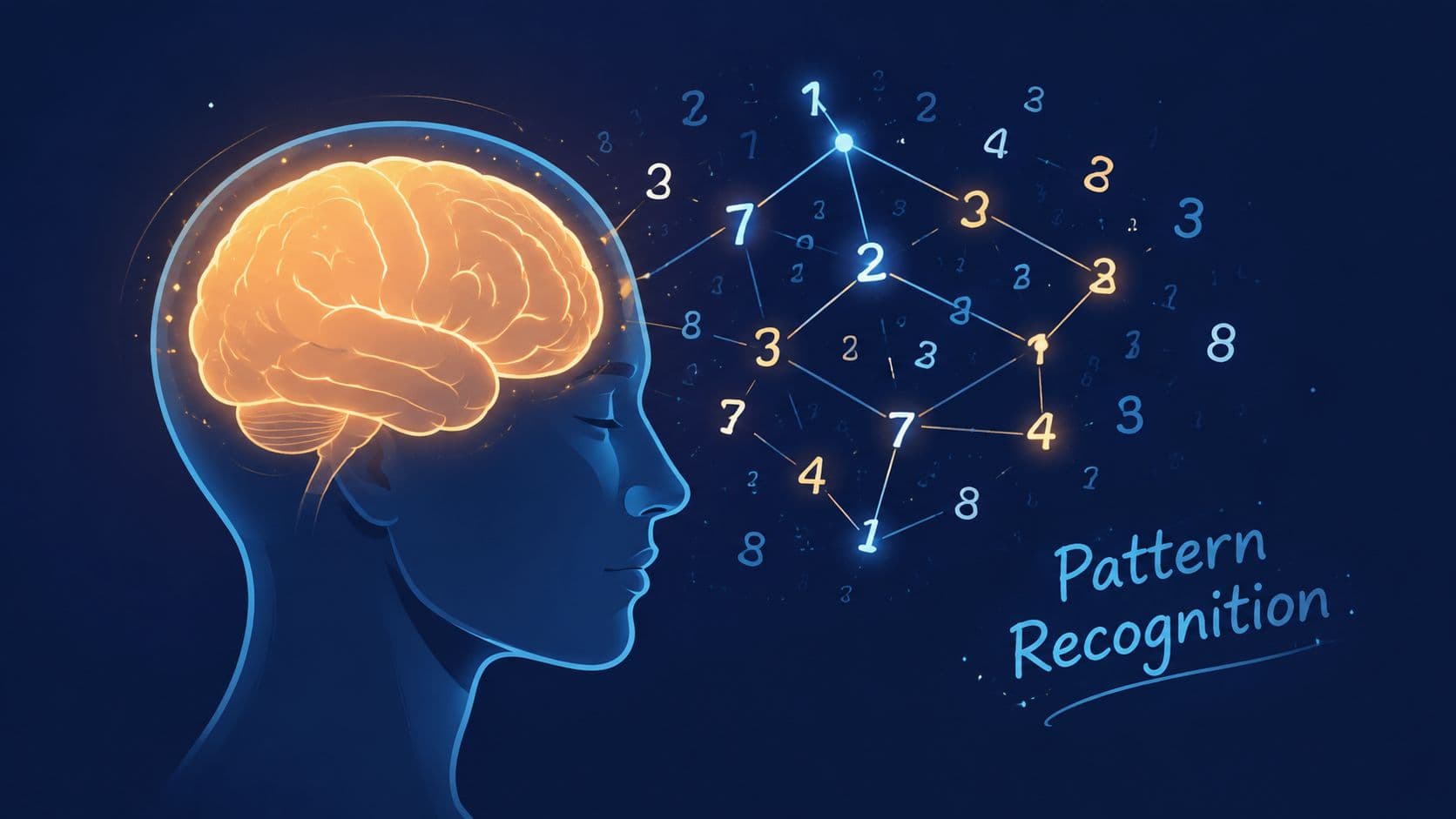
Human beings are built to notice patterns. That tendency helps in ordinary life. It lets you recognize faces, read moods, and connect past experience to present decisions. It also makes symbolic systems like numerology feel more convincing than they may be.
When people ask how accurate numerology is, psychology offers part of the answer. The system can feel precise because the mind is actively helping it feel precise.
Confirmation bias and apophenia
A useful summary from Numerologist.com's analysis of numerology as a paranormal claim states that numerology is not scientifically accurate, and that confirmation bias and apophenia help explain why people still believe it works. Confirmation bias means people remember hits and overlook misses. Apophenia means people perceive meaningful patterns in random information.
You can see confirmation bias in a simple example. A life path description in Dan Millman's The Life You Were Born to Live might say that a person is caring, idealistic, and prone to self-doubt. If two of those points sting with familiarity, the reader often gives the whole profile high marks, even if other parts don't fit as well.
Apophenia works differently. It's the mental habit of connecting scattered details into a meaningful design. A date, a repeated number, a difficult year, and a personality trait can suddenly feel linked by destiny rather than by interpretation.
Why broad statements can sound personal
Another reason numerology feels accurate is that many readings use statements that are broad enough to fit many people but intimate enough to feel private. “You want to be appreciated.” “You've had to learn through struggle.” “People don't always see your full depth.” Those lines hit because they touch common emotional experiences.
This is close to the same psychology behind cold reading. The statement isn't meaningless. It's just widely applicable.
Here are a few mental habits that strengthen the effect:
-
Selective attention
You focus on the phrases that match your self-image. -
Emotional memory
You remember the line that felt uncanny and forget the weaker parts. -
Identity reinforcement
You welcome interpretations that make your life feel coherent.
A system can feel personal because the reader is doing part of the interpretive work.
This doesn't mean every insight is fake. It means the feeling of certainty needs to be handled carefully. The same mind that finds meaning in numerology also falls for flattering generalizations, motivational slogans, and stories that tidy up messy reality. The psychology behind that process overlaps with the way habits form and fail. If you're interested in that broader lens, Habit Huddle has a thoughtful piece on why willpower fails, which shows how often our inner explanations miss the forces shaping our behavior.
For a numerology reader, that's a useful reminder. The point isn't to stop noticing meaning. It's to notice how the mind helps create it. A related perspective appears in this discussion of the power of perception, which fits naturally with how people interpret life-path material from Dan Millman's The Life You Were Born to Live.
A Scientific Perspective on Numerology
If you shift from personal meaning to scientific testing, the answer becomes much firmer. Numerology is not considered scientifically accurate. Science asks whether a claim can be tested, replicated, and shown to perform better than chance. Numerology hasn't met that standard.
That's why it's typically classified as pseudoscience, alongside other systems that make claims about personality or destiny without reliable empirical support.

What testing looks for
A scientific test of numerology would need to show that birth-number claims consistently predict something real, such as personality traits, outcomes, or special abilities, in a way that's repeatable and stronger than coincidence.
That's a high bar, but it's a fair one. If a system says numbers reveal stable truths about people, then those truths should show up under controlled conditions.
What the evidence says
A concrete example comes from IFLScience's summary of research on numerology and pseudoscience. It reports that scientific studies have found no empirical validation for numerology's claims. It also cites a peer-reviewed paper analyzing Nobel Prize data, which found that “the pattern of birth number distribution between the winners of the six different prizes does not differ from chance expectation.”
That matters because numerological claims often imply that certain birth numbers should appear in meaningful patterns among high achievers or distinctive personality types. In this case, they didn't.
The same source also summarizes experimental work on whether particular numbers correlate with psychic ability. Those tests failed as well. The reported conclusion was blunt: “the number 7 does not stand out in the results where it should do.” The researcher even noted that if there were any such number, the graphs suggested 5 would be “a better bet than 7.” That directly undercuts a core style of numerological claim.
A simple comparison helps:
| Question | Scientific answer |
|---|---|
| Is numerology meaningful to some people? | Yes, many people experience it that way |
| Has numerology been empirically validated? | No, the evidence cited above does not support it |
| Does repeatable calculation prove the interpretation is true? | No |
Science doesn't ask whether a reading feels profound. It asks whether the claim survives testing.
That distinction is easy to miss because subjective accuracy can be powerful. But from a scientific standpoint, numerology hasn't shown reliable predictive power.
Using Numerology for Insight Responsibly
How should you use a system that can feel very personal, yet lacks scientific support?
A good starting point is to treat numerology as a reflective tool rather than a source of factual certainty. Once you make that distinction, the practice becomes easier to place in context. It can still be useful, but for a different reason than many people first assume.
Systems influenced by Dan Millman's The Life You Were Born to Live offer a clear example. A life-path description can work like a well-written journal prompt. It gives you language for patterns you may already sense but have not fully examined. The useful question is often not, “Is this objectively true?” It is, “Why does this description resonate with me, bother me, or miss the mark?”
That shift matters.
It moves numerology out of the role of authority and into the role of mirror. A mirror can help you notice something real about yourself, even if the mirror itself is not explaining the world with scientific precision. That is often where numerology's practical value sits. It helps people organize reflection.
A responsible approach usually includes a few guardrails:
-
Use descriptions as starting points
Let a number-based theme spark reflection. Do not treat it as a final verdict on your personality or future. -
Notice the pull of emotional accuracy
A reading can feel precise because it speaks to common human struggles, hopes, and identity questions. That feeling is meaningful, but it is not the same as evidence. -
Test insights against real life
Journaling, therapy, meditation, and honest conversations can help you see whether an idea actually fits your behavior and choices. -
Keep major decisions grounded
Health, money, relationships, and career decisions need evidence, context, and judgment. Symbolic systems can support reflection, but they should not make the decision for you.
This approach leaves room for both curiosity and skepticism. You do not have to mock numerology to avoid overclaiming for it. You can appreciate its archetypal language, notice the psychology that makes it feel accurate, and still accept the scientific view that it has not been validated as a predictive system.
Some readers explore Dan Millman's framework through books, personal study, or digital calculators such as Life Purpose App. Used carefully, a tool like that can help you generate a life-path profile and reflect on your reactions to it. Its value depends less on the calculation itself and more on the honesty you bring to the interpretation.
A balanced conclusion is simple. Numerology may offer perspective, vocabulary, and self-reflection. It does not offer reliable proof about destiny, personality, or future outcomes. Holding both ideas at once is the most grounded way to engage with it.
Discover Your Life Purpose Today!
Unlock your true potential and find your life’s purpose.
