Feeling adrift in a noisy world? This practical guide helps you quiet distraction, build self-awareness, and turn small daily habits—mindfulness, journaling, boundaries—into lasting inner alignment.
December 15, 2025 (7mo ago) — last updated June 27, 2026 (1mo ago)
Inner Alignment: How to Connect With Yourself
Practical steps to reconnect: short mindfulness resets, journaling prompts, clear boundaries, and small repeatable self-care to live more authentically.
← Back to blog
How to Connect With Yourself: Inner Alignment Guide
Feeling lost? Learn how to connect with yourself on a deeper level. This guide offers practical steps for mindfulness, self-discovery, and authentic living.

Introduction
Feeling adrift in a noisy world is increasingly common. This guide gives clear, practical steps to quiet distraction, build self-awareness, and turn small daily practices into real inner alignment. You won’t find vague theory here — only actionable habits you can start today to reconnect with your inner life and live more authentically.
Why You Might Feel Disconnected from Yourself
Does it ever feel like you’re going through the motions—waking, working, socializing—without being present? That slow drift usually comes from roles and expectations piling up: the good employee, the supportive friend, the perfect partner. Over time those layers can hide the person underneath. Naming the causes is the first step back.
Common Modern Causes
Notifications and endless scrolling train us to seek external validation instead of tuning into internal cues. Role-splitting—work self, family self, social self—also fragments attention and energy. When you ask, “Who am I when I’m not performing for others?” you’re already reopening the door to yourself.
“This guide is a hands-on roadmap for rebuilding the most important relationship you’ll ever have—the one with yourself.”
Quieting the Noise with Mindful Presence
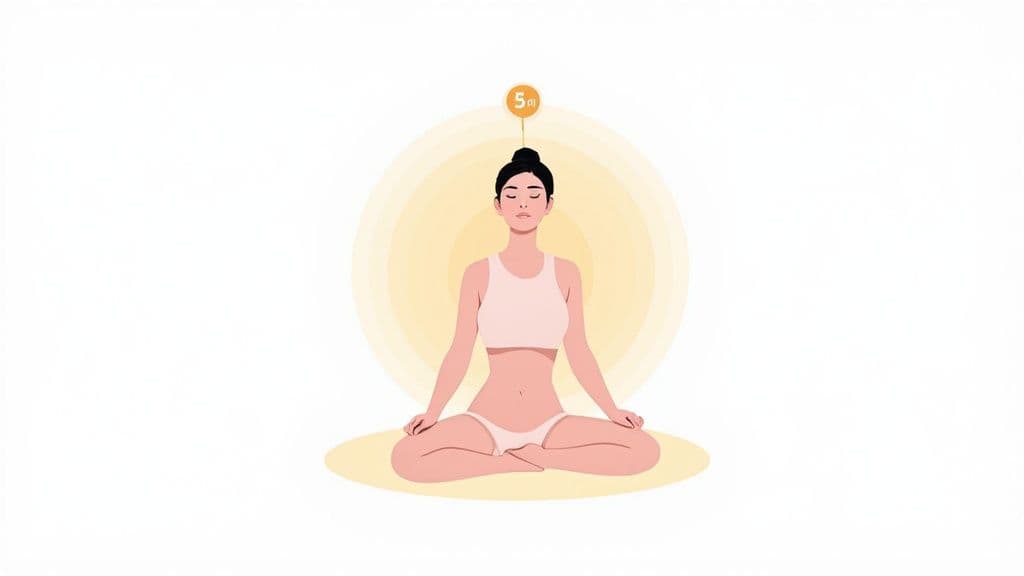
Before you can hear your inner voice, you have to turn down the volume on everything else. Start by creating small pockets of quiet. Mindfulness isn’t about emptying your mind — it’s about noticing what’s there without getting swept away.
The Five-Minute Mindfulness Reset
Mindfulness can be practiced anywhere. Try this five-minute reset:
- Find a comfortable seat.
- Set a timer for five minutes.
- Close your eyes or soften your gaze and take one or two intentional breaths.
- Notice the sensation of breathing without changing it.
- When your mind wanders, gently guide your attention back to the breath.
This tiny habit creates space between stimulus and reaction, improving clarity and presence. For more daily routines, see our guide on how to practice mindfulness.
Calm Your Nervous System with Box Breathing
When stress tightens your breath, box breathing can help reset your nervous system by stimulating the relaxation response1.
- Breathe in for a count of four.
- Hold for four.
- Breathe out for four.
- Hold for four.
Repeat four or five cycles and notice tension ease. This helps the body shift from fight-or-flight to a calmer state and supports clearer inner listening.
Connect Through Mindful Movement
Your body holds information. Mindful movement shifts focus from performance to sensation.
- Take a mindful walk without a podcast or phone—notice your feet, breath, and the air on your skin.
- Do a gentle morning stretch and really feel muscles opening.
These practices build body awareness and make inner quiet more accessible in daily life.
Exploring Your Inner World Through Journaling and Reflection

Journaling is a direct line to the subconscious. It’s not about eloquence; it’s about honest conversation with yourself. Writing creates distance so you can spot patterns and make sense of recurring themes.
Simple, Revealing Prompts
If a blank page feels intimidating, start with small prompts:
- What activities make me lose track of time?
- What recurring frustrations pop up in my day?
- What did I love doing as a child?
These answers point to energy, values, and buried interests. For more prompts, see our self-discovery journal prompts.
The Real Power of Self-Awareness
Research finds that relatively few people are highly self-aware, which means many of us operate on autopilot rather than understanding the “why” behind our choices2. Developing self-awareness improves decision-making and relationships because you can question biases before acting.
Writing longer-form life stories—memoirs or timelines—can help you connect the dots and clarify your path.
A Structured Map to Your Life Path
A structured framework can highlight themes you keep revisiting. Tools like the Life Purpose App, inspired by Dan Millman’s system, offer a lens for viewing core purpose, talents, and challenges. Used alongside journaling, frameworks can validate patterns and suggest practical next steps.
Turning Self-Knowledge into Aligned Action
Insight matters only when it becomes action. Living in alignment means making choices that reflect your values. Each “yes” and “no” is an opportunity to honor yourself.
The Power of Boundaries as Self-Respect
Boundaries are practical self-respect. They are not walls; they are a gate you control.
Examples:
- When asked to take on extra work: “I appreciate you thinking of me. My plate is full right now, so I’ll have to pass.”
- When a friend offloads negativity often: “I care about you, but our conversations have felt heavy lately. Can we try sharing something more positive today?”
- When family pressures you: “Thanks for the invite, but I need to rest this time.”
Clear, polite boundaries protect your energy and reinforce your inner truth.
Auditing Your Life for Energy Leaks
Track what fills you up versus what drains you. Over a week, list energizers and drainers. Then ask: can I reduce one drainer or add one energizer?
| Energizers | Drainers |
|---|---|
| Morning walk | Mindless social scrolling |
| Phone call with a supportive friend | Repetitive, unproductive meetings |
| 30 minutes on a hobby | Saying yes out of guilt |
This audit turns abstract authenticity into concrete choices.
Building a Sustainable Self-Care Practice
Self-care is maintenance, not indulgence. Create a personalized menu of options so you can respond to what you actually need.
Create Your Personal Self-Care Menu
Categories and examples:
- For Your Body: gentle stretches, short walks, mindful meals.
- For Mind & Heart: an hour screen-free before bed, listening to moving music.
- For Creative Spirit: doodling for ten minutes, dancing to a favorite album.
- For Quiet & Solitude: sit with a cup of tea, journal for five minutes about one feeling.
- For Genuine Connection: call someone who makes you feel seen, set a boundary with someone who drains you.
The most effective self-care practices are small and repeatable. Start with five minutes a day of one practice for one week and build from there.
Working Through Common Sticking Points
You will hit roadblocks. That’s normal and a sign you’re doing real work. Here are answers to common concerns.
“Am I actually connecting with myself, or am I just overthinking?”
Overthinking feels frantic and circular; true connection feels like quiet curiosity and clarity. Do a quick body check: if you feel calmer and clearer after the practice, you’re likely connecting rather than spiraling.
“I have no free time. How can I squeeze this in?”
You don’t need large time blocks—find pockets of presence:
- Two-minute brew: notice the kettle while your drink brews.
- Red-light reset: take three slow breaths at a stoplight.
- Five-minute check-in: before bed, jot one feeling from your day.
Consistency beats duration.
“What if I don’t like what I find?”
The inner journey can reveal uncomfortable truths. Meet them with self-compassion. Think of how you would respond to a friend’s vulnerability—offer yourself the same kindness. These discoveries are often the gateway to meaningful change.
“Can technology actually help me connect with myself?”
Yes—when used with intention. Guided meditation and journaling apps can support practice rather than distract. Tools like the Life Purpose App can offer structure and insight when paired with reflection.
Three Quick Q&A Summaries
Q: What three small daily practices reconnect me fast?
A: A five-minute mindfulness reset, a short body-focused stretch or mindful walk, and a nightly five-minute journal check-in.
Q: How will I know I’m making progress?
A: Look for small changes: you react less automatically, feel clearer about choices, and notice a greater sense of calm after reflection.
Q: What’s the quickest way to calm overwhelm before a difficult conversation?
A: Do three to five cycles of box breathing, then state your boundary calmly and clearly1.
1.
Harvard Health, “Relaxation techniques: Breath control helps quell errant stress response,” https://www.health.harvard.edu/mind-and-mood/relaxation-techniques-breath-control-helps-quell-errant-stress-response
2.
Tasha Eurich, “What self-awareness really is and how to cultivate it,” Harvard Business Review, https://hbr.org/2018/01/what-self-awareness-really-is-and-how-to-cultivate-it
3.
JAMA Internal Medicine, Goyal et al., “Meditation programs for psychological stress and well-being: a systematic review and meta-analysis,” https://jamanetwork.com/journals/jamainternalmedicine/fullarticle/1809754
4.
McKinsey & Company, “Feeling good: The future of the $1.5 trillion wellness market,” https://www.mckinsey.com/industries/consumer-packaged-goods/our-insights/feeling-good-the-future-of-the-1-5-trillion-wellness-market
Discover Your Life Purpose Today!
Unlock your true potential and find your life’s purpose.
