February 7, 2026 (2d ago) — last updated February 8, 2026 (1d ago)

How to Discover Your Talents and Unlock Your True Potential

Struggling with how to discover your talents? This guide offers reflective exercises and a unique system from Dan Millman's Life Purpose App to find your gifts.

← Back to blog
Cover Image for How to Discover Your Talents and Unlock Your True Potential

Struggling with how to discover your talents? This guide offers reflective exercises and a unique system from Dan Millman's Life Purpose App to find your gifts.

How to Discover Your Talents and Unlock Your True Potential

Summary: Struggling with how to discover your talents? This guide offers reflective exercises and a unique system from Dan Millman's Life Purpose App to find your gifts.

Introduction: Struggling with how to discover your talents? This guide offers reflective exercises and a unique system from Dan Millman's Life Purpose App to find your gifts.

Uncovering your talents isn't about finding something you lack. It’s about finally seeing the abilities you already have—often the very things you do so naturally you’ve never considered them special.

This guide walks you through that journey of self-awareness with practical reflection prompts and a structured framework based on Dan Millman’s work. We skip the generic advice and go straight to exercises and tools that help you recognize, name, and start using your natural gifts.

Your Talents Are Hiding in Plain Sight

We’ll blend practical self-reflection with a framework for understanding your innate gifts—the system from Dan Millman’s book, The Life You Were Born to Live—and the Life Purpose App, which applies the same system. The goal is a clear, step-by-step path to decoding your own blueprint so the process feels more like an exciting excavation than a chore.

The journey to recognizing a talent usually moves through three phases: overlooked, awareness, and potential. A talent often starts as an everyday activity you don’t think twice about. The magic happens when you bring awareness to it—the first step toward unlocking its full potential.

A black and white diagram illustrating the three-step talent discovery process: overlooked, awareness, and potential.

Why Our Best Talents Go Unnoticed

Most of us can’t see our own greatest strengths because they feel completely normal. It’s a classic blind spot. We assume that if something comes easily to us, it must be easy for everyone else.

“Things you are truly great at are often the things you think nothing of. They are so natural to you that you don't even perceive them as skills.”

This isn’t your fault. Many education systems emphasize fixing weaknesses over developing natural strengths, which leaves many people without a clear language to describe what they do well.1

As we go through this process, you’ll learn to:

  • Identify powerful abilities you’ve been taking for granted.
  • See how your natural gifts can shape work and personal life.
  • Create a simple, practical plan to start developing these talents.

Start by Auditing Your Life Experiences

The best place to start looking for your talents isn’t some online quiz. It’s right here: in your life story. Your experiences, the things you do for fun, and even your little quirks are full of clues.

This first step builds a foundation of self-awareness before you bring in outside tools. Instead of asking, “What am I good at?”, dig into concrete patterns in your life.

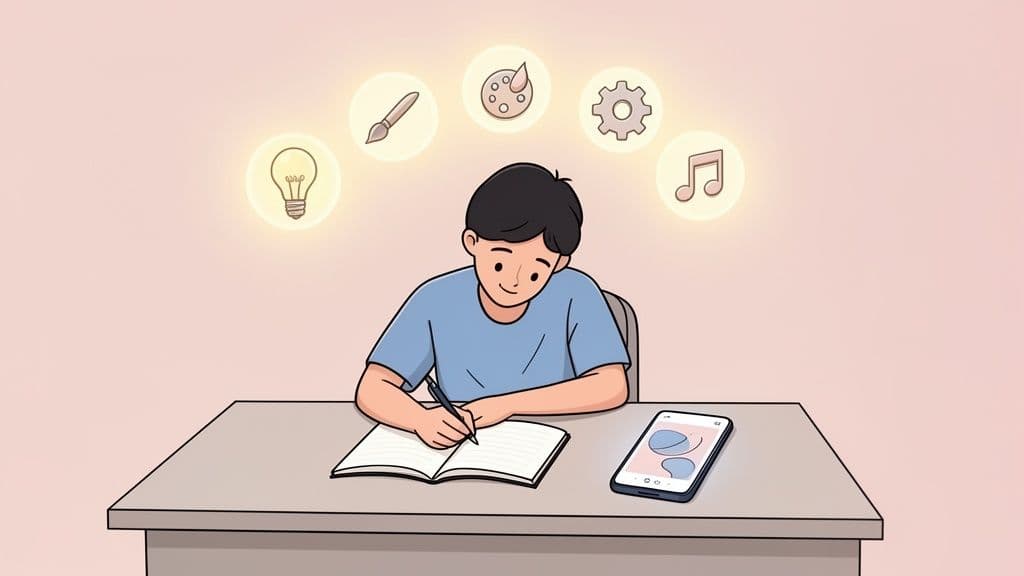
A young man sits at a desk writing in a notebook, surrounded by icons of tools, creativity, and time.

This kind of guided reflection is a powerful beginning. If you want to go further, the Life Purpose App and its blog offer additional practices for learning about yourself and deepening your audit.2

Finding Clues in Daily Life

Hidden talents often show up in ordinary situations. For example, a friend who always organized group travel thought it was just being helpful—later she realized those organizing skills were marketable in logistics and project management.

That’s the mental shift we want: seeing “being helpful” as a transferable strength.

“Your talents are the activities that energize you, the problems you instinctively solve, and the subjects you can’t stop learning about.”

Personal Talent Audit Prompts

Grab a notebook or open a document. The goal is exploration, not polished answers. Be honest and nonjudgmental.

Use these prompts to spot recurring themes and overlooked skills:

Area of ReflectionJournaling Prompt
Flow StateWhat activities make you lose track of time? What were you doing when hours flew by?
Problem SolvingWhat problems do friends or colleagues bring to you first? Are you the go-to person for tech issues, planning, or emotional support?
Natural CuriosityWhat topics do you explore purely for fun? Where does your mind wander when you have free time?
Childhood PassionsWhat did you love doing as a kid before practicality shaped choices? Early interests often hold clear clues.

Spending real time with these questions gives you a personal inventory—a map of experiences that makes the next steps far more effective.

Uncovering Your Life Path Blueprint

Now that you’ve looked inward, let’s introduce a different lens: Dan Millman’s system in The Life You Were Born to Live. This framework links your birth date to one of 45 distinct life paths, each describing core gifts and common challenges. Many people experience an “aha” when they see a pattern they’ve always felt but couldn’t name.4

Your Number Is in Your Birthday

The idea is simple: add the digits in your birth date (don’t reduce the result to a single digit). For example: May 8, 2001 → 5 + 8 + 2 + 0 + 0 + 1 = 16, so Life Path 16. That number highlights talents like spiritual insight and relational harmony for many people on that path.3

If you prefer a quick, foolproof reading, the Life Purpose App turns your birth date into one of the 45 life paths and summarizes its core themes instantly.3

What Your Life Path Reveals

Think of your life path number as a lens, not a destiny. It brings natural tendencies into sharper focus—where you’ll likely find energy, satisfaction, and growth opportunities.

Examples of how a life path might describe a gift:

  • 26/8 → talent for business, leadership, and resource management
  • 16/7 → strength in deep analysis and spiritual inquiry
  • 35/8 → flair for adventurous creative expression

Combining life-path insights with your reflection notes gives a clearer picture of your unique gifts and how you might apply them.

Weaving Your Life Path into Your Career

The real breakthrough comes when you map life-path insight to work. A life path isn’t a list of job titles; it’s how you naturally tackle problems and add value.

Think of a life path as your personal operating system. Someone on a Life Path 4 might excel at creating order and foundations—roles like software architect or operations leader. A Life Path 3 often signals natural communication and creativity—marketing, writing, or speaking.

One client who felt adrift discovered, via the Life Purpose App, she was a 22/4—someone wired to build large-scale projects that serve a higher purpose. That insight helped her shift from solo practice to creating an organization that trains others, multiplying her impact.

Numerical patterns in life paths can also correlate with real-world outcomes; some analyses have pointed out trends among high-achievement groups and specific paths, which can be interesting to explore but shouldn’t be seen as rule-setting for your life.6

If you’re looking for practical career moves, resources on finding work that fits your strengths can help you translate insight into action.7

How Relationships Reveal Hidden Gifts

Talents show up in how you connect with people. Think of interactions with family, friends, and partners as a mirror reflecting interpersonal gifts.

Each life path shapes relational style. A Life Path 2 often brings diplomacy and mediation skills; a Life Path 8 may show up as natural leadership. When you understand your own blueprint and those of people close to you, you see strengths and friction points with more clarity.

The Life Purpose App includes features that compare birth dates to show how energies interact—turning vague feelings into actionable insight. Counselors and coaches who use this approach report stronger engagement with clients when insights map to concrete relational advice.5

This is useful across relationships:

  • Family: Understand why siblings communicate differently and how to combine strengths.
  • Friends: See the energetic foundation of your bond.
  • Colleagues: Improve collaboration by recognizing different approaches to problems.

Knowing your interpersonal strengths builds empathy and helps you form healthier connections.

Putting Discovered Talents into Practice

Figuring out what you’re good at is just the starting line. The real work is using that awareness. Start with small, low-stakes experiments to “test drive” talents and gather feedback.

These aren’t dramatic overhauls. They’re simple actions that build momentum and confidence.

A person walks up steps labeled volunteer, workshop, mentor, and side project, showing career progression.

From insight to action:

  • Teaching talent (e.g., Path 33/6)? Lead a short workplace training or volunteer to run a weekend workshop.
  • Innovation gift (e.g., Path 10)? Launch a small side project or prototype rather than writing a huge business plan.
  • Service orientation (e.g., Path 9)? Volunteer a few hours a month with a nonprofit.

These small experiments create a feedback loop—confirming what feels right or guiding you to adjustments. As you grow, mentors or focused courses can accelerate progress. Creating a brave space to try and learn is essential.

Common Questions on the Path to Discovery

Is my life path number my destiny?

No. Think of your life path number as a map of your natural energetic landscape. It highlights strengths and recurring themes, but your choices and effort shape your life.

What if I don’t relate to my life path description?

That’s common. Sometimes people have suppressed natural abilities for so long the description feels foreign. Give it time—insights often surface later as new situations trigger recognition.

Can my talents change over time?

Your core talents are stable, but how you express them evolves. A childhood storytelling gift can turn into leadership, public speaking, or persuasive writing later in life.


Quick Q&A: Common User Questions

Q: Where do I start if I don’t know my talents?

A: Start with a life audit—track moments you lose time, problems others ask your help with, and topics you study for fun. Use the Personal Talent Audit prompts above to find patterns.

Q: How reliable is the life path system?

A: It’s a descriptive lens, not deterministic. Many people find it clarifies recurring tendencies and helps them make practical choices; treat it as one of several tools in your self-discovery toolkit.

Q: How do I test a talent without quitting my job?

A: Try low-stakes experiments—teach a short workshop, volunteer, start a tiny side project, or lead a small team initiative to gather real-world feedback.


Ready to map your blueprint? The Life Purpose App offers instant access to the system behind Dan Millman's The Life You Were Born to Live and can turn your birth date into a clear starting point for exploration.

1.
Kubrio, “Why Most Kids Never Discover Their Natural Strengths and How AI Changes That,” https://kubrio.com/blog/why-most-kids-never-discover-their-natural-strengths-and-how-ai-changes-that.
2.
Life Purpose App Blog, “How to Learn About Yourself,” https://lifepurposeapp.com/blog/how-to-learn-about-yourself.
4.
Spiritual Media Blog, “An Interview With Author Dan Millman on The Life You Were Born to Live,” https://www.spiritualmediablog.com/2018/08/13/an-interview-with-author-dan-millman-on-the-life-you-were-born-to-live/.
5.
Life Purpose App, homepage and app information about features and user stories, https://lifepurposeapp.com.
6.
Discussion and analysis of life-path patterns and notable groups referenced in interviews and commentary on Dan Millman’s system, see: https://www.spiritualmediablog.com/2018/08/13/an-interview-with-author-dan-millman-on-the-life-you-were-born-to-live/.
7.
Resources on career fit and translating strengths into work: Access Courses Online, “How to Find the Career That’s Right for You,” https://accesscoursesonline.com/blogs/news/how-to-find-the-career-that-s-right-for-you.
← Back to blog

Discover Your Life Purpose Today!

Unlock your true potential and find your life’s purpose.