Feeling lost? You don’t need a dramatic revelation to find purpose. Purpose grows through steady self-awareness, small actions, and frameworks that translate insight into daily choices.
August 13, 2025 (1y ago) — last updated April 17, 2026 (4mo ago)
Find Your Life Purpose: A Practical Guide
Practical framework to discover and live your purpose using a Joy Audit, Impact Inventory, and Dan Millman’s life-path system.
← Back to blog
Find Your Life Purpose: A Practical Guide
Summary: Feeling lost? Learn how to discover and live your purpose with a practical framework: Joy Audit, Impact Inventory, and Dan Millman’s life-path system.
Introduction
Feeling lost? You don’t need a single dramatic revelation to find purpose. Purpose grows through steady self-awareness, small actions, and clear frameworks that turn insight into everyday choices. This guide pairs simple exercises with Dan Millman’s life-path system to help you move from confusion to clarity and start living more authentically today.
Finding your purpose isn’t a lightning-bolt discovery. It’s a process you build, piece by piece. Combine honest self-exploration with real-world experiments and let go of the idea that you must have one fixed passion to feel whole.
Why Finding Your Purpose Feels Hard
If you feel like you’re drifting, you’re not alone. The expectation that purpose is a single buried treasure creates pressure and anxiety. In reality, purpose is something you cultivate over time. Think of it as an internal compass assembled from self-knowledge, experience, and deliberate practice.
The Myth of a Single Passion
The “passion myth” suggests we all have one true calling. That belief is limiting. People are complex and change over time. Purpose is not only what you do but who you choose to be. It’s the meaning you bring to your actions—at work, at home, and in community. When you stop searching for the single right job and instead express your core qualities, you can begin building a meaningful life now.
Modern Hurdles in the Search for Meaning
Today’s world adds new obstacles. Social pressure, constant digital distraction, and widening inequality can fracture our sense of belonging and make it harder to hear our inner voice5. True life satisfaction blends social connection, reasonable work hours, and ongoing personal growth4. Mixing deep introspection with a tested framework helps cut through the noise. One accessible tool is Dan Millman’s system from The Life You Were Born to Live2, which is also available through the Life Purpose App3.
Building a Foundation with Self-Awareness
Before deciding what to do with your life, get clear on who you are. Treat this like data-gathering rather than aimless soul-searching. You’re a detective; the clues are your values, strengths, and what genuinely energizes you. This foundation makes any framework, including Millman’s, far more useful.

Joy Audit: Uncover Your Natural Energy
The Joy Audit is a weeklong tracking exercise. Jot down moments that spark joy, curiosity, or flow. At the end of the week, look for patterns: creativity, problem-solving, helping others, or being outdoors. Those patterns are clear data points pointing to your intrinsic motivators.
Key questions to notice during the week:
- Were you energized by organizing, teaching, or solving problems?
- Did a conversation leave you feeling alive?
- Which tasks felt effortless and rewarding?
Activities that energize you without external reward are clues to what will sustain you long-term.
Impact Inventory: Recognize Your Contribution
Spend about 30 minutes recalling three to five times you felt you genuinely made a difference. For each moment, note:
- What exactly did I do?
- What skills or qualities did I use?
- Why did it feel meaningful to me?
These memories highlight where you naturally contribute and what kinds of roles let you feel impactful.
Connect the Clues
Your Joy Audit and Impact Inventory together create a personal dossier. When you later explore a framework like Millman’s life-path system, you’ll have context to interpret it more deeply. For more on building self-awareness, see Deepening Self-Awareness.
Discover Your Life Path with Dan Millman’s System
With clearer self-knowledge, you can use a framework to bring your insights into focus. Dan Millman’s The Life You Were Born to Live presents a system that uses your birth date to generate a life-path number and a profile of core energies and lessons2.
This system isn’t fortune-telling. It’s a blueprint of archetypal patterns—your natural talents, recurring challenges, and themes to develop. Use it as a lens to understand consistent patterns in your life, not as a fixed destiny.
The Simple Math Behind Your Life Path
Add the digits of your birth date to find your primary path number. Millman’s system identifies 45 unique paths, each with distinct strengths and lessons2.
Example (December 17, 1985): 1 + 2 + 1 + 7 + 1 + 9 + 8 + 5 = 34 → 3 + 4 = 7 → life path 34/7.
You can do the math yourself, or use the Life Purpose App for an immediate profile and interpretation3.
How to Calculate Your Life Path
- Write your birth date in digits (M/D/YYYY).
- Add every digit.
- If the total has two digits, add them together to get a secondary number.
Example (April 29, 1993): 4 + 2 + 9 + 1 + 9 + 9 + 3 = 37 → life path 37/10.
Each path has a chapter in Millman’s book and a full profile in the Life Purpose App, linking the math to practical guidance23.
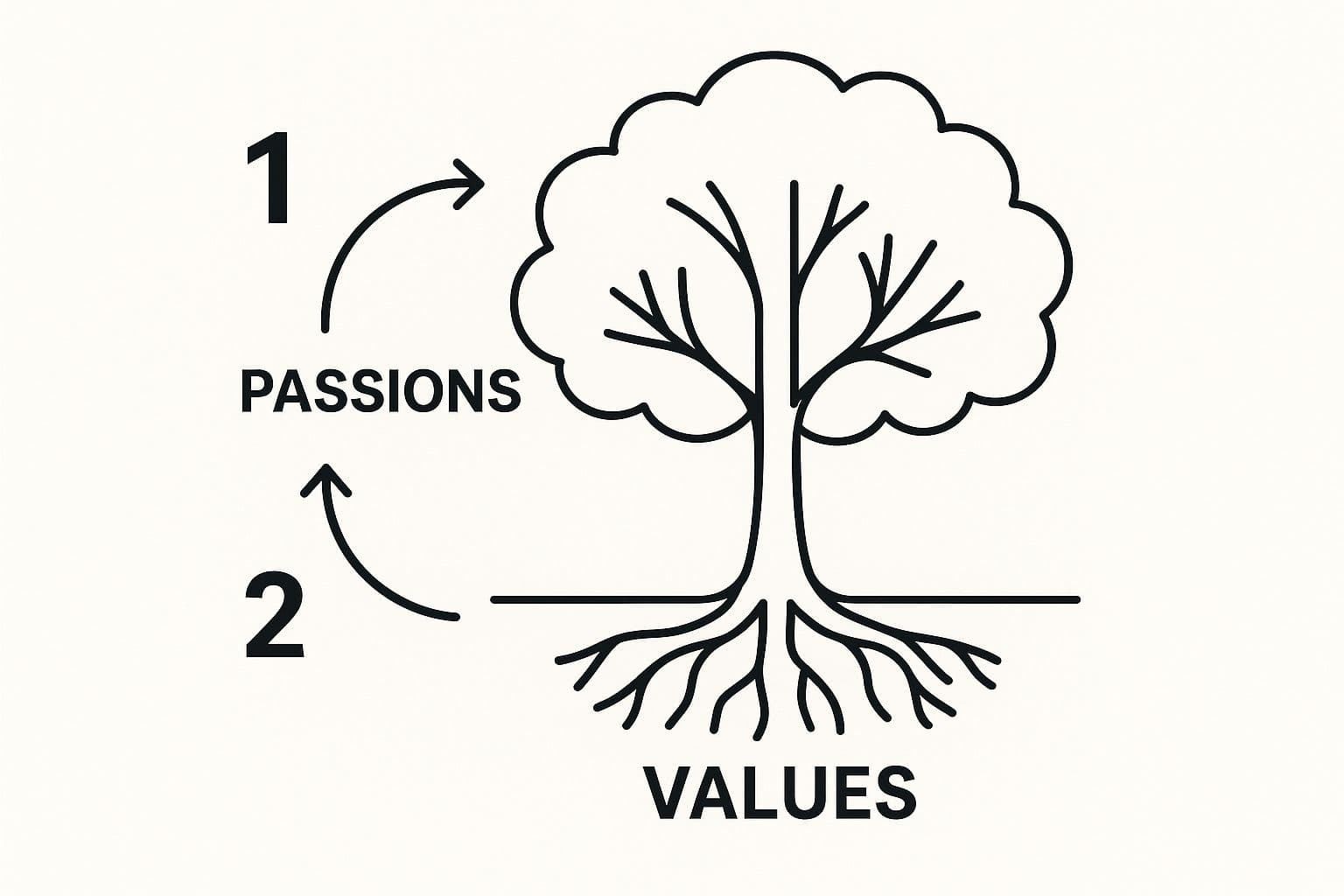
Read Your Blueprint with the Life Purpose App
After calculating your number, the next step is interpretation. The Life Purpose App converts your birth date into a full profile: core issues, inborn talents, potential hurdles, and practical notes on career and relationships3.
The app helps you translate a number into a narrative that can validate patterns you’ve experienced and surface hidden talents. It’s a tool for language and context, not a label.
What you’ll typically find in a profile:
- Core issues to address
- Natural strengths and talents
- Shadow patterns and potential pitfalls
- Career and relationship guidance
Use those insights to choose small experiments that express your life-path energies in daily life. For a step-by-step walkthrough, see Calculating Your Life Path.
Weaving Purpose into Everyday Life
Insight without action doesn’t last. The real work is living your purpose through small, consistent choices. You don’t need a radical life change to begin expressing your path.
Infuse Meaning into Your Current Role
Think in terms of qualities, not job titles. If your path emphasizes creativity and you work with data, introduce clearer storytelling or more elegant visualizations. If your path centers on service, focus on helping colleagues and clients in practical ways.
Ask: Who do I want to be in this role? That shifts the focus from waiting for the perfect job to bringing purpose into the life you already have.
Set Purpose-Aligned Micro-Goals
Break big ideas into weekly micro-goals that reinforce your path. If your profile highlights trust and cooperation, try:
- Delegating one task at work and trusting a teammate to complete it.
- Making an event collaborative so everyone contributes.
- Asking for help with a small household project.
Micro-goals compound into visible change over time.
Purpose, Well-Being, and the Bigger Picture
Finding space to live purposefully is often shaped by social and economic conditions. Countries that prioritize fair wages, reasonable hours, and time off tend to report higher life satisfaction and better work-life balance4. If you’re struggling to find energy for purposeful activities, it often reflects these broader pressures. Be kind to yourself and use your purpose as a compass for how to spend the time you do have.
Global average life expectancy has increased significantly over recent decades, giving many people more time to explore and refine purpose over a longer lifespan1.
Common Questions About Finding Your Life Purpose
Finding purpose is personal and ongoing. Here are answers to common concerns.
What if My Job Doesn’t Align with My Life Path Number?
That’s common. Purpose is about the qualities you bring to life, not just your paycheck. Express your path through mentoring, process improvements, volunteer work, or creative projects outside of work. See your life path as a set of energies to express rather than a job description.
Is My Life Path Number the Only Thing That Defines My Purpose?
No. Your life path is one guiding layer within a larger mix that includes your values, passions, experiences, and choices. Use it as a map, not a destiny.
What if My Life Path Description Doesn’t Resonate?
First, double-check the math. If it’s correct but still feels off, read the fuller descriptions in the book or app—sometimes themes appear as challenges you’ve avoided. If it still doesn’t fit, take what helps and leave the rest.
Quick Q&A
Q: How do I start right now?
A: Do a one-week Joy Audit and a 30-minute Impact Inventory. Those two practices give immediate clues you can act on.
Q: Can I use my life path without believing in destiny?
A: Yes. Treat it as a practical lens that points to strengths and recurring lessons—use it to design experiments, not to lock yourself in.
Q: Will this guarantee I’ll be happy?
A: No guarantees. Purpose helps guide choices that increase meaning, but well-being also depends on relationships, health, and social conditions4.
Concise Q&A: Three Practical Questions
Q: What’s the fastest way to find clues about my purpose?
A: Track what energizes you for one week (Joy Audit) and list three moments you made an impact (Impact Inventory). Patterns appear quickly.
Q: How do I test my life-path insights without drastic change?
A: Run micro-experiments—small weekly goals that express a core quality from your profile.
Q: When should I use a system like Millman’s?
A: Use it once you’ve gathered self-knowledge. It’s most helpful when you have context from your Joy Audit and Impact Inventory.
Ready to uncover your blueprint? Use the Life Purpose App to calculate your life path and explore a detailed profile to begin aligning daily actions with what truly matters to you3.
1.
Our World in Data, “Life expectancy,” https://ourworldindata.org/life-expectancy.
2.
Dan Millman, The Life You Were Born to Live (New World Library) and Dan Millman’s resource page, https://danmillman.com/books/.
3.
Life Purpose App, official site, https://lifepurposeapp.com.
4.
OECD, Better Life Index — Work-Life Balance, https://www.oecd.org.
5.
World Inequality Lab, World Inequality Report, https://wir2022.wid.world/.
Discover Your Life Purpose Today!
Unlock your true potential and find your life’s purpose.
