Feeling lost? This practical guide offers journaling prompts, mindful exercises, and simple daily routines to help you discover your true self and live more authentically.
February 9, 2026 (5mo ago) — last updated June 24, 2026 (1mo ago)
How to Find Your True Self: Practical Guide
Practical steps, journaling prompts, and daily routines to discover your true self and live more authentically.
← Back to blog
How to Find Your True Self: Practical Guide
Feeling lost? This practical guide offers journaling prompts, mindful exercises, and small daily routines to help you discover your true self and live more authentically.
Starting the Journey to Your Authentic Self

If you feel like you’re just going through the motions, you’re not alone. That sense of being a stranger to yourself is a clear nudge to begin an inward journey. Searching for how to find your true self isn’t about becoming someone new. Think of it as gently clearing away social conditioning, old stories, and other people’s expectations to reveal who you already are.
This guide gives a practical, compassionate path forward. We break the process into manageable steps so what feels monumental becomes a simple, honest conversation with yourself.
Roadmap for Self-Discovery
We’ll focus on a few core pillars—different trails that lead to the same summit: your authentic self. Each pillar offers practical tools and daily practices.
Your Self-Discovery Starter Kit
| Pillar of Discovery | What It Uncovers | Key Action |
|---|---|---|
| Internal Exploration | Your non-negotiable values and natural talents. | Identify and rank your top five core values. |
| Life Path Blueprint | Your unique purpose and recurring life themes. | Calculate your life number from your birth date. |
| Mindful Reflection | Subconscious beliefs and quiet wisdom. | Start a simple daily journaling practice. |
| Shadow Integration | Hidden or suppressed parts of your personality. | Gently acknowledge one trait you often judge in others. |
Each pillar is a doorway. By walking through them, you’ll begin to piece together a clearer, more complete picture of who you are.
“This process isn’t about chasing perfection. It’s about cultivating wholeness by embracing every part of who you are—the light, the shadow, and everything in between.”
Modern Tools for an Ancient Quest
Today’s tools can speed the work of self-knowledge. The life-planning app market is growing quickly, reflecting higher demand for clarity and purpose-driven tools1. Apps like the Life Purpose App apply Dan Millman’s framework to your birth date for a practical starting point2.
Defining Your Personal Compass: Values and Strengths
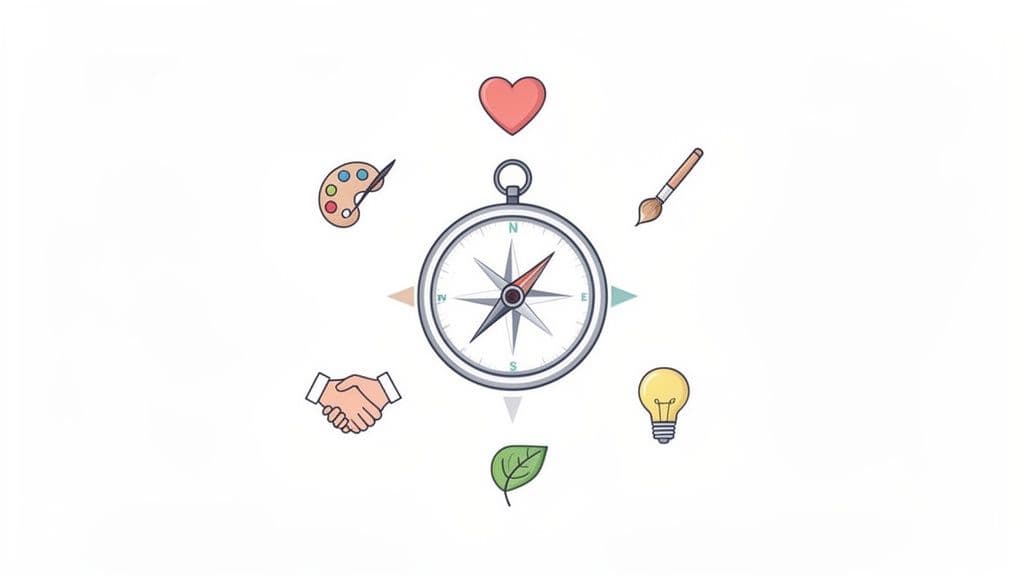
Think of your values as your internal true north. When your choices align with that compass, life feels right. When they don’t, you feel friction and a nagging sense that something’s off.
Most people have a vague sense of values—honesty, loyalty, kindness—but these are often too broad to guide daily decisions. The work is defining what those ideas actually mean to you.
Pinpointing Your Core Values
Use emotional highs and lows as data. Strong emotions act like neon signs pointing at what matters most.
Grab a journal and reflect on these prompts:
- When did you feel most alive? What were you doing, who was there, and what core need was met?
- What makes you angry? Recall a time you felt frustrated or drained—what rule or principle felt violated?
- Who do you admire? What qualities do you respect in them that mirror values you want to embody?
Patterns will appear. Maybe “community” threads through your best memories, or your frustration spikes when “autonomy” is challenged.
“Your values aren’t abstract. They’re the bedrock emotional and psychological needs you have.”
From Vague Ideas to Actionable Principles
Distill your list to your top five values. Translate each into behaviors and boundaries. For example, if “creativity” is a top value, plan weekly creative time or choose roles that let you experiment. If repetitive work drains you, that’s a sign you’re off course.
See our exercises on identifying core values for examples and worksheets: [/blog/what-are-core-values-examples].
Identifying Your Innate Strengths
Values are one side of the coin; strengths are the other. Innate strengths energize you and make time disappear—organizing, researching, welcoming others. Notice what fills you up. These clues help you build a reliable map of your inner world.
Your Life’s Blueprint: Using a Life Purpose System
After clarifying values, step back and view your life from a higher vantage point. Dan Millman’s system in The Life You Were Born to Live outlines life paths derived from your birth date, offering a framework to understand innate gifts and core challenges. This perspective helps you stop fighting your nature and start working with it.
You can calculate your life number manually or use the Life Purpose App for an instant reading that reveals your life path, core issues, and talents2.
“Your life path provides context for recurring patterns and where your greatest potential for fulfillment lies.”
For detailed calculations and interpretations, see our life path calculator guide: [/blog/life-purpose-calculator].
Tuning In Through Journaling and Mindfulness

Journaling and mindfulness are essential for anyone serious about finding their true self; both have documented benefits for self-awareness and emotional regulation45.
Reflective Journaling Prompts
Try these prompts for ten minutes without censoring yourself:
- When do I feel most authentically myself?
- What activities make me lose all track of time?
- If fear and judgment weren’t factors, what’s one thing I’d do differently tomorrow?
- What recurring frustration might point to an unmet need?
Regular answers create a breadcrumb trail back to your core self.
“Your journal is a safe space to meet yourself where you are.”
Listening to Your Body’s Wisdom
Mindfulness connects you to bodily signals. A five-minute body scan—just noticing sensations—grounds you in the present and reveals where you hold tension. Combining journaling and mindfulness creates a feedback loop that clarifies inner guidance. Learn more about combining these practices: [/blog/meditation-and-journaling].
Embracing Your Whole Self Through Shadow Work

Finding your true self includes facing what’s in the shadows. These are the traits we deny or suppress—jealousy, insecurity, anger. Shadow work isn’t about defeat. It’s about reclaiming energy and wisdom that’s been hidden.
Identifying Your Triggers
Triggers are direct signals from the shadow. Recall a time you reacted strongly. What exactly pushed your buttons? Is there a version of that trait in you? Intense envy might highlight a deep desire for recognition.
Ask:
- What exactly about that person pushed my buttons?
- Is there a version of that trait in me?
- What unmet need is this feeling pointing toward?
“The aim isn’t to eliminate flaws but to understand the messages they carry.”
The Practice of Integration
Integration means acknowledging and accepting hidden parts of yourself. Meet difficult traits with curiosity instead of shame. That stance transforms shadow traits from saboteurs into allies and frees energy for authentic living.
Living Authentically as an Ongoing Practice
Finding your core values and life path isn’t a finish line. It’s like getting the keys to a new car; the real work begins when you drive. The daily task is aligning your job, relationships, and routines with your personal blueprint.
Small Adjustments That Matter
If “adventure” is a core value and your life path supports change, evaluate small shifts rather than dramatic overhauls. Try micro-adjustments:
- At work: Volunteer for a stretch project.
- With people: Suggest a new group activity like climbing or a weekend trip.
- Daily: Try one new recipe a week or explore a different neighborhood park.
Small choices add up. Each one signals, “I see who I am, and I choose to honor that.”
Staying Connected with Consistent Practice
Consistency matters. We can channel common app-checking habits into meaningful daily check-ins—tools that show your life path and offer prompts help maintain alignment. Mobile behaviors make it easy to keep your personal blueprint accessible in your pocket3.
Common Questions
How long does this take? There’s no set timeline. Some people notice shifts within months; for others it unfolds over years. Regular check-ins and small adjustments create lasting change.
Will my true self change? Your core essence is steady, but how it expresses itself evolves with life stages. The goal is to stay connected to your inner compass so you can adapt with integrity.
What if I find things I don’t like about myself? Approach discoveries with curiosity, not judgment. Shadow traits point to unmet needs or protections. Understanding them is the first step toward integration and healing.
Quick Q&A — Practical Answers
Q: What’s the first practical step to begin finding my true self? A: Start journaling—answer prompts about when you feel most alive and what drains you, then draft your top-five values.
Q: How can a life-path system help me make real decisions? A: It offers context for recurring patterns, highlights innate strengths, and makes choices feel less random.
Q: How do I do shadow work without getting overwhelmed? A: Treat it as gentle curiosity: notice triggers, ask what unmet need lies beneath, and respond with self-compassion.
Reader Q&A — Concise Answers
Q: How do I identify my top values quickly? A: Review your emotional highs and lows, note repeating themes, then pick five values and translate each into one clear behavior.
Q: What daily habit helps most with self-discovery? A: Five minutes of reflective journaling plus a short body scan helps you notice patterns and shifts over time.
Q: When should I use a life-path tool? A: Use it after you’ve clarified values and strengths; the tool gives context for choices and recurring challenges.
Ready to see the blueprint you were born to live? The Life Purpose App gives instant access to Dan Millman’s life-path framework and helps you understand your unique gifts and challenges. Start your journey with clarity and purpose today.
1.
Market report on life-planning and purpose-driven apps showing market size and growth projections. https://www.marketreportanalytics.com/reports/life-planning-apps-74652
2.
Life Purpose App official site and description of the Life Purpose system based on Dan Millman’s book. https://www.lifepurposeapp.com/
3.
Mobile app usage and download statistics including projections for global app downloads and user engagement. https://www.tekrevol.com/blogs/mobile-app-download-statistics/
4.
Mayo Clinic—Benefits of journaling for mental health and self-reflection. https://www.mayoclinic.org/healthy-lifestyle/stress-management/in-depth/journaling/art-20046372
5.
Review of mindfulness-based interventions and effects on anxiety and self-awareness. https://www.ncbi.nlm.nih.gov/pmc/articles/PMC6226509/
Discover Your Life Purpose Today!
Unlock your true potential and find your life’s purpose.
