Learn how to find your career path in life with this practical guide. Discover your values, test options, and build a roadmap for lasting fulfillment.

October 14, 2026 (1d ago)
How to Find Your Career Path in Life: A Step-by-Step Guide
Learn how to find your career path in life with this practical guide. Discover your values, test options, and build a roadmap for lasting fulfillment.
← Back to blog
Learn how to find your career path in life with this practical guide. Discover your values, test options, and build a roadmap for lasting fulfillment.
You're sitting at your desk with three open job tabs, a half-finished personality quiz, and a growing suspicion that everyone else received a career map you somehow missed. One option looks sensible, another feels exciting, and a third would make your family proud. You keep asking, “What should I do with my life?” when the more useful question is, “What direction can I test next?”
Finding a career path isn't about uncovering one hidden occupation and committing to it forever. It's about combining self-knowledge, practical evidence, and a willingness to adjust. The process below will help you move from vague anxiety to deliberate experiments, without pretending that one assessment can decide your future.
Why You Feel Lost in Your Career Search
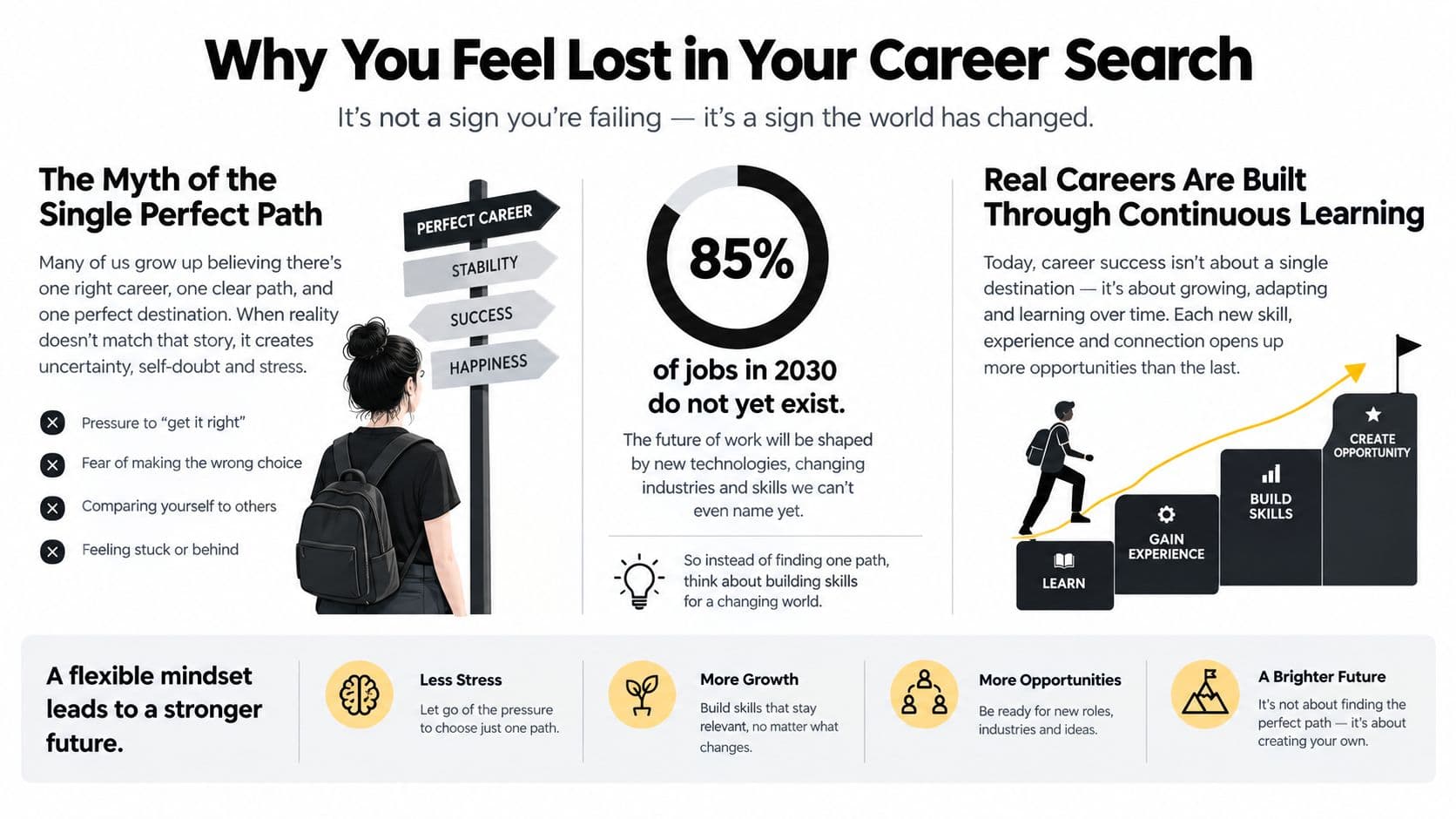
You feel lost partly because you've been given the wrong picture of career choice. School, family, and online advice often imply that a good career is a straight line from interest to education to job title. When your interests change, an application fails, or an industry shifts, you interpret the detour as evidence that you chose badly.
That interpretation is wrong. Career paths are increasingly shaped by continuous learning rather than one permanent occupational decision. The World Economic Forum's Future of Jobs Report 2025 projects that between 2025 and 2030, approximately 170 million new jobs will be created globally while 92 million existing roles will be displaced. The same report estimates that 39% of workers' current core skills will change by 2030.
Stop searching for a permanent answer
A person choosing marketing today may later move into customer research, product strategy, sales enablement, or education. Someone who starts in healthcare may discover that operations, data, policy, or patient advocacy fits better than direct clinical work. Those moves aren't proof of failure. They're information gathered through experience.
The World Economic Forum also identifies analytical thinking, resilience, flexibility, agility, leadership, social influence, and creative thinking among important workplace capabilities. That's why you shouldn't evaluate a possible path only by its title. Ask which abilities the work will strengthen and whether those abilities can travel with you.
Practical rule: Choose a direction you can develop, not an identity you must defend.
Suppose you accept a role because it sounds prestigious, then discover that the daily work drains you. The useful conclusion isn't “I'm incapable of choosing.” It's “I now know more about the conditions in which I work well.” If anxiety is making that conclusion difficult, how young adults get unstuck at work offers helpful context on separating career uncertainty from emotional overwhelm.
Your first task is to replace the demand for certainty with a commitment to evidence. You don't need to know the final destination before taking the next well-designed step.
Understanding Your Core Values and Life Path
Before you compare occupations, identify what you're trying to protect and express through work. A large salary may matter because you need stability. Flexible hours may matter because you care for family. Autonomy may matter because close supervision shuts down your best thinking. Values become useful when you connect them to real working conditions.
Start with three separate lists:
- Interests: Which subjects, problems, and activities hold your attention without constant external pressure?
- Abilities: What do you perform reliably, and what do other people ask you to help with?
- Personality and environment: Do you think best alone or with others? Do you prefer predictable routines, urgency, debate, practical activity, or long periods of concentration?
An American Psychological Association career-assessment resource identifies occupational interests, abilities, and personality as three major domains with value across a broad range of career concerns. Use those domains to generate questions, not to receive a verdict.

Add reflection without surrendering judgment
If numerology or spiritual self-inquiry speaks to you, use it as a second lens. Dan Millman's book, “The Life You Were Born to Live,” presents a life-path framework based on a date of birth, while the Life Purpose App offers a digital way to explore that framework. Treat the result as reflective material about possible gifts, challenges, motivation, and direction. It can help you articulate themes you've felt but struggled to name.
It shouldn't replace work samples, conversations, financial planning, or labor-market research. A life-path reflection may suggest that you value teaching, independence, service, creativity, or disciplined practice. Your responsibility is to test whether those themes appear in the way you actually work.
Write one sentence for each prompt:
- “I feel useful when I…”
- “I lose energy when work requires me to…”
- “I want my work to make possible…”
- “I'm unwilling to sacrifice…”
- “People consistently trust me to…”
Then compare your answers with the guide to discovering your core values. Circle recurring themes and translate each theme into a workplace requirement. For example, “freedom” might mean flexible scheduling, independent problem-solving, or the ability to build a business. Those are different needs, and each points toward different experiments.
Your values are not a job title. They're criteria for choosing environments in which you can remain effective and healthy.
Testing Hypotheses Through Real-World Exposure
Self-knowledge becomes useful only when it changes what you do. You can believe you'd enjoy counseling, design, engineering, or nonprofit leadership, but imagination edits out repetition, conflict, deadlines, administration, and ordinary Tuesday mornings. Real exposure restores the missing details.
Build several occupational hypotheses rather than selecting one identity. Write each as a testable statement:
“I may enjoy this direction because I like the problems, the pace, and the way the work uses my strengths.”
Then design the cheapest experiment that could challenge that statement. An informational interview can reveal the difference between a job title and its daily responsibilities. A volunteer shift can show whether you enjoy serving the people connected to a field. A short course can test your persistence when the material becomes difficult. A portfolio project can expose whether you like producing the actual output, not just discussing it.
A meta-analysis of 57 career-choice intervention studies found a weighted mean effect size of 0.352, indicating a meaningful but moderate average benefit rather than guaranteed success. The career-choice intervention research supports structured decision-making, feedback, written occupational analysis, and attention to obstacles. It does not support waiting for a perfect feeling of certainty.
Gather behavioral evidence
After every experiment, record more than enjoyment. Use a simple evidence log:
| Question | What to record |
|---|---|
| Energy | Which tasks increased or reduced your energy? |
| Performance | What did you complete well, and where did you struggle? |
| Retention | What did you keep thinking about after the activity ended? |
| Feedback | What did a practitioner, teacher, or client observe? |
| Repeatability | Would you willingly do similar work again? |
| Barrier | What training, access, money, or confidence gap appeared? |
A three-hour conversation may confirm that you like the subject but dislike the work environment. A portfolio project may show that your technical ability is developing, while your patience for solitary work is limited. Both findings are valuable.
When a direction still interests you, research the entry routes and use resources such as find career transition jobs to understand how people move between fields. Don't enroll in a long program just because it feels more decisive. Test the work first, then invest in credentials when the evidence justifies the cost.
Building a Decision Matrix for Your Options
After several experiments, you'll have competing options and incomplete evidence. That's the moment to stop relying on whichever possibility feels most exciting that day. A decision matrix forces you to compare the same criteria across every option.
List three to five paths across the top of a page. Put your criteria down the side. Score each option using a consistent scale, then multiply each score by the importance you assign to that criterion. You don't need mathematical precision. The value comes from making hidden trade-offs visible.
Use criteria such as:
- Intrinsic fit: Does the daily work match your interests and preferred way of thinking?
- Transferable strengths: Can you contribute now while continuing to grow?
- Labor-market access: Are there realistic openings, entry routes, and locations available to you?
- Compensation and stability: Does the path support your financial responsibilities?
- Growth: Could you develop into adjacent roles rather than becoming trapped in one narrow function?
- Barriers: How much time, money, health capacity, relocation, or training does entry require?
Give each criterion a weight. If financial stability is urgent, compensation and access deserve more weight than they would for someone with substantial flexibility. If autonomy is essential, don't bury it under a high score for prestige.
Don't confuse fit with a promise
Personality and interest assessments can help you notice possibilities, but they can't guarantee satisfaction. Longitudinal evidence summarized in an Annual Review of Organizational Psychology and Organizational Behavior found that person-vocation fit and job satisfaction were unrelated in one study, while earlier meta-analytic work found the overall fit-satisfaction relationship nonsignificant.
That finding should change how you use assessments. A strong fit score is a reason to ask better questions, not a reason to stop gathering evidence. You may match a profession on paper and still dislike its schedule, management culture, customer demands, or pace.
| Decision question | Evidence to use |
|---|---|
| Could I do this work? | Skills, work samples, feedback |
| Would I want the daily reality? | Interviews, shadowing, short projects |
| Can I enter this field? | Requirements, openings, training options |
| Can I sustain it? | Health, finances, location, schedule |
| Could it evolve with me? | Transferable skills and adjacent roles |
For a practical approach to weighing difficult options, use this guide. Make your choice based on the pattern across evidence, not on one test result or one person's approval.
Creating a Flexible Action Plan
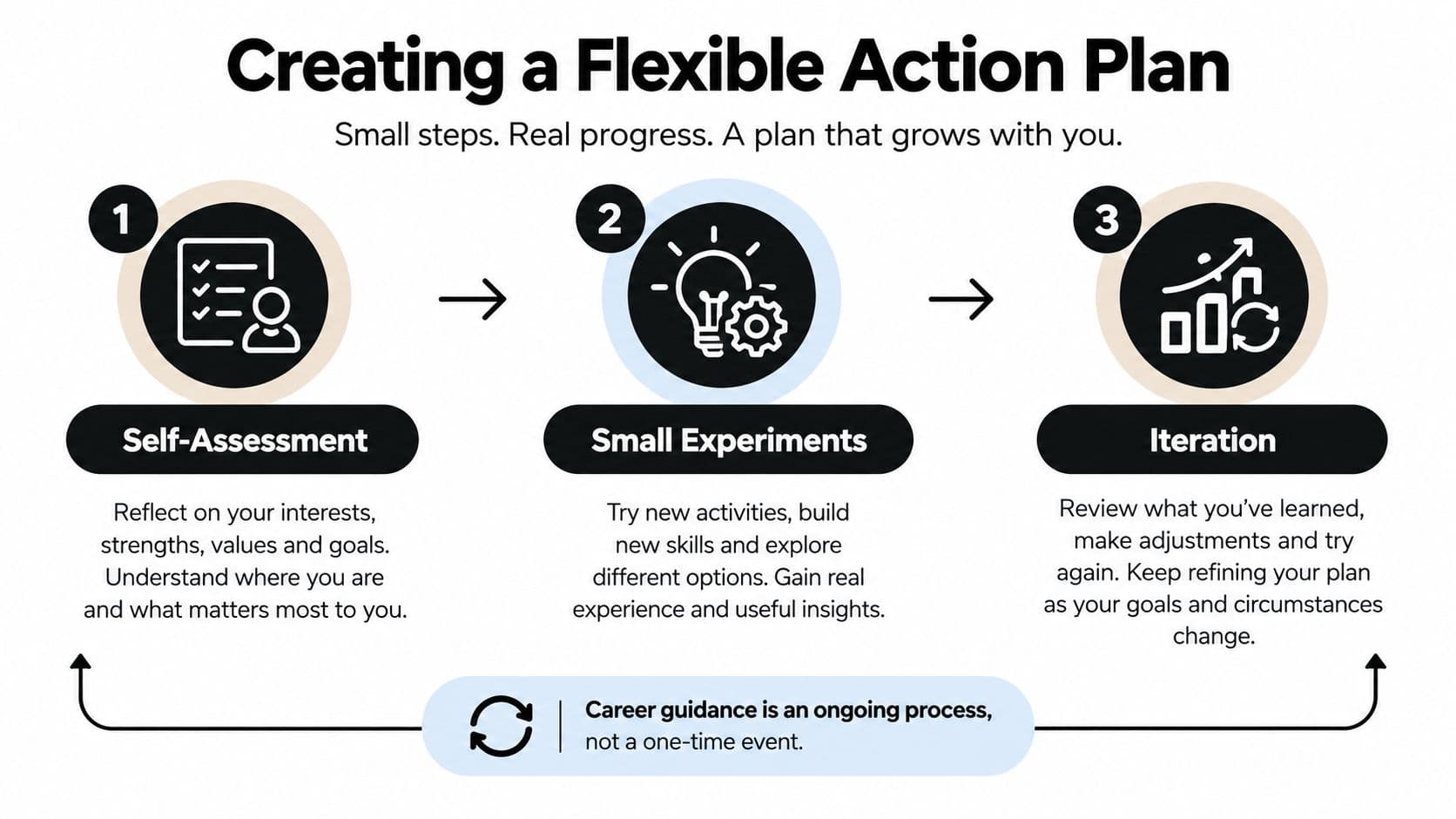
A career plan should tell you what you'll do next, what evidence you'll collect, and when you'll reconsider. It shouldn't lock you into a dramatic declaration about the rest of your life.
Write a one-page plan with five parts:
- Direction: Name the current path you're willing to test.
- Reason: Connect it to your values, abilities, and practical needs.
- Next experiment: Choose one conversation, project, course, application, or volunteer activity.
- Skill investment: Identify the capability that would make the next step easier.
- Review date: Decide when you'll evaluate the evidence.
Build review points into the plan
Career guidance works better as a continuing relationship than as one decisive conversation. An OECD analysis of career guidance for adults found that among adults who had met an adviser during the previous year, 33% had three or more interactions. Repeated conversations give you a place to interpret new evidence instead of making every decision alone.
Set a review every six to twelve months, or sooner when your responsibilities, health, location, or industry changes. At each review, ask:
- What did I learn about the work itself?
- Which skill became more valuable?
- What evidence argues against this direction?
- What adjacent path now deserves testing?
- What should I stop doing because it no longer serves the plan?
A useful personal development plan should connect long-term direction to immediate behavior.
Keep more than one professional asset in motion. One project can build expertise, another can expand your network, and a third can preserve a fallback option. That portfolio approach gives you room to adapt without treating every change as a crisis.
Moving Forward with Confidence
You don't find a career path by thinking harder until certainty arrives. You find it by combining honest self-assessment with contact with reality. Your interests and values tell you what deserves attention. Your abilities show where you can contribute. Your experiments reveal what the work demands.
Use Dan Millman's “The Life You Were Born to Live” when you want a reflective framework for exploring personal themes and life direction. Use assessments based on interests, abilities, and personality to generate occupational questions. Use conversations, projects, volunteering, short courses, and job observations to challenge your assumptions. Then compare the options against access, sustainability, growth, and constraints.
A career path is a direction with evidence behind it, not a life sentence.
You'll make better decisions when you separate your purpose from your current method. Your purpose may involve helping people, solving difficult problems, creating beauty, building security, or developing knowledge. The specific occupation may change as you learn more. Holding the deeper motive steady while allowing the job title to change protects you from both impulsive pivots and stubborn loyalty to a path that no longer fits.
Uncertainty will return. That's normal. Review your assumptions, run a smaller experiment, ask someone with direct experience, and update the plan. You don't need to become fearless before moving. You need a next step that produces useful information.
Start this week. Write your three strongest career hypotheses, contact one practitioner in each area, and schedule one small project that lets you experience the work rather than merely imagine it. Each honest result will narrow the field and bring your working life closer to a direction that fits who you are becoming.
Life Purpose App offers a digital companion to Dan Millman's “The Life You Were Born to Live,” letting you enter your date of birth to explore a life path, related strengths, challenges, and career themes. Visit Life Purpose App and use the reflection as one input alongside real-world experiments and practical career research.
Discover your life path today
Enter your date of birth and see your life path, free.
Find your life path