Ever feel like you’re going through the motions and the person you show the world doesn’t match who you feel inside? This practical guide offers simple, repeatable tools—journaling prompts, short embodiment exercises, a values audit, shadow work, and relationship checks—to help you uncover your authentic self and live with more clarity and purpose.

January 1, 2026 (9mo ago) — last updated September 22, 2026 (27d ago)
Find Your Authentic Self: Practical Steps
Practical steps—journaling, embodiment, values audits, and gentle boundaries—to uncover your authentic self and live with clarity.
← Back to blog
Ever feel like you’re going through the motions and the person you show the world doesn’t match who you feel inside? This practical guide offers simple, repeatable tools—journaling prompts, short embodiment exercises, a values audit, shadow work, and relationship checks—to help you uncover your authentic self and live with more clarity and purpose.
Find Your Real Self: A Practical Guide
Summary: Discover how to find your real self with clear, actionable steps—journaling, embodiment, values audits, and gentle boundaries—to live with purpose and alignment.
Introduction
Ever feel like you’re going through the motions and the person you show the world doesn’t match who you feel inside? You’re not alone. This practical guide gives focused tools—journaling prompts, short embodiment practices, a values audit, gentle shadow work, and relationship checks—to help you uncover and live from your authentic self.
Why Authenticity Matters
If you’ve ever felt like an actor in your own life, that’s a signal to slow down. We wear masks to fit in at work, keep the peace with family, or get through social situations. When those masks feel more real than your own face, remove layers of expectation and tune into the quiet voice you already have. Living in alignment with your core values supports well-being and reduces chronic stress1.
Practical Tools for Self-Discovery
Use reliable practices you can repeat: focused journaling, brief stillness and embodiment work, a personal values audit, gentle shadow exploration, and simple relationship checks. You can also use frameworks like the Life Purpose App, based on Dan Millman’s The Life You Were Born to Live, to notice recurring patterns4.
Create Space to Listen
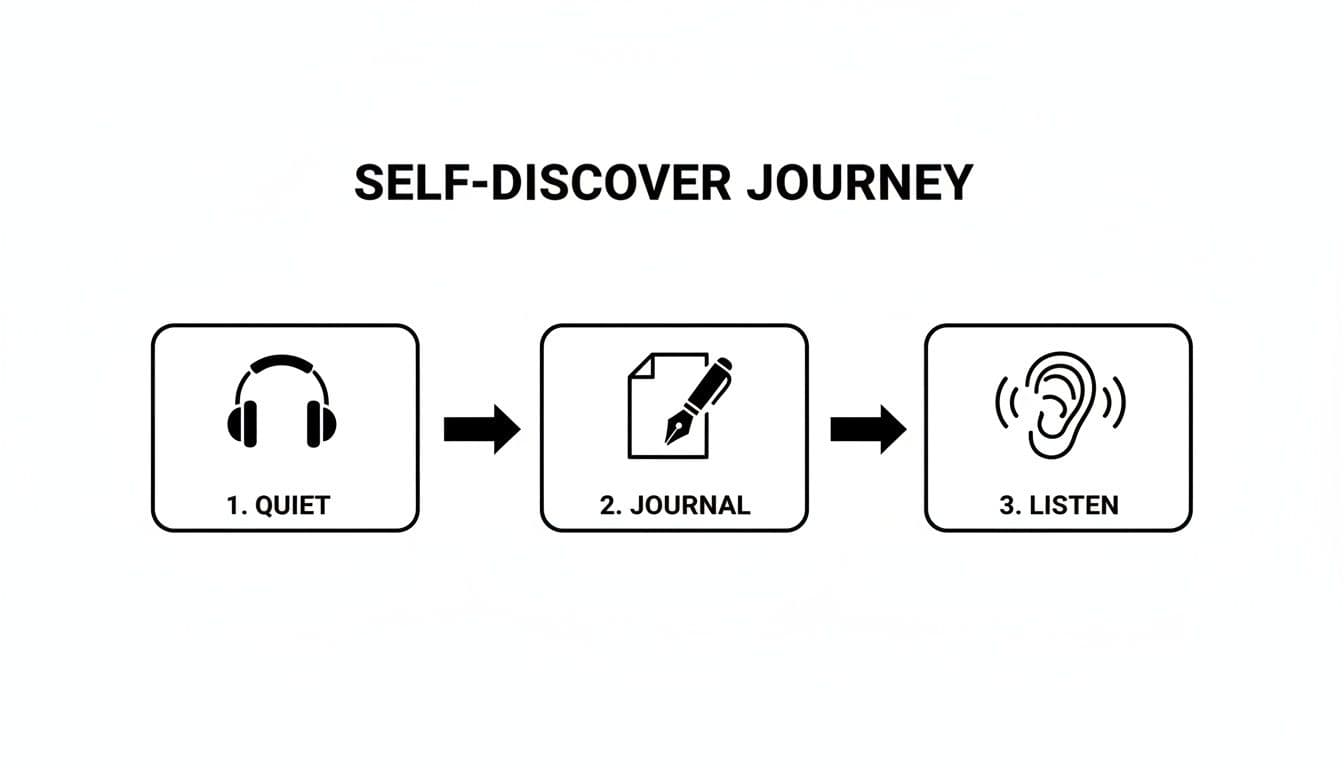
Before you can hear that inner voice, turn down the external noise. Carve out brief, regular pockets of solitude so thoughts can settle, like letting muddy water clear. Reduce constant consumption—social media and other people’s opinions—and intentionally turn inward.
Use Journaling to Ask Better Questions
Journaling isn’t just logging your day. The deepest shifts come from asking questions that bypass surface answers. Treat your journal as a private lab where you test, notice, and respond honestly.
Try these prompts:
- What activities make me lose all track of time? (A clue to your passions and flow.)
- When do I feel like I’m wearing a mask? Name the situations and why.
- If fear and judgment were gone, what is one thing I would do differently tomorrow?
Pair Writing with Brief Stillness
Pair writing with short stillness practices. Meditation isn’t about clearing your mind forever, it’s learning to observe thoughts without getting pulled in. Even five minutes a day focused on the breath can reduce reactivity and increase clarity2. For guided options, see Meditation for Self-Discovery.
Map Your Inner Blueprint
Use the quiet you’ve created to map your values, shadow parts, and bodily signals. These are practical tools, not mysticism.
Conduct a Personal Values Audit
Your values are a compass for decisions. List your top five non-negotiables—freedom, creativity, security, compassion, adventure, or others. Then rate how much each one shows up in daily life on a scale of 1 to 10. This exposes mismatches you can address.
Be radically honest. If financial security drives your choices, own it. There’s no moral hierarchy here, only alignment.
Gently Explore Your Shadow
Shadow work isn’t about shame. It’s about noticing traits you’ve suppressed—anger, envy, stubbornness—and meeting them with curiosity. Triggers are useful signals: when someone sparks a strong reaction, pay attention; it often points to unresolved material.
Try reframing: what appears as “nosiness” might be deep curiosity; “stubbornness” can be steady determination. Integrating shadow parts recovers energy and strengthens self-awareness. For more on self-awareness, see How to Develop Self-Awareness.

Reconnect Through Embodiment
Embodiment means getting out of your head and into physical sensation. Your body holds cues—tension, openness, energy—that tell you whether a choice aligns with you. Try a body scan: lie down, bring attention to your toes, notice without judgment, and move attention slowly through the body. Mindful movement and walks without headphones help reconnect to this guidance. For practical exercises, see Mind-Body Practices.
Put Authenticity into Practice
Uncovering who you are is only the start. The work is integrating those discoveries into relationships and work, where you spend most of your time. Small, consistent shifts have an outsized impact.
Audit Your Key Connections
Reflect on friends, family, and partners. For each, answer:
- Do I feel more energized or exhausted after time with them?
- Can I be my full, unfiltered self around them, or do I perform?
- Do they celebrate my growth?
This audit isn’t about cutting people out immediately. It’s about awareness so you can make conscious choices about who gets your time.
Practice Gentle Boundaries
Boundaries protect time, energy, and well-being. They don’t have to be dramatic. Start small with concise scripts: “I value our friendship and I’m here for you, but I only have about 15 minutes to talk about this now.” Clear limits honor you and the relationship. For full guidance, see How to Set Healthy Boundaries.
Bring Purpose into Your Work
You don’t need to quit your job to add authenticity at work. Match tasks to your core values. If creativity matters, propose a new way to organize a project or volunteer to design an internal newsletter. If connection matters, check in with a colleague or mentor someone.
Tools like the Life Purpose App, based on Dan Millman’s framework, can reveal patterns that affect your work and relationships4. Mobile productivity and wellness apps are increasingly used to support purpose-driven habits and daily routines3.

Navigate with Courage and Compassion
This isn’t a finish line. It’s an ongoing practice that asks for courage and self-compassion. As you change, you may outgrow people and situations. That can feel unsettling, but it’s part of honest growth.
Handle the Ebb and Flow
Expect ups and downs. Celebrate small wins—setting a tiny boundary, choosing a value-driven activity—and be gentle when you stumble. Doubt is often a clue to where you can grow. If self-doubt is a struggle, explore practical reframes at How to Overcome Self-Doubt.
Notice Your Personal Seasons
Some challenges reflect natural cycles. Dan Millman’s life-path framework can show nine-year cycles and give perspective on whether you’re planting seeds, consolidating, or letting go. That context helps you work with the energy of the moment rather than against it4.
Live Authentically Every Day
True change happens through small daily habits. Turn insights into repeatable practices that keep you moving toward alignment.
From Insight to Integration
Simple habits that help:
- Take mindful pauses: before you say yes, breathe and ask, “Does this feel right for me?”
- Make value-based choices: keep your top values visible—sticky notes or a phone wallpaper—and use them as decision anchors.
- Practice consistent boundaries: say one small no this week to build the muscle for bigger boundaries later.
Every small, authentic choice is a win.
FAQ — Common Questions
How long does authentic living take?
There’s no fixed timeline. Some people have sudden insights, for most it’s a gradual unfolding. Focus on daily practices rather than a finish line.
What if I don’t like what I discover?
That’s common. The aim is integration, not perfection. Shadow traits often contain strengths—meet them with curiosity and experiment with small changes.
Will authentic living harm my relationships?
Some relationships will change. The connections that are resilient often deepen, and you’ll start attracting people who resonate with your true self.
1.
Evidence linking authenticity and autonomy with improved well-being and lower stress is rooted in Self-Determination Theory. See the theory overview: https://selfdeterminationtheory.org/SDT/theory/
2.
A meta-analysis on meditation and mindfulness found reductions in anxiety and stress with short, regular practice. See the JAMA Internal Medicine review: https://jamanetwork.com/journals/jamainternalmedicine/fullarticle/1809754
3.
Market data shows rising adoption of productivity and wellness apps as people seek meaning and purpose; see app usage statistics: https://buildfire.com/app-statistics/
4.
Dan Millman’s framework and The Life You Were Born to Live are the basis for the Life Purpose App: https://danmillman.com/books/the-life-you-were-born-to-live/
Discover your life path today
Enter your date of birth and see your life path, free.
Find your life path