Feeling stuck in your current job? This practical guide shows how to plan and execute a confident career change: honest self-assessment, market research, targeted skill-building, financial planning, and strategic networking.

November 28, 2025 (10mo ago) — last updated August 1, 2026 (2mo ago)
Career Transition Guide: Change Careers
Step-by-step guide to plan a confident career change: assess yourself, research markets, build skills, network, and plan finances.
← Back to blog
Feeling stuck in your current job? This practical guide shows how to plan and execute a confident career change: honest self-assessment, market research, targeted skill-building, financial planning, and strategic networking.
Career Transition Guide: Change Careers
Feeling stuck? This practical guide walks you through the steps to change careers with clarity and confidence: honest self-assessment, market research, skills building, financial planning, and strategic networking.
Finding Your Direction When You Feel Stuck

That nagging feeling of being stuck is a signal that something needs to change. Before you rewrite your LinkedIn profile or start applying, pause and look inward. Honest self-assessment builds the foundation for a transition that lasts.
This isn’t just listing skills. It’s digging deeper to uncover core motivations, pinpoint what drains your energy, and identify what truly lights you up. That discomfort can be the catalyst for meaningful change.
Get Clear on What Needs to Change
Define what’s actually not working. Is it the industry, your role, company culture, or the day-to-day tasks? Be specific.
If you’re drawn to tech, a beginner’s roadmap for an IT career can show whether that path fits you. Explore industry roadmaps and training paths to see what skills and timelines are realistic.2
“The goal isn’t just to run away from a job you hate. It’s about moving toward work that truly aligns with who you are.”
Try structured exercises to surface values, energizers, and meaningful tasks; then let that internal compass guide your search.
Career Transition Starting Checklist
| Action Item | Key Question | Tool/Resource |
|---|---|---|
| Pinpoint the dissatisfaction | What specifically about my job makes me unhappy? | Journaling, mentor conversations |
| Identify your energizers | What tasks make me feel engaged and motivated? | Review past projects, hobbies, volunteer work |
| Assess core values | What matters most at work (autonomy, impact, stability)? | Values exercises, online assessments |
| Understand patterns | What are my recurring strengths and limits? | The Life Purpose App and Dan Millman’s framework1 |
Complete this internal work so your external search stays focused and aligned with long-term satisfaction.
Discovering Innate Talents and Patterns
A structured self-discovery framework can help you identify gifts, recurring challenges, and environments that fit your temperament. Dan Millman’s system and the Life Purpose App offer one such lens to understand strengths and repeating patterns.1
That perspective can clarify which roles are likely to feel energizing—creative tasks may point to marketing or design, while order-oriented work may suit project management or engineering.
Grounding Purpose in Market Reality
After the internal work, connect your discoveries to real jobs and industries. Think of this as building a bridge from self-knowledge to opportunity.
Your life-path insights aren’t a magic bullet, but they can point you to environments and tasks where you’re more likely to thrive.1
Timing and Personal Cycles
Map your personal cycles. Some seasons are for planting new seeds; others are for planning or finishing projects. Aligning a transition with a natural “new beginning” period can make the process feel smoother.
Time for a Reality Check
Shift from introspection to investigation. Ask: What industries are growing? Is there demand for the roles that excite you? Start by:
- Checking industry projections and job descriptions with the U.S. Bureau of Labor Statistics’ Occupational Outlook Handbook2.
- Analyzing job postings on LinkedIn, Indeed, and niche boards to spot recurring skills and responsibilities.
- Getting realistic salary ranges with Glassdoor and PayScale to understand compensation expectations3.
Data is useful, but the most powerful insights come from conversations with people doing the work. Informational interviews let you confirm fit and start building relationships. A strong professional community improves transition outcomes and workplace adaptability4.
Building Skills and a Financial Runway
A good idea needs the right skills and enough savings to carry you through the change. Start with a skills-gap analysis: compare target job descriptions to your resume and note the gaps.
Bridging Your Skill Gap
Knowing what you don’t know is progress. The world of work is shifting quickly; projections highlight major skills changes and the need for reskilling through 2030 and beyond5.
Practical ways to build skills:
- Take online courses on platforms like Coursera to learn coding, data, or marketing tools.
- Earn professional certifications that show job-ready skills.
- Do freelance or volunteer projects to build a portfolio and gain real-world experience.
Use a personal development plan to map learning goals and timelines. Many employers are already investing in retraining and upskilling programs—look for companies that support growth6.
Calculating Your Financial Runway
Figure out how much you need to live while you study, job hunt, or accept an initial pay cut. Add essential monthly expenses (rent, utilities, groceries, insurance, debt) and multiply by the number of months you expect the transition to take. Aim for at least six months if possible, and tailor this to your situation.
A financial cushion gives you the mental space to make clear decisions instead of panicked ones.
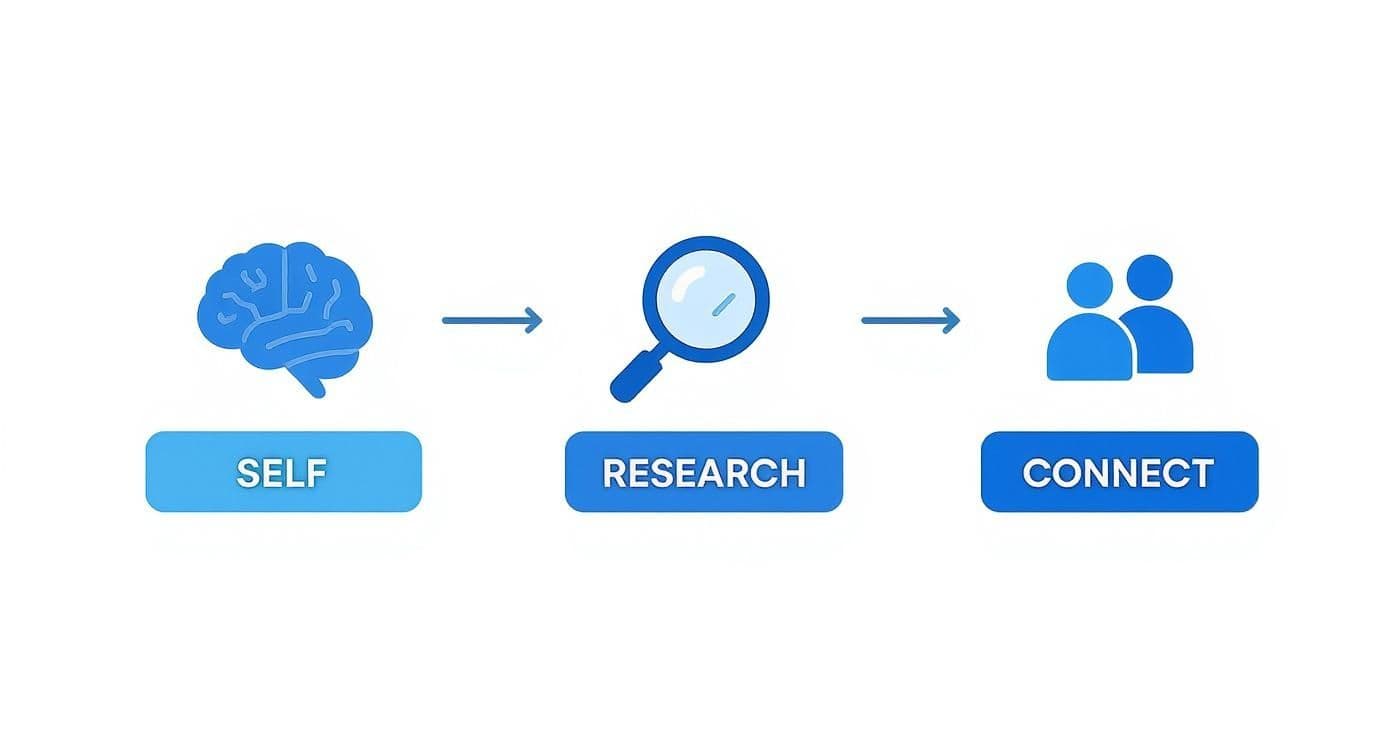
This flow starts with you (self-reflection), moves to the outside world (research), and ends with people (connecting). Building skills and savings grounds your plans in reality.
Telling Your New Career Story

Your resume and LinkedIn profile should show where you’re headed, not just where you’ve been. This is a strategic rebrand: translate your history so hiring managers see how your experience fits the new role.
Crafting a Forward-Looking Narrative
Recruiters read your resume summary and LinkedIn About section first. Replace old objective statements with a clear, forward-looking summary that names the target role or industry and highlights your most relevant transferable skills.
“Your new professional story should be a compelling argument for why your background makes you a great fit for this new role.”
Translating Skills and Experience
Describe your skills in the language of your target industry. Convert phrases like stakeholder management to client relationship building, or curriculum development to instructional design.
Start by:
- Auditing your wins and adding numbers—“managed a $50,000 budget” or “boosted team efficiency by 15%.”
- Becoming a job-description detective: mirror the keywords and action verbs employers use.
- Focusing on impact, not just tasks.
See career-change resume examples and templates to model strong rebrands. For examples and templates, consider internal resources like a company careers hub or a dedicated resume guide at /career-resources or /resume-examples.
Networking and Interviewing as a Career Changer
Your network and interview presence are crucial. Building intentional relationships in your new field is more valuable than collecting contacts. Many workers change roles frequently; understanding trends helps you position yourself effectively7.
Building Your New Professional Circle
Expand your network with intention. Search LinkedIn for people in the roles you want and ask for brief informational interviews. A simple outreach message works best:
“Hi [Name], I’m exploring a career change into [Industry] and was impressed by your work at [Company]. Would you be open to a 15-minute chat so I can learn about your experience?”
These conversations give insider information, build relationships, and put you on people’s radars before jobs are posted.
Nailing the “Why the Change” Question
Interviewers will ask why you’re changing careers. Frame your answer as a deliberate move toward something new, not an escape from something old. Connect your past experience to future ambitions with concrete examples.
Example: “I loved developing young minds, but my passion is creating learning systems for adults. My curriculum design and classroom management experience gives me a foundation to build effective corporate training programs.”
Common Interview Questions for Career Changers
| Question | What They’re Really Asking | How to Frame Your Answer |
|---|---|---|
| “Why are you changing careers?” | Are you running from something or toward something? | Emphasize the pull of the new industry and the logical link to your skills. |
| “Why our company/industry?” | How much do you know about this field? | Show research: mention projects, company values, or trends that excite you. |
| “How will your past experience apply here?” | Can you prove your skills are relevant? | Use Situation–Action–Result examples to connect past wins to future needs. |
| “What’s your biggest weakness in this new role?” | Do you know your gaps, and can you close them? | Acknowledge one gap and show the plan you’re using to bridge it. |
Show adaptability, passion, and transferable skills with concrete examples to move from a risky hire to a memorable candidate.
Common Concerns and Practical Answers
“What if I feel like a total fraud?” (Imposter syndrome)
Feeling like an imposter is common. Reframe how you see yourself—every expert was once a beginner. To push back:
- Keep a win journal of small victories.
- Embrace a learner mindset—focus on growth, not perfection.
- Talk to a mentor or trusted friend to shrink self-doubt.
“Am I too old to make a change?”
No. Changing careers later in life means starting from experience. You bring transferable skills—communication, leadership, problem solving—and clarity about what you want. Use that foundation to make smarter choices.
“How do I explain this to family and friends?”
Have a simple, confident story. Focus on your why and the steps you’re taking: building a financial cushion, taking courses, and talking to people in the field. Ask for support and set boundaries when needed.
Three Concise Q&A Sections
Q: What’s the first step I should take?
A: Start with honest self-assessment: identify what’s not working, what energizes you, and your core values. Use structured exercises and a journal to get specific.
Q: How can I reduce financial risk during a transition?
A: Build an emergency cushion (aim for several months of expenses), cut nonessential spending, and seek part-time freelance or contract work while you upskill.
Q: What action gives the fastest clarity?
A: Conduct informational interviews—talking with people in the roles you want reveals day-to-day realities and hiring signals faster than any course.4
Quick Q&A: Common Career-Change Questions
Q: What’s the first step in making a career change?
A: Do honest self-assessment: clarify what’s not working, identify energizers, and define your values. Use exercises and tools to get specific.
Q: How do I know if a new field is viable?
A: Research industry growth (BLS), analyze job postings for recurring skills, and talk to people in the field through informational interviews.24
Q: How can I bridge skill gaps without quitting my job?
A: Take online courses, earn targeted certifications, and pick up freelance or volunteer projects to build a portfolio.
Essential Q&A (Bottom-Line Summary)
Q: How long will a career transition typically take?
A: It varies by field and preparation. Expect a practical timeline of 3–12 months for skills-building and networking, longer if a full reskilling is required.
Q: What’s the safest way to reduce financial risk during a transition?
A: Build an emergency cushion, reduce nonessential expenses, and pursue part-time freelance or contract work while you upskill.
Q: What’s the single most impactful action I can take now?
A: Start informational interviews—talking to people in the roles you want gives real-world clarity faster than any course.4
Ready to uncover your innate talents and find a career that aligns with your purpose? The Life Purpose App is a digital guide to Dan Millman’s system and can help you get clarity for your next move: https://lifepurposeapp.com
1.
Dan Millman, The Life You Were Born to Live, and the Life Purpose App [https://www.lifepurposeapp.com](https://www.lifepurposeapp.com)
2.
U.S. Bureau of Labor Statistics, Occupational Outlook Handbook [https://www.bls.gov/ooh/](https://www.bls.gov/ooh/)
3.
Salary research resources: Glassdoor https://www.glassdoor.com and PayScale https://www.payscale.com
4.
O.C. Tanner, 2025 Global Culture Report [https://www.octanner.com/global-culture-report.html](https://www.octanner.com/global-culture-report.html)
5.
World Economic Forum, Future of Jobs Report (skills shifts and reskilling projections) [https://www.weforum.org/reports/future-of-jobs-2020](https://www.weforum.org/reports/future-of-jobs-2020)
6.
Global hiring trends analysis (employer retraining and upskilling): https://www.hireborderless.com/post/global-hiring-trends-report-2025-mid-year-analysis
7.
OECD, Employment Outlook 2025 [https://www.oecd.org/en/publications/2025/07/oecd-employment-outlook-2025_5345f034/full-report/component-9.html](https://www.oecd.org/en/publications/2025/07/oecd-employment-outlook-2025_5345f034/full-report/component-9.html)
Discover your life path today
Enter your date of birth and see your life path, free.
Find your life path