April 3, 2026 (Today)

How to Stop Feeling Like a Failure and Find Your Purpose

How to stop feeling like a failure - Learn how to stop feeling like a failure and discover actionable steps to reclaim your confidence and find your true purpos

← Back to blog
Cover Image for How to Stop Feeling Like a Failure and Find Your Purpose

How to stop feeling like a failure - Learn how to stop feeling like a failure and discover actionable steps to reclaim your confidence and find your true purpos

If you’re ready to stop feeling like a failure, the first and most important thing to do is understand you are not alone. From there, we can start a simple practice that begins rewiring your brain to see possibility instead of defeat. This combination is your foundation for real, lasting change.

That Crushing Feeling? You Are Not Alone
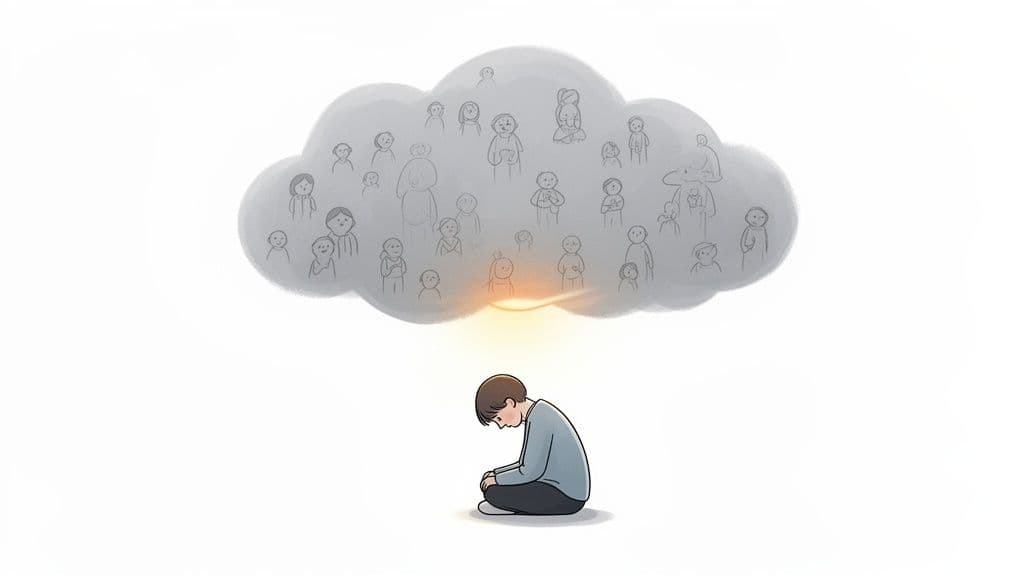
A person sits alone, head bowed, under a cloud representing numerous people, with a light shining.

It’s a heavy weight, isn’t it? That feeling of failure can whisper that you're the only one who just can't get it right, leaving you feeling isolated and completely stuck. But that feeling is a powerful illusion.

The truth is, this is one of the most universal human experiences. You are in very good company.

From high-achieving executives to new parents finding their footing, countless people wrestle with self-doubt and what’s often called imposter syndrome. In fact, an eye-opening 2026 global survey revealed that a staggering 85% of people report feeling like a failure at some point. Think about that. The vast majority of us have been exactly where you are.

This feeling isn't a life sentence; it’s a signal. It's a call to look a little deeper and understand what’s really going on beneath the surface.

The most important thing is to realize that feeling like a failure is just a story. It’s not the truth. It's a frame of reference that you have the power to change.

The Power of Shifting Your Focus

The goal isn't to pretend your feelings don't exist. It's to see them for what they are and then gently shift your focus. So, how can you start to counter this heavy narrative? One of the simplest and most effective evidence-backed habits is gratitude.

It almost sounds too simple to work, but the science is solid. Studies from the American Psychological Association in 2025 showed that people who kept a daily gratitude journal managed to reduce these crushing feelings by 25% in just four weeks.

Why? Because gratitude actively rewires your brain, training it to scan for positives instead of fixating on perceived shortcomings.

Here’s how this small practice creates big change:

  • It counters our natural negativity bias. Our brains evolved to look for threats and problems. Gratitude is a deliberate counterbalance, forcing you to acknowledge what’s going right.
  • It builds emotional resilience. By regularly noticing small wins, moments of peace, or sources of comfort, you create a mental library of positive evidence to draw on when self-doubt creeps in.
  • It reframes your perspective. Gratitude helps you see setbacks not as dead ends, but as data points on a much longer, more complex journey.

If these feelings of failure seem tied to a deeper sense of being adrift, you might find our guide on what to do when you feel lost in life especially helpful.

Gratitude in Action: A Practical Reframe

Putting this into practice is incredibly simple. It's not about ignoring your problems, but about consciously choosing a different thought to hold alongside the difficult one. You’re taking back control of your inner dialogue.

Let's look at how this works in the real world. A simple shift to gratitude can completely reframe the thoughts that keep you stuck.

Negative Thought vs Gratitude Reframing

Common Failure-Based ThoughtGratitude-Based Reframe
"I messed up that project completely.""I'm grateful for the lesson this project taught me. Now I know what to do differently next time."
"I'm so far behind everyone else my age.""I'm thankful for my unique path and the personal strengths I've developed along the way."
"I can't seem to get anything right today.""I'm grateful for the chance to rest tonight and start fresh tomorrow with a new perspective."

This isn’t about toxic positivity or pretending everything is perfect. It's about acknowledging the difficulty while also giving weight to the good, however small it may seem.

This small, consistent action is a gentle but powerful first step on the journey to stop feeling like a failure for good.

Uncover the Triggers Behind Your Failure Narrative

That gut-punch feeling of failure doesn't just appear from nowhere. It's almost always a reaction, set off by something specific—a person, a place, a critical email, or even just a passing thought that sends you down a familiar, painful spiral.

If you want to break free from feeling like a failure, you first have to become a detective in your own life. It’s about learning to spot the breadcrumbs that lead to that feeling, so you can stop the cycle before it even gets going. This is how you move from feeling overwhelmed and reactive to being proactive and in control.

Pinpointing Your Personal Triggers

While your triggers are deeply personal, they often cluster around a few common themes. Think back to the last time you felt that sinking sense of inadequacy. What was happening right before?

  • Social Comparison: Let's be honest, this is a big one. Were you scrolling through LinkedIn, seeing another promotion, and suddenly feeling like you're miles behind? Our "behind-the-scenes" mess rarely feels good next to someone else's polished highlight reel.
  • Criticism from Others: Did a blunt comment from your boss or even a well-meaning jab from a family member hit a raw nerve? External feedback, even when it's not meant to be harsh, can easily wake up our loudest inner critic.
  • Impossible Self-Imposed Standards: Have you set the bar so high that anything less than perfection feels like a catastrophe? This often shows up in our careers, parenting, or fitness goals, where we demand flawless performance from an imperfect human—ourselves.

These narratives are often supercharged by mental traps known as cognitive distortions. These are patterns of thinking that warp reality and make you feel much worse than you need to. A classic example is "all-or-nothing thinking," which tells you that if you didn't achieve a total, smashing success, you're an absolute failure. There's no in-between.

Your feelings are not facts. By identifying what causes the feeling, you separate the emotion from your identity. A setback is an event; it does not make you a failure.

Start a Trigger-Tracking Journal

The most powerful way to get a handle on this is to start writing it down. This isn't about crafting beautiful prose; it's about collecting data.

For the next week, try this. Every time that wave of "I'm a failure" washes over you, grab a notebook or open a notes app. Don't overthink it, just quickly log the scene.

  • What was the specific situation? (e.g., "I was in the weekly team meeting and my project update was met with silence.")
  • Who was I with? (e.g., "My manager and the whole department on Zoom.")
  • What was the thought right before the feeling hit? (e.g., "I thought, 'They all think I'm dropping the ball. I'm completely out of my depth.'")
  • What did I feel in my body? (e.g., "My stomach twisted, my face flushed, and I just wanted to turn my camera off.")

After just a few days of this, you’ll start seeing patterns you never could have noticed otherwise. Maybe you'll realize your failure-meter spikes every Sunday evening before the workweek begins. Or perhaps you'll see that a particular friend’s "helpful advice" consistently leaves you feeling small and incompetent.

This awareness is everything. It’s the moment you stop being ambushed by your feelings and start anticipating them. When you can see the trigger coming, you have a choice. And having a choice is where you reclaim your power.

Practice Self-Compassion Instead of Self-Criticism
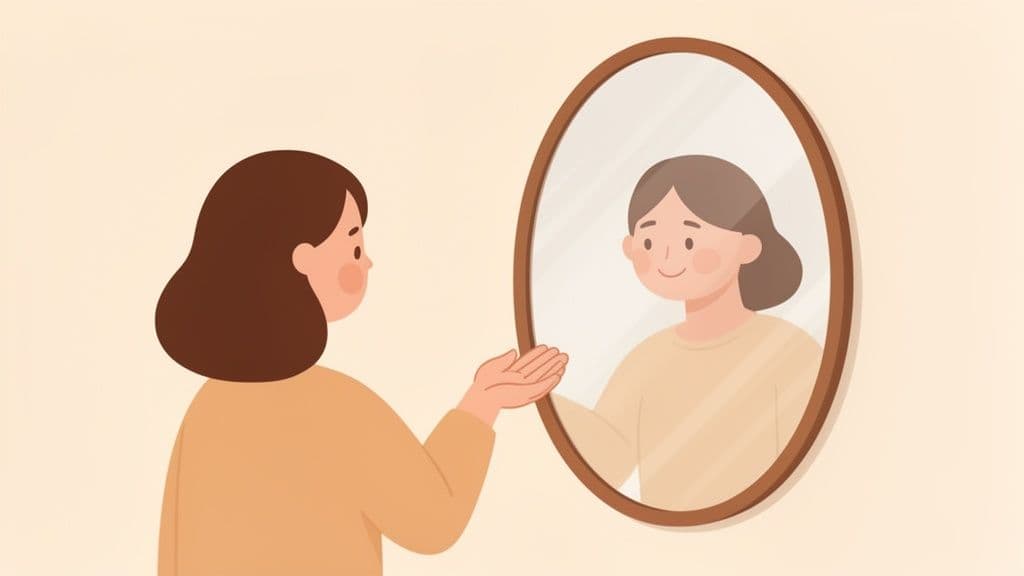
Illustration of a woman looking at her smiling reflection in an oval mirror, extending her hand.

We all have that voice—the one that replays every misstep on a relentless loop. It's our own inner critic, whispering that we aren't smart enough, good enough, or that this latest setback is the final, definitive proof of our inadequacy.

But what if you could change that inner monologue? What if, instead of a critic, you had an ally in your head?

This is the entire premise behind self-compassion, and it’s a powerful tool for anyone struggling with feelings of failure. It’s not about letting yourself off the hook or making excuses. It's about giving yourself the mental and emotional space to look at your mistakes honestly, without the crippling shame, so you can actually learn and find the courage to try again.

What Self-Compassion Actually Looks Like

Dr. Kristin Neff, a pioneer in this field, has shown that self-compassion isn't some vague, fluffy concept. It’s a practice you can actively cultivate. Instead of beating yourself up, try leaning into these three core ideas:

  • Self-Kindness vs. Self-Judgment: When you mess up, talk to yourself the way you would a dear friend. This means making a conscious choice to use gentle, supportive language rather than tearing yourself down.
  • Common Humanity vs. Isolation: Remind yourself that stumbling is a fundamental part of being human. You are not the only person who has ever felt this way. Everyone struggles, and this experience connects you to others rather than isolating you.
  • Mindfulness vs. Over-Identification: Acknowledge your painful feelings without letting them consume you. You can observe your disappointment or frustration with a sense of balance, recognizing that a feeling is just a feeling—it doesn't have to define your reality.

The data on this is compelling. A landmark 2026 meta-analysis in JAMA Psychiatry found self-compassion can lower symptoms of depression by 33% and boost resilience by 28%. Another study showed that a daily self-kindness practice cut negative self-talk by 40% in just six weeks. These findings, and others like them, are regularly discussed and can be explored further in journals like the JAMA Network.

A Quick Self-Compassion Exercise: The next time that wave of failure washes over you, try this. Pause. Put a hand over your heart, feel its beat, and take a deep breath. Silently say to yourself, "This is a moment of suffering. Suffering is part of life. May I be kind to myself right now."

This simple act can be enough to interrupt the shame spiral and reconnect you to your own strength. If that inner critic is still loud, our guide on how to overcome self-doubt offers more targeted ways to quiet the noise.

From Criticism to Coaching

Think about how you'd treat a child who falls off their bike. Would you yell, "You're a clumsy idiot! You'll never get it!"? Of course not.

You'd be far more likely to say, "That was a great try! You almost had it. Let's figure out what we can do differently this time."

That’s the voice of a coach, not a critic. That’s the voice of self-compassion. It acknowledges the fall but immediately pivots to learning and encouragement. This approach is far more motivating than harsh judgment ever could be.

Some people find it helpful to use physical reminders to cultivate this mindset. For example, incorporating gemstones for self-love into your space or daily routine can serve as a tangible cue to practice kindness. By trading your inner critic for an inner coach, you stop seeing every stumble as proof of failure and start seeing it as part of your training.

Shrink the Goal, Build the Momentum

Illustration of a progress path with checked steps leading to a flag on a peak.

That feeling of failure often has less to do with our actual ability and more to do with the sheer, impossible size of the goals we set. We stare up at a massive ambition—"write a book," "change my career"—and the distance from here to there feels so vast that we’re crushed before we even start.

This puts us in a dangerous all-or-nothing trap. If the book isn't finished, you've failed. If you haven't landed the dream job yet, you've failed. It's an exhausting and demoralizing way to operate, and it completely ignores the only thing that actually creates change: small, consistent steps forward.

But here’s the good news. You can flip this script entirely by redefining what success looks like on a daily—or even hourly—basis.

The Underrated Power of the Micro-Goal

The antidote to that overwhelming, paralyzing ambition is the micro-goal. Think of these as tiny, actionable steps that are so small they feel almost too easy to complete. They immediately shift your focus from the terrifying final outcome to the satisfying progress you can make right now.

Instead of "write a book," your micro-goal is "write 100 words today." Instead of "get in shape," it’s "walk for 10 minutes during my lunch break."

Each time you check one off, you get a small win. It’s a piece of hard evidence that you are capable and you are moving forward. These little victories stack up, creating momentum and, just as importantly, rebuilding your trust in yourself.

Here's the secret: A micro-goal isn't just a tiny task. It's a psychological tool that generates momentum, proves your inner critic wrong, and gives you a daily dose of "I did it."

This approach rewires your brain by giving it what it craves: a steady drip of accomplishment and control. Over time, these daily wins snowball into major, meaningful change, all without the pressure of a single, monolithic objective hanging over your head.

Turn Vague Ideas into SMART Goals

To give your micro-goals real teeth, they need a little structure. The best framework for this is making them SMART goals. This ensures your goals aren't just small, but also focused and clear.

Here’s a quick breakdown:

  • S - Specific: Be crystal clear. Not "work on my resume," but "add my last two job responsibilities under the 'Experience' section."
  • M - Measurable: How will you know it’s done? Not "write more," but "write for 15 minutes without stopping."
  • A - Achievable: Is this actually realistic for you today? If you're feeling stuck, "write one paragraph" is far better than "write a whole chapter."
  • R - Relevant: Does this tiny action move you toward your bigger ambition? Make sure the step, however small, is in the right direction.
  • T - Time-bound: Give yourself a deadline. "Draft one email to a networking contact by 3 PM today."

Turning vague wishes into a concrete action plan like this makes a huge difference. In fact, a 2025 analysis from Harvard Business Review showed that people using SMART goals were 42% less likely to feel like failures, with their goal completion rates jumping from a dismal 20% to an impressive 76%. You can dig into more of the research on goal-setting over at HBR.org.

Your Micro-Goal Action Plan in Action

Let's take a big, intimidating goal and break it down into something you can actually start today.

The Big, Scary Goal: "I need to build a professional website for my side business."

Your SMART Micro-Goals:

  1. (S) Research and list three potential website builders (like Squarespace, Wix, or WordPress). (M) A list of three. (A) Totally doable in an hour. (R) A critical first step. (T) Finish this by the end of the day Tuesday.
  2. (S) Write a 50-word "About Me" bio for the homepage. (M) 50 words. (A) A small, focused writing task. (R) Essential website content. (T) Complete this on Wednesday morning.
  3. (S) Choose and purchase a domain name. (M) One domain bought. (A) Can be done in 15 minutes. (R) A non-negotiable step. (T) Get it done by Friday.

See how that works? None of these steps is "build a website." Each one is a small, manageable task that gets you closer to the finish line. Every time you complete one, you're proving to yourself that you're not failing—you're building. If you want more help breaking things down, you might find these goal-planning templates useful for organizing your thoughts.

Connect With Your Deeper Purpose

Sometimes that nagging feeling of failure has nothing to do with your talent or how hard you’re working. It’s a deeper, more subtle signal. It’s that feeling you get when you’re swimming upstream, trying to force success in a way that just doesn't fit who you are.

When this happens, the answer isn’t to try harder. It’s to get curious about your own internal compass and see if you've been reading the map upside down.

Find Your True North and Reframe Your Journey

A powerful tool for this kind of self-discovery comes from Dan Millman's classic book, The Life You Were Born to Live. This isn't about fortune-telling. Think of it more like understanding the unique spiritual physics you were born with, all based on your birth date.

The book, and its digital counterpart the Life Purpose App, helps you identify your specific life path. Each path has its own set of core strengths, natural talents, and, most importantly, predictable hurdles.

For instance, some of us are born communicators who feel utterly lost if we can’t express ourselves creatively. Others are natural-born leaders who feel like failures if they aren't taking charge and shouldering responsibility. Discovering your path can feel like a lightbulb moment. You start to see that a so-called "flaw" might actually be a core part of your life's curriculum—a challenge you’re perfectly designed to overcome.

This diagram gives you a sense of how this shift in perspective works.

A visual process flow diagram outlining three steps to finding personal purpose and meaning.

It all starts with a simple piece of information—your birthdate. From there, you can unlock a blueprint that helps you see your entire life story through a much kinder, more purposeful lens.

Reframing Failure as a Course Correction

This framework gets even more specific. It doesn't just give you a static "life path"; it also maps out the nine-year cycles that influence your life's themes. By knowing which cycle you're in right now, you can place your recent "failures" into a context that actually makes sense.

Here’s how this can play out in real life:

  • The Career Implosion: You lose a job you poured your heart into. The feeling of failure is crushing. But then you check your life path on the Life Purpose App and discover you’re in a cycle centered on endings and letting go. All of a sudden, the layoff isn't a verdict on your worth. It's a necessary clearing of the decks, making space for something far more aligned with your soul's work.

  • The Relationship Desert: You feel disconnected and lonely, struggling to connect with people. It’s easy to think, "What's wrong with me?" But your insights might show you’re in a cycle of introspection and self-discovery. The friction isn't a sign you're "bad at relationships." It's your life's rhythm telling you it's time to turn inward for a season.

What you once called a failure can be reframed as a fated course correction. It’s a necessary lesson you had to learn to get back on your authentic path.

When you start connecting with a framework like this, you go from feeling lost to feeling guided. The random, painful events in your life start to click into place. Instead of fighting the current and feeling exhausted, you learn to flow with it.

You begin to trust that even the hard stuff is serving a higher purpose. And that's when you finally stop feeling like a failure—because you realize you were never failing at all. You were just learning a lesson your unique path required.

Turning These Skills Into a Lifelong Practice

Let's be real: overcoming that sinking feeling of failure isn't a one-and-done deal. It’s not a destination you finally arrive at. It’s more like learning a new language—the language of self-awareness and resilience. The strategies we've talked about, from spotting your triggers to reframing your story, are the vocabulary. Now, it's time to start speaking it fluently.

The idea isn't to build some rigid, complex system you have to follow perfectly. That would just be another way to feel like you're failing! Instead, think of it as creating your own personal first-aid kit for your mind. You just need to know which tool to grab when those familiar clouds of self-doubt start rolling in.

Some days, a quick gratitude list might be all you need to clear the air. On tougher days, you might need to pull out a few tools—maybe pair a self-compassion break with a look at your micro-goals to remind yourself of the ground you've already covered.

Build Your Go-To Response Plan

This is all about creating a simple, go-to plan for when things get tough. When you know difficult moments are inevitable, you can meet them with a plan and a bit of grace instead of getting pulled into that downward spiral. This "plan" can be as simple as a note on your phone or a dedicated page in your journal.

Here’s what that might look like in practice:

  • When I notice myself doom-scrolling and comparing, I will… immediately close the app and take five minutes to write down three things that went well for me this week, no matter how small.
  • When a big goal feels totally overwhelming, I will… ask myself, "What's one tiny thing I can do in the next 15 minutes to move this forward?" and then do just that.
  • When that inner critic starts yelling, I will… take a deep breath, put my hand on my heart, and ask myself what my kindest friend would say to me right now.
  • When a setback feels like proof that I've failed, I will… open the Life Purpose App to see how this challenge fits into my current life cycle. I’ll look for the lesson, just as Dan Millman describes in The Life You Were Born to Live.

The more you practice this, the more resilient you become. You'll start to notice that while setbacks still sting, they don't have the power to knock you out anymore. Your bounce-back time gets shorter, and that feeling of failure loses its grip much, much faster.

Questions to Keep in Your Back Pocket

As you continue on this path, keep these questions handy. Use them as journal prompts or just as something to reflect on when you need to find your footing again.

  1. What's one "failure" from my past that I can now see was actually a necessary redirection?
  2. What is one small, genuinely kind thing I can do for myself today?
  3. If I were my own best coach, what's the one piece of encouragement I'd offer myself in this exact moment?

By weaving these small actions into your life, you're not just coping—you're building a deep, unshakable foundation of self-trust. You now have a set of reliable, human-centered ways to meet life's challenges with your head held high, fully connected to your own unique journey.

Common Questions (And Honest Answers)

As you start this work, you're bound to have some questions. It’s only natural. Let's tackle a few of the most common ones that come up when you begin to untangle yourself from the feeling of failure.

What If I Try All This And Still Feel Like A Failure?

This is probably the biggest question of all, and it's completely valid. Let’s be realistic: this work isn't a straight line to success. You're going to have days when old feelings creep back in. That's part of the process.

When a tough day hits, don't see it as proof that the work isn't "working." Instead, see it as an opportunity to practice. Go back to the self-compassion exercises. Acknowledge the feeling without letting it define your reality, and gently remind yourself that one setback doesn't wipe out all your progress.

The goal isn’t to never feel like a failure again. The real win is shortening the time you spend in that headspace and knowing you have the tools to pull yourself out. Of course, if these feelings feel too big to handle on your own, that's often a clear sign that it's time to connect with a mental health professional for more targeted support.

How Can Learning About My Life Path Actually Help?

It might sound a little abstract at first, but think of it like this: understanding the spiritual blueprint of your life provides powerful context. The system from Dan Millman's book, The Life You Were Born to Live, which you can explore with the Life Purpose App, helps you see your life from a higher perspective.

Suddenly, "failures" stop looking like personal shortcomings and start looking like necessary parts of your unique curriculum. For example, if you learn you’re in a nine-year cycle focused on "endings," a sudden job loss feels less like a catastrophe and more like your path being cleared for what's next.

This shift in perspective is everything. It changes the inner narrative from "I am a failure" to "I am learning a lesson meant specifically for me," which allows you to detach your self-worth from what happens externally.

When you grasp the themes and challenges tied to your life number, you can see obstacles as assignments, not dead ends. That context alone can be incredibly freeing when you're trying to heal.

How Long Does This Take? When Will I Feel Better?

There's no magic timeline, because your story is yours alone. But the data we have is genuinely encouraging.

For instance, studies have found that consistent gratitude journaling can dial down feelings of failure by 25% in as little as four weeks. Other research shows that practicing self-compassion can cut harsh self-talk by 40% in about six weeks.

The key isn't a grand, sweeping gesture but rather small, sustainable habits. You’ll likely notice subtle shifts in your thinking within a few weeks, with more profound changes taking root over several months of consistent practice. My best advice? Focus on the process, and trust that the destination will take care of itself.


The journey to stop feeling like a failure is deeply personal, but you don't have to walk it alone. At Life Purpose App, we build tools to help you find your unique path and reframe your story. Discover the deeper meaning behind your challenges and connect with your true purpose—download the Life Purpose App and start today.

← Back to blog

Discover Your Life Purpose Today!

Unlock your true potential and find your life’s purpose.