Discover how the 'I am abundance' affirmation shifts your mindset. Learn practical daily routines, journaling tips, and spiritual integration strategies.

September 29, 2026 (24d ago)
I Am Abundance: A Practical Guide to Daily Use
Discover how the 'I am abundance' affirmation shifts your mindset. Learn practical daily routines, journaling tips, and spiritual integration strategies.
← Back to blog
Discover how the 'I am abundance' affirmation shifts your mindset. Learn practical daily routines, journaling tips, and spiritual integration strategies.
You check your bank balance before breakfast, postpone a purchase you need, and still feel uneasy after doing the math. Or perhaps your life looks full from the outside, yet your inner dialogue keeps repeating, “There isn't enough time, money, love, or opportunity.” In that moment, “I am abundance” can sound either reassuring or completely disconnected from reality.
Used carefully, it isn't a magic spell. It's a practice for changing how you notice resources, interpret possibilities, and choose your next action. Used carelessly, it can become a promise that positive thinking alone will create wealth. A grounded approach holds both spiritual hope and practical honesty together.
Understanding the True Meaning of I Am Abundance
Maya has a full calendar, supportive friends, and useful skills, but she still moves through each day with a clenched feeling in her chest. She sees an unexpected bill and immediately thinks, “Everything is running out.” A colleague offers help, but she hesitates because she assumes she should manage alone. An opportunity appears, yet she focuses first on all the reasons it might fail.
For Maya, saying “I am abundance” doesn't mean pretending the bill doesn't exist. It means interrupting the automatic conclusion that one difficulty defines the whole picture. She might ask, “What resources are available to me? Who could I speak with? What can I learn? What support have I overlooked?”
Dictionary coverage defines abundance as “more than enough,” while broader interpretations connect it with love, happiness, career, perceived sufficiency, and shared potential, not only personal wealth. You can explore that core meaning in the Cambridge Dictionary definition of abundance.
This distinction matters. Abundance isn't always a larger bank balance. It may be the ability to recognize existing skills, relationships, time, knowledge, or choices while still acknowledging genuine limits. Someone facing financial pressure shouldn't be told that a difficult reality is caused by insufficient belief. A healthier interpretation expands options without denying circumstances.
The phrase also belongs to a modern affirmation tradition rather than a single historical doctrine. The abundance mindset perspective presents the idea as a way to notice sufficiency and possibility. In daily life, that can sound like:
A grounded translation: “I can recognize what supports me, receive help, and take practical steps toward greater possibility.”
That sentence is less dramatic than a promise of instant prosperity, but it gives you something useful to do. It turns identity language into attention, and attention into behavior.
The Psychology and Science Behind Affirmation Practices
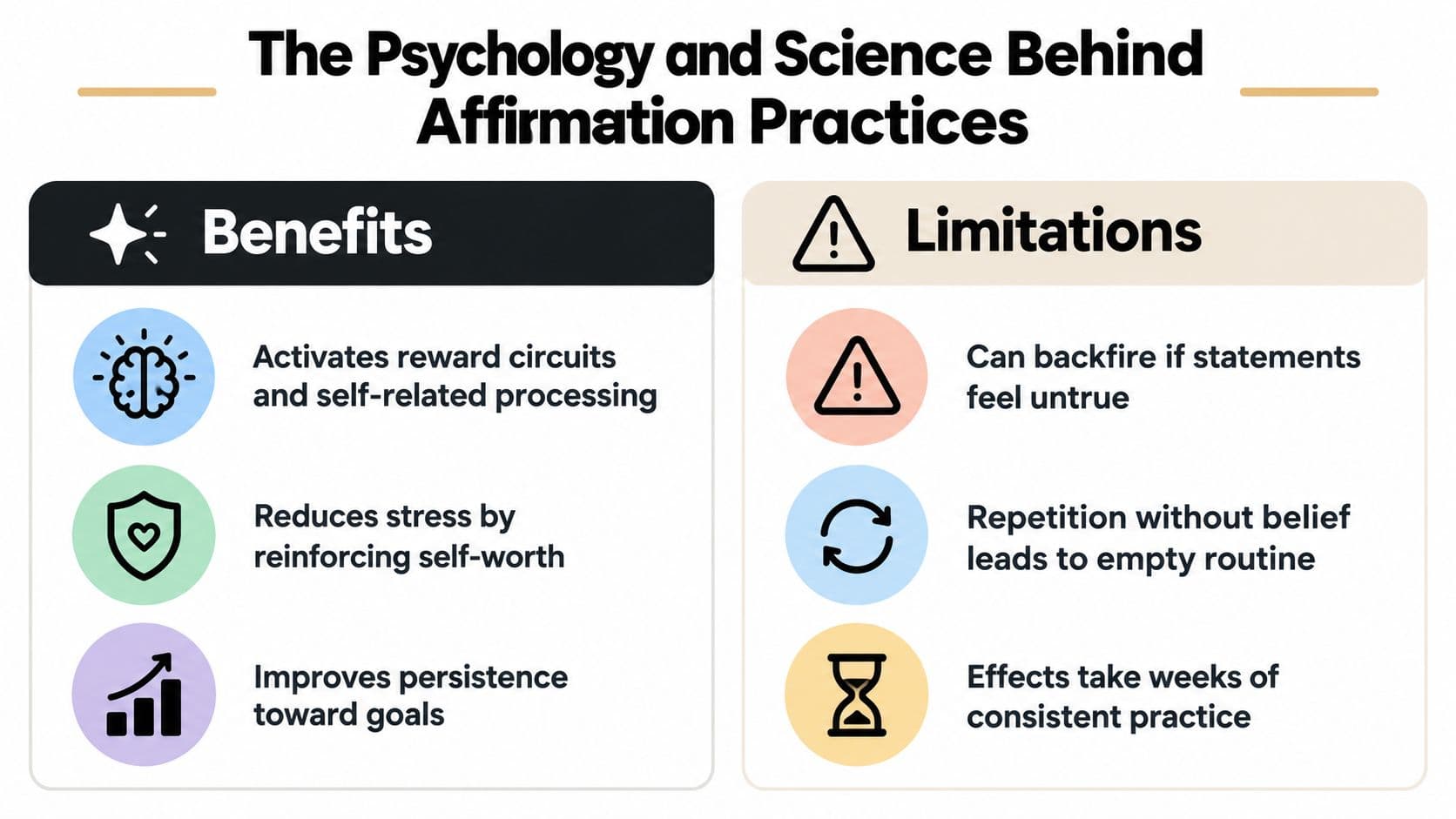
Suppose a setback makes you think, “There is never enough, and I cannot change that.” Repeating “I am abundance” does not transfer money into your account. It can interrupt that automatic conclusion, giving you a deliberate cue to notice resources, choices, and actions that fear may hide. The phrase works through meaning, attention, and self-perception, especially when it reflects values you are ready to practice.
Research summaries report possible improvements in self-perception and reductions in anxiety, while also noting that direct randomized evidence does not show affirmations causing financial wealth. The strongest supported claim is psychological rather than monetary, as explained in this summary of abundance affirmation research.
What the phrase can influence
An affirmation can create a pause between an event and your response. If you usually treat a mistake as proof that you are incapable, the phrase may help you ask, “What can I learn, request, or try next?” That pause supports calmer planning, persistent effort, and a greater willingness to seek support.
It can also broaden your measure of progress. Alongside income or approval, you might observe clearer communication, new learning, stronger relationships, or wiser use of a resource. These outcomes do not promise financial results. They show how an internal reframing can influence choices that shape daily life.
A review of abundance mentality describes the concept as academically underdeveloped and recommends observable indicators such as lifelong learning, human flourishing, profound learning outcomes, perspective-taking, and resource-sharing. This approach offers a related way to examine how beliefs connect with financial behavior. Using visible behaviors as evidence keeps the practice grounded. A feeling of abundance becomes meaningful when it changes how you learn, cooperate, or share resources.
Where manifestation claims go too far
Some law-of-attraction explanations imply that thoughts alone produce material outcomes. That claim goes beyond what affirmation research supports. Coverage of the psychology of manifesting abundance distinguishes belief-based manifestation from practices that may support gratitude and emotional well-being, while emphasizing that guaranteed manifestation lacks scientific support.
A practical boundary: Use the affirmation to guide attention and action. Do not use it to deny risk, replace financial planning, or blame yourself for circumstances outside your control.
Connect the words to one observable experiment. After repeating them, review an expense, send a thoughtful message, practise a skill, or ask an informed question. The phrase then functions like a compass, not a lottery ticket. It points toward a chosen behavior, while the behavior provides evidence about what helps.
Choose wording your mind can accept. If “I am abundant” creates resistance, try “I am learning to notice support” or “I can build more options with the resources I have.” Believable language is more likely to encourage honest reflection than a statement your mind immediately rejects.
Daily Routines for Embodying an Abundance Mindset
A useful routine gives the phrase a job. Rather than repeating it while waiting for life to change, attach it to a specific moment when you want to make a different choice.
In the morning, write “I am abundance” at the top of a page. Underneath, answer three prompts:
- What already supports me? Name a skill, person, tool, habit, or piece of knowledge.
- Where am I interpreting a limit too quickly? Identify one assumption that deserves examination.
- What action would express possibility today? Choose something observable, such as applying for an opportunity, reviewing a plan, sharing information, or accepting help.
The phrase appears in contemporary wellness content as a compact identity affirmation, often beside statements such as “I am aware of the abundance around me.” You can see that pattern in this collection of I am affirmations for abundance. The value isn't in finding a perfect sentence. It's in using the sentence to direct your awareness toward a meaningful response.

Make visualization concrete
Visualization becomes more useful when you picture qualities and actions, not only possessions. Instead of imagining a luxury purchase, imagine yourself opening a difficult email calmly, discussing money without shame, or using your abilities in a way that serves other people. Notice the posture, breathing, and choices connected with that scene.
During the visualization, ask:
- What does enough feel like in my body?
- How would I behave if I trusted myself to respond?
- What would I do first after the image ends?
Then write down the first practical action. A vision that never reaches your calendar remains a pleasant mental scene.
Anchor the practice to an existing habit
Repeat the phrase after brushing your teeth, during a commute, before opening your inbox, or while taking a mindful breath. One quiet repetition can be enough if it helps you notice a habitual thought and choose a more useful response.
You can also use different versions for different domains:
| Area of life | Grounded affirmation | Matching action |
|---|---|---|
| Money | “I can work with the resources available to me.” | Review a decision without panic |
| Relationships | “Connection and support are available to receive and offer.” | Contact someone honestly |
| Learning | “My options expand as I keep learning.” | Practice a skill or seek feedback |
| Well-being | “I can care for myself without treating rest as failure.” | Schedule recovery time |
The routine should feel supportive, not compulsory. If the phrase makes you feel guilty for having needs, change the language. Abundance includes honest awareness of scarcity, compassion for your current situation, and the courage to seek appropriate help.
Integrating Affirmations with Spiritual and Life Path Routines
Affirmations become more personal when they connect with a broader question: What kind of abundance am I here to develop? One person may need to cultivate financial responsibility. Another may need to receive affection, use a creative gift, repair trust, or stop treating constant exhaustion as proof of worth.
Dan Millman's book, The Life You Were Born to Live, provides one structured way to explore that question. The companion Life Purpose App presents the book's life-path system as a tool for self-knowledge. It can give an affirmation a context, so “I am abundance” becomes less like a generic slogan and more like a prompt connected with your talents, challenges, relationships, and choices.

Use the life-path method carefully
In Dan Millman's system, you add every digit in your full birth date, and the final sum remains the life path number rather than being reduced to a single digit. This preserves distinctions such as 27/9 and 36/9, as explained in this guide to The Life You Were Born to Live method.
That detail changes how you interpret the result. The number isn't a shortcut that tells you whether you'll become wealthy. It offers a symbolic framework for reflecting on recurring themes, innate talents, and core issues. You still have to test the interpretation against your lived experience and make responsible decisions.
For example, you might pair the affirmation with questions such as:
- Where do I have a natural capacity that I'm underusing?
- Which fear makes me hoard energy, information, or support?
- How can my work create value without making self-sacrifice my identity?
- What relationship pattern limits my ability to give and receive?
The spiritual framework can also encourage timing and patience. Life-purpose work is most useful when it helps you recognize a season for learning, service, rest, or decisive action. It shouldn't replace therapy, financial advice, medical care, or direct communication.
For readers interested in applying the spiritual dimension to money, additional reflection prompts can be useful. Keep the interpretation practical: identify a value, choose a behavior, and observe what changes.
A useful synthesis: Let spiritual systems supply meaning, let psychology test your assumptions, and let daily behavior show whether the practice is helping.
Navigating Common Pitfalls and Measuring Real Progress
The most common mistake is treating a hopeful identity statement as proof that your circumstances have already changed. Saying “I am abundance” while avoiding a bill, refusing necessary feedback, or dismissing another person's hardship isn't spiritual growth. It's avoidance wearing positive language.
A peer-reviewed literature review recommends measuring abundance mentality through observable proxies such as lifelong learning and resource-sharing. It also warns that conceptual drift, where abundance becomes optimism, generosity, resilience, or financial confidence, can make apparent success look greater than it is. Read the peer-reviewed review of abundance mentality for that methodological perspective.
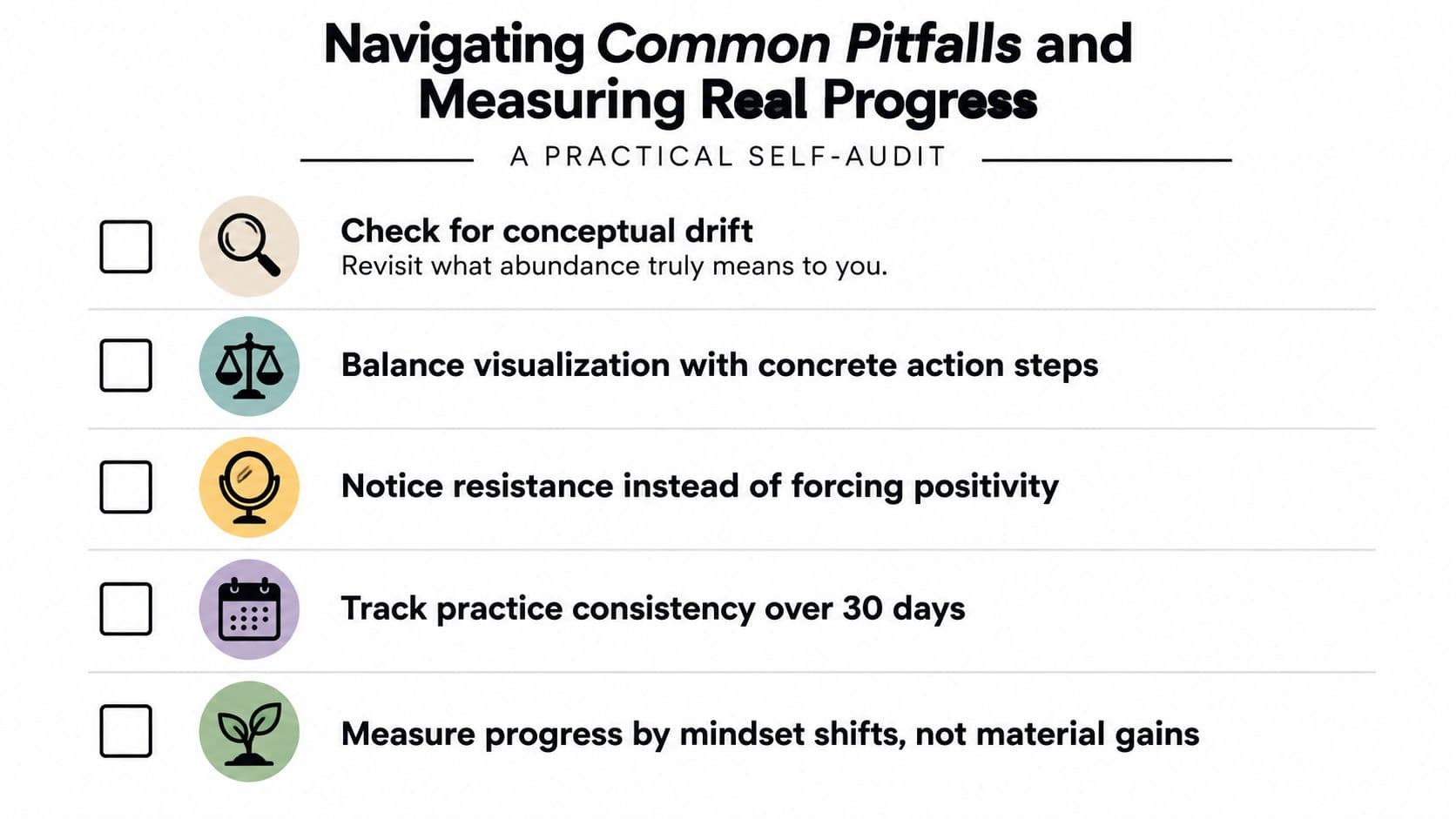
Keep two records. In one, note your internal experience, such as anxiety, self-trust, openness, or resistance. In the other, record behavior, such as learning, asking for help, sharing resources, completing planned tasks, or having a direct conversation.
| Question | More grounded evidence |
|---|---|
| Did I feel abundant? | I noticed the feeling without forcing it |
| Did I act abundantly? | I shared, learned, asked, received, or followed through |
| Did my life improve? | I can identify a specific change in choices or relationships |
| Am I forcing positivity? | I can name the difficulty and respond realistically |
Confirmation bias can make ordinary fluctuations feel like proof that an affirmation caused a particular outcome. Stay curious instead. Look for repeated patterns in your choices, not dramatic stories about sudden windfalls.
Sustaining Your Practice for Long-Term Fulfillment
“I am abundance” works best as a long-term orientation, not a temporary escape from fear. It invites you to recognize what is present, expand what is possible, and share resources without pretending that everyone starts from the same circumstances.
Keep the practice small enough to maintain. A sentence in your journal, a breath before a difficult decision, and one action that reflects sufficiency can be more valuable than an elaborate ritual you abandon. Return to the central question: “What would abundance look like here, in a form that respects reality?”
Practical abundance also includes recovering value that already belongs to you. If financial pressure is part of your scarcity experience, a resource such as find refunds and credits from Compass+ may help you look for overlooked savings while you continue making larger financial plans.
The deepest shift is not convincing yourself that you have everything. It's learning that you can meet the present directly, notice support, develop capacity, and choose your next step with greater freedom.
The Life Purpose App helps you explore Dan Millman's life-path system, spiritual laws, life cycles, and personal themes related to purpose and relationships. Visit the Life Purpose App to connect your abundance affirmation with a more intentional path of self-discovery and practical reflection.
Discover your life path today
Enter your date of birth and see your life path, free.
Find your life path