Explore the crucial difference in intelligence vs knowledge. Learn how fluid and crystallized intelligence shape your life path and how to cultivate both.
June 23, 2026 (1mo ago) — last updated June 27, 2026 (27d ago)
Intelligence vs Knowledge: What's the Real Difference?
Explore the crucial difference in intelligence vs knowledge. Learn how fluid and crystallized intelligence shape your life path and how to cultivate both.
← Back to blog
What's the difference between being smart and being full of information, and why do so many people confuse the two?
That confusion matters more now than it used to. Today, facts are always available, search is instant, and answers arrive before reflection does. A person can know a lot and still struggle to make sound decisions. Another person may know less on paper, yet learn quickly, spot patterns, and adapt with surprising grace.
That's why the question of intelligence vs. knowledge isn't just academic. It touches how you learn, how you work, how you relate to others, and how you understand your own path. In spiritual terms, it also touches discernment. Information can fill the mind. Intelligence helps organize it. Wisdom decides what matters.
Are You Smart or Are You Knowledgeable
A lot of people secretly ask this question in moments of insecurity. You forget a historical fact and wonder if you're not that bright. Or you solve a hard problem at work but feel embarrassed because someone else seems more “well read.”
Those are not the same thing.
Knowledge is what you've gathered. It includes facts, concepts, vocabulary, procedures, and lived familiarity with a subject. Intelligence is more about what you can do with what you have. It shows up when you face something unfamiliar and still find a way through.
That distinction has become more important because the amount of available information keeps exploding. By the early 21st century, the total stock of human knowledge began doubling approximately every 13 months, with some projections suggesting it could approach every 12 hours, according to The American Legion's discussion of the wisdom gap. No one can master all of it. So the ability to learn, filter, and adapt matters more than sheer accumulation.
Practical rule: If you judge yourself only by how much you know, you'll always feel behind. If you also notice how you learn, connect, and respond, you'll see your strengths more clearly.
This is one reason self-awareness matters so much. If you've been trying to understand your own patterns better, this guide offers a grounded starting point.
Personal growth begins when you stop treating “smart” as a single label. Some people shine through fast reasoning. Others through deep study. Others through intuition, timing, and emotional insight. A mature view makes room for all of that.
Defining Intelligence and Knowledge Clearly
Before comparing them, it helps to give each one a clean shape.

What most people mean by each term
In everyday life, people already sense a difference. A 2023 study found that over 70% of people describing “being intelligent” mentioned knowledge application or problem-solving, while fewer than 30% of people describing “knowing” mentioned intelligence. The study suggests an intuitive understanding of intelligence as the active use of knowledge, not just possession of it, as discussed in this research article on lay definitions of intelligence and knowledge.
That lines up with common experience. If your friend can explain a complex article, connect it to real life, and use it to make a decision, you call that intelligence. If your friend can recite facts but can't do much with them, you usually call that knowledge.
Here's a simple way to hold the difference:
- Knowledge is your inner library.
- Intelligence is how you engage with, question, combine, and apply what's in that library.
The psychological view in plain language
Psychology often separates fluid intelligence and crystallized intelligence.
- Fluid intelligence is your ability to reason through new situations. You see a pattern, solve a puzzle, or adapt on the spot.
- Crystallized intelligence is the understanding you've built over time. It includes language, facts, frameworks, and learned skills.
People get confused here because crystallized intelligence sounds a lot like knowledge. They overlap. But they aren't identical. Knowledge is the content itself. Crystallized intelligence is the organized use of learned content.
There's another useful pair:
- Explicit knowledge is formal and easy to explain. Think algebra rules, grammar, or the names of planets.
- Tacit knowledge is harder to put into words. Think knowing when a conversation is going badly, sensing timing in a meeting, or adjusting your posture while teaching.
If you want a broader primer on how these mental abilities fit together, it helps to explore brain health and cognitive skills in a practical, non-technical way.
Intelligence often feels invisible because people notice results before they notice the process behind them.
That's also why inner awareness matters. Some of your knowing is conscious and verbal. Some of it lives below the surface in pattern recognition, intuition, and habit. Reflecting on the difference between subconscious and conscious can help you reflect on that layer more.
A grounded example
Suppose two people enter a new kitchen.
One person knows the names of spices, cooking methods, and food chemistry terms. That's knowledge.
The other person may know fewer terms, but tastes the soup, senses what's missing, adjusts the heat, and improvises a better result. That shows intelligence in action.
The ideal, of course, is both.
A Side-by-Side Comparison of Intelligence and Knowledge
Some differences become obvious only when you place the two side by side.
Studies suggest that general knowledge and general intelligence are related but distinct. Their correlations typically fall between r = 0.40 to 0.55, which means only about 16–30% of the variance in a person's knowledge can be explained by intelligence. The rest reflects things like education, curiosity, and experience, as summarized in this psychometric research overview.
That's a helpful correction to a common myth. High intelligence can support learning, but it doesn't automatically produce broad knowledge. A curious, disciplined reader may know far more about history, art, health, or relationships than a sharper but less engaged thinker.
Intelligence vs. Knowledge at a Glance
| Attribute | Intelligence | Knowledge |
|---|---|---|
| Fundamental nature | An ability to reason, learn, adapt, and solve | Information, facts, concepts, and skills acquired |
| How it develops | Through cognitive growth, challenge, reflection, and novel problem-solving | Through study, reading, teaching, observation, and experience |
| How it shows up | Making sense of new situations | Recalling and using what has been learned |
| How it is measured | Often through reasoning or problem-solving tasks | Often through tests of information or subject familiarity |
| How it changes over time | Can appear in flexible adaptation and pattern recognition | Usually expands with exposure, interest, and repeated learning |
Why people mix them up
In school, knowledge often gets rewarded first. You memorize dates, formulas, definitions, and procedures. That makes sense because knowledge is easier to test.
But life tests something else too. Can you handle ambiguity? Can you notice what doesn't fit? Can you change course when the first plan fails? That's where intelligence becomes visible.
Think of traveling in an unfamiliar city:
- Knowledge is knowing street names, transit routes, and local customs.
- Intelligence is realizing your map app is wrong, asking the right person for help, and adjusting without panic.
Neither one is enough alone
A knowledgeable person without much flexibility can become rigid. They may know the rulebook but freeze when reality changes.
An intelligent person without enough knowledge can become shallow. They may think quickly but miss depth, context, or history.
A sharp mind still needs material to work with. A full mind still needs judgment.
This is why many inner struggles aren't really about lacking ability. They're about imbalance. Some people hide inside endless learning and never act. Others trust quick thinking so much that they stop studying. If that pattern sounds familiar, this short read on understanding internal conflict gives a useful language for the tension many people feel inside themselves.
A more humane way to assess yourself
Ask better questions than “Am I smart?”
Try these instead:
- When I face something new, do I stay curious or shut down?
- Do I regularly build my understanding, or do I rely on instinct alone?
- Can I explain what I know clearly?
- Can I use what I know in a different setting?
- Do I seek truth, or just the comfort of feeling competent?
Those questions reveal far more about your development than a label ever will.
How Your Life Path Shapes Your Expression
Psychology explains part of the picture. Spiritual frameworks can illuminate another part.

Most writing about intelligence and knowledge stops at cognitive definitions. It rarely asks a more personal question. Why does one person naturally express intelligence through fast pattern recognition, while another expresses it through slow, contemplative understanding? That's where Dan Millman's The Life You Were Born to Live opens an underserved and meaningful angle.
Different paths, different expressions
Some people seem built for decisive movement. They read the room quickly, act fast, and learn by doing. Others gather meaning over time. They reflect, absorb, and become wise through depth rather than speed.
In the framework of The Life You Were Born to Live, your life path points toward recurring themes, lessons, strengths, and blind spots. That doesn't box you in. It gives you a language for your natural style.
A person oriented toward initiative and leadership may express intelligence through swift synthesis, strategic action, and real-time adaptation. Another person oriented toward sensitivity and cooperation may build knowledge more patiently, especially around emotions, relationships, and subtle human dynamics.
Neither style is superior.
The spiritual value of knowing your style
A lot of suffering comes from self-mislabeling. Someone with a contemplative temperament may feel inferior in fast-moving environments. Someone with natural improvisational intelligence may feel ashamed for not liking academic accumulation.
But your path may not be asking you to imitate someone else's mind. It may be asking you to refine your own instrument.
Your way of knowing is part of your path. Growth begins when you honor it, then strengthen what's missing.
Dan Millman's The Life You Were Born to Live is valuable here because it treats development as purposeful. You're not just collecting traits. You're learning how your gifts and lessons interact.
A grounded example from everyday life
Take a workplace disagreement.
One person quickly sees the pattern, identifies the root issue, and proposes a clean solution. That looks like fluid intelligence.
Another person senses the emotional undercurrent, remembers similar dynamics, and understands what each person needs to feel respected. That looks like a different kind of knowing, built from observation, empathy, and accumulated insight.
Both matter. In real life, the best outcomes often come when quick reasoning and seasoned understanding work together.
The same is true in spiritual growth. Some people awaken through study. Others through silence, service, or relationship. Some learn by naming patterns. Others learn by living them. The life-path perspective in Dan Millman's The Life You Were Born to Live reminds us that development isn't one-size-fits-all, and the Life Purpose App can help readers explore that framework through their own birth-based patterning.
Cultivating Both for a Fulfilling Life
You don't have to choose between becoming more knowledgeable and becoming more intelligent. A fulfilling life asks for both. One gives you substance. The other gives you agility.
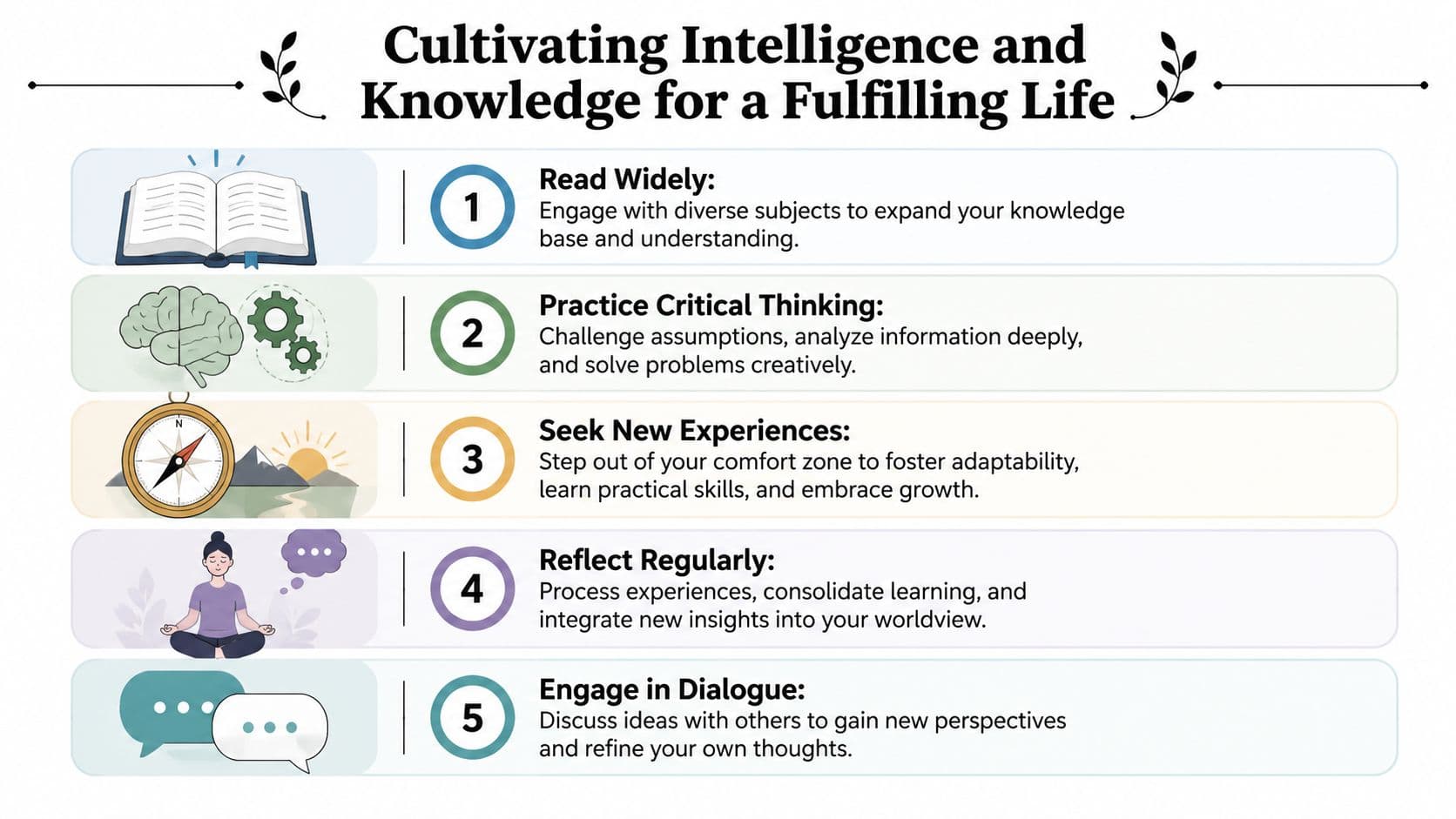
Research on “Knowledge Intelligence” suggests that broad education matters. Students in well-rounded programs that included technical and humanistic disciplines outperformed more specialized peers by about 15–20% on tasks requiring synthesis across unrelated domains, according to this IE Insight on knowledge intelligence. Breadth seems to support creative problem-solving when it's paired with thoughtful application.
Build knowledge with intention
Knowledge grows best when you stop consuming randomly.
- Read across categories. Don't stay trapped in one shelf. Pair psychology with memoir, philosophy with biology, and practical work with spiritual writing.
- Study what keeps returning. If you're repeatedly drawn to conflict, healing, money, relationships, or teaching, that's worth respecting.
- Keep a living notebook. Use Apple Notes, Notion, or a paper journal. Save insights, questions, and examples, not just quotes.
Strengthen intelligence through friction
Intelligence grows when your mind has to work in unfamiliar terrain.
Try a few forms of good friction:
- Learn a skill that humbles you. Music, drawing, public speaking, or a new language all force adaptation.
- Solve real problems. Planning a trip, fixing a workflow, mediating tension, or teaching someone else sharpens thought.
- Reflect after action. Ask what worked, what failed, and what you missed.
If emotional reactivity gets in the way of clear thinking, building emotional intelligence is a strong complement.
Small shift: Don't just ask, “What did I learn?” Ask, “How did I think?”
Let wisdom hold the center
Knowledge can become hoarding. Intelligence can become pride.
Wisdom softens both. It asks whether your learning is making you more humble, more useful, and more honest. It asks whether your sharpness is helping you love well.
A balanced practice might include:
- Morning input. Read something nourishing.
- Midday challenge. Do one task that requires active thinking.
- Evening reflection. Name one thing you understood better today, and one thing you still need to question.
That rhythm turns growth into a way of life, not a performance.
Common Questions About Intelligence and Knowledge
Which is better, intelligence or knowledge
Neither wins alone. Knowledge gives you material. Intelligence helps you work with that material. In a good life, they operate as partners.
A wise teacher, therapist, coach, or leader usually draws on both. They've learned profoundly, and they can respond to what's unfolding in front of them.
Is knowledge a form of intelligence
Sometimes people use the terms loosely, but they're not identical. In psychology, knowledge is often treated as accumulated content, while intelligence refers more to learning, reasoning, and adaptation. There's overlap, but not sameness.
Where does wisdom fit in
Often, modern discussions become shallow. A common question is how to balance intellect with spiritual wisdom. Most guides separate these ideas, but they rarely offer practical ways to notice when intellectual confidence has started overpowering compassion, humility, or grounded discernment.
A few useful daily practices can help:
- Pause before certainty. When you feel mentally superior, stop and ask what you may be missing.
- Check the heart. Is your conclusion accurate but unkind, or clever but immature?
- Use your path as a mirror. In Dan Millman's The Life You Were Born to Live, each life path carries strengths and lessons. The Life Purpose App can help people reflect on where insight becomes imbalance.
What about artificial intelligence
AI has made this distinction more visible. A system can appear impressive because it holds or retrieves enormous amounts of information. But flexible reasoning, context sensitivity, and human judgment are another matter.
That's one reason lifelong development still matters. If you want a simple companion piece on that mindset, this article on what is lifelong learning is a useful read.
Can you increase both
Yes. You can grow your knowledge through study and experience. You can strengthen intelligence through challenge, reflection, and active problem-solving. You can deepen wisdom by aligning both with conscience, humility, and purpose.
The aim isn't to win at labels. It's to become a person who learns thoroughly, thinks clearly, and lives with heart.
If you want to explore your own learning style, inner tendencies, and life themes through Dan Millman's The Life You Were Born to Live, the Life Purpose App offers a practical way to do that. It can help you reflect on your life path, your natural gifts, and how to bring intelligence, knowledge, and wisdom into better balance.
Discover Your Life Purpose Today!
Unlock your true potential and find your life’s purpose.
