Is compatibility important in a relationship? Learn what research and psychology reveal about finding true relationship fit.
August 2, 2026 (5d ago)
Is Compatibility Important in a Relationship? Key Insights
Is compatibility important in a relationship? Learn what research and psychology reveal about finding true relationship fit.
← Back to blog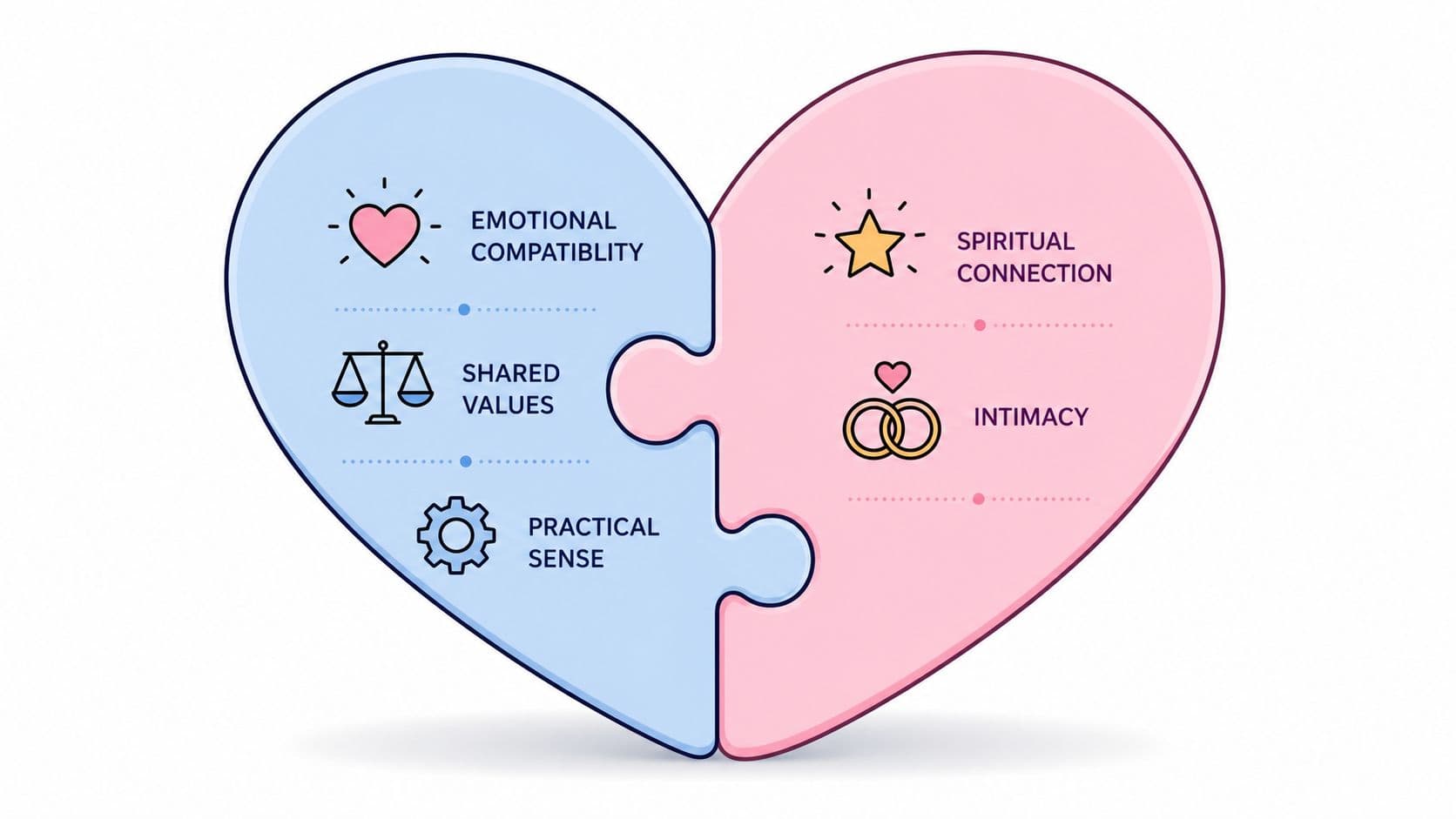
Most advice about relationship compatibility turns it into a pass or fail test. You either “click” or you don't, you either match on paper or you're doomed, you either share a taste in music and travel or you're wasting your time. Real relationships are messier than that, because compatibility isn't one thing. It's a mix of what you can see, what you feel, what you negotiate, and what you build over time.
That's why the question is compatibility important in a relationship deserves a more careful answer. Yes, it matters. But it matters in specific ways, and the wrong kind of “matching” can distract people from the deeper signals that sustain love, trust, and shared purpose.
Why Compatibility Is More Complicated Than You Think
Compatibility sounds simple until you try to define it. One couple means shared hobbies. Another means shared faith. Another means they fight well, even when they disagree on money, children, or where to live. The word gets used for all of it, which is why people end up talking past each other.
The problem with the “we just click” test
Early attraction can make almost anything feel like proof. Two people laugh easily, finish each other's sentences, and assume the fit is real. Yet compatibility is often judged before either person knows the other well, which means the first impression can be doing a lot of emotional heavy lifting. Psychology Today has argued that compatibility is often judged early, when people know each other least, and that perceptions can change as partners learn more about one another.
That fits an older spiritual truth too. A surface harmony can be real and still be incomplete. You can feel comfortable with someone and still be mismatched on the things that shape daily life, character, and long-term direction.
Practical rule: if your only evidence is chemistry, you've got a beginning, not a conclusion.
Compatibility is layered, not binary
A healthier way to think about it is this. Some kinds of compatibility are perceptual, some are behavioral, and some are almost life-path questions about values, timing, and purpose. The relationship may feel easy because both people believe they fit. It may function well because their habits line up. Or it may endure because they keep choosing each other with honesty, humility, and care.
The University of Wyoming defines compatibility as the capacity for living together harmoniously, and notes that people with similar backgrounds, personality types, interests, and viewpoints tend to be attracted to one another and get along better than people who differ greatly in those areas. That's a useful starting point, but not the full story. Similarity can help partners orient toward each other. It doesn't automatically teach them how to handle disappointment, conflict, or change. The Truth About Compatibility puts the emphasis where it belongs, on compatibility as something couples create through negotiation over time.
Ancient wisdom traditions tend to say the same thing in different language. A good union is not just found, it's cultivated. The best relationships don't depend on a perfect match. They depend on two people willing to become a workable match through truth-telling, restraint, and shared intention.
What the Research Actually Says About Relationship Compatibility
The research doesn't support a simplistic “similarity solves everything” story. A 2025 scoping review of nearly 340 studies found that the evidence for actual similarity was mixed, with few domains showing a clear link to better relationship outcomes. The stronger and more consistent effects were for perceived similarity, meaning how similar partners think they are, and even that mattered more for satisfaction and stability than for universal success across every trait and study. The review is a direct challenge to the idea that compatibility works as a single universal law. 2025 scoping review on romantic couples
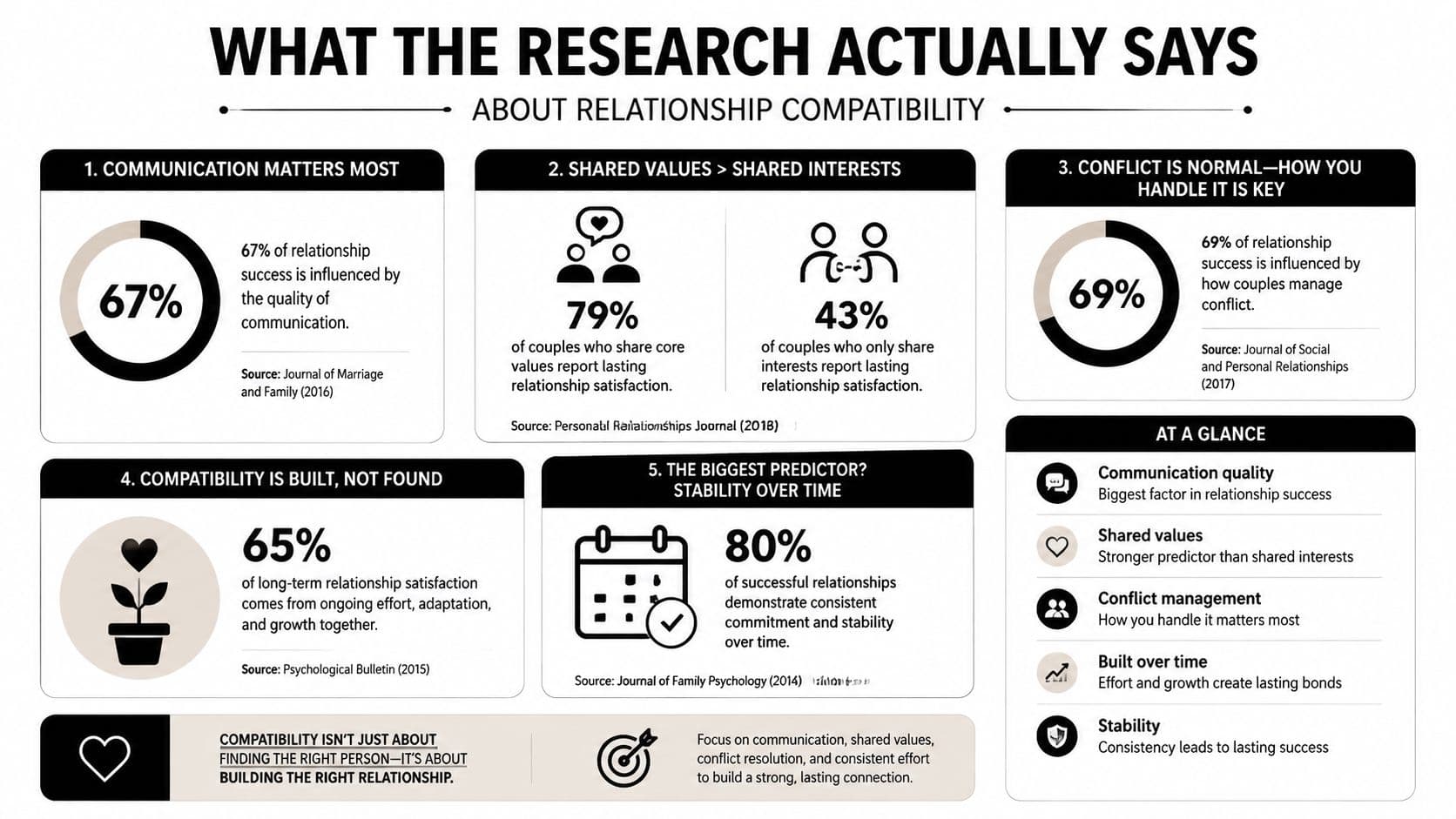
What seems to matter most
A separate line of evidence points to early compatibility impressions as powerful predictors. Research summarized in Psychological Science found that relationship effects and partner effects were the strongest predictors of later romantic desire and dating outcomes, which means the way two people evaluate each other at the start carries real weight. An APA summary of work published in the Journal of Personality and Social Psychology also reported that couples were more likely to be satisfied and less likely to break up when both partners believed the other matched their ideal partner traits. In other words, what people think they see in each other can shape how the relationship unfolds. Compatibility impressions and dating outcomes
That does not mean every trait matters equally. The same overall body of research keeps pointing toward lifestyle and values as domains that carry outsized importance. Those are the areas where daily friction becomes chronic, or where two people can build a stable rhythm without constantly translating their lives for each other.
For readers who want to think more carefully about early bonding, attachment styles in relationships offer a useful companion lens. Attachment doesn't replace compatibility, but it helps explain why two people can feel drawn to each other and still struggle to feel safe.
Compatibility still matters in modern dating
A 2026 study in Frontiers in Psychology found that men and women rated compatibility as important in mating decisions as much as, or more than, compassion. That doesn't mean compatibility is more valuable than kindness. It means people still use it as a core filter when deciding who feels viable for partnership. Frontiers in Psychology compatibility study
The takeaway is clean. Compatibility is real, but it's not universal in the way pop culture often implies. It's strongest when it reflects shared perceptions, practical fit, and core values, not just a vague sense that two people are “the same.”
The 24 Dimensions of Compatibility That Shape Your Relationship
Compatibility gets clearer when you stop treating it like a single trait and start seeing it as a profile. A 2023 study in Personality and Individual Differences identified 24 distinct compatibility factors, including lifestyle, opinions, morals, family, religion, residence, intellect, conflict, and empathy. The pattern was straightforward. People generally felt more compatible with partners who were similar rather than opposite across most of these dimensions. 24 factors of romantic compatibility
Which dimensions matter at which stage
Short-term attraction and long-term partner choice are not the same test. Short-term chemistry can be pulled by intellect, appearance, novelty, and the ease of conversation. Long-term choice weighs broader alignment, especially on values and daily living. If you want a deeper dive into how attraction patterns can vary by temperament, personality types and attraction insights is a helpful resource for comparing style, not just sentiment.
| Compatibility Dimension | Short-Term Importance | Long-Term Importance |
|---|---|---|
| Lifestyle | Moderate | High |
| Opinions | Moderate | High |
| Morals | Moderate | High |
| Family | Low to Moderate | High |
| Religion | Low to Moderate | High |
| Residence | Low | High |
| Intellect | High | Moderate |
| Conflict style | Moderate | High |
| Empathy | High | High |
| Shared routines | Moderate | High |
| Child-rearing views | Low to Moderate | High |
| Social and moral issues | Low to Moderate | High |
The strongest similarity preferences in that study clustered around socio-cultural opinions, morals, conformity values, lifestyle, and residence. That matters because those are the areas that shape both identity and logistics. A couple can have great chemistry and still live in constant strain if one person wants urban roots, political alignment, and family-centered planning while the other wants distance, flexibility, and a looser view of commitment.
Clear test: if a difference changes your day-to-day life, don't label it a “small issue” just because the conversation feels polite.
The deepest lesson here is that compatibility isn't about finding a clone. It's about recognizing where similarity supports peace, where difference creates growth, and where difference becomes chronic tension. In long-term partnership, broad sameness is less important than alignment on the things that shape how life is lived.
Signs of Strong Compatibility and Subtle Red Flags
A couple can look good on the outside and still be fighting the same invisible battle every week. I once worked with a pair who loved the same books, the same food, and the same weekend routines. They looked easy together. But one wanted public, community-based faith, and the other wanted spirituality kept private and flexible. Every major decision eventually dragged that difference back to the surface.
What healthy fit feels like
Strong compatibility usually shows up in ordinary moments. Conversations don't require translation. Disagreements don't feel like identity threats. A partner can say, “I don't agree,” without making the other person feel unsafe or stupid. Shared vision matters too, especially around money, work, family, and how children would be raised.
The Biola Center for Marriage and Relationship Research cited a national survey of 24,671 couples, and the contrast there is hard to ignore. 82% of spiritually incompatible couples were unhappy, compared with 9% of spiritually compatible couples, and 36% of high-agreement couples were very happy versus 5% of low-agreement couples. Those numbers don't prove that every spiritual mismatch ends badly, but they do show why people who ignore core alignment often pay for it later. Biola Center for Marriage and Relationship Research
Red flags that often get mistaken for “normal differences”
The subtle warning signs usually look reasonable at first. One person always compromises while the other barely notices. One partner treats values as flexible, the other treats them as the foundation. The relationship feels calm, but only because one person has stopped bringing up what matters.
Politics, remote work, and changing life-stage expectations make this even more complicated now. A couple may agree on hobbies and still clash over home routines, caregiving expectations, or whether the relationship should prioritize mobility or rootedness. The mismatch doesn't need to be dramatic to be serious.
For a practical checklist of early warning signs, it's worth reading alongside the questions you're already asking yourself.
Watch this closely: when every disagreement turns into one person shrinking and the other person “winning,” the relationship may be organized around avoidance, not harmony.
Compatibility shows itself less in what you both like on a relaxed day and more in what happens when life gets inconvenient. If your partner can respect your core values, and you can respect theirs, the relationship has room to grow. If not, the mismatch usually gets louder, not quieter.
How to Assess and Build Compatibility Using Life-Path Wisdom
Compatibility is easier to assess when you have a framework that goes deeper than hobbies and initial attraction. Dan Millman's book, The Life You Were Born to Live, and the Life Purpose App use birth-date-based life-path patterns to explore gifts, challenges, and relationship tendencies. Entering a date of birth can reveal one of 45 unique life paths, and the app also maps nine-year life cycles and relationship dynamics for partners, friends, family, co-workers, and public figures. That makes it one useful way to look at fit through a spiritual lens rather than a purely social one.
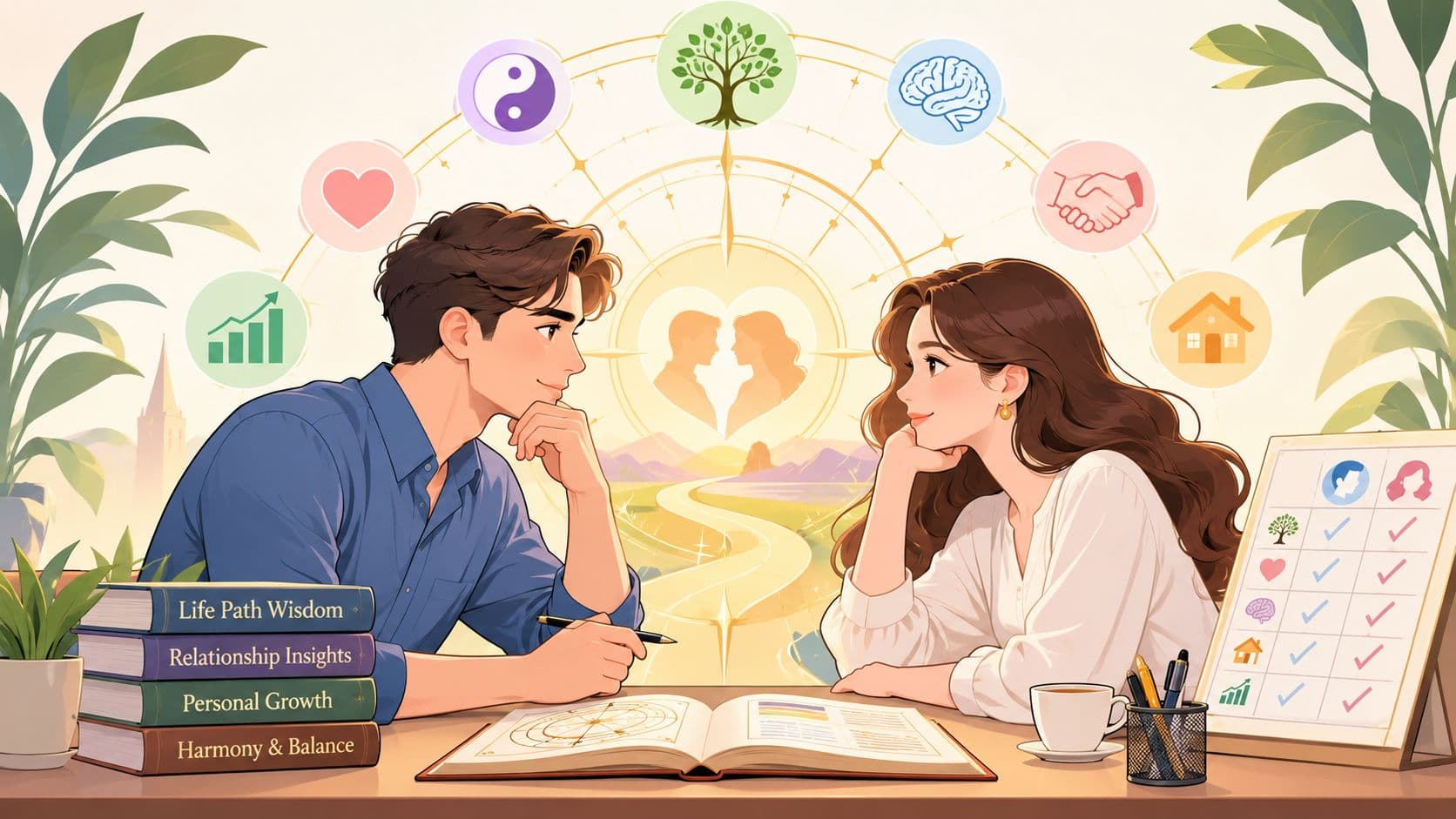
A simple way to evaluate fit
Start with the obvious, then go deeper. Ask whether you agree on money, work, family, faith, children, and the shape of daily life. Then look at how you repair when things go wrong. A strong answer to both sets of questions matters more than a charming answer to only one.
A practical sequence helps:
- Name the non-negotiables. Write down the values or life choices you can't easily compromise on.
- Separate preferences from principles. You may not need the same music, but you probably do need similar expectations around honesty, caregiving, and timing.
- Notice conflict habits. If one of you escalates and the other disappears, that pattern will matter more than shared taste.
- Use self-knowledge tools. The Life Purpose App can help you compare life paths and relationship dynamics, which is useful when you want a deeper picture of how two people may fit together.
- Make room for boundaries. Compatibility doesn't mean merging into one person. It means knowing where to bend and where to stay steady.
For readers who want a structured way to think about life-path language and relationship fit, this numerology and relationship compatibility guide adds more context without reducing love to a formula.
There are also situations where standard dating advice misses the issue at hand. For example, people dating with disabilities often need a platform that respects accessibility, practical needs, and honest communication about support. A service like Special Bridge can be relevant in that context because the quality of fit depends on more than profile photos.
Compatibility grows when people know themselves clearly. The more honest you are about your pace, values, and purpose, the easier it becomes to spot whether another person can meet you there.
Compatibility as an Ongoing Process Rather Than a Fixed Trait
The most useful relationship insight is also the least glamorous. Compatibility isn't a trophy you win at the start. It's something two people continue to shape through decisions, language, and repair. Psychology Today argues that compatibility is something couples create through negotiation over time, and that fits with what strong relationships look like in daily life.
What sustains a relationship after the initial fit
A compatible match is necessary, but it isn't sufficient. Two people can have excellent alignment and still lose the relationship if they don't act with reliability, perspective-taking, and a willingness to repair after conflict. Many couples get confused here. They think the early feeling should carry the entire relationship. It won't.
A neuroscience study adds an interesting layer here. It found that resting-state functional connectivity could predict whether pairs were compatible before interaction, with patterns in the salience network, limbic areas, and cerebellum contributing to prediction. In plain language, some of the ease or friction people feel may have both psychological and neurobiological roots. That doesn't make love mechanical. It just means the nervous system is part of the conversation too. Neuroscience study on compatibility prediction
The deeper skill is adaptation
The ancient view is surprisingly modern here. Strong partners don't just find agreement, they learn how to stay truthful while adapting without self-betrayal. That's why self-knowledge matters so much. If you know your life pattern, your triggers, and your likely blind spots, you can tell the difference between a solvable mismatch and a core incompatibility faster.
The Life Purpose App is one tool that helps with that kind of reflection. It organizes life-path insight and relationship dynamics in a way that can support better questions, especially when you're trying to see whether two people can grow together.
Bottom line: compatibility is not a static label, it's a living process of honesty, adjustment, and shared responsibility.
When couples treat compatibility as a skill rather than a verdict, they stop asking, “Are we the perfect match?” and start asking, “Can we build a faithful, workable, life-giving partnership together?” That shift changes everything.
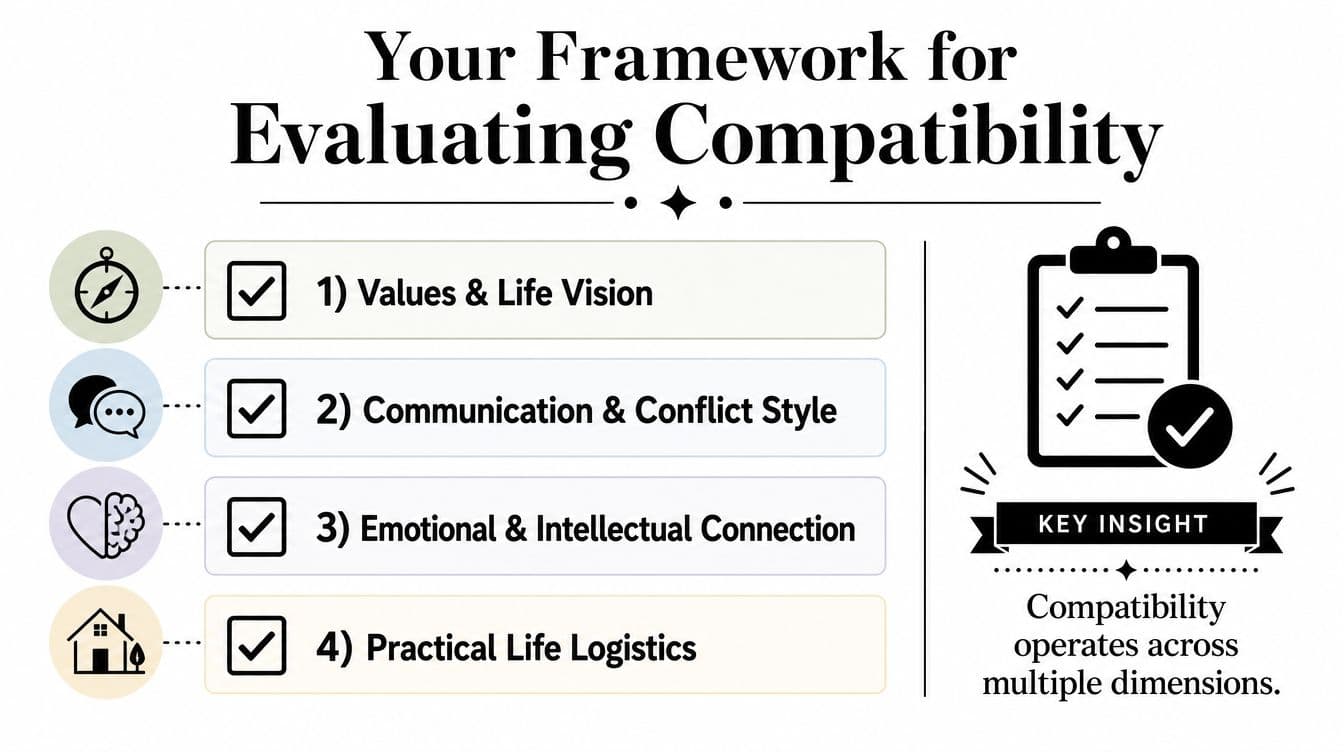
Your Framework for Evaluating Relationship Compatibility
A good compatibility check doesn't ask whether two people are identical. It asks whether they can live truthfully, respectfully, and sustainably together. Start with values and life vision, then look at communication and conflict style, emotional and intellectual connection, and practical life logistics. If those pieces line up well enough, the relationship has a real foundation. If they don't, attraction alone won't hold it together.
A coach or counselor can use a tool like Coachful to track relationship-coaching clients and organize the questions that reveal whether a couple is growing, stalling, or avoiding the harder conversations. That kind of structure matters because compatibility is easier to judge when you're asking specific questions instead of staring at a vague feeling.
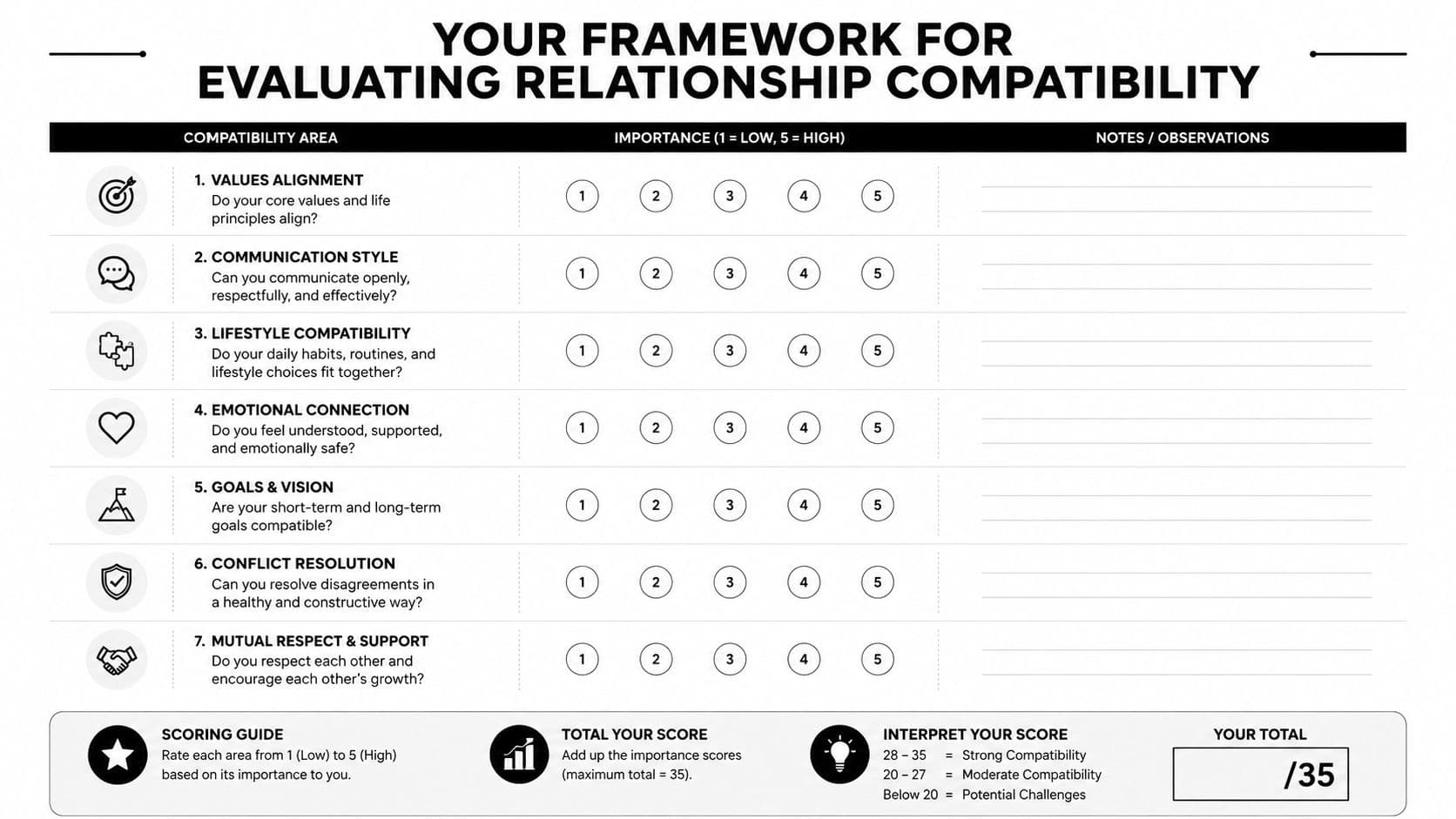
Use these questions to ground your own discernment. Do we agree on the big things? Can we repair after conflict? Do I feel more myself with this person, not less? Can we build a shared life without abandoning what matters most?
If you want a deeper way to explore relationship fit through life-path insight, visit Life Purpose App and compare your own patterns with the people you love. It can help you see compatibility as something clearer than a vibe, and more enduring than a checklist.
N/A
Discover Your Life Purpose Today!
Unlock your true potential and find your life’s purpose.
