Explore the lady of the moon mythology, her symbolism across cultures, and how to incorporate her spiritual practice into your life in 2026.
August 18, 2026 (1mo ago) — last updated August 19, 2026 (1mo ago)
Lady of the Moon: Mythology, Symbolism & Spiritual Practice
Explore the lady of the moon mythology, her symbolism across cultures, and how to incorporate her spiritual practice into your life in 2026.
← Back to blog
Who is the lady of the moon when one culture names Chang'e, another venerates Selene, and a modern spiritual teacher speaks about intuition or feminine power? The phrase sounds singular, but its history isn't. It gathers several goddesses, festival traditions, literary images, and contemporary interpretations under one poetic title.
That distinction matters. A moon goddess from Chinese folklore doesn't automatically belong to Greek mythology, and a modern wellness archetype shouldn't be presented as an ancient doctrine. The most respectful way to work with lunar symbolism is to identify its cultural roots first, then choose consciously how you want to interpret it in your own life.
Why the Lady of the Moon Is Not Just One Figure
The lady of the moon is often expected to have one name, one origin story, and one set of sacred customs. Comparative mythology gives us a more interesting answer. The phrase can point to Chang'e in Chinese folklore, Selene in Greek mythology, Luna in Roman religion, or a modern fictional character and spiritual archetype.
Those figures share a lunar association, but they don't share the same religious system. Chang'e's connection with the Mid-Autumn Festival is specific to Chinese tradition, while Selene and Luna belong to the religious worlds of ancient Greece and Rome. Treating them as interchangeable may create a pleasing universal story, but it also erases the details that give each tradition meaning.
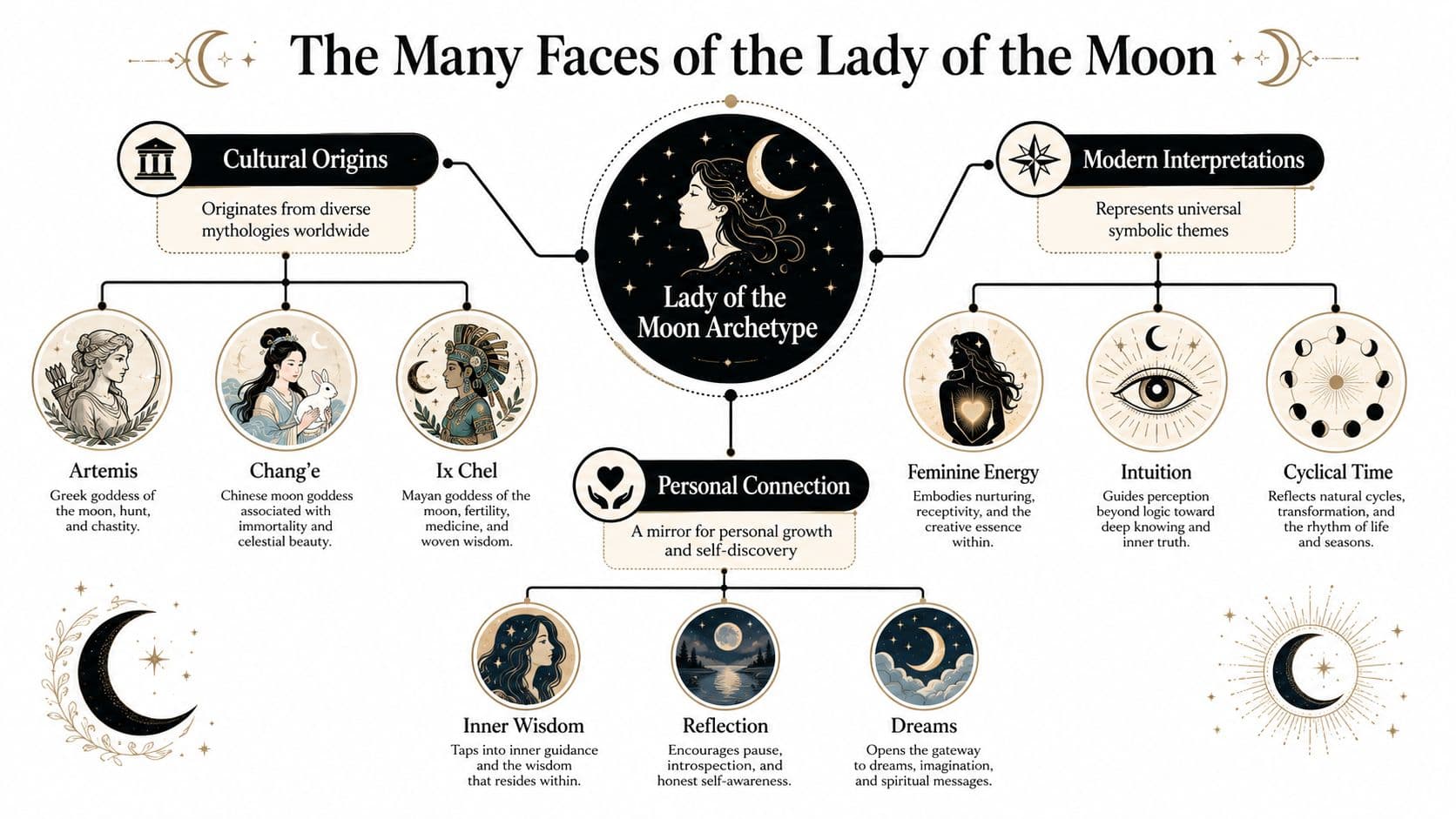
A useful cultural map
Start with identity before symbolism:
- Chang'e: The Moon goddess of Chinese mythology, associated with the Moon Palace, the Moon rabbit, and the Mid-Autumn Festival.
- Selene: The Greek goddess who personifies the Moon and crosses the night sky in a chariot.
- Luna: The Roman lunar goddess later equated with Selene.
- Artemis and Diana: Goddesses who became associated with the Moon in later religious and cultural interpretations, although their identities include wider domains.
- Modern Lady of the Moon: A flexible spiritual image connected with reflection, intuition, cycles, and self-discovery.
The differences aren't academic technicalities. They tell you what kind of story you're entering. A ritual inspired by Chang'e might respectfully acknowledge Chinese festival imagery. A meditation invoking Selene draws from a Mediterranean lunar figure. A personal practice using “lady of the moon” as a metaphor is your contemporary interpretation, not automatically an inherited ancient rite.
Practical rule: Name the tradition before you borrow its symbols.
This approach also helps with online searches, where a generic “moon goddess” summary can blend separate figures together. If you're looking for an origin story, identify the culture first. If you're creating a personal practice, say clearly that you're working with a modern archetype inspired by lunar mythology.
Lunar Goddesses Across Ancient Cultures
The clearest way to understand the lady of the moon is to place the figures beside one another rather than forcing them into one blended character.
Selene in Greek tradition
Selene personifies the Moon in Greek mythology. Classical accounts identify her as the daughter of the Titans Hyperion and Theia, and as the sister of Helios, associated with the Sun, and Eos, associated with dawn. Ancient depictions present her as a figure who drives a chariot across the night sky.
Her worship was linked with the new and full moons, connecting her religious presence with the monthly lunar cycle. Another enduring story connects Selene with Endymion and with the birth of 50 daughters known as the Menai. These stories helped make Selene a foundational figure for lunar symbolism in the Mediterranean world.
Chang'e in Chinese mythology
Chang'e is explicitly identified as the Moon goddess in Chinese mythology. In one widely cited version of her story, she consumes an elixir of immortality and retreats to the Moon Palace, where she lives with the Moon rabbit. Older traditions identify her as Heng'e before the name became Chang'e.
Scholarly summaries trace early layers of the myth to the Warring States period, roughly the 5th century BCE, while later traditions place major developments in the Tang dynasty, 618 to 907 CE. The story became closely tied to the Mid-Autumn Festival, observed on the 15th day of the 8th month of the Chinese lunisolar calendar, when the Moon is traditionally at its brightest. Offerings made on that date give Chang'e's myth a concrete ritual and seasonal context.
Luna, Artemis, and Diana
Roman religion later equated Selene with Luna, creating a Roman lunar counterpart while retaining the broader Mediterranean pattern of a goddess connected with the Moon's movement and radiance.
Artemis and Diana require more care. Both became strongly associated with lunar imagery, but neither should be substituted for Selene or Luna in every context. Artemis is a Greek goddess with a broader identity, and Diana is her Roman counterpart. Their lunar associations developed within changing religious and artistic traditions, so a reference to a lunar goddess may mean one of several figures depending on the source.
| Goddess | Culture | Key Attributes | Rituals and Festivals |
|---|---|---|---|
| Chang'e | Chinese mythology | Moon goddess, Moon Palace, Moon rabbit, elixir of immortality | Mid-Autumn Festival, offerings on the 15th day of the 8th lunar month |
| Selene | Greek mythology | Personification of the Moon, lunar chariot, daughter of Hyperion and Theia | Worship at new and full moons |
| Luna | Roman religion | Roman lunar goddess, later equated with Selene | Lunar observances within Roman religious tradition |
| Artemis | Greek mythology | Wider goddess identity with later lunar associations | Varies by cult and historical context |
| Diana | Roman religion | Roman counterpart of Artemis, later lunar associations | Varies by cult and historical context |
For a wider look at goddess names and their meanings, you can compare names across traditions without assuming they all belong to the same tradition.
Symbolic Meanings of the Lunar Archetype
Ancient lunar goddesses carry distinct stories, but the Moon also invites symbolic interpretation. Its visible cycle gives people a natural language for change. We watch brightness grow, reach fullness, diminish, and disappear from view, then we apply that pattern to creativity, emotion, relationships, work, and rest.
That application is modern symbolic practice, not proof that every ancient culture assigned the same meaning to every phase. Historical evidence supports specific myths and rituals. The broader language of intention-setting, emotional release, and feminine energy belongs largely to contemporary spirituality.
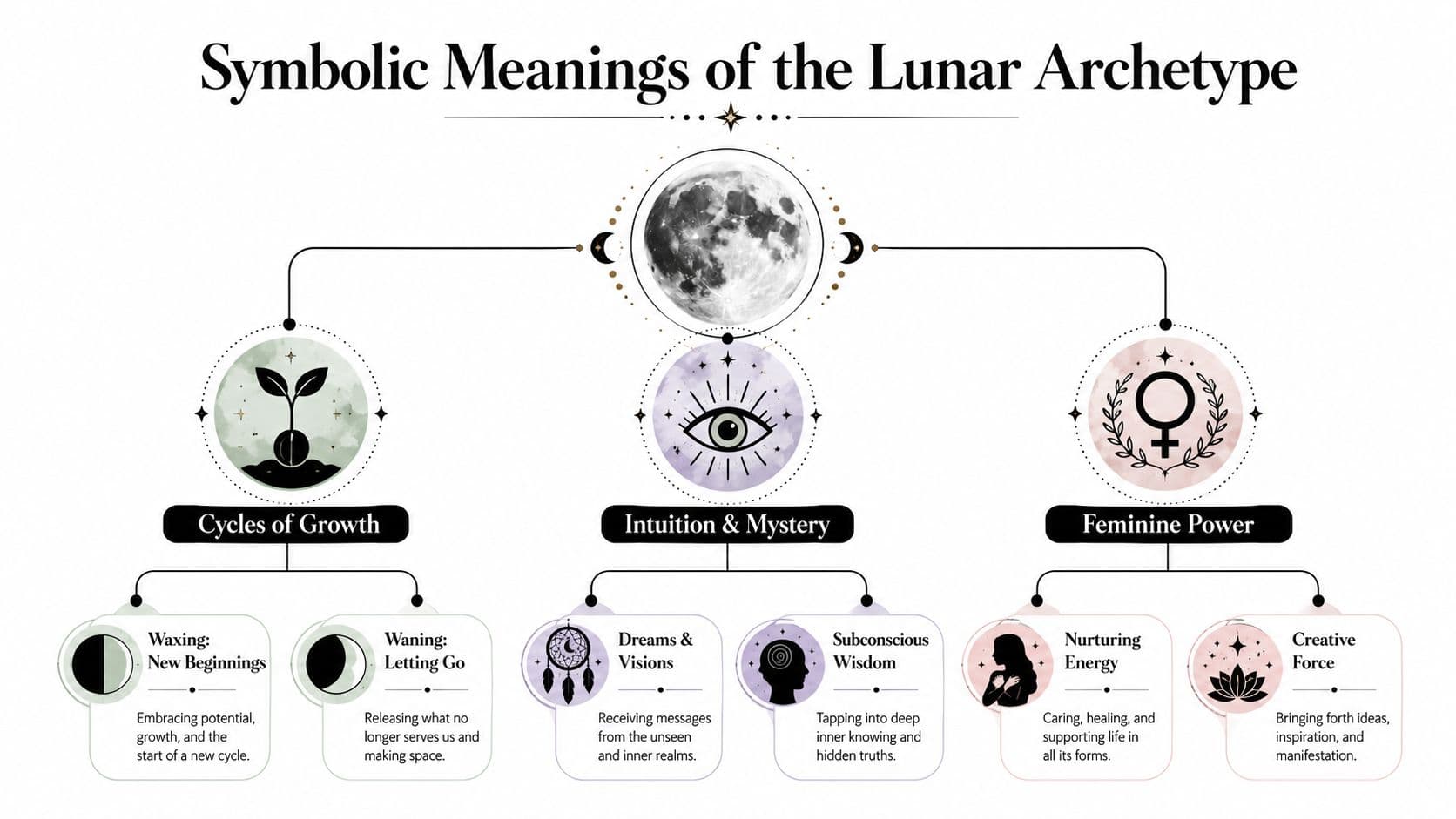
The Moon as a language of cycles
The waxing Moon can serve as a metaphor for beginning and building. You might use that image when starting a creative project, strengthening a habit, or giving attention to an intention that still needs care.
The full Moon often becomes a symbol of illumination. In a reflective practice, that can mean noticing what has become visible, expressing gratitude, or releasing something you no longer want to carry. The waning or dark Moon can represent retreat, quiet, and honest examination rather than failure or absence.
- Waxing phase: Beginning, gathering energy, developing an intention.
- Full phase: Seeing clearly, appreciating what has emerged, releasing consciously.
- Waning phase: Simplifying, completing, clearing space.
- Dark phase: Resting, listening inward, making room for renewal.
These correspondences don't predict your mood or dictate your behavior. They offer a structure for observation. Just as the Moon's appearance changes, your energy and emotional capacity may change across a month, although your experience won't follow a perfectly fixed pattern.
Intuition and feminine symbolism
Modern spiritual writing often connects the lady of the moon with intuition, mystery, dreams, nurturing energy, and creative force. Those associations can be meaningful when you treat them as interpretive tools rather than historical facts. “Feminine” here should also remain flexible. It can describe a symbolic quality, not a rule about how women or any other group must behave.
The Moon's reflected light makes it especially useful as an image for indirect knowing. You may not have a complete answer, but you notice a feeling, recurring dream, bodily response, or quiet preference. Journaling can help you test that impression against reality instead of treating every inner sensation as infallible guidance.
For readers drawn to uncertainty, dreams, and hidden perception, TarotElya's guide to The Moon tarot card offers a useful adjacent perspective. You can also explore deeper meanings while keeping symbolic interpretation separate from documented mythology.
Contemporary Rituals and Spiritual Practices
A contemporary lunar ritual works best when it's simple enough to repeat. You don't need to recreate an ancient ceremony, and you shouldn't present a personal practice as though it came directly from Chang'e, Selene, or Luna. Choose a phase, name your intention, and use the Moon as a dependable prompt for attention.
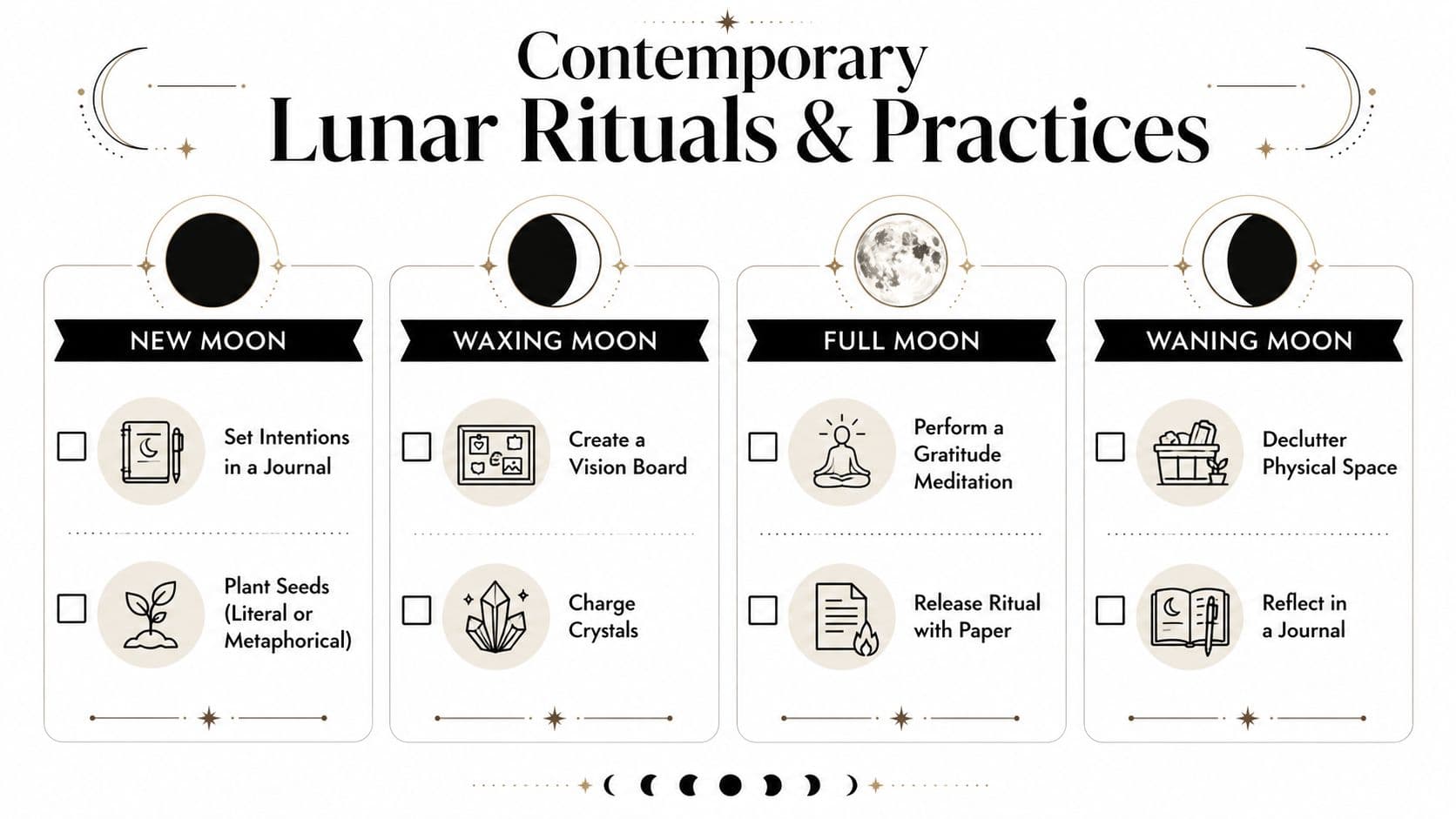
A phase-based practice
New Moon intention practice
Sit somewhere quiet with a journal. Write one intention in plain language, then add a sentence describing the first action that would support it. Close by reading the intention aloud and putting the journal away.
Waxing Moon building practice
Review the intention a few days later. Ask what needs strengthening, learning, or consistent effort. You might create a small vision board, tend a plant, or place a meaningful object on your desk as a reminder. The object doesn't hold power by itself. It helps you remember the choice you made.
Full Moon release ritual
Write down a habit, fear, resentment, or unfinished thought you're ready to loosen. Read the page privately, thank yourself for recognizing it, and tear the paper into small pieces before discarding it safely. Pair the release with gratitude for something that supported you.
Dark Moon rest practice
Reduce stimulation for a short period. Turn off unnecessary notifications, sit in dim light, and ask what your mind has been trying to say beneath daily noise. You don't need to solve anything. Record a few observations and let rest count as part of the practice.
Creating a modest moon altar
A small altar can hold a bowl of water, a silver-colored object, a white flower, a candle, or an image that reminds you of the lunar figure you've chosen. These are contemporary correspondences, not universal requirements. If you're working specifically with Chang'e, learn the cultural setting of her story rather than combining her automatically with unrelated symbols.
Keep the practice sustainable. One journal entry per phase is enough. If your schedule is chaotic, observe the Moon when you can and use the phase as a prompt rather than a deadline. For a movement-based option, a guide to yoga Moon Salutations can complement seated reflection.
Journaling and Meditation Prompts for Lunar Reflection
A lunar journal becomes more useful when you return to the same questions and notice how your answers change. You aren't trying to prove that the Moon controls your inner life. You're creating a recurring pause in which patterns can become easier to see.
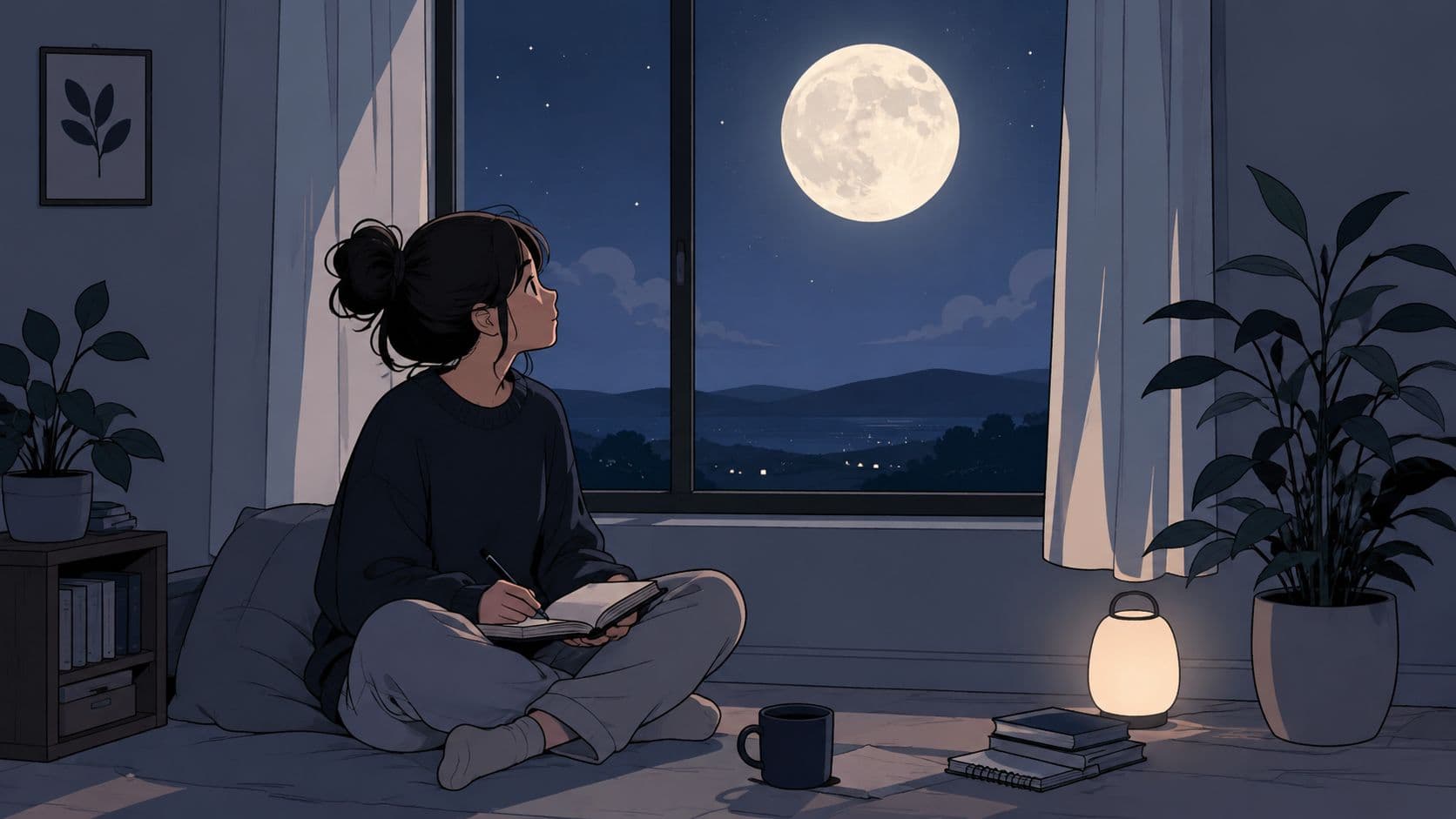
At the new Moon, write from the perspective of someone beginning again:
- What do I want to give patient attention to?
- Which desire feels genuinely mine, rather than borrowed from someone else?
- What small action would honor this intention?
During the waxing phase, make the questions practical. What has gained momentum? Where are you avoiding effort because the result isn't visible yet? Which support, conversation, or boundary would help you continue?
At the full Moon, shift toward recognition:
- What has become clearer?
- What am I grateful to have learned?
- What can I release without denying that it mattered?
The dark Moon invites gentler shadow work. Ask what you've been concealing from yourself, where exhaustion has altered your judgment, and what kind of rest would help you return with greater honesty.
Meeting the lady of the moon inwardly
For meditation, sit comfortably and breathe without forcing a particular rhythm. Imagine a quiet scene under moonlight. A figure approaches, but you don't need to decide whether she is Chang'e, Selene, Luna, or an entirely personal image.
Notice her clothing, expression, distance, and surroundings. Ask three questions: What do you bring? What do you see in me? What do I need to stop carrying? Let the answers arrive as images, words, or sensations, then write them down after the meditation.
This exercise is personal exploration, not prescribed dogma. If a particular goddess doesn't resonate, use the Moon itself, a silver light, or a wise inner presence. The value comes from attentive reflection, not from claiming that your visualization reproduces an ancient ritual.
Connecting the Lunar Archetype to Your Life Purpose
The Moon can help you notice rhythm, while a life-purpose system can help you name recurring themes. Used together, they create two different lenses. Lunar reflection asks, What is changing in me now? Structured life-path work asks, What enduring pattern might I be learning to work with?
Dan Millman's book, The Life You Were Born to Live, presents a system covering all 45 paths of life and describes a method for determining your own life path and the paths of others. The book connects each path with core issues, talents, and needs involving areas such as health, money, sexuality, career, and relationships. The revised edition uses 45 paths, while an earlier version had 37 life paths, a change discussed in a later interview with Millman (source discussing the revised system).
The Life Purpose App is described in its support documentation as a companion to the 25th Anniversary Edition of The Life You Were Born to Live, with sections of the text available in the app's About area (Life Purpose App support documentation). That makes it important to understand what you're using. This isn't a vague collection of moon meanings. It's a specific system connected to Millman's book.
Layering the two lenses
Begin with your life path as a stable reference point, then use lunar journaling to observe how that theme appears in different circumstances. A person may notice that the same challenge feels expansive during one period and draining during another. The lunar cycle doesn't change the life path. It gives you a reflective calendar for noticing how you engage with it.
You might ask:
- Which lunar phase makes reflection easiest for me?
- When do I feel most ready to initiate, build, complete, or rest?
- How does my current behavior relate to the core issues and talents described for my path?
Keep the distinction clear. Dan Millman's framework provides the structured life-path lens. Lunar ritual provides a symbolic practice for observation. Neither replaces practical judgment, professional support, or direct action in your relationships and work.
Building a Personal Lunar Practice This Week
Start tonight by identifying the current lunar phase with a reliable calendar, then write a few lines about your energy, attention, and emotional weather. Don't interpret too quickly. The first week is for noticing.
- Day one: Choose whether your practice centers on Chang'e, Selene, Luna, or a non-specific lunar archetype.
- Day two: Set aside a journal and write one phase-appropriate prompt.
- Day three: Create a small altar with one object, such as a bowl of water or a white flower.
- Day four: Spend a few quiet minutes looking at the Moon or imagining moonlight during meditation.
- Day five: Complete one practical action connected with your intention.
- Day six: Record what changed, what resisted change, and what you learned.
- Day seven: Decide which part of the practice you can repeat without pressure.
Missing a phase doesn't invalidate the work. Start at the phase you're in, or choose a weekly evening that your schedule can support. Over time, your journal will become a record of recurring patterns rather than a test you can fail.
Let the Moon provide a rhythm, not another demand.
The Life Purpose App offers a digital companion to Dan Millman's The Life You Were Born to Live, helping you explore the book's 45 life paths alongside questions about purpose, relationships, and personal growth. Visit the app to begin a structured life-path reflection, then pair what you discover with the lunar journaling practice that feels most honest to you.
Discover Your Life Purpose Today!
Unlock your true potential and find your life’s purpose.
