You open your laptop because something in you wants a clearer answer than another social media quote. This guide explains what people mean by “universal laws,” how to choose a book that fits your temperament, and simple ways to turn reading into a steady practice.

June 2, 2026 (4mo ago) — last updated October 2, 2026 (23d ago)
Best Laws of the Universe Books (2026 Guide)
Discover practical laws of the universe books, how to choose the right style for your life path, and simple practices to apply what you read.
← Back to blog
You open your laptop because something in you wants a clearer answer than another social media quote. This guide explains what people mean by “universal laws,” how to choose a book that fits your temperament, and simple ways to turn reading into a steady practice.
Title: Your Laws of the Universe Book Guide for 2026
Summary: Looking for a laws of the universe book? Our guide explains what these laws are and helps you choose a book that aligns with your self-discovery journey.
Introduction: Looking for a laws of the universe book? Our guide explains what these laws are and helps you choose a book that aligns with your self-discovery journey.
Tags: laws of the universe book, spiritual laws, self discovery, dan millman, life purpose app
You open your laptop because something in you wants a clearer answer than another quote on social media. Maybe you’ve heard people mention manifestation, vibration, or “the universe is trying to tell you something.” Maybe a friend recommended a laws of the universe book, and now you’re staring at a long list of titles that all seem to promise insight, healing, and direction.
That moment is more common than people admit.
A lot of readers aren’t looking for abstract philosophy. They’re trying to make sense of a real season of life. A relationship feels off. Work feels empty. A repeating pattern won’t leave. You want language for what you’ve been sensing, but you don’t want to get pulled into something foggy, dramatic, or impossible to use in daily life.
A good spiritual book should help you feel more grounded, not less. It should give you a way to reflect, test, and apply ideas without asking you to shut off your common sense. If you’re early in that search, this guide can help you sort the symbolic from the practical and find a path that supports your growth.
Embarking on your search for answers
Some people begin this search after a crisis. Others begin because life is outwardly fine, but inwardly flat. You go through your day, answer emails, make dinner, pay bills, and still feel that quiet ache that says, “There has to be more than this.”
That’s often when a laws of the universe book enters the picture.
You hear terms like synchronicity, alignment, karma, or the law of attraction. At first, they can feel exciting. Then the confusion starts. One book sounds highly mystical. Another sounds like psychology dressed in spiritual clothing. A third claims to explain everything, but leaves you with more questions than clarity.
“A healthy beginning is simple: look for a book that helps you observe your life more honestly, not one that pressures you to believe faster.”
A reader in this stage usually isn’t asking for perfect certainty. They’re asking better questions. Why do certain patterns keep repeating? Why do some seasons feel like expansion and others feel like contraction? Why do spiritual ideas sometimes resonate strongly, yet still feel hard to apply on an ordinary Tuesday morning?
If that sounds familiar, it helps to slow down and start with orientation instead of intensity. This guide on how to start a spiritual journey can be a helpful companion as you form your own framework and path.
What most beginners actually need
Not more slogans. Not bigger promises.
Usually, you need three things:
- Clear definitions so you know what a book is talking about
- Real-life application so the ideas meet your work, relationships, and habits
- A grounded filter so you can stay open without becoming gullible
That balance matters. Spiritual reading can be nourishing, but only when it supports discernment alongside wonder.
What people mean by universal laws
When people talk about “universal laws,” they usually aren’t talking about physics. They’re talking about a metaphysical framework that presents certain principles as underlying patterns of reality, such as vibration, polarity, rhythm, and gender. These ideas are usually described qualitatively rather than through empirical scientific testing2.
If you pick up a laws of the universe book expecting laboratory proof, you’ll likely be disappointed. If you pick one up as a reflective map for interpreting life, emotion, behavior, and meaning, the genre makes more sense.
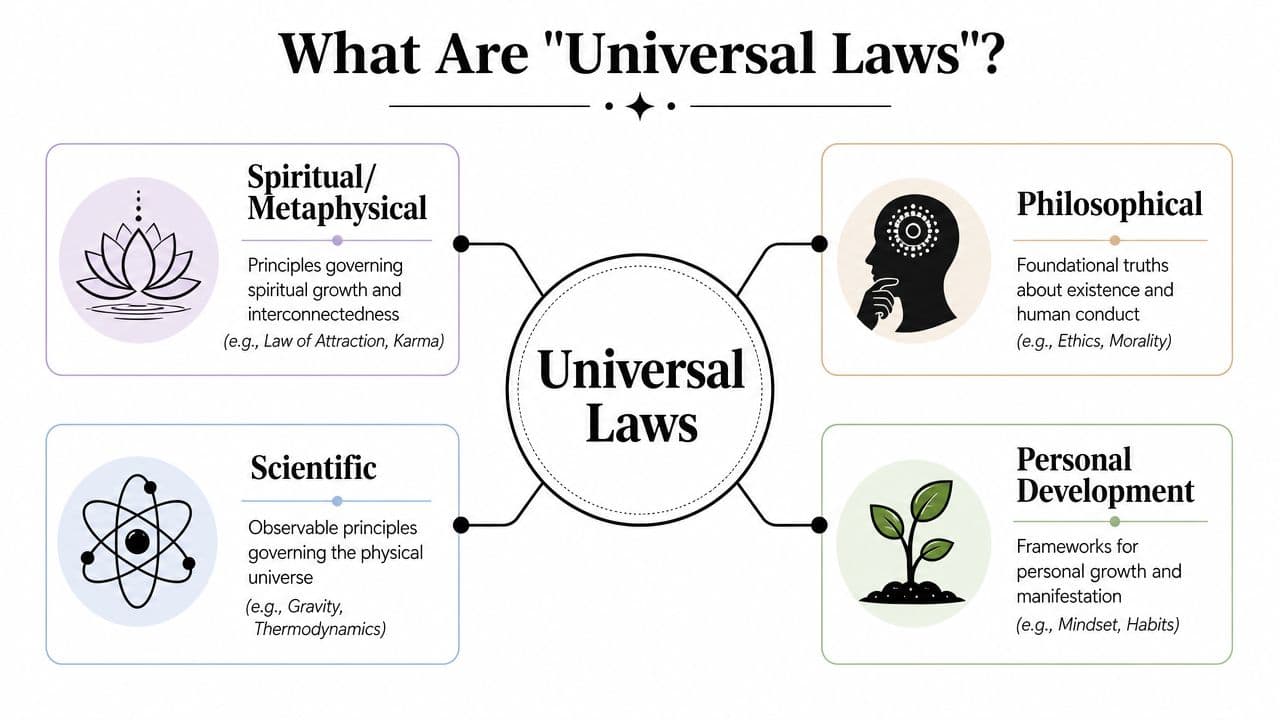
The simplest way to understand the core ideas
A few of these laws appear again and again across books and conversations.
- Vibration points to the idea that everything is in motion. In practical terms, people often use this as a way to think about the emotional and mental tone they bring into a situation.
- Polarity suggests that life contains opposites: hot and cold, grief and joy, effort and rest. Contrast helps us perceive and move.
- Rhythm frames life as cyclical. There are phases of beginning, growth, release, and renewal. If you’ve ever had a week where everything flowed, followed by a week where everything felt slow, you already understand why this idea appeals to people.
- Gender, in this context, is usually presented symbolically. It refers to active and receptive principles rather than everyday social categories.
For a broader spiritual overview, this explainer on spiritual laws can help you separate foundational concepts from internet shorthand.
Where readers often get tangled
The biggest misunderstanding is assuming these ideas are meant in exactly the same way by every author. They aren’t.
One writer may treat vibration as a poetic description of emotional states. Another may speak as if it were a literal force shaping outcomes. One book may use polarity to talk about inner balance. Another may turn it into a full worldview about creation and identity.
That’s why language matters so much.
“Universal laws are often more useful when treated as lenses for reflection than as mechanical guarantees of results.”
If you want to contrast this spiritual genre with books rooted more firmly in physical cosmology, a helpful side trip is this list of essential cosmology reads to sharpen the difference between symbolic meaning and scientific explanation.
A plain-language test
If a concept feels slippery, ask yourself:
- What is the author claiming?
- Is this symbolic, philosophical, or presented as fact?
- Can I apply this idea in a healthy way without blaming myself for everything?
Those three questions keep your feet on the ground.
Finding your fit among different book styles
Not every laws of the universe book is trying to do the same job. Some books want to expand your worldview. Others want to change your morning routine. Some lean ancient and esoteric. Others borrow the language of psychology, habit change, or even science-adjacent metaphors.
If you choose the wrong style for your temperament, even a decent book can feel frustrating.
Comparing book personalities
| Book type | Primary focus | Best for readers who... |
|---|---|---|
| Theoretical | Big-picture metaphysical ideas, origins, and systems | Want to sit with concepts and don’t mind abstraction |
| Practical workbook | Prompts, exercises, journaling, daily application | Need a book that leads to action quickly |
| Mystical or esoteric | Symbolism, sacred language, hidden traditions | Enjoy depth, intuition, and symbolic thinking |
| Modern self-development blend | Mindset, emotional awareness, behavior, purpose | Prefer grounded language and daily relevance |
| Hybrid systems book | Spiritual framework plus personal pattern mapping | Want ideas tied to their own life structure |
Theoretical books
These books usually ask for patience. They spend time on underlying principles and may move slowly through ideas like correspondence and symbolic creation.
That can be valuable if you want depth. It can also be exhausting if you’re already overwhelmed.
One philosophical strand in this space treats polarity as central to creation, describing interaction of an active principle and a receptive principle as essential across levels of existence.
Practical books
These are easier for many readers to start with. They tend to ask questions like:
- What did you notice today?
- Where are you resisting change?
- What belief are you practicing every morning without realizing it?
They may include journaling prompts, reflection exercises, or simple rituals. The upside is usefulness. The downside is that some become repetitive or overly certain.
If you want a broader reading list before buying, see this roundup of best books for spiritual growth.
“Some readers need language that opens the heart. Others need language that steadies the mind. The right book often does a little of both.”
Mystical versus modern
A mystical book may speak in symbols, archetypes, sacred unions, cycles, and energies. If that language nourishes you, wonderful. If it makes you squint and wonder what the author means, that matters too.
A modern spiritual book often translates those same ideas into pattern recognition, emotional intelligence, and intentional living. It may lose some poetry, but it gains accessibility.
Neither style is superior. The better choice is the one you’ll actually read, think about, and apply with honesty.
A smart reader’s checklist for choosing a book
The spiritual book world contains insight, beauty, confusion, and overstatement all mixed together. That means discernment isn’t optional. It’s part of the practice.
A thoughtful reader doesn’t ask only, “Does this sound inspiring?” A thoughtful reader also asks, “Does this hold together?”
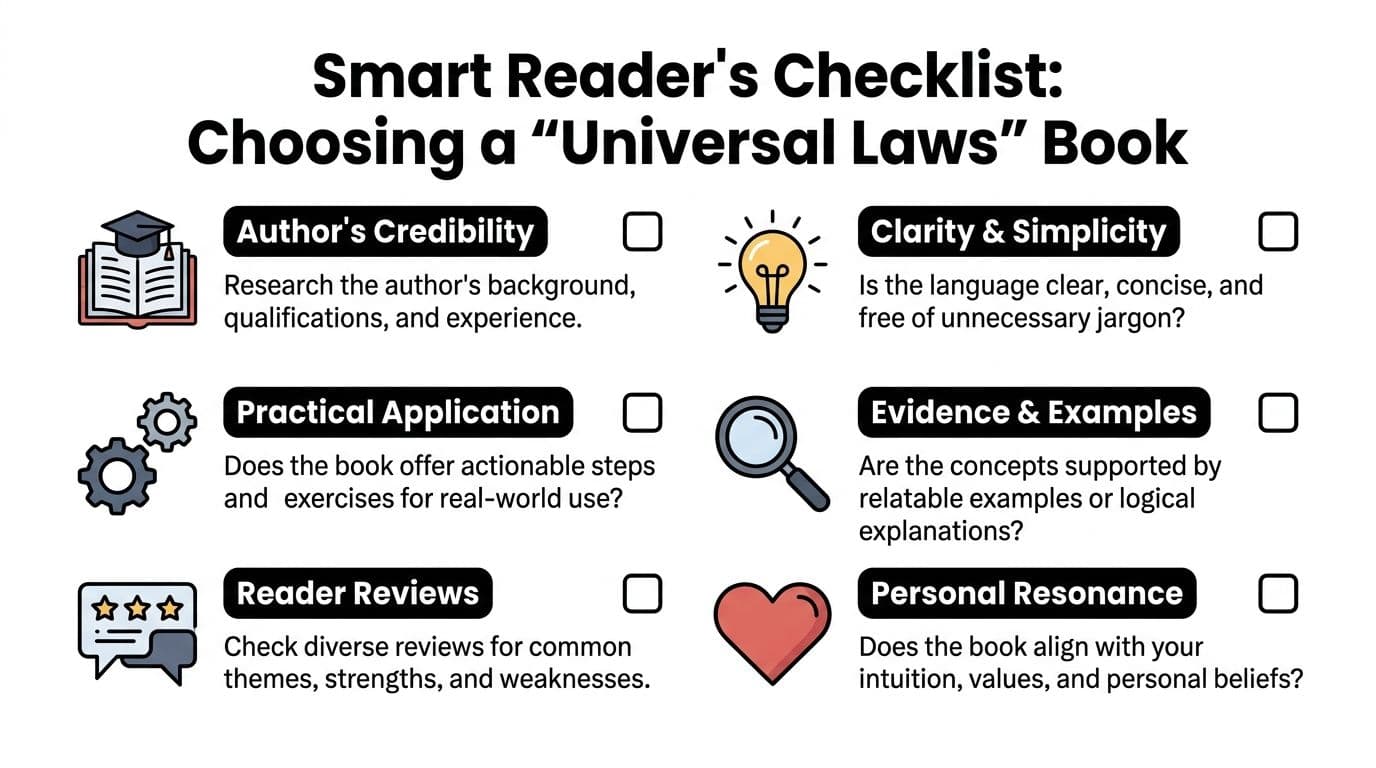
The checklist that protects your energy
Use this short filter before you buy or commit to any laws of the universe book.
-
Check the author’s posture Do they write like a guide, a teacher, a philosopher, or a salesperson? Confidence is fine. Pressure is not.
-
Watch for clarity A meaningful idea can be expressed in plain language. If a chapter sounds profound but remains vague after careful reading, pause.
-
Look for usable examples Good spiritual writing connects the abstract to work stress, grief, conflict, habits, rest, choice, and responsibility.
-
Notice whether the book creates freedom or dependency A healthy framework helps you think more clearly. An unhealthy one makes you feel you always need one more secret, one more interpretation, one more paid layer of access.
-
Test the logic Does the book contradict itself? Does it redefine failure in a way that always protects the system?
The problem with unfalsifiable claims
Some spiritual systems become impossible to question because every disappointing result gets explained away. Failures can be attributed to insufficient belief or a need for more waiting, which creates circular reasoning and emotional burden.
That doesn’t mean all spiritual reflection is useless. It means you should stay alert when a framework can never be wrong.
“Grounding question: If a teaching helps me reflect, that’s useful. If it makes me responsible for every outcome in a totalizing way, that’s too much weight to carry.”
A simple review method
Before adopting a book’s worldview, ask these questions in your journal:
- What does this teaching help me notice about myself?
- What does it ask me to ignore?
- Do I feel more honest after reading it, or just more impressed by it?
- Can I disagree with part of it and still learn from it?
That last question matters. Mature spiritual reading doesn’t require total agreement. It requires sincerity and discernment.
Connecting universal laws to your personal life path
General spiritual principles can be illuminating, but many readers eventually hit a limit. They understand the ideas in theory, yet still wonder why one person experiences a law through relationships, another through work, and another through inner healing.
A more personal framework becomes useful.

Dan Millman’s The Life You Were Born to Live was first published in 1993 and later re-released in a 25th Anniversary Edition, and its system is built around 45 distinct life paths derived from birth dates3. That level of specificity is part of what makes it different from broad spiritual books that describe everyone in the same terms.
Why personal patterning matters
A universal principle may be shared. Its expression often isn’t.
Two people can both resonate with rhythm, for example, but live it differently. One person may experience life in obvious cycles of ambition and retreat. Another may notice recurring lessons in intimacy, self-worth, or money. A broad laws of the universe book can name the principle. A structured life-path framework can help place it in the context of your own recurring themes.
I find Dan Millman’s work especially valuable in conversations about numerology and purpose. It gives readers something more detailed than “trust the universe” and more personal than a generic personality label. It asks, in effect, what kind of path are you walking, and what gifts and lessons tend to travel with it?
Bridging symbol and daily life
Some readers process insight best through writing. Others through visuals. If you like turning inner themes into something cinematic and reflective, tools for creating cinematic videos or visual journals can help you build symbolic mood boards around your spiritual reading. That kind of creative practice can make abstract ideas more tangible.
Here’s the core value of connecting universal laws with a life-path system:
- It reduces vagueness by giving you a more specific personal lens
- It makes reflection practical because patterns become easier to name
- It supports self-compassion because recurring challenges may feel less random and more interpretable
A grounded way to hold both
You don’t have to choose between universal ideas and personal insight. They can work together.
A universal framework offers the weather of existence. A personal path framework describes the terrain you tend to walk through. When those two are held together carefully, spiritual reading becomes less like collecting concepts and more like recognizing your own life with greater precision.
For readers interested in numerology, life paths, or life numbers, the Life Purpose App pairs with Dan Millman’s system and helps you explore your life path in a structured way so insight doesn’t stay abstract.
Turning reading from an act into a practice
A spiritual book can inspire you for an evening. A practice can shape how you move through your week.
If you read about universal laws but never pause to notice them in your actual life, the book becomes decoration for the mind. Useful reading asks for response. Not dramatic response. Just honest response.
Three simple ways to work with what you read
-
Choose one principle for the week Sit with a single idea, such as rhythm or polarity, and watch where it appears in your conversations, moods, or decisions.
-
Keep a brief reflection note Write a few lines each day. What repeated? What shifted? What felt true in experience, not just attractive in theory?
-
Build a system for your insights If you tend to read a lot and forget what mattered, knowledge-management best practices can help you organize notes, patterns, and questions in a way you’ll actually revisit.
“A useful spiritual practice doesn’t ask you to become someone else overnight. It asks you to become more aware of who you are being today.”
Keep it small and steady
You don’t need an elaborate ritual. You need consistency.
Read a few pages. Notice one idea. Test it in your lived experience. Keep what deepens your honesty and peace. Leave what clouds your judgment or inflates your fear. That approach lets a laws of the universe book become a companion rather than a fantasy object.
Common questions and concise answers
Q: How do I choose between mystical and practical books?
A: Match the book’s style to how you process insight. If symbolism moves you, try a mystical book. If you need small steps, choose a practical workbook.
Q: What if a book’s claims feel too certain or unfalsifiable?
A: Use the checklist: check the author’s posture, look for clarity and examples, and test whether the system can be questioned without collapsing.
Q: Can universal laws actually change my life?
A: They can change how you see patterns, which changes choices. Combine big ideas with daily practices to make insight actionable.
1.
Grand View Research, “Self-improvement Market Size, Share & Trends Analysis Report,” 2022, [https://www.grandviewresearch.com/industry-analysis/self-improvement-market].
2.
“Metaphysics,” Encyclopaedia Britannica, [https://www.britannica.com/topic/metaphysics-philosophy].
3.
Dan Millman, “The Life You Were Born to Live,” DanMillman.com, [https://www.danmillman.com/books/the-life-you-were-born-to-live/].
Discover your life path today
Enter your date of birth and see your life path, free.
Find your life path