Explore how leadership and purpose connect, why they matter, and how to align your leadership with a deeper sense of meaning in everyday life.
August 15, 2026 (1mo ago)
Leadership and Purpose: How to Lead with Meaning
Explore how leadership and purpose connect, why they matter, and how to align your leadership with a deeper sense of meaning in everyday life.
← Back to blog
You can be the person everyone turns to and still feel strangely absent from your own work. The meetings are handled, decisions get made, and people may even describe you as dependable. Yet somewhere between solving problems and carrying responsibility, a quiet question keeps returning: What am I here to lead?
Leadership and purpose meet in that question. One concerns how you influence direction, choices, and people. The other concerns whether that direction feels meaningful to you. Looking at both together can help you lead with more steadiness, without turning purpose into another performance target.
The Moment a Leader Stops Moving
A team lead arrives early, opens a laptop, and reviews the same dashboard she reviewed yesterday. Her team trusts her judgment. She's delivered difficult projects, coached new managers, and stayed calm through several changes in direction. On paper, her leadership looks successful.
But she's tired in a way that sleep doesn't fix. She finds herself avoiding decisions that once energized her. A promotion sounds impressive, yet the thought of taking on more responsibility brings no excitement. She isn't failing. She's moving without feeling connected to where she's going.
That distinction matters. Many leaders first search for a better technique when the deeper need is personal alignment. They read about communication, motivation, and strategic thinking, but the unease continues because the question isn't only, “How can I lead more effectively?” It's also, “Does the way I lead express what matters to me?”
Looking beyond the role
A leadership title shows what you're responsible for. It doesn't explain your temperament, convictions, formative experiences, or recurring gifts. Two people can hold the same role and create entirely different experiences for the people around them. One may lead through control and image. Another may lead through clarity, patience, and a willingness to tell the truth.
Your whole life enters the room with you. So do your fears, ambitions, unfinished lessons, and ideas about what makes a life worthwhile. Ignoring those elements doesn't make leadership more objective. It often makes your behavior less conscious.
A team reset can help when a group has been carrying pressure that nobody has named. Resources such as the Corporate Challenge Events team reset offer a useful reminder that leaders and teams sometimes need space to surface what ordinary workdays conceal.
Reflective pause: What part of your current leadership feels natural, and what part feels like an image you're working hard to maintain?
The purpose of this article isn't to give you a polished identity to wear. It's to help you understand how leadership and purpose fit together in your actual life, then turn that understanding into daily choices. Meaningful leadership begins less with finding the perfect answer and more with noticing where your energy, values, and actions already point.
What Leadership and Purpose Really Mean
Leadership is the practice of directing attention, energy, and decisions in a way that others are willing to follow. It isn't limited to formal authority. A parent, teacher, a coach, a founder, or experienced colleague can lead by shaping what people notice, what they believe is possible, and how they respond when circumstances become difficult.
Purpose is different. It's the felt sense that your life and work are pointed toward something that matters. Purpose doesn't have to sound grand. It might involve helping people regain confidence, making complex ideas understandable, building safe communities, creating useful things, or bringing order to situations that feel chaotic.
A simple image can clarify the relationship. Think of a captain and a coastline. Purpose is the coastline, the meaningful direction that tells you where the journey is headed. Leadership is the captain's practice, reading conditions, choosing a route, and helping everyone aboard move together. A captain without a coastline can stay busy while drifting. A coastline without a captain remains a distant possibility.
Separate the neighboring ideas
Purpose often gets confused with goals, values, and vision.
- Goals describe outcomes you want to reach. They can be completed, replaced, or revised.
- Values describe how you want to behave while pursuing those outcomes.
- Vision describes a future you want to help create.
- Purpose describes why the effort matters to you and to the people your effort serves.
You need all four, but they perform different jobs. A goal might be to launch a program. A value might be care. A vision might be a community where people can access support. Purpose might be helping people feel less alone while they move through change.
For leaders, this distinction prevents a common mistake. A compelling vision can still leave people confused if daily decisions don't reflect meaningful values. A clear purpose can also remain private unless leadership gives it expression through priorities, conversations, and action.
The practical relationship is straightforward: purpose gives leadership direction, while leadership gives purpose reach. If you're exploring how personal values become visible in workplace decisions, this values alignment workplace guide provides another useful lens.
Why Purpose-Driven Leadership Changes Outcomes
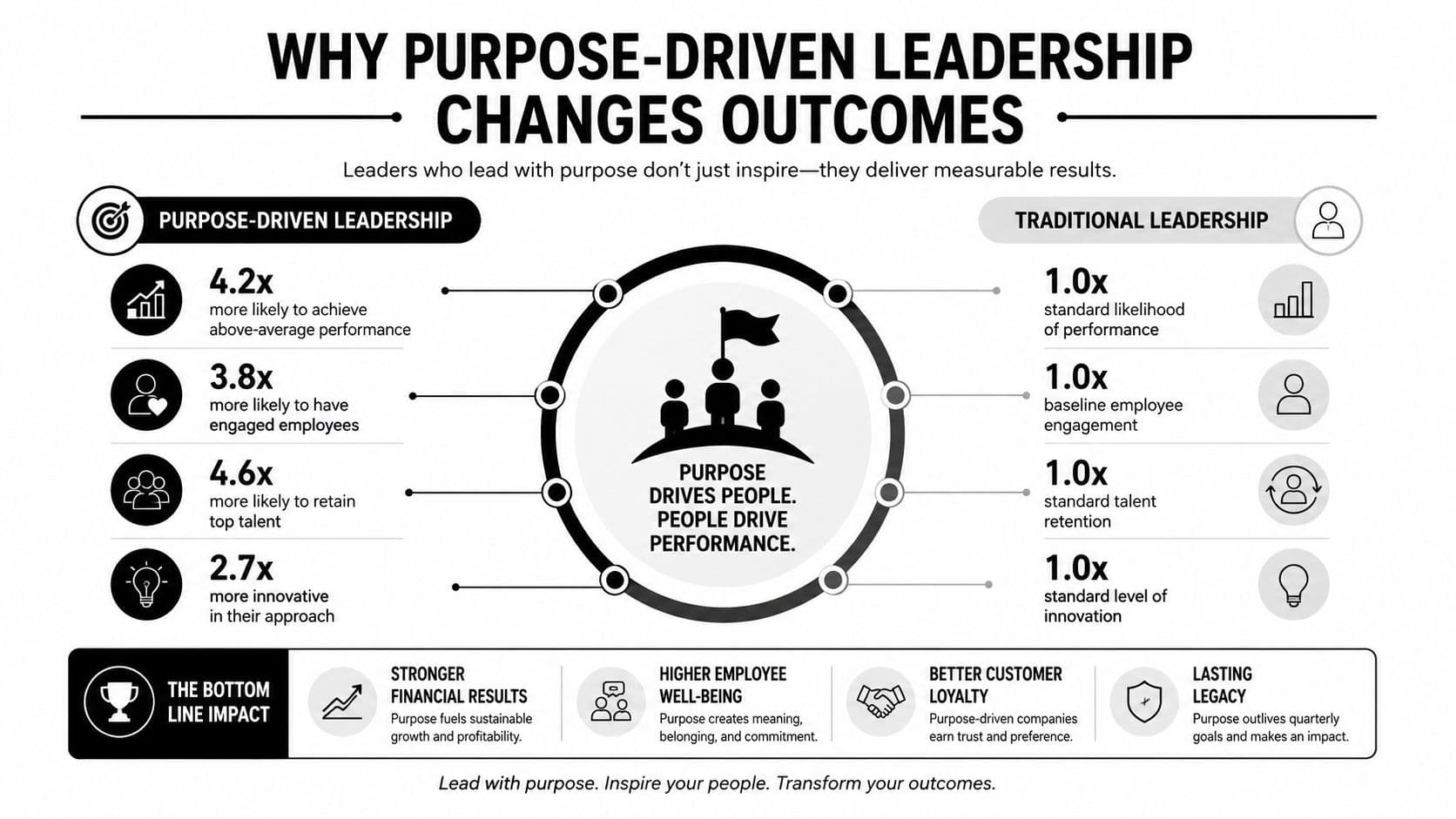
Purpose-driven leadership isn't merely a warmer way to describe management. It changes what leaders pay attention to, how they explain decisions, and whether people can connect ordinary tasks to something meaningful.
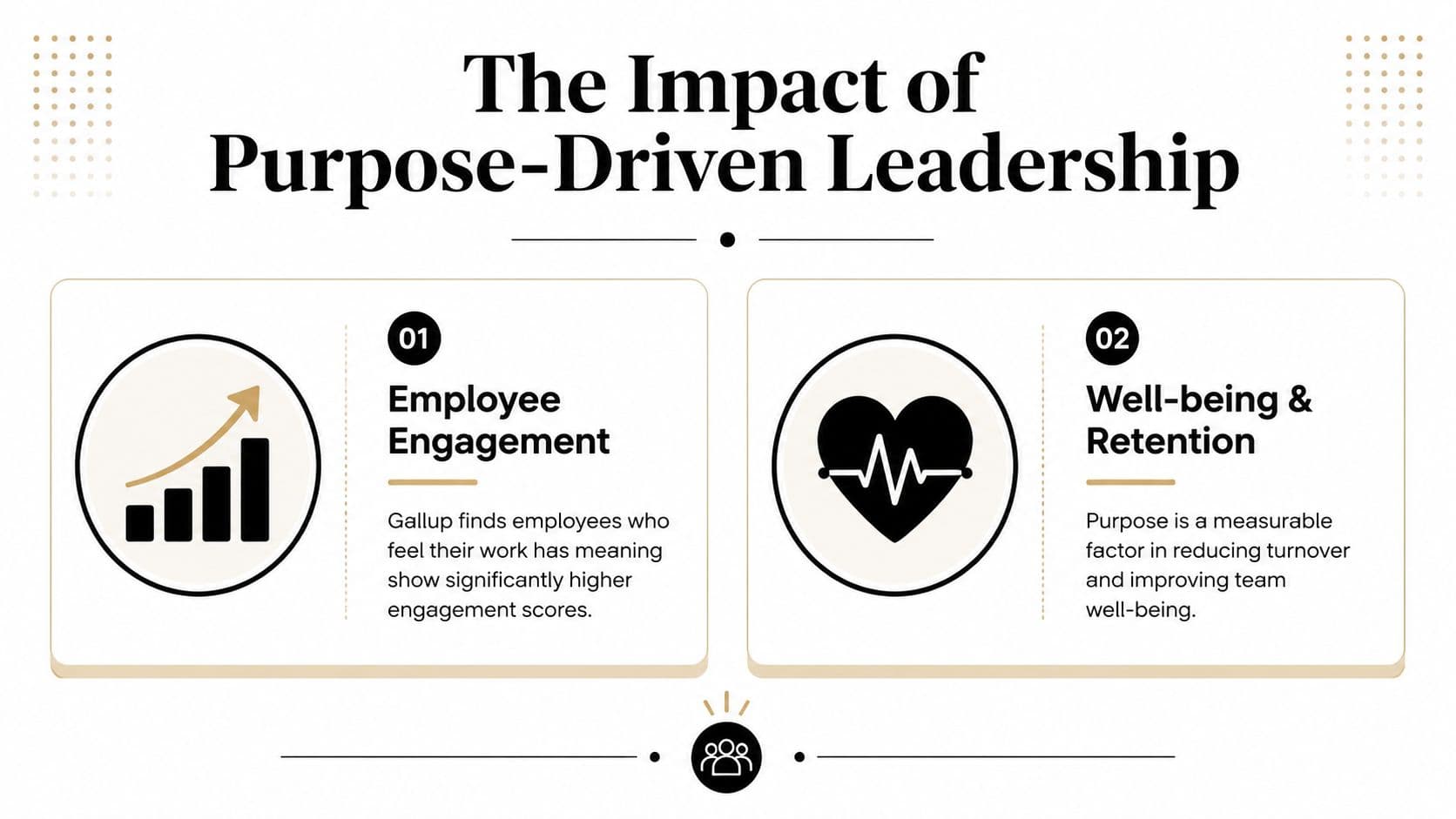
Gallup's 2025 update reported that global employee engagement fell to 21%, leaving nearly four out of five workers not engaged, while Europe recorded 12% engaged. The same update found that only 32% of employees strongly felt connected to their organization's mission or purpose, 31% strongly agreed that someone at work encouraged their development, and 28% strongly agreed that their opinions counted at work. These findings are reported in Gallup's update on purposeful work and engagement.
The personal connection to purpose is especially clear in the United States. Employees with a strong sense of purpose at work were 5.6 times as likely to be engaged as employees with low purpose, with engagement at 50% among the high-purpose group compared with 9% among the low-purpose group, according to the same Gallup source. That doesn't mean a purpose statement automatically creates commitment. It means leaders should treat meaning, development, and voice as practical parts of the working experience.
Purpose and leadership reinforce each other
A 2024 analysis of 1,860 Top Employers found 79% employee engagement among companies with strong organizational purpose and good leadership. Companies with weak purpose and no good leadership recorded 75%, while strong purpose without good leadership reached 76%, according to Top Employers' analysis of leadership and organizational purpose.
The lesson is more nuanced than “purpose solves engagement.” Purpose helps, but people also judge whether leaders act competently and consistently. A meaningful mission can't compensate for confusing priorities, poor listening, or a leader who rewards behavior that contradicts the stated values.
Research in the APA PsycNET record identifies six practices associated with meaningful-work outcomes:
- Explain the larger impact of everyday work.
- Recognize and nurture potential in other people.
- Build personal connections, rather than treating colleagues as functions.
- Discuss values and organizational purpose during hiring.
- Model integrity through values-based behavior.
- Give employees freedom where judgment and responsibility allow it.
These practices are described in the APA PsycNET study on meaningful work. Notice how concrete they are. None requires a dramatic speech. A leader can make work meaningful by explaining who benefits, giving thoughtful feedback, inviting judgment, and keeping promises.
Psychological mechanisms matter too. Research on authentic leadership links work meaningfulness with psychological safety, learning from errors, and stronger self-efficacy. The study on authentic leadership and meaningfulness reports that authentic leadership predicted meaningfulness directly and indirectly through self-efficacy, with the effect becoming stronger when self-efficacy was lower.
That gives leaders a practical route. Don't just tell people that their work matters. Help them feel capable of contributing, safe enough to learn, and respected enough to speak openly.
Finding Your Own Life Path as a Leader
Organizational evidence can show why purpose matters, but it can't tell you what your purpose is. That question requires self-knowledge.
Dan Millman's book The Life You Were Born to Live presents the Life-Purpose System, a personal-growth method based on ancient wisdom. The book is described as a 447-page guide, and its revised 25th Anniversary Edition covers 45 birth numbers or life paths, as described in the book's published description.
Within this framework, a life path points toward recurring gifts, challenges, and themes. It isn't a job title or a prediction. For a leader, it can serve as a prompt for noticing the kinds of contribution that repeatedly draw your attention, along with the habits that make leadership harder.
Use the framework as a mirror
The Life Purpose App can help you explore the Life-Purpose System by entering your date of birth and reviewing the resulting life-path interpretation. Approach the result with curiosity rather than obedience. The value lies in comparing the themes with your lived experience, not in handing over responsibility for your decisions.
Try this sequence:
- Read for recognition. Notice which gifts or challenges feel familiar across your career and relationships.
- Compare the pattern with your role. Ask whether your current responsibilities give those qualities room to develop.
- Name the tension. Identify where your work rewards behavior that conflicts with the leader you want to become.
- Choose one experiment. Change a small behavior, such as how you run a meeting, delegate authority, or respond to mistakes.
- Review what happens. Look for changes in energy, honesty, and connection rather than chasing instant certainty.
For a companion exercise, try a values-clarification activity before interpreting any life-path material. It can help you distinguish what matters from what you've absorbed from family, status, or workplace expectations.

Use these prompts in writing:
- What recurring feedback do I receive that aligns with my life path?
- Where in my leadership do I feel most alive?
- Which responsibilities repeatedly drain me, and what might that teach me?
Self-knowledge doesn't remove difficult choices. It helps you make them with fewer borrowed expectations. Your outer effectiveness often changes when your inner direction becomes clearer.
Aligned Leaders and Misaligned Leaders
Two leaders can use the same language about purpose and create opposite experiences.
The first has read widely about meaningful work. Her office contains thoughtful books, and she can explain the organization's values without looking at a note. Under pressure, though, she becomes preoccupied with appearing decisive. In difficult conversations, she interrupts to protect her image. When a project fails, she searches for a person to blame. Her team learns to offer reassuring updates instead of honest information.
The second leader has done quieter work. He knows that patience, useful teaching, and fairness matter to him, so he builds those qualities into ordinary decisions. He asks questions before offering solutions. He admits when he misunderstood a situation. When someone makes a mistake, he separates accountability from humiliation and looks for the lesson the team needs.
Neither leader is perfect. The difference isn't a flawless personality. It's whether each person notices the gap between stated purpose and actual behavior, then takes responsibility for closing it.
Meaning appears in small choices
Purpose becomes visible in what a leader repeatedly rewards, tolerates, and refuses to normalize.
| Daily moment | Misaligned response | Aligned response |
|---|---|---|
| A team member raises a concern | Defend the existing decision | Ask what the concern reveals |
| A deadline is missed | Shame the person publicly | Clarify responsibility and learn from the breakdown |
| A high performer behaves badly | Excuse the conduct because results look strong | Protect the standard that applies to everyone |
| A decision affects others | Announce the answer quickly | Invite relevant perspectives before deciding |
The aligned leader may still make unpopular choices. Alignment doesn't mean avoiding conflict or pleasing everyone. It means the choice reflects a considered set of values rather than fear, vanity, or automatic habit.
A leader who wants to understand this distinction can explore why self-awareness is important. Self-awareness gives you a chance to notice the moment when an old defense takes over, before that defense becomes the team's culture.
A useful test: Ask, “What would my team say I protect when pressure rises?”
Teams often experience purpose through these micro-choices. They notice whether a leader listens fully, gives credit, tells the truth about uncertainty, and makes room for other people's judgment. A mission statement can describe the destination, but behavior tells people whether the journey is safe and worthwhile.
A Practical Method for Coaches and Practitioners
Coaches, counselors, and wellness practitioners can bring leadership and purpose into client work without turning a session into a corporate exercise. The work begins with the client's own life pattern, then moves toward observable choices.
A simple session flow has three parts.
Begin with reflection
Invite the client to use the Life Purpose App to explore their life-path analysis, then ask what feels familiar, surprising, or resistant. Don't treat the interpretation as a verdict. Treat it as a conversation starter that may reveal repeated themes in the client's work, relationships, and decisions.
Ask:
- What does your life path suggest about the kind of leadership you're here to offer?
- Where does your current role contradict that?
- Which strengths do other people rely on you to bring?
- What challenge keeps returning whenever you take responsibility?
Map values to behavior
Draw two columns. In the first, write the client's chosen values. In the second, list the leadership behaviors that would make each value visible.
For example, if the value is compassion, the behavior might be listening before correcting. If the value is courage, it might be naming an uncomfortable truth early. If the value is freedom, it might involve giving a colleague room to solve a problem without unnecessary interference.
The Life Purpose App is relevant here because practitioners can use detailed life-path analyses for client work and maintain unlimited contacts, according to the product information provided by the publisher. Those features support organizing multiple client profiles while keeping the session focused on interpretation and action.
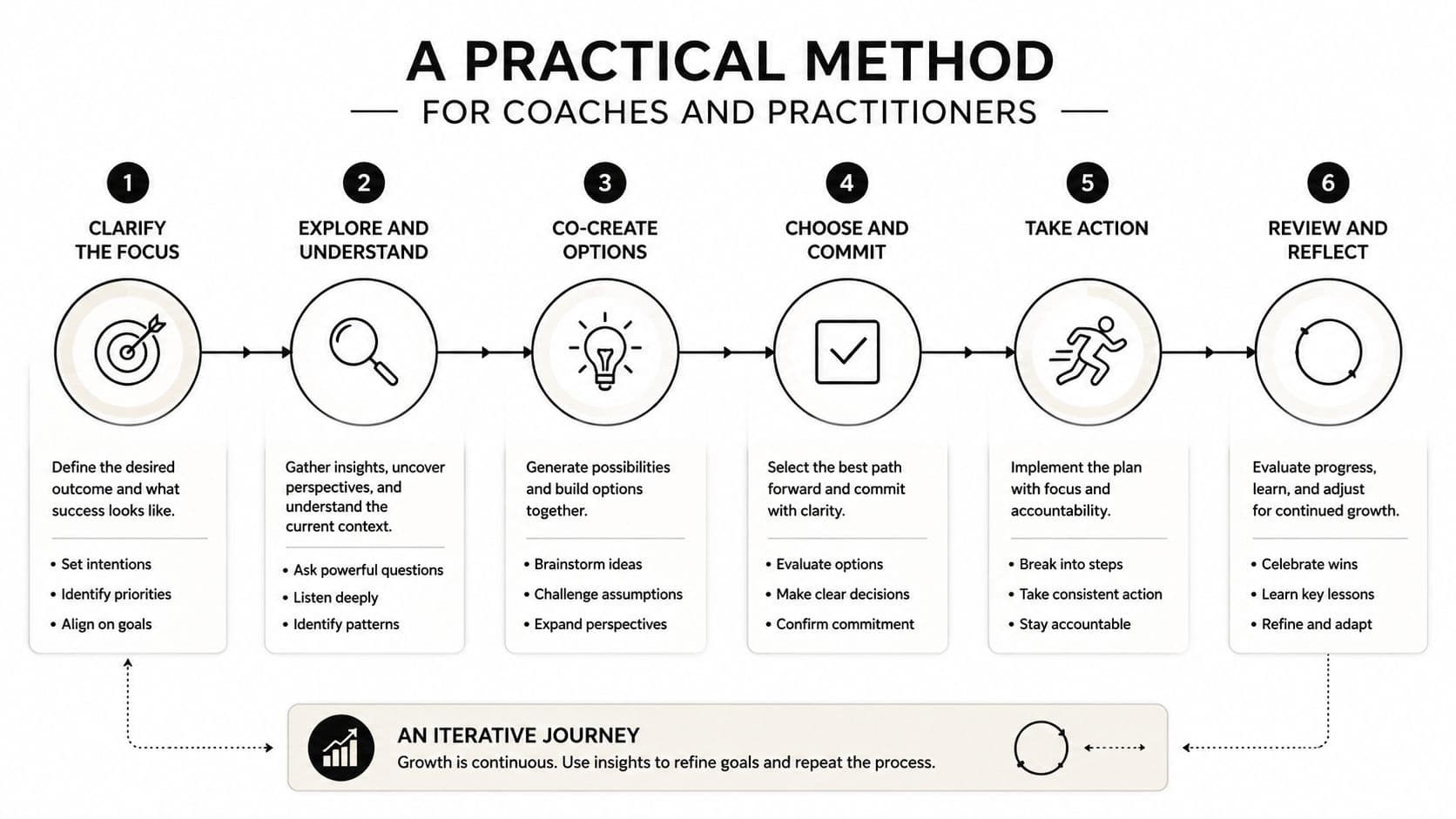
Close with one experiment
End the session with a small action for the coming week. A useful 30-day practice asks the client to record one significant decision each day, identify the value or life-path theme involved, and note whether the decision felt aligned. At the end of each week, they review patterns instead of judging individual days.
A client might discover that they value enabling others but keep taking over tasks. The aligned experiment could be delegating one decision and resisting the urge to control the method. A resource on building a personal development system can help structure this kind of ongoing review.
Leading With Purpose as an Ongoing Practice
Purpose isn't a destination you reach once. It changes shape as you gain experience, face loss, accept responsibility, and discover new ways to serve. The Life Purpose App's reference to nine-year cycles offers one way to reflect on these changing phases and the different expressions of leadership they may invite.
Keep the practice simple:
- Daily: Ask, “What am I leading toward today?”
- Weekly: Review one action that felt aligned and one that felt driven by fear or image.
- Quarterly: Consider whether your role, relationships, and decisions still reflect your life path.
Purpose also needs practical expression. If your work involves building support for a cause, resources such as 8 quick fundraising strategies can help connect intention with concrete action.
Meaningful leadership is less about having arrived and more about staying honest on the way. You'll change, your circumstances will change, and your understanding of contribution will deepen. The practice is returning to what feels true, then allowing that truth to shape what you do next.
The Life Purpose App offers a way to explore Dan Millman's Life-Purpose System, review life-path themes, and connect self-knowledge with everyday leadership choices. Visit Life Purpose App to begin reflecting on the kind of leader your life is asking you to become.
Discover Your Life Purpose Today!
Unlock your true potential and find your life’s purpose.
